
For Christmas, a comic book makes a successful gift provided you anticipate: professional grading times increase significantly at the end of the year (several weeks to several months depending on the service chosen), and the best pieces: key vintage issues or end-of-year editions that have become cult like the Marvel Holiday Special or Batman: Christmas: become rarer as we approach the holidays. The safest rule remains to target what the recipient actually collects (a character, a period, a creative team) rather than an “impressive” number chosen at random, and to check the rating on recent sales before concluding the purchase.
Christmas occupies a special place in the calendar of a comic book collector: it is often the only time of year when several loved ones (family, spouse, friends) are simultaneously looking for a gift idea linked to their passion, which increases the risk of duplicates but also the opportunities to hit the mark with a truly sought-after number. Unlike a birthday, the date of which is fixed and known in advance by a single person, Christmas imposes an additional constraint: everyone buys at the same time, over the same window of a few weeks, which tightens the supply on the most demanded pieces.
This calendar constraint has a direct consequence that we often underestimate: an old comic book that we wish to have certified before offering it must be sent for grading well before December, otherwise we will receive the package after the holidays. Conversely, a copy already graded and sealed, or a modern edition readily available, leaves much more latitude for a last minute purchase.
This guide details the editorial history of end-of-year comics, how to choose a relevant key issue according to the recipient's budget and profile, the pitfalls specific to the holiday season, and the real impact of the cinema release calendar on the demand for certain titles at the time you are looking for your gift.
Christmas, an editorial season in its own right in the history of comics
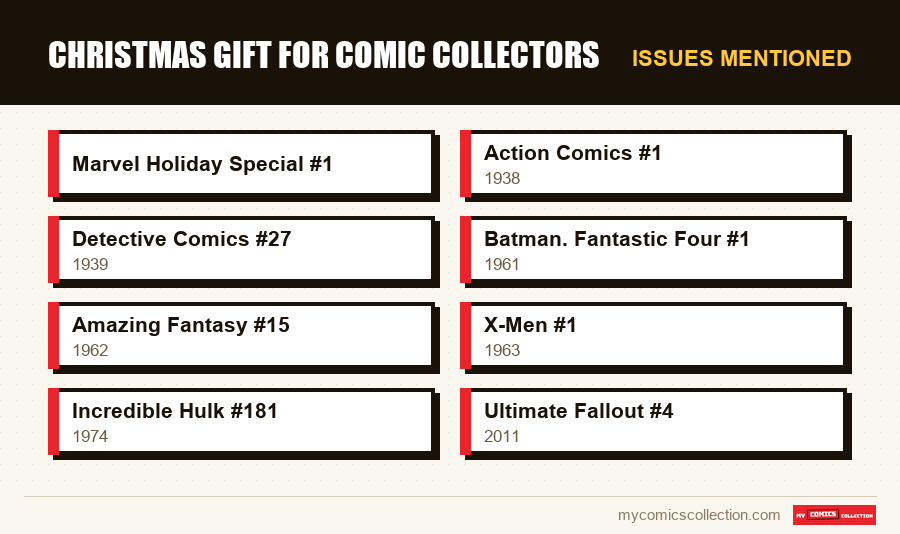
The major American publishers did not wait for the modern era to transform the holiday period into an editorial event. Marvel launched the Marvel Holiday Special #1 in 1991: released on newsstands on November 19, 1991 with a cover date of December 1991, this anthology issue brought together several creative teams around Christmas stories featuring the all under a wraparound cover signed Arthur Adams. The series continued annually until 1996, before being revived between 2004 and 2007.
DC followed a different logic by focusing on the long format rather than the annual anthology: Batman: Christmas, original graphic novel written and drawn by Lee Bermejo and published in 2011, revisits A Christmas Carol by Charles Dickens by placing Batman in the role of Scrooge. In this version, the shadow of Jason Todd takes the place of the specter of Marley while Superman embodies the ghost of Christmas present: a reading which left an impression with its tone and the graphic work of Bermejo, and which remains today one of the rare great Christmas one-shots taken seriously by a major publisher rather than treated as a simple seasonal derivative product.
This editorial tradition counts when choosing a gift: unlike a classic key issue (first appearance, first costume), a Christmas issue or work carries a double reading: the story it tells and the calendar ritual to which it belongs. Offer a Marvel Holiday Special vintage or the original edition of Batman: Christmas therefore has an immediate narrative meaning that any other number does not necessarily have at the precise time of Christmas.
Anticipating deadlines: the real trap of end-of-year comic gifts
The number one problem with giving comics at Christmas isn't the choice of issue, it's the calendar. An old comic book that we wish to offer, already certified and sealed, must be submitted to a professional grading service well in advance: depending on the level of service chosen, a processing time ranges from several weeks for the fastest formulas to several months for standard formulas, and these deadlines are never guaranteed: they become even longer during busy periods, precisely at the end of the year, when the volume of submissions explodes before the holidays.
Concretely, this means that a copy sent at the beginning of December has very little chance of returning graded before Christmas, regardless of the service paid for. Two realistic options are therefore available to anyone who wants to offer a certified comic book under the tree: either buy a copy already graded and sealed by a recognized service (which eliminates any risk of delay), or agree to offer the raw copy accompanied by a note explaining that it will be released for grading after the holidays, which can even become a shared ritual with the recipient if they actively collect.
An already graded copy has another advantage for a Christmas gift: it can be wrapped without risk of damaging the cover, unlike a raw comic book which requires a rigid sleeve and cardboard reinforcement before any gift wrapping: a detail that many non-collecting loved ones are unaware of and which can damage a valuable copy in a single session of folding gift paper.
The key numbers that make a real impact under the tree
A “key issue” refers to a comic associated with an enduring editorial event-the first appearance, first costume, death, or return of a character. These issues remain the highest impact gifts because they are inseparable from the story of the character being offered, regardless of the time of year. Some useful chronological references to locate a number before purchasing:
- Action Comics #1 (June 1938, Jerry Siegel and Joe Shuster): first appearance of Superman, founding piece of the Golden Age, today almost exclusively traded in graded and sealed form given its rarity.
- Detective Comics #27 (May 1939, Bob Kane, with long-uncredited contribution from Bill Finger): First appearance of Batman.
- Fantastic Four #1 (November 1961, Stan Lee and Jack Kirby): Officially launches the modern Marvel era.
- Amazing Fantasy #15 (on sale June 5, 1962, cover date August 1962, Stan Lee and Steve Ditko, cover with the participation of Jack Kirby): first appearance of Spider-Man, in an issue of a title then on the verge of being canceled: the unexpected success of sales justified the launch of Amazing Spider-Man in March 1963.
- X-Men #1 (September 1963, Stan Lee and Jack Kirby): First appearance of the original X-Men team.
- Incredible Hulk #181 (November 1974, Len Wein and Herb Trimpe): first full appearance of Wolverine, after a teaser at the very end of the previous issue, #180.
- Ultimate Fallout #4 (September 30, 2011, Brian Michael Bendis and Sara Pichelli): first appearance of Miles Morales, with approximately 74,000 copies ordered through the direct market circuit for the initial print run: a figure which explains why this modern issue remains significantly more accessible than an issue from the Golden or Silver Ages while retaining a real historical significance.
To measure how much these numbers can rise in value to the top of the market, two recent sales provide a benchmark: a copy of Amazing Fantasy #15 graded CGC 9.6 (the highest grade ever achieved on this issue, with only four examples listed at this level and none above on the census) sold for $3.6 million at Heritage Auctions on September 9, 2021, breaking the previous record held by a Action Comics #1 graded CGC 8.5, sold for $3.25 million during a private sale in April 2021. These amounts obviously concern exceptional examples beyond the reach of the ordinary Christmas gift, but they illustrate a useful reality for choosing a more modest gift: it is the state of conservation, verified and certified, which tilts the value of a key number much more than just its theoretical rarity.
Read a gradation before offering an old copy
Independent grading companies use a numerical scale that runs from 0.5 (Poor) to 10.0 (Gem Mint), with increments spaced 0.5 points apart between 0.5 and 9.0, then narrowed to 0.2 points or less beyond 9.0: it is precisely in this upper zone that the difference in value between two very close grades becomes most significant, as shown by the difference between the record of Amazing Fantasy #15 in 9.6 and copies in lower grades of the same number. A copy thus certified is sealed in a rigid transparent case bearing the note and a unique certification number, publicly viewable on the census of the grading body.
For a Christmas gift, this reading of the gradation avoids a frequent disappointment: a seller who uses vague vocabulary such as “close to Near Mint” or “almost perfect” without an official grade describes a subjective estimate, not a recognized grade. Faced with the pressure of the end-of-year calendar, where busy buyers are more inclined to rely on a vague description rather than verifying a precise grade, this verification reflex becomes even more important than in normal times.
The grading vocabulary itself (Near Mint, Very Fine, Fine, Very Good, Good, Fair, Poor) originally comes from the standardization work carried out in the Overstreet Comic Book Price Guide, a historical reference for the industry since the early 1970s, before being taken up and refined by independent certification companies. Knowing these categories, even briefly, allows you to compare two ads with full knowledge of the facts rather than blindly.
Collecting this series?
Track what you own, what you are missing and what your collection is worth. 7 day trial.
Start my trial →Pitfalls specific to last-minute gifts
The Christmas period concentrates several traps which exist all year round but which become more dangerous under the pressure of the calendar. The first concerns the distinction between the “newsstand” edition (sold on newsstands, recognizable by its UPC barcode printed directly on the cover) and the “direct market” edition (intended for specialized stores, with a box or diamond without a visible barcode instead). On many issues, the distribution between the two circuits was very unequal, which makes one of the two formats significantly rarer for the same issue and the same publication date: a point that buyers in a hurry at the end of the year often neglect, due to lack of time to compare the announcements.
The second trap is undeclared restoration: relining the spine, retouching color with a marker on a scratch, replacing damaged pages with pages from another copy (“married pages”). An independent certification company is required to report any restoration detected directly on the sealed case label; a private seller, however, has no obligation to do so. During the Christmas shopping rush, favoring an already graded copy eliminates this net risk, while a direct negotiation with an individual leaves more room for approximation, voluntary or not.
Finally, the tension on stocks at the end of the year pushes some sellers to overestimate their prices on the most requested numbers, banking on the urgency of last-minute buyers. Systematically comparing an ad with actual and recent sales of the same issue, in comparable condition, remains the best reflex to avoid paying for a copy significantly above its current market value.
The impact of adaptations on the rating
The calendar of cinema releases directly influences demand for certain issues, and this effect is particularly visible around Christmas, a period when several major studios historically position their most anticipated superhero films. Spider-Man: No Way Home was released in theaters on December 17, 2021, after several postponements linked to the pandemic, while Spider-Man: Into the Spider-Verse had been scheduled for December 14, 2018. In both cases, the release of the film coincided with the peak of end-of-year gift purchases, which mechanically reinforced the general public's interest in comics linked to the characters highlighted on screen.
Into the Spider-Verse illustrates this mechanism well on a specific modern issue: the popularity of the film fueled the demand for Ultimate Fallout #4, the first appearance of Miles Morales published seven years earlier, an issue that remained relatively confidential until the film adaptation brought it back to the forefront with a much wider audience than just Ultimate comics readers.
For a Christmas gift, this phenomenon has a double practical consequence: on the one hand, an issue linked to a cinema release of the season is a gift whose cultural relevance is immediately readable for the recipient, including for a loved one unfamiliar with the world of comics; on the other hand, this same news can make the desired copy more difficult to find in good condition, or more contested on sales platforms, precisely in the weeks preceding the holidays. Anticipating the purchase for several weeks as soon as a release related to the desired character is announced remains the best way to avoid this last minute tension.
Buying guide: the right reflexes for a successful Christmas gift
- Anticipate professional gradation. A copy sent for certification after the beginning of December has almost no chance of returning graded before the holidays; for a guaranteed certified gift under the tree, choose an already graded and sealed copy rather than a raw one to be certified urgently.
- Check that it is not a duplicate. At Christmas, several relatives often buy at the same time without consulting each other: discreetly cross-reference the information with another member of the family before confirming the purchase.
- Distinguish between newsstand and direct market. On an old issue, the less common format of the two distribution circuits can become rarer more quickly as the holidays approach; check the cover for the presence or absence of a barcode before purchasing.
- Require an official grade rather than an estimate. An ad that says “near Mint” without numerical certification describes a feeling, not a verifiable condition: a pitfall more common during the end-of-year shopping rush.
- Compare with recent actual sales. Before validating a purchase, check the price range on comparable sales of the same number in a similar condition rather than relying on a single ad.
- Take advantage of the latest cinema news with discernment. An issue linked to a recent release is an immediately readable gift, but the increased demand around this news can also reduce availability in good condition as Christmas approaches.
- Adapt the format to the intended use. A graded and sealed copy is intended to be exhibited as is; a raw copy in good condition leaves the recipient free to read and handle it.
- Provide suitable packaging. A raw comic book must be protected by a rigid sleeve and a cardboard backing before any gift wrapping, to avoid any accidental creases under the gift wrap.
- Consider a vintage Christmas issue or book. a Marvel Holiday Special or the original edition of Batman: Christmas provide a double reading (the history and the calendar ritual) that a “generic” key number does not necessarily offer at this precise time of the year.
- Complete with a collection tracking tool. For a collector who is just starting to structure his collection, a application dedicated to tracking and inventorying its comics can usefully accompany the physical gift and avoid duplicates during future Christmases.