The right gift for a comics collector depends above all on their profile: a nostalgic reader will appreciate a careful reissue or the issue that marked their childhood, a “key issues” hunter will be delighted by a comic graded CGC in good condition, and a fan of a specific artist will dream of an original page or a copy authenticated via CGC Signature Series. In any case, three reflexes are worth more than any budget: check the state of conservation before purchasing, choose a cover and protective cardboard adapted to the format of the comic, and keep proof of purchase or provenance. It is these details, not the price displayed, that transform a simple booklet into a gift that retains, or gains, value over time.
Giving a comic to someone who collects has nothing to do with giving a comic to someone who reads occasionally. The first instinct, often, is to rush for the best-known issue of a popular character without asking questions about the condition, the edition or even if the person does not already own it. Result: a gift that leaves with good intentions but which can disappoint, or even end up in a drawer without ever joining the collection.
What makes this type of gift delicate is that the value of a comic (whether sentimental, aesthetic or commercial) depends on a set of precise criteria: the physical condition of the paper and the cover, the original print run, the presence or absence of third-party certification, and sometimes the market situation at the time it is offered. The same issue can have a value of up to tenfold depending on whether it has remained in a damp drawer or whether it has been kept in a sleeve and cardboard box since its release. It’s this variability that makes all the difference between a successful gift and a failed one.
This guide is based on the principle that there is not a universal “best comics gift”, but families of gifts adapted to different collector profiles. We discuss the history of modern collecting to understand why certification has become central, the major categories of gifts that really work, the role of grading services like CGC, the effect of screen adaptations on the rating of certain issues, and a series of concrete purchasing tips to avoid the most common pitfalls.
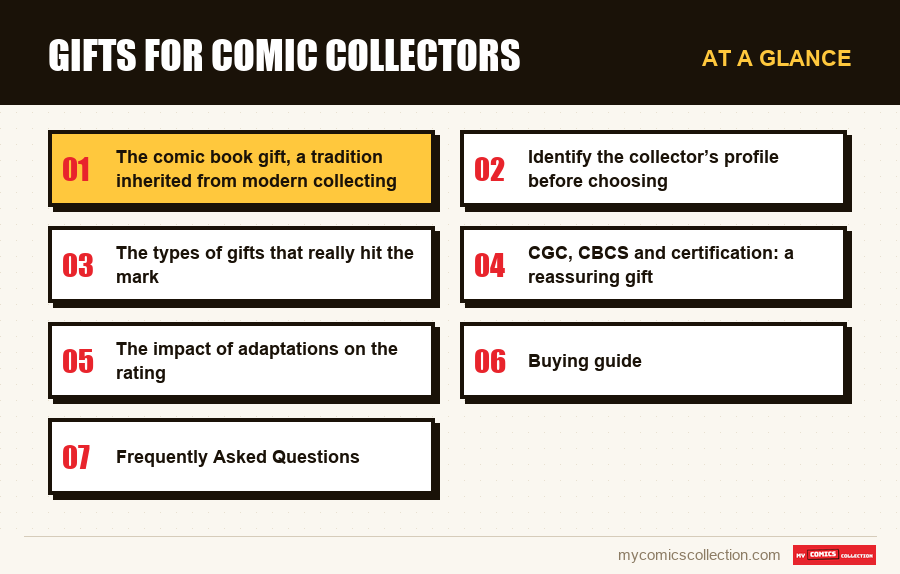
The comic book gift, a tradition inherited from modern collecting
The comic as a collector's item worthy of being offered has not always existed in this form. For decades, booklets were designed as disposable products: read, exchanged between children, then thrown away or recycled. The shift towards a culture of structured collecting really began in the 1970s, with the appearance of the first listing guides which gave fans a common vocabulary to talk about condition and value, and with the rise of the "direct market", this specialized distribution circuit which allowed comics to find an audience of regular buyers rather than depending solely on newsstands.
The real turning point for comics gifts came in 2000, with the creation of Certified Guaranty Company (CGC). Before CGC, giving someone a "rare" comic meant trusting a seller's valuation or one's own eye to judge the condition of a copy-a subjective exercise, a source of litigation and disappointment. CGC introduced a third-party evaluation, objective and sealed in a tamper-proof plastic shell, with a numerical rating from 0.5 to 10. Overnight, a graded comic became an object whose quality is no longer questionable: what the shell displays is what the buyer receives. It is this guarantee that has made graded comics one of the “safe” gifts par excellence for a demanding collector, in the same way as a certified coin or an encapsulated sports card.
In 2001, CGC added an additional brick to this gift culture with the launch of CGC Signature Series: the possibility of authenticating a designer signature affixed in the presence of a CGC witness. A comic signed and certified in this way combines the value of the gradation note with the more personal value of the direct link with the author: a particularly strong gift format for a fan of a specific artist or screenwriter. The most spectacular proof of what certification can do to the value of a comic remains the sale of a copy of Superman #1 certified by CGC, sold for $5.3 million: an extreme case, but which clearly illustrates the extent to which condition and traceability weigh in the balance, much more than the simple fact of having "the right number".
Alongside the gradation, another tradition has been established to punctuate the comic book giveaway calendar: Free Comic Book Day. The event was imagined by a Californian retailer in 2001 and organized for the first time on May 4, 2002, with more than 2,000 points of participation in its first edition. Since then, it has been held every first Saturday in May (May 2, 2026 for the upcoming edition) and remains an excellent excuse to offer a “comics” release rather than an object, by accompanying a collector looking for the exclusives of the day. Major conventions, starting with Comic-Con International in San Diego (July 23-26, 2026, with opening night on the 22nd), play a similar role: they have become places where we find convention exclusives, signing sessions and experiences that, offered in the form of a ticket or curated outing, are among the gifts most appreciated by collectors who are accustomed to participating each year.
Identify the collector’s profile before choosing
Before thinking about the specific number or object, the most useful question to ask yourself is: what type of collector do I have in front of me? Expectations and satisfaction criteria differ radically from one profile to another, and a gift that is perfectly relevant for one may fall completely flat for another.
The nostalgic reader
This collector buys to reconnect with an emotion from childhood or adolescence: the comic he read at a loved one's house, the series he followed at a specific period of his life. For him, the perfect condition matters less than the authenticity of the memory. A careful reissue, a period copy in good but affordable condition, or a box set containing the entirety of a run that he has only read in part will often be more of a hit than an overpriced graded copy that he will never dare take out of its case.
The key issue hunter
In contrast, this profile specifically looks for pivotal issues in editorial history: first appearance of a character, first costume, significant death or resurrection, decisive change of creative team. Amazing Fantasy #15 (first appearance of Spider-Man, 1962), For this profile, the rarity at the top of the grade (visible in the CGC public census, which lists the number of copies certified at each grade for each issue) is often more telling than a simple displayed price.
The wealth investor
This collector sees his collection as a tangible asset, just like a coin or an old collectible card. He systematically favors graded examples, with a marked preference for high grades (9.6, 9.8) and particular attention to the census: the fewer examples there are certified at a given grade, the more the relative rarity weighs in his decision. For this profile, a relevant gift is an already graded comic, ideally accompanied by a clear provenance history, rather than a raw copy that they will have to have certified themselves.
The fan of a specific artist or character
This collector organizes his collection around a strong thematic axis (a designer, a screenwriter, a character) rather than around the logic of “first appearances”. For him, an original plate, a signed print, a variant cover created specifically by the artist he follows, or a number obtained as a dedication at a convention will often have more emotional value than a number that is objectively rarer but outside his field of interest.
The types of gifts that really hit the mark
Once the profile has been identified, it remains to choose the form of the gift. Here are the large families that work best in practice, with their respective advantages and limitations.
The CGC graded comic
It is the “safest” gift in the literal sense: the sealed shell guarantees that the condition cannot deteriorate between purchase and delivery of the gift, and the displayed note eliminates any ambiguity about the quality of the copy. The other side of the coin is that the comic becomes an object to be looked at rather than handled: an aspect which does not suit all collectors, some preferring to keep their comics readable. This format is particularly suitable for key issue hunters and wealth investors mentioned above.
The variant edition or convention exclusivity
The variant covers, printed in deliberately limited quantities compared to the standard cover, and the exclusives distributed at a trade show give the gift a "you can't find it everywhere" dimension which greatly appeals to collectors already well stocked with classic issues. The main thing is to check that the recipient does not already own the variant in question: this type of purchase is almost always made to measure, relying on what we already know about their existing collection.
A complete run rather than an isolated number
Offering the entirety of a narrative arc or a cult mini-series, rather than a single overpriced flagship issue, often makes it possible to offer a complete reading experience for a budget equivalent to, or even lower than, that of a single graded key issue. This is an option particularly suited to the nostalgic reader, who favors the story told over the rarity of the medium.
The original plate or art print
For a fan of a specific artist, an original sketch or inking plate, a signed limited edition, or a signed bookplate constitute gifts that go beyond the scope of a simple booklet. This market works differently from that of graded comics: each piece is unique, and authentication (via CGC Signature Series or an equivalent certification for original art) becomes the central element of trust, exactly as for a graded comic.
Conservation accessories
It is the most underestimated gift, and yet one of the most useful for any collector profile: polypropylene or PVC-free mylar sleeves, acid-neutral reinforcement cardboard in the right format (industry standards generally distinguish between the Golden Age format, the Silver/Bronze Age format and the slightly narrower modern comics format), suitable storage boxes, or simply a dehumidifier for a storage room. A collector who has never taken the time to properly equip his collection will welcome this type of gift with enthusiasm that is often greater than expected, because it is this equipment that concretely protects the value of everything he already owns.
Collecting this series?
Track what you own, what you are missing and what your collection is worth. 7 day trial.
Start my trial →CGC, CBCS and certification: a reassuring gift
Understanding how grading actually works helps you make an informed choice, especially if the idea is to offer a comic already certified or to have a raw copy certified as a gift. CGC remains the reference service in this market, but CBCS (Comic Book Certification Service) offers a comparable offer and also publishes its own public census. In both cases, the principle is the same: one or more graders examine the copy, give it a grade on a scale of 0.5 to 10, then seal it in a hard shell with a label indicating the series, number, publisher and grade.
Since the CGC price revision which came into force at the beginning of January 2026, the price structure for the standard grading of comics is available in several levels depending on the declared value of the copy: approximately $27 for a batch of modern comics in grouped submission (value capped at $400), $30 for an isolated modern comic, $42 for a batch of grouped old comics, $45 for an isolated old comic, 105 $ for the “high value” tranche, and a proportional rate of 4% of the market value (with a minimum of $135) for copies with no declared value ceiling. The CGC Signature Series plan, which combines signature grading and authentication, follows a slightly increased equivalent grid, with an additional $8 for the detailed signature imaging option.
For a gift, two approaches are possible. The first consists of offering an already graded copy: the recipient immediately receives a finished object, without waiting time or uncertainty about the result. The second is to offer a rough copy accompanied by coverage of submission fees: a more personal option, since the recipient chooses the service themselves, retains control over the choice of grader and experiences the experience of receiving their own certified copy. This second option requires more involvement on the part of the offerer, but it is often perceived as more generous, because processing times can extend over several months depending on the level chosen.
The impact of adaptations on the rating
It's impossible to talk about comic book gifts without mentioning the now well-documented effect of screen adaptations on demand for certain specific issues. Each release of a film or series centered on a character generally causes a renewed interest in its first appearance number, with an effect all the more marked if the film is a commercial or critical success.
The case of Venom is particularly telling: the release of the film Venom in 2018, followed by its sequels, permanently put Amazing Spider-Man #300 back in the spotlight: an issue already considered a cornerstone of the Spider-Man collection since its publication in 1988, but whose general public demand has clearly expanded with the arrival of the character in the cinema. The same phenomenon is systematically observed around the X-Men franchises, with peaks of interest in
For those looking to offer a gift that has meaning in the news, following the release calendar linked to the recipient's universe is therefore a relevant strategy: a key issue purchased before a film maintains the craze around a character often has more emotional, and sometimes commercial, value than a purchase made after the fact, once the general public's attention has already shifted elsewhere. Conversely, offering a number directly linked to a recent release allows you to ride an immediate craze and share pop-cultural news with the recipient.
Buying guide
Here is a series of concrete checks to do before validating the purchase of a comic book gift, whatever the available budget:
- Check that the recipient does not already have the item in question. A simple message to someone close to the collector, or a discreet glance at his collection if it is listed in an application, avoids the most classic duplicate.
- Choose a graded copy for any purchase above a certain budget. Beyond a certain amount, certification eliminates the risk of unpleasant surprises regarding the actual condition of the item, which the buyer cannot always assess with the naked eye.
- Compare the score displayed with the public census of CGC or CBCS to understand if the example offered is common or truly rare at this specific grade, rather than relying solely on the price asked by the seller.
- For a raw copy, systematically examine the corners, the binding (spine), the color of the paper and possible discoloration due to exposure to light before purchase: these elements directly influence the rating the comic would obtain if it were subject to grading.
- Always provide a pouch and a backing box in the right size to accompany the gift: it's a simple gesture that shows that the purchase has been thought through all the way, not just at the checkout.
- Keep proof of purchase and, if possible, the provenance of the copy (previous sale, certificate, ownership history): this traceability counts for future resale as much as for the immediate confidence of the recipient.
- For a fan of a specific artist, verify the authenticity of any signature before purchase: without authentication by a recognized service such as CGC Signature Series or JSA, a signature cannot be guaranteed, regardless of the certainty displayed by the seller.
- Think about “experience” formats: a ticket to a convention, a registration for a signing session, or simply an organized outing on Free Comic Book Day: for collectors who value the experience as much as the object itself.
One final reflex, often overlooked: if the recipient already lists their collection digitally, it may be helpful to consult this list before purchasing rather than guessing. A collection management application like collection tracking app allows you to know at a glance what a collector already owns, which avoids many duplicates: provided, obviously, that you can take a look without arousing suspicion before the occasion.