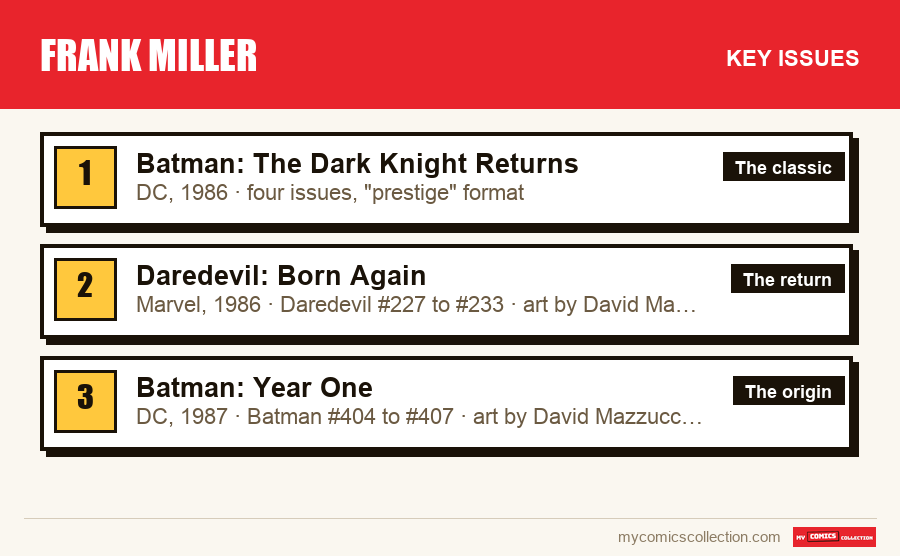
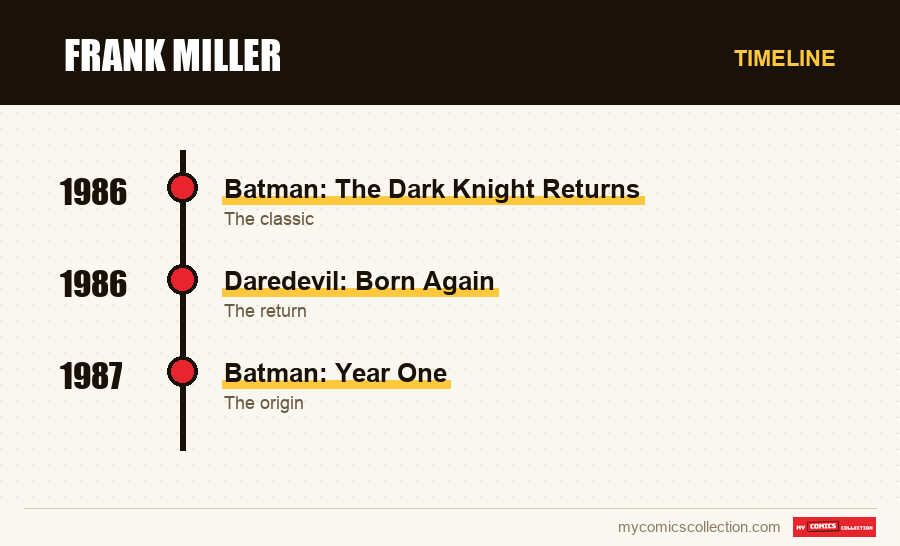
Frank Miller, born on January 27, 1957 in Olney (Maryland) and raised in Montpelier (Vermont), is the creator who tipped superheroes toward crime fiction and darkness in the early 1980s. He arrived on Daredevil as an artist at #158 (May 1979), became its writer as well, created Elektra in #168 (January 1981) and killed her off in #181. At DC, he wrote and drew Ronin, then The Dark Knight Returns (1986) and Batman: Year One (Batman #404 to #407, 1987), while Born Again (Daredevil #227 to #233) closed his Marvel period. The 1990s belong to Sin City and 300 at Dark Horse, then to film. In 2026, he publishes his autobiography and, with Peach Momoko, writes "Tears of the Spider-Queen" in Amazing Spider-Man #1000.
There are creators who write good stories, and creators who change the way others write. Frank Miller undeniably belongs to the second category. In less than ten years, between 1979 and 1987, he gave two characters, Daredevil and Batman, the version that still serves as a reference for films, series and most of the writers who take them up. He imported into American comics codes from manga and European comics, and helped establish the graphic novel format in bookstores.
He is also a contested creator, part of whose late work has been harshly criticized, including by former admirers. This page retraces the career in order, without hagiography, dwelling on what interests a reader and a collector: which works matter, where they were published, and why his name is back in the contents of Amazing Spider-Man #1000.
The beginnings: from Vermont to Marvel (1957-1979)
Frank Miller was born in Maryland and grew up in Vermont, the fifth of seven children in a Catholic family of Irish origin. A comics reader since childhood, he had one of his letters published in 1973 in the letters page of a Marvel title, The Claws of the Cat. His first professional work appeared at Gold Key, a publisher then specializing in licenses, before he settled in New York and looked for work at the two big houses.
The decisive moment came in 1979. Miller drew Daredevil, first as a guest in Spectacular Spider-Man, then as regular artist of the blind hero's series from #158, dated May 1979, on scripts by Roger McKenzie and with inker Klaus Janson. Daredevil was then a fragile series, with modest sales, threatened with cancellation. It was precisely that fragility that would leave the young artist room to maneuver he would never have had on a flagship title.
Daredevil, first era: Marvel's most transformed series (1979-1983)
Very quickly, Miller was no longer content to draw. He took over the script and, from #168 of January 1981, wrote both the story and the layouts. That issue introduces Elektra, Matt Murdock's former lover turned assassin for hire. The character became in a few months one of Marvel's most popular, to the point of being adapted to film in 2005. #168 remains today the most sought-after entry point of this period, and the page devoted to Daredevil #168 details its importance.
What Miller changes comes down to three words: city, violence, solitude. The New York of his Daredevil is a neighborhood, Hell's Kitchen, with its alleys, its bars and its underworld. He installs the Kingpin, from the Spider-Man stories, as the godfather of local crime. He gives the Hand, a sect of ninjas, a central place. And he pushes the story's logic to the point of having Bullseye kill Elektra in #181, in April 1982, an episode that lastingly marked readers of the time. Miller left the series shortly after, in early 1983.
At the same time, he drew with Chris Claremont the first Wolverine miniseries, four issues published from September to December 1982, which takes the mutant to Japan and fixes part of his mythology. You can recognize Miller's taste for samurai Japan, which would feed his next project.
Ronin and the arrival at DC (1983-1984)
Ronin, a six-issue miniseries published by DC in 1983 and 1984, is Miller's first entirely personal project. A masterless samurai, reincarnated in a futuristic, run-down New York: the pitch says everything about his influences. The art borrows from the manga of Kazuo Koike and Goseki Kojima, whose covers for the American reissues of Lone Wolf and Cub Miller would soon illustrate, and from French comics, in particular Moebius. The coloring is by Lynn Varley, who would become his regular colorist until the late 1990s.
Ronin was not a huge popular success, but it proved that a major publisher could publish a creator's story, in a polished format, with no in-house superhero. That proof would be put to use two years later.
1986, the year everything tips
In 1986, Miller publishes almost simultaneously three works that would define his reputation.
Batman: The Dark Knight Returns
A fifty-five-year-old Bruce Wayne takes the costume back in a Gotham handed over to gangs. DC publishes these four issues in an unusual format: square spine, thick paper, cardboard cover. The story and the object establish the idea that a superhero comic can be an adult book. The whole later depiction of a massive, aging Batman at war with his city follows from it.
Daredevil: Born Again
Miller returns to Daredevil as a writer, with David Mazzucchelli on art. Karen Page sells Matt Murdock's secret identity, the Kingpin discovers it and sets out to destroy him methodically. A story of fall and rebuilding, Born Again is often cited as the character's best story, and it largely inspired the series Daredevil: Born Again.
Batman: Year One
Published in the regular Batman series in early 1987, this four-part story rewrites the first year of Bruce Wayne and James Gordon in a corrupt Gotham. Urban crime fiction rather than a superhero tale, it served as the basis for several films. Our article on the value of Batman: Year One and the entry for Batman #404 detail the single issues.
These three works share the same method: take an established character, break him, and show what is left when his protections are removed. They also share a style of writing, with its choppy voice-overs, its layouts of small repeated panels like television screens, and its taste for the city as a character.
The 1990s: independence, Sin City and 300
In the late 1980s, Miller announces that he will now publish his personal projects at Dark Horse, an independent publisher that leaves ownership of the works to their creators. He first honors a last commitment at Epic, Marvel's adult line, with Elektra Lives Again (1990), fully painted. Then come two collaborations at Dark Horse: Hard Boiled with Geof Darrow, three issues of satirical violence, and Give Me Liberty with Dave Gibbons, which launches the character Martha Washington.
In 1991, Miller begins Sin City, serialized in the anthology Dark Horse Presents #51 to #62. Sharp black and white, with no half-tones, and crime fiction pushed to abstraction: the series becomes a sequence of stories that would occupy Miller for a good part of the decade. The entry for Sin City #1 and our comparison between the 2005 film and the comics give the detail. In 1994, he takes part in founding Legend, an imprint bringing together several creators under Dark Horse's aegis.
In 1998 comes 300, a five-issue miniseries devoted to the Battle of Thermopylae, with Lynn Varley's painted colors. The landscape format, in double-page spreads, makes each issue a fresco. The book would be adapted to film in 2007.
During the same period, Miller briefly returns to Daredevil with The Man Without Fear (1993), an origin story drawn by John Romita Jr. That artist's name would reappear later in his career.
The 2000s: back to Batman and the move to film
Miller returns to DC for The Dark Knight Strikes Again (2001-2002), a sequel to The Dark Knight Returns, whose reception was much more divided. He then writes All Star Batman & Robin, the Boy Wonder with Jim Lee, starting in 2005, a series with a very irregular publication pace and a deliberately over-the-top tone, left unfinished.
Film then takes up a growing place. Miller had already written the scripts for RoboCop 2 and RoboCop 3 in the early 1990s, an experience he remembered bitterly. Robert Rodriguez convinces him to co-direct Sin City, released in 2005, then Sin City: A Dame to Kill For in 2014. Alone, Miller directs The Spirit in 2008, an adaptation of Will Eisner's character, which was a failure. The adaptations of 300 in 2007 and of its sequel in 2014 were made without him directing.
The controversies
You cannot honestly present Miller without mentioning the criticism that has accompanied his career since the 2000s. In 2011, he publishes at Legendary the graphic novel Holy Terror, initially conceived as a Batman story, in which a vigilante fights Islamist terrorists. The book is accused of Islamophobia, and Miller then makes public statements that worsen the controversy. He would later say he regrets the book, and that he could no longer write it.
Alan Moore, who had warmly written a foreword for one of his early works, judged his work harshly from Sin City on, blaming it for misogyny and homophobia. This criticism has not erased the influence of his 1980s works, but it explains why part of the public sharply separates the Miller of Born Again from the Miller of the 2000s.
Since 2015: comebacks and a new house
In July 2015, Miller enters the Eisner Awards Hall of Fame. From 2015 to 2017, DC publishes The Dark Knight III: The Master Race, nine issues co-written with Brian Azzarello and drawn mainly by Andy Kubert. In 2019, he reunites with John Romita Jr. for Superman: Year One, three issues under the Black Label imprint.
In April 2022, Miller launches his own publishing house, Frank Miller Presents, of which he is president and editorial director, with Dan DiDio as publisher. There he relaunches his personal universes. In June 2024, the documentary Frank Miller: American Genius premieres in New York. And in 2026 comes his autobiography, Push the Wall: My Life, Writing, Drawing, and the Art of Storytelling, presented as both memoir and storytelling course.
Amazing Spider-Man #1000: closing the loop with the Hand
On September 30, 2026, Marvel publishes Amazing Spider-Man #1000, 104 pages, including a series of anniversary stories entrusted to creators tied to the character. Miller writes "Tears of the Spider-Queen" there with Peach Momoko. It is the first collaboration between the two artists, and the story pits Spider-Man against the Hand, the ninja sect Miller had placed at the heart of his Daredevil more than forty years earlier.
The choice is far from trivial. Miller has almost never written Spider-Man, even though his Marvel career began in a series of the web-slinger. Momoko, known for her rereadings of Marvel heroes inspired by woodblock prints and Japanese folklore, shares with him a taste for Japan that Miller has shown since Ronin. The result closes a loop: the creator who gave Daredevil his ninjas finds them again, this time facing Spider-Man, in the most ordered issue of the year for Marvel.
What to read, and what to collect
For reading, the most illuminating order follows the career: the first-era Daredevil, in a collected edition; Ronin; The Dark Knight Returns; Born Again; Year One; then Sin City and 300. The articles on the great Daredevil runs and on his best arcs place Miller's work in the character's history, and our comparison between the Elektra film and the comics shows what the screen kept of his creation.
For collecting, the hierarchy has been stable for a long time. Daredevil #168, first appearance of Elektra, dominates; Daredevil #158, the first issue drawn by Miller on the series, and #181, the death of Elektra, follow. At DC, the first issue of The Dark Knight Returns in first printing is the most followed piece. The issues of Year One and Born Again, published in the regular series, are abundant and mostly play on condition. Dark Horse editions, finally, interest fans of the creator more than the general market. No price guide is given here: for a specific copy, the free estimate starts from the real condition of your comic.