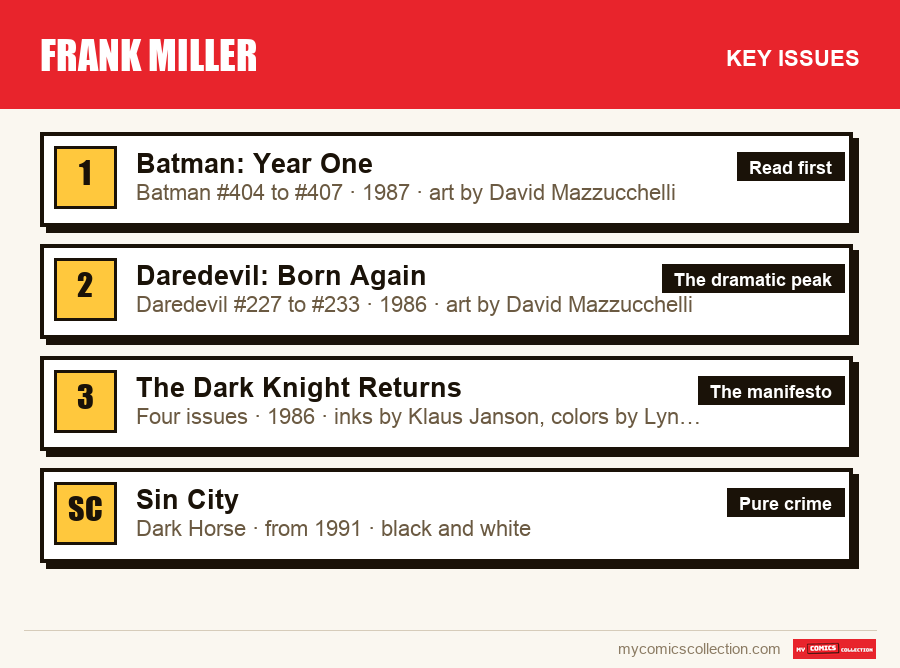
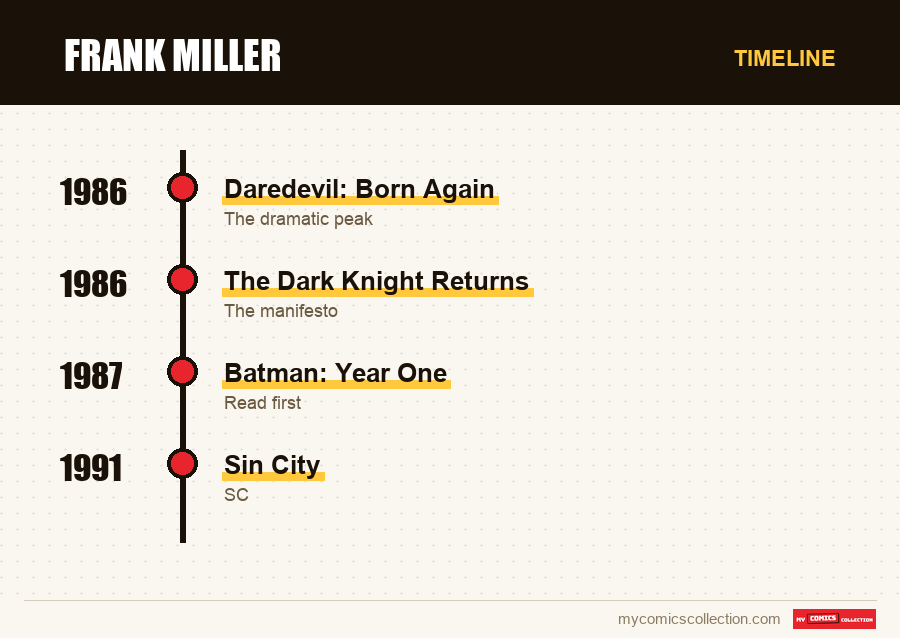
To discover Frank Miller, start with Batman: Year One (Batman #404 to #407, 1987): four episodes, no prerequisites, Miller on script and David Mazzucchelli on art. Follow with Daredevil: Born Again (Daredevil #227 to #233, 1986), same duo, then The Dark Knight Returns (1986, four issues). After that, it all depends on your taste. The superhero reader goes back to the Daredevil run (art from #158 in 1979, script from #168 to #191). The crime fan moves on to Sin City (Dark Horse, from 1991). Whoever likes history and form opens 300 (1998) or Ronin (1983-1984). Keep the 2000s sequels, more divisive, for later, and read his story in Amazing Spider-Man #1000 (2026) as a curiosity.
Frank Miller is one of the few comic creators whose name sells on its own, and one of the hardest to approach. His work spans fifty years, three major publishers, an independent house, superheroes, crime, ancient history and science fiction. It contains undisputed peaks and books that violently divide even his own admirers. Starting in the wrong place risks missing out.
This article does not tell his life story. It answers one question: in what order to read Miller, depending on what you are looking for. It offers a common entry door, then four distinct paths, and flags the titles to keep for later.
The entry door: three books, in this order
Whatever your profile, these three titles make the best start. They are short, complete, available in collected form for decades, and they show Miller's three faces: the precise storyteller, the dramatist, the provocateur.
Batman: Year One
Four episodes on the first year of Bruce Wayne and James Gordon in Gotham. It is Miller's most accessible book: no prerequisites, restrained narration, captions crossed between the two characters, and Mazzucchelli's exemplarily clear art. You see Miller mastering his material without forcing it. Whoever does not like this book will hardly like the rest.
Daredevil: Born Again
The Kingpin discovers Matt Murdock's identity and sets out to destroy him methodically. Seven episodes of fall and rebuilding, often cited as the character's best story. Reading it requires knowing who Murdock, Karen Page and the Kingpin are, but the story recalls the essentials. It is the book where Miller best links intimate tragedy and spectacle.
The Dark Knight Returns
A fifty-five-year-old Batman returns to duty in a future Gotham saturated with television screens. It is Miller's most famous book and the densest: sixteen-panel waffle-iron grids, media satire, unapologetic violence, a final showdown with Superman. Reading it third lets you measure the distance between the restraint of Year One and the claimed excess of the Dark Knight.
After these three books, you know what draws you to Miller: precision, tragedy or the charge. The next four paths start from there.
Path 1: the superhero reader
You liked Born Again and want to understand where it comes from. The route goes through Daredevil, the character that made Miller.
The Daredevil run, from #158 to #191
Miller arrives as artist at #158, dated May 1979, on scripts by Roger McKenzie. He takes over the script at #168 (January 1981), which introduces Elektra, and keeps the series until #191 (February 1983). It is there that he sets up the tone that has defined the character since: nocturnal New York, the ninjas of the Hand, the Kingpin as grand orchestrator, Bullseye as obsessive killer. Elektra's death in #181 remains one of the most discussed episodes of the period.
Wolverine, the 1982 miniseries
Four issues written by Chris Claremont and drawn by Miller, sending Logan to Japan. It is the best demonstration of what Miller brings to a character who is not his own: a code of honor, a setting, an economy of words. The 1982 Wolverine #1 is also a collector's piece in its own right.
Born Again, then Elektra: Assassin
Reread Born Again at its chronological place, then open Elektra: Assassin (1986-1987, eight issues, art by Bill Sienkiewicz): a hallucinated spy story, very far from Mazzucchelli's realism. It is a demanding book, to read when you already know Elektra well.
Daredevil: The Man Without Fear
In 1993, Miller rewrites Matt Murdock's origins in five issues drawn by John Romita Jr. It is the counterpart of Year One for Daredevil, and a good way to close the path.
To place this run within the whole series, see our selection of the best Daredevil arcs and the Daredevil reading guide, which place Miller between his predecessors and successors.
Path 2: the crime fan
You liked the dirty Gotham of Year One more than Batman's costume. The Miller you need is the one of Sin City.
Sin City
The first story appears serialized in the anthology Dark Horse Presents from 1991, before being collected. Several independent stories follow, sharing a city, a few characters and a very high-contrast black and white. Each book reads alone. Start with the first, which sets the rules of the game, then take the others in publication order: the characters cross paths and the cross-references reward sequential reading.
After Sin City, two titles extend the path. Hard Boiled (Dark Horse, 1990-1992), written by Miller and drawn by Geof Darrow, pushes violence to graphic saturation; it is an artist's book as much as a writer's. Give Me Liberty (1990), with Dave Gibbons, tells of a future America through a soldier, Martha Washington; it is the most political Miller of the period.
The Daredevil run also has a strong crime flavor, especially in its Kingpin episodes. If you started with this path, it is the natural bridge to the first. Our ranking of the best noir and crime comics places Sin City among the genre's references.
Path 3: the reader of history and form
What struck you in The Dark Knight Returns was the layout, the way of cutting up time. This path follows the experimenter.
Ronin (DC, 1983-1984, six issues) comes first: a masterless samurai is reincarnated in a future New York. Miller absorbs the influence of manga and European comics, with full pages and a rhythm very far from the comics of the time. The book heralds everything that follows.
300 (Dark Horse, 1998, five issues, colors by Lynn Varley) tells the battle of Thermopylae in widescreen panels, designed to be read as panoramic double-page spreads. It is Miller's most spectacular book, and the most discussed for its vision of history. Our article 300, the film versus the comics compares the two versions.
Xerxes (Dark Horse, 2018, five issues) is its distant sequel, from the Persian and then Greek side. It reads after 300, never before.
Path 4: the collector
If you read Miller to build a collection, the order changes. It is no longer about understanding the author, but about spotting the issues that matter and acquiring them in a consistent condition.
Start with the recognized key issues
Daredevil #168 (first appearance of Elektra), Dark Knight Returns #1, Batman #404 and the 1982 Wolverine #1 form the core of any Miller collection. These are the issues the market identifies immediately.
Complete whole arcs
A complete arc in single issues (Born Again, Year One, the Dark Knight) is worth more, for reading as for the collection's coherence, than a pile of isolated first issues. Set yourself one arc at a time.
Add the original independent editions
The Dark Horse issues of Sin City, 300 and Hard Boiled are less hunted than the Marvel and DC issues, but they document the author's most personal period.
Keep room for the recent
The story "Tears of the Spider-Queen" in Amazing Spider-Man #1000, out on September 30, 2026, is Miller's first collaboration with Peach Momoko. It is a recent object, printed in very large numbers: it counts for the author collection, not as an investment.
What is better kept for later
Part of Miller's work divides even his most faithful readers. It is not a reason to ignore it, but starting there would give a false picture of the author.
The Dark Knight Strikes Again (2001-2002, three issues) takes the opposite tack from its predecessor: deliberately rough art, garish digital colors, satire pushed to the extreme. It is better understood when you know the first Dark Knight well and Miller's career in the 1990s.
All Star Batman & Robin, the Boy Wonder (2005-2008), drawn by Jim Lee, presents an outrageous Batman that many read as an assumed parody and others as a slip. It remains unfinished.
Holy Terror (2011) is Miller's most contested book, because of its subject. To reserve for those who want to know the whole bibliography.
Dark Knight III: The Master Race (2015-2017), co-written with Brian Azzarello and drawn mainly by Andy Kubert, and Superman: Year One (2019), with John Romita Jr., are calmer works, where Miller's share is divided. They read as extensions, not as entry doors.
Recap: which book for which reader
| Profile | First book | Next | To avoid at the start |
|---|---|---|---|
| Discovery | Batman: Year One | Born Again, Dark Knight Returns | Dark Knight Strikes Again |
| Superhero | Born Again | Daredevil #158 to #191, Wolverine 1982 | Elektra: Assassin first |
| Crime | Year One | Sin City, Hard Boiled | All Star Batman & Robin |
| History and form | Dark Knight Returns | Ronin, 300, Xerxes | Holy Terror |
| Collection | Daredevil #168 | Complete arcs in single issues | The recent as an investment |
One last piece of advice: read Miller with his artists in mind. Mazzucchelli, Janson, Varley, Sienkiewicz, Darrow, Gibbons, Romita Jr. each pulled his scripts in a different direction. A reader who does not like Elektra: Assassin can adore Year One, and vice versa, without the writer being the cause.