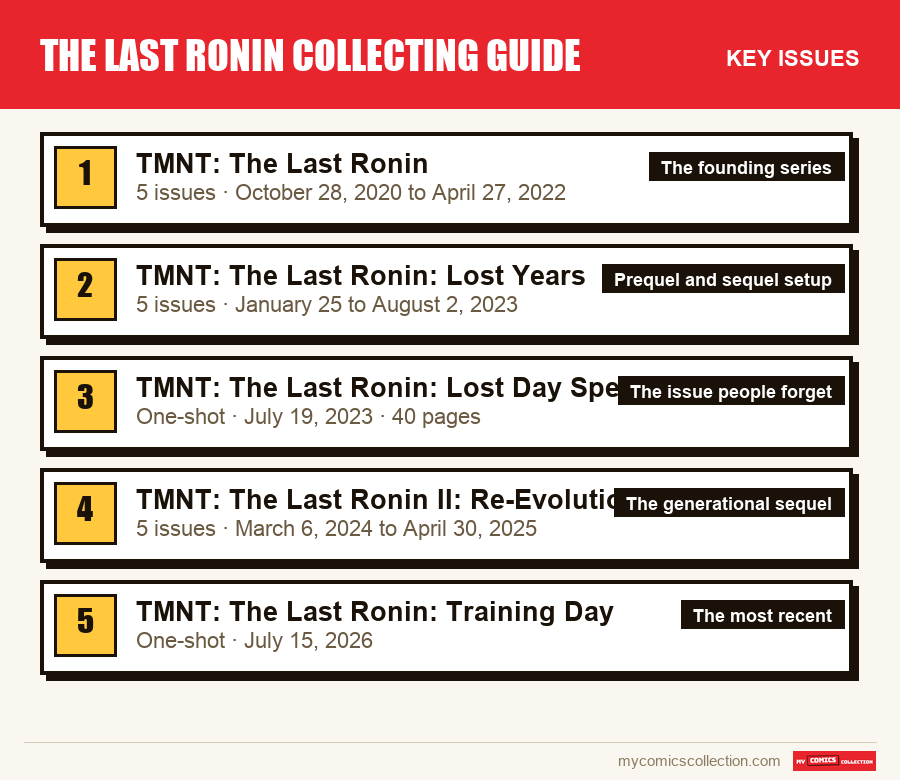
The Roninverse is the parallel universe opened by TMNT: The Last Ronin at IDW, independent of the Turtles' main continuity. It currently counts three five-issue miniseries (The Last Ronin, from October 28, 2020 to April 27, 2022; The Last Ronin: Lost Years, from January 25 to August 2, 2023; The Last Ronin II: Re-Evolution, from March 6, 2024 to April 30, 2025) and two one-shots (Lost Day Special, July 19, 2023, and Training Day, July 15, 2026), for seventeen issues in all. The announced conclusion, The Last Ronin III: Return to New York, is expected in summer 2027. The most strained pieces on the market are the first printings of issues #1 and #2 of the founding series, sent back to press at record quantities for the publisher. This guide gives the exact inventory, the reading order, the hierarchy of issues and the method for not confusing a first printing with a reprint.
A closed, short, finished universe, entirely published in six years: on paper, the Roninverse is the easiest collection to complete in the whole Ninja Turtles catalog. Seventeen issues, a single publisher, a single creative core, no earlier continuity to catch up on. That is precisely what makes it an interesting trap, because the apparent ease hides three real difficulties: the reading order is not the publication order, two of the most in-demand issues circulate mostly as reprints without their cover saying so clearly, and only one of the five titles concentrates an avalanche of alternate covers that turns the notion of "complete series" into an open question.
We are writing on October 2, 2026. As of this date, everything published in this universe is available, the most recent one-shot came out less than three months ago, and the last chapter is dated but not yet solicited. It is the right time to take inventory: late enough for the whole to be readable as a block, early enough to prepare for the last installment's arrival without buying in a rush.
This guide does not tell the story of the Turtles at Mirage, nor the market value of the 1984 TMNT #1, nor the succession of publishers: these subjects are covered elsewhere on the site, and links are given throughout the text. It deals with one thing, in detail: how to build and maintain a complete Roninverse collection.
What the Roninverse is, and why it is a separate continuity
The word "Roninverse" is not a reader nickname: it is the term officially used by the publisher from July 2022, when it announced the universe's extension with Lost Years. This formalization matters, because it settles the question every newcomer asks: do these issues fit into the very long regular Turtles series published by the same publisher since 2011? No. The Roninverse is published by IDW, but it is not tied to house continuity. It is a self-contained set, with its own future, its own deaths and its own generation of characters.
The consequence for a collector is liberating. You can acquire and read the Roninverse in full without owning a single issue of another Ninja Turtles series, and without knowing the state of main continuity. It is a door that closes behind itself, a case rare enough in superhero comics to deserve mention. The reverse is also true: a reader following the regular series has no narrative gap if they ignore the Roninverse. The two projects move in parallel, and January 2027 pulls them a little further apart, since the regular series changes creative team at its #25 with Matthew Rosenberg and Juann Cabal, a distinct subject we cover separately.
Second particularity, decisive for the value of the whole: the project's origin. The story rests on an outline written by Kevin Eastman and Peter Laird in 1987, left in a drawer, which Eastman took up and reworked with Tom Waltz for publication. At the announcement of the first issue's second printing, Eastman spoke of thirty-two years of gestation. The Roninverse is therefore not an opportunistic relaunch: it is the late publication of an old document, and it is the first credited collaboration between the Turtles' two co-creators in a quarter century. A collector is buying here a piece of editorial history as much as a recent comic.
Third particularity: the register. The whole is published under a "mature" label, with a violence and a tone of mourning that have nothing to do with the franchise's mainstream image. This has two practical effects. The initial print run was calibrated on an adult readership, therefore narrower than that of an all-ages title, which partly explains the 2020 and 2021 supply tensions. And the audience that buys it reads it, then keeps it: copies in very high grade are proportionally fewer than on a title bought to be set aside.
The exact inventory: five publications, seventeen issues
Here is what made up the Roninverse as of October 2, 2026, in publication order, with only the data we were able to verify.
TMNT: The Last Ronin
Story by Eastman and Laird, script by Eastman and Waltz, art by Esau and Isaac Escorza, flashback sequences by Ben Bishop, colors by Luis Antonio Delgado, lettering by Shawn Lee. Michelangelo, the last survivor of the Hamato family, returns to a New York controlled by Oroku Hiroto, the Shredder's grandson. The five chapters carry titles: Wish for Death, First to Fall, Fight or Flight, Blood in Snow and a fifth that takes up the series' name.
TMNT: The Last Ronin: Lost Years
Eastman and Waltz on script, S.L. Gallant on main art, Ben Bishop on the sequences projected into the future. The series works on two threads: Michelangelo's years of wandering and training before his return, and, further in time, Casey Marie Jones training a new generation of mutant turtles named Odyn, Moja, Uno and Yi. It is the title that turns a closed story into an extensible universe.
TMNT: The Last Ronin: Lost Day Special
Eastman and Waltz, with an unusual art split: Freddie E. Williams II on some pages, the Escorza brothers on others, Ben Bishop on most of the volume. The story takes place after Hiroto's fall, in the power vacuum that follows: April O'Neil takes the four young turtles on a supply run and gets caught up in a faction struggle.
TMNT: The Last Ronin II: Re-Evolution
Eastman and Waltz, art by the Escorza brothers and Ben Bishop, colors by Delgado. The action takes place more than ten years after the founding series' conclusion, in a city fallen back into disorder where gangs fight for political and economic control. Casey Marie Jones and her four students must build a coalition. The chapters are titled Red Skies at Dawn, Playing God, Day Dreams and Nightmares, Secrets and From the Ashes.
TMNT: The Last Ronin: Training Day
Announced in February 2026, published July 15, 2026. Eastman and Waltz on script, Escorza brothers and Ben Bishop on art, Delgado on colors: exactly the founding series' team. The story slots between the third and fourth issues of that series and covers the twenty-four hours during which Michelangelo trains Casey Marie before the final assault.
To this is added what is announced and not yet published: The Last Ronin III: Return to New York, revealed in July 2026 and expected in summer 2027. Eastman and Waltz are reunited there with the Escorza brothers, Ben Bishop and Luis Antonio Delgado. The story follows Casey Marie Jones and the four turtles facing a reconstituted Foot Clan, and the publisher explicitly presents it as the last act, the one that closes the main trilogy. No format, page count or number of issues was confirmed at our time of writing: we will not invent any.
Reading order and collecting order: two different lists
Many Roninverse collections are shelved in purchase order, which is the worst of the three possible orders. Here is how to separate the logics.
For a first read, follow the release
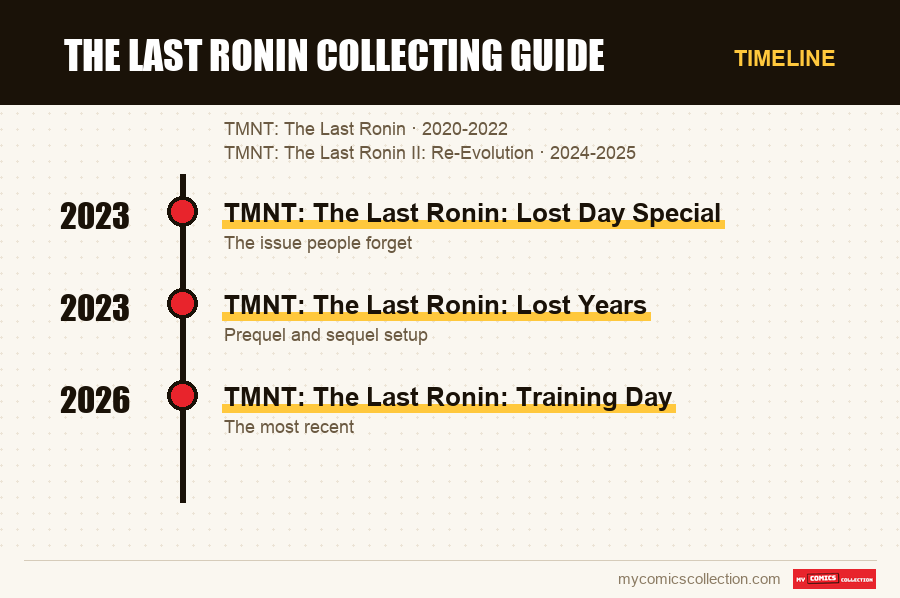
Founding series, then Lost Years, then Lost Day Special, then Re-Evolution. It is the order in which the creators built the revelations, and the only one that preserves the initial mystery about the survivor's identity. Keep Training Day for later: it assumes you already know who Casey Marie is and what awaits her.
For a reread, follow the internal chronology
The Lost Years flashbacks precede Michelangelo's return, Training Day slots between chapters three and four of the founding series, Lost Day Special comes after its conclusion, and Re-Evolution takes place more than ten years later. This order destroys the effect of the first read, but it makes the mourning device much sharper.
For the collection, shelve by title and note the bridges
Five publications, five distinct entries, each with its own numbering that restarts at 1. A purely numerical shelving produces four "#1" side by side with no hierarchy, and two one-shots floating. The full title is the only reliable key, and the printing notation must be on the same line.
Decide once and for all the status of alternate covers
Either they count as distinct copies in your inventory, or they count as duplicates of the same reference. Both choices are defensible, but changing your mind midway on Re-Evolution makes the inventory unusable. Make the decision before recording the first copy.
An issue-by-issue tracking tool settles the question structurally: you declare five series, the system knows how many issues each has, and the absence of the Lost Day Special becomes visible instead of remaining invisible. It is exactly the scenario for which a collection app is more useful than a spreadsheet, because a spreadsheet will never tell you something is missing that you have not entered in it.
The real hierarchy of the issues
In a universe of seventeen issues, not all carry the same weight. Four criteria separate the structuring pieces from the rest: the relative scarcity of the first printing, the first appearance of a lasting character, the status of opening chapter, and the supply disruption observed at release.
The Last Ronin #1 remains the central piece, and it is not debatable. It is at once the universe's first issue, the first appearance of Oroku Hiroto, of Karai in this continuity, of the Synjas and of the adult version of April O'Neil, and an oversized 64-page format. It is also the only issue whose demand immediately exceeded the publisher's printing capacity, which makes it the only one for which the distinction between first and second printing is a market stake and not a catalog curiosity.
The Last Ronin #2 is the piece that gets underestimated. Released on February 17, 2021, it was printed at more than 130,000 copies, which was then the largest print run ever made by the publisher for a single issue in twenty-two years of existence. This figure has two opposite readings, and both are true. On one hand, 130,000 copies is a lot: the absolute scarcity of this issue is nil, and nobody should buy it betting on their copy. On the other, a publisher of this size does not order a record print run out of optimism: it does so because retailer orders demanded it, and the publisher had even committed to a second printing, scheduled for March 31, 2021, before even observing the first one's sell-through. Issue 2 is therefore the best available indicator of the intensity of 2021 demand, and it is as such that it deserves a place in a reasoned collection.
The fifth issue, released on April 27, 2022, closes Michelangelo's arc. The final chapters of miniseries are systematically ordered in lower quantities than the first ones, because part of the readership shifted to the collected format along the way. It is a constant market mechanism, independent of the issue's quality, and it makes conclusions harder to find than openings a few years later.
Lost Years #1, of January 25, 2023, carries the first appearance of the four new turtles. Odyn, Moja, Uno and Yi have become the protagonists of all the rest of the universe, including the last installment announced for 2027. In the logic that has governed comics' value for forty years, a lasting character's first appearance is a more solid criterion than a series opening issue. It is the Roninverse issue whose status is the most likely to evolve, precisely because these four characters have not yet reached the end of their story.
Re-Evolution #1, of March 6, 2024, and the two one-shots close the list of structuring issues. The first is the opening of the second act, the Lost Day Special is the issue most easily missing, and Training Day is the most recent, therefore the one whose availability is best today and the most uncertain in five years, since nothing guarantees that a 2026 one-shot will be reprinted.
To place these pieces in the whole Turtles catalog, and not just the Roninverse, our ranking of TMNT key issues and our selection of issues that matter give the comparative frame. The Roninverse occupies the place of a modern block there: issues less than seven years old, printed in the tens of thousands, whose demand rests on a completed story and not on a historic scarcity.
Sold-out first printings: the only real trap of this guide
It is the point on which a Roninverse collection is made or unmade, and it concerns almost exclusively the first issue of the founding series.
The facts, first. On December 2, 2020, five weeks after release, the publisher announced a second printing of The Last Ronin #1 at 50,000 copies, then described as the largest reprint in its history, twenty years old. This reprint is distinguished by a recolored cover, credited to Kevin Eastman and the Escorza brothers. A month and a half later, the publisher committed to a second printing of issue 2, planned for March 31, 2021, with a new illustration by the Escorza brothers. The collected format went through the same phenomenon: its initial print run of 60,000 copies sold out in six weeks, and the book entered the New York Times best-seller list.
What this means concretely: a very large share of the copies of The Last Ronin #1 circulating today on the secondary market are not first printings. It is not a scandal, it is arithmetic. And since the printing notice, at this publisher as at most, appears in small type in the credits and not in large on the cover, confusion is easy, sometimes in good faith.
Three reflexes are enough to avoid it. First reflex: look at the cover. The reprint of #1 is not an identical reprint but a recolored version, so the image differs visually from the first printing, which is a rare chance and should be taken advantage of. Second reflex: read the interior credits, where the printing notice and date are printed. Third reflex: refuse a listing that shows neither the whole cover nor the credits page, whatever the text description.
Our guide to second printings details the general identification method and explains why the great majority of reprints never gain value. For the history of successive printings of the same Turtles issue, the best-documented example remains that of the 1984 TMNT #1 and its printings, whose mechanism is the same on a whole other scale and forty years apart.
A word on grading. A certified copy carries the printing notation on its label, which settles the identification question definitively. Should you therefore have a 2020 issue, printed in tens of thousands of copies, certified? The answer depends entirely on your copy's real condition and your intention, and our CGC grading guide sets the criteria. The useful reflex is the opposite of what you imagine: you have a copy certified because it is manifestly flawless, not because the issue is sought-after.
Alternate covers: the problem specific to Re-Evolution
The Roninverse's five publications were not treated the same way on this front, and the gap is spectacular. The 2020 founding series received a measured number of covers, on the order of a few variants per issue. Re-Evolution #1, in March 2024, received several dozen distinct illustrations: series covers, ratio variants reserved for large orders, and a long list of retailer exclusives signed by artists outside the project.
This inflation is not specific to the Turtles, but on this title it has a clear practical consequence: there is no single definition of a complete Re-Evolution #1. If you aim for exhaustive covers, you enter a quest whose scope is not public, since distribution exclusives are not all cataloged in the same place. If you aim for the story, a single cover is enough, and the most coherent is the series cover signed by the Escorza brothers, who are the artists of the content.
Our recommendation is explicit, and nothing original: on a multi-cover title, choose coherence over exhaustiveness. A Roninverse collection in series covers, from the 2020 first issue to the 2027 last installment, tells something. A collection of twenty covers of the same issue tells nothing but the state of the cover market in 2024. If you nevertheless choose exhaustiveness, record each copy with the illustrator's name from the moment of purchase: reconstructing this information two years later is considerable work.
Single issues, collected formats or box set
The Roninverse exists in three forms of acquisition, which do not serve the same uses.
Single issues are the only format that keeps the covers, the per-chapter credits, the printing notices and the original breakdown. It is the collectible form in the strict sense, and the only one that lets you tell a first printing apart. It is also the most demanding to complete, because you have to track down seventeen objects spread over six years, two of them unnumbered one-shots.
Collected formats are the right choice for reading and rereading. The founding series volume has been a lasting bookstore success: annual general bookstore sales charts placed it second best-selling adult graphic novel in 2023, the year it was the only non-manga title on that ranking, and first graphic novel sale in all categories in 2024. An object sold at that rate for several years is, by construction, easy to find and unlikely to become scarce.
The box set published on November 26, 2025 gathers the three miniseries in a single set. It is the most time-efficient entry point for a new reader, and it leaves out the two one-shots, which will therefore have to be acquired separately. Worth noting for those keeping an inventory: a box set recorded as a single object hides three series in the database, and makes the visibility of gaps disappear.
Finally there is a fourth form, which is not a comic: an adult novelization of the founding story, written by Erik Burnham and illustrated by the Escorza brothers, published on June 2, 2026. It has no place in a comic collection, but it has a place in a library, and its publication says something about the commercial longevity of the material.
What awaits the Roninverse, and what to deduce from it
Three projects are open at very different degrees of certainty, and mixing them is the best way to buy at the wrong time.
The comic is the surest. The Last Ronin III: Return to New York was announced in July 2026 for summer 2027, with a named creative team and an explicit concluding role. It is a public publisher commitment, the kind of schedule that sometimes slips by a few weeks but does not evaporate. The practical consequence is simple: if you want to own the complete series in single issues, the useful moment to fill the gaps is now, not when the last installment comes out and brings attention back to the whole.
The video game is committed but young. A game adaptation had been announced in 2023 at a first studio, then abandoned without communication, which was only learned in 2026 on the occasion of the announcement of a new version, entrusted to PlatinumGames and published by Paramount's games studio for PlayStation 5, Xbox Series and Windows. This story deserves to be known in full, because it illustrates what an adaptation announcement is worth: the first one died in silence for three years.
Cinema is at a standstill. A live-action adaptation had been announced in April 2024, intended for a restricted rating. In November 2025, its development was suspended, the studio having chosen to entrust the franchise to a new live-action relaunch carried by another producer. In other words: there is no Last Ronin film in production as of October 2, 2026, and any collecting anticipation based on this film anticipates a project that no longer exists in its announced form.
The collecting lesson that emerges from these three trajectories is more useful than any forecast. What established the Roninverse is not its adaptation announcements: it is that the whole reads on its own, that it is signed by the franchise's co-creator, and that it held for six years without changing teams. All three reasons are verifiable today. None needs a film.
Maintaining the collection: the four-point method
A universe of seventeen issues spread over five titles, two of them unnumbered, plus an upcoming installment, calls for minimal discipline. Here is what works.
Declare five series, not one. The temptation to create a single "Last Ronin" entry is strong, and it is the starting error. The full titles, as they appear on the covers, are the only nomenclature that will later let you tell Lost Years from Lost Day Special, two different objects with similar names.
Note the printing at entry. Not later, at entry. The information is legible when you have the comic in hand, and almost impossible to reconstruct from memory six months later. This is particularly true for the first two issues of the founding series, the only ones where the stake is real.
Let the system flag the gaps. It is the function for which missing issues detection exists: you do not have to remember that a July 2023 one-shot belongs to the set, it is enough that the reference list contains it. A Roninverse collection is complete or incomplete in a verifiable way, which is comfortable and quite rare.
Update before the 2027 release, not after. A maintained inventory lets you know, when the last installment is announced for preorder, exactly what you are missing and in what condition. An unmaintained inventory leaves you rebuying a copy you already own. If you want to place the value of what you hold before deciding, our free estimate gives a starting reference, and our complete collection management method details the rest of the process.
A last word, for those discovering the Turtles through this door. The Roninverse is an excellent entry point, but it is an ending, not a beginning: it tells the death of a family you do not yet know. If the whole struck you, the logical next step is not another modern series, it is the original material, whose route our history of TMNT comics traces publisher by publisher, and whose crossovers with other independents, like another creator's ronin rabbit, explain a good part of the Roninverse's grammar.