The crossovers between Usagi Yojimbo and the Ninja Turtles are the most well-known part of Stan Sakai's work and the cheapest to collect today. The August 29, 2026 survey places recent crossings around $3.69 requested in raw form, when an appearance from 1988 by the same publisher is asked around $22. The price does not follow the crossover: it follows the era. This is the only solid lesson we can draw from it.
These crossovers are most readers' entry point into this series. They are also the source of widespread misunderstanding about what they are worth.
This article describes what these crosses really are, what the market says about them, why the price difference doesn't measure what you think, and what to note when you own them.
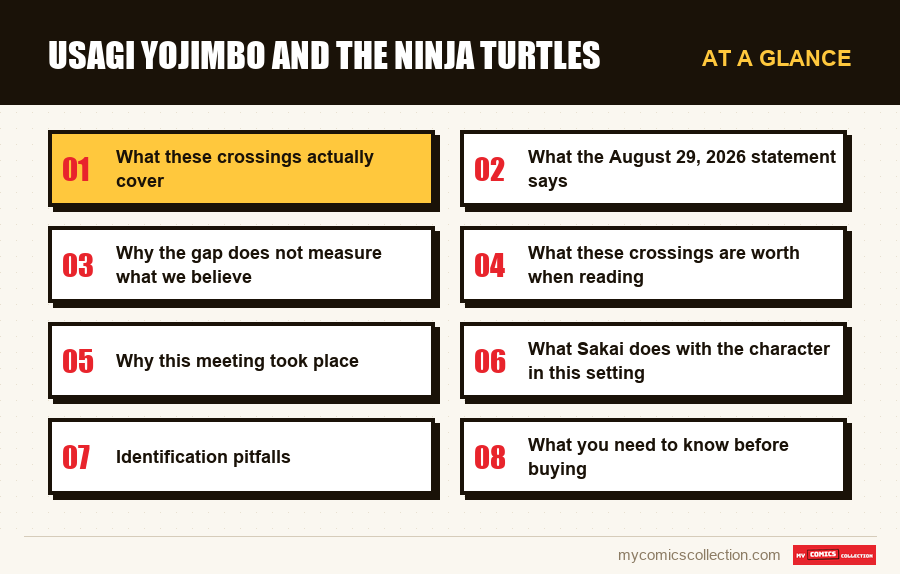
What these crossings actually cover
The word “crossing” here covers three very different situations, which are systematically confused and none of which are collected in the same way.
Occasional appearances. The character goes through a Turtles story, or the other way around, over a few pages. These are the oldest and they are scattered in collective collections that are difficult to find.
Common publication periods. At one time, the series was published by the company that published the Turtles, which produced a lasting association in the minds of readers without it being a crossover per se.
Dedicated crossover series. Much more recent, they explicitly bring together the two universes over several issues, with several alternative covers per issue.
This distinction is not academic. The three categories have opposing markets, and confusing one with the other is the cause of most bad acquisitions in this area.
What the August 29, 2026 statement says
Asking prices observed on August 29, 2026 on separate fixed price, gross and graded listings. These are seller requests, not closed sales.
Recent crossings
3,00 à 3,99 $ demandés for issues of the crossover series published in 2023, including alternate covers. Out of 178 raw ads noted, the overall median is $14.95, but recent issues all occupy the bottom of this distribution.
In other words: they are asking for less than an ordinary issue of the main series.
Issues from the late 1980s
$22.00 requested for a 1988 issue associated with the Turtles, $21.97 for another from 1994. The median recorded over this period comes out to 23,50 $out of 10 raw ads.
No graded announcement on this selection: the certified market does not exist for these numbers.
The collective collection of 1987
Asking $12.99 to $21.00, median $20.00 out of 6 raw announcements, for the anthology which contains one of the first encounters. Only one graded ad raised, at $60.00.
The top of the graded market
On all the announcements combining the two series, 8 graded ads only, from $84.99 to $1,999.99, median $135.00. A handful of certified copies compared to 178 raw ads.
Why the gap does not measure what we believe
The spontaneous reading of these figures is wrong, and it is worth saying why.
We naturally conclude that the old crossbreeds are “worth more” because they are the real ones, the founders, the ones who count. This is a satisfactory explanation and it doesn't hold up.
What price measures here is circulation and time, not the importance. A 1988 issue was printed in limited quantities, went through forty years of losses, and now only exists in reduced numbers. A 2023 issue was printed in comfortable quantities, available in several covers, and can still be found in stores.
The proof is simple: in the same statement, numbers from the same old period unrelated to Turtles wonder in the same range. The association does not produce any identifiable premium.
This is a textbook case of confusion between rarity and significance. The two often correlate by accident, and we mistake this coincidence for causation.
The practical consequence is frankly pleasant. If you want to read these crossovers, they are accessible: the recent ones for the price of a coffee, the old ones for around twenty dollars asked.
If you buy them hoping that they will increase in value because they are "important", the statement indicates the opposite: the number of alternative covers per issue is enough to rule out this hypothesis for recent series.
What these crossings are worth when reading
The interesting question is not their price but their interest, and the answer depends on what is expected of them.
As a gateway, they function poorly. They show the character in a register that is not his own: accelerated pace, strong humor, adventure series issues. A reader who discovers the series this way will have a false idea of what it is.
As a supplement, they work well. A reader who already knows the tone of the series finds an amusing contrast and sees what the character becomes when he is taken out of his box.
This is the opposite of how we generally use it. They are recommended for beginners because they are recognizable, even though they are the only place in the work where the usual tone does not apply.
A reader who liked these crossovers and nothing else didn't like the series: he liked an exception. And a reader who hated them should definitely not conclude anything about the rest.
Why this meeting took place
The origin of the association explains a lot of what the market does with it today, and it is more circumstantial than one might imagine.
The two series were born at the same time, in the same environment of independent authors publishing on a small scale, with the same constraints of means and the same black and white imposed by the cost of printing. Their authors knew each other and read each other.
The first meetings are therefore wink between neighbors in the radius much more than a concerted editorial operation. They took place in collective anthologies where several authors contributed a short story, a format which almost no longer exists.
This context is what makes these issues difficult to find today: they do not have an identifiable commercial title, they were not intended as events, and no one archived them as such at the time.
The rest is much more classic. When one of the two series became a phenomenon, the association was deliberately repeated, this time with the usual apparatus: announcements, multiple covers, proper numbering. The price contrast noted above exactly covers this break.: on the one hand, stories born from proximity, on the other, products built to be sold as encounters.
Collecting this series?
Track what you own, what you are missing and what your collection is worth. 7 day trial.
Start my trial →What Sakai does with the character in this setting
One detail deserves attention, because it distinguishes these crossovers from most exercises of the genre.
The character is not adapted to the tone of reception. He maintains his seriousness, his way of speaking, his relationship to duty, and it is precisely the gap between this gravity and the lighter universe in which he lands which produces the comic effect.
It's a difficult choice to make. The easy solution would have been to make the character funnier to suit his hosts; it would have produced more fluid and uninteresting stories.
This fidelity is also what allows these stories to remain readable for those who only know one of the two series.
Identification pitfalls
Repeating numbers
Several different series have the same numbers. A “#1” means nothing without the publisher and year, and ads often omit both.
Multiple covers
Recent series include each issue in several covers. Two visually very different copies can be the same number.
Poorly indexed anthologies
The oldest appearances are in collective collections whose titles do not mention either character.
Unreported reprints
Some old issues have been reprinted without visible mention on the cover. The statement shows both at similar prices.
What you need to know before buying
Three checks, in this order, which are enough to avoid common errors in this area.
Identify the publisher and the year before the issue. This is the only pair which designates a copy without ambiguity here, the numbering being shared between several successive series.
Check if it is an apparition or a crossover. Many ads mention both characters for an issue where one of them passes in three boxes. This is not a seller error, it is an SEO practice.
Do not pay a crossover premium. The statement does not show any bonus attributable to the association itself. A seller who justifies it by the historical importance of the crossing describes an exact fact and a price consequence which is not verified in the advertisements observed.
What to record
One field counts more than the others on this specific field, and it is not the one we expect.
The nature of presence. Three-page appearance, shared full story, or simple cover? On a series where the merchant referencing does not distinguish these three cases, this is the information that allows you to know what you really have, and not to mistakenly repurchase a number that you already have under another title.
The number of known covers for this issue. In recent series which include several, knowing which one has avoided involuntary duplication, which is here the first point of unnecessary expense.
The publisher and the year remain the obligatory identification pair, for the shared numbering reason explained above.
These three fields answer what this subset specifically asks: what exactly do I own, and do I already have it?
Frequently asked questions
No, it's even the worst entry point. They show the character in a register that is not his own (accelerated pace, strong humor, adventure stakes) and give a false idea of the series. They work well as a complement, once you know the usual tone.
The August 29, 2026 statement places them between $3.00 and $3.99 asking gross, below the price of a regular issue of the main series. The number of alternative covers per issue is enough to rule out the hypothesis of rapid scarcity. Buy them to read them.
Because they are rarer, not because they are more important. Issues from the same era unrelated to the Turtles ask in the same range, showing that the association produces no identifiable premium. The price measures the print run and time.
Difficult from the advertisements: many mention the two characters for an issue where one passes in three boxes, for referencing practice. You must check the contents of the issue in the catalog before purchasing, based on the publisher and the year rather than the issue alone.
Very little. Of all the ads combining the two series with the statement, only 8 graded ads compared to 178 raw, from $84.99 to $1,999.99 with a median of $135.00. Specifically on issues from the late 1980s, no graded announcements were noted.
Appearance or complete crossover?
In this area, knowing exactly what you own avoids involuntary repurchase.