Three Usagi Yojimbo "number ones", published by three different publishers, ask for exactly the same price: $14.99. Asking prices observed on August 29, 2026 on the American market. The market does not distinguish them: the number printed on the cover therefore provides no information. Another fact, unpublished in our records: the first appearance of the character has more certified copies than free copies: 48 against 16. This issue has simply left the reading market.
A series published over forty years by four successive houses produces a price structure that no other configuration generates, and that published odds never describe correctly. The statement makes it readable in a few lines.
Above all, it reveals two situations that we do not encounter anywhere else in our statements, and which each have an immediate practical consequence for those who buy.
This article gives the complete figures, explains the three anomalies that they reveal, two of which have no equivalent in the other bibliographies noted, and draws practical consequences for those who want to buy without making the mistake of object or period.
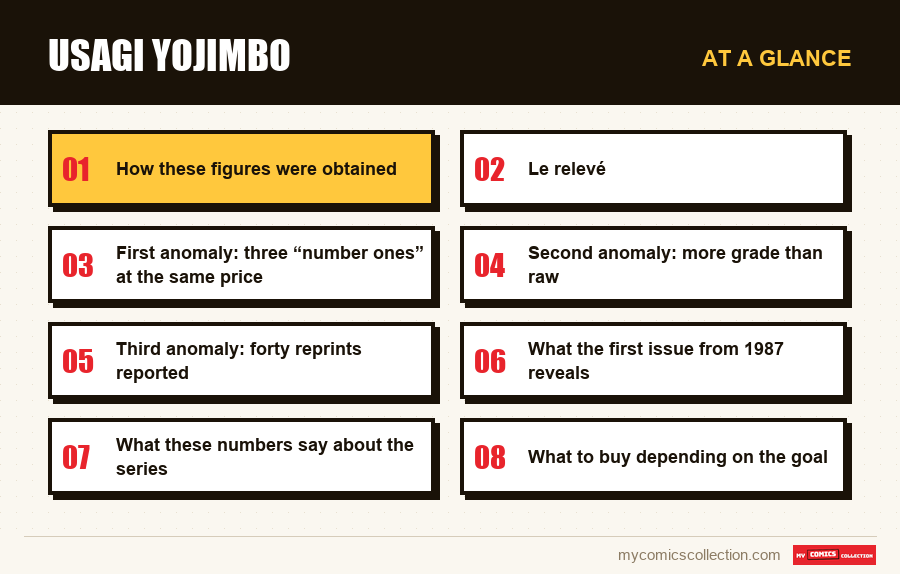
How these figures were obtained
None come from an argus. All come from a count of the offers opened that day across the Atlantic: what sellers hope to obtain, never what buyers paid.
Collections, lots and integrals have been discarded: they describe other objects and distort medians. The free copies and those under cover make two separate columns, because a book that can be opened and a sealed object are not exchanged between the same people.
A third column counts the announcements whose title reports a reprint. It is essential over a series of forty years, and its result on a specific number constitutes one of the lessons of the survey.
Le relevé
La première apparition, 1984
Raw : $108.50 on 16 annonces seulement.
Certified: $288 on 48 ads.
Réimpressions signalées : 40.
Three times more sealed copies than free copies. This is the only case of this type in our records.
The first issue of the series, 1987
Raw : $27 on 118 listings ($2.50-$1,000.99).
Certifié : $225 on 69 listings.
Reported reprints: 25.
The most supplied certified market in the series, and a difference of more than eight times with the crude.
The relaunches of 1993 and 1996
Raw : $14.99 each, on 97 and 71 listings.
Certified: $115 and $119, on 21 and 8 listings.
Two different publishers, two eras, exactly the same median.
The 2019 relaunch
Raw : $14.99 on 121 listings.
Certified: $215 on 39 listings.
Thirty-five years after the first appearance, the same gross price as previous relaunches.
First anomaly: three “number ones” at the same price
This is the most directly useful fact of the statement for a buyer, and it confirms through figures what no reasoning allows to establish a priori: because nothing obliged the market to treat these three objects as equivalent.
Three booklets bearing the number one, published in 1993, 1996 and 2019 by three different houses, all wonder $14.99. The market makes absolutely no difference between them.
This means that the number printed on the cover does not carry any valuable information. A seller who advertises “Usagi Yojimbo #1” for fifteen dollars can name any of the three without the price being a deciding factor.
The practical consequence is direct: on this series, asking for the publisher and the year is not a precaution for a picky collector, it is the only way to know what you are buying. The price provides no clue, unlike most series where the difference in value betrays the period.
Second anomaly: more grade than raw
The first appearance presents a configuration that we have not encountered in any of the bibliographies noted so far.
Sixteen free copies on sale, against forty-eight under hull. Three times more sealed objects than readable objects.
This report means that a failover has occurred. This issue is no longer purchased to be read: it is purchased, noted, resold as an object. He left the reading market to enter entirely into the collecting market.
Three factors explain this. Its original rarity: a confidential anthology publication from 1984. Its first appearance quality, which is the most sought-after status on the market. And the fact that its content is available elsewhere, in a collection, which removes any reason to want a readable copy.
It is a transposable indicator: when certified copies exceed free copies, an issue has ceased to be a book.
Third anomaly: forty reprints reported
The same number displays forty advertisements explicitly indicating a redraw: a considerable figure compared to the sixty-four total offers.
The mechanism is the one found on all the first appearances of authors who have become important: the original title is reprinted, sometimes several times, to satisfy a demand born well after publication.
This creates a situation where the difference in value between an original and a reprint is maximum, and the information is the most difficult to obtain. A reprint cover looks just like the original.
This is probably what explains the exceptional certification rate of this issue: having a copy graded by a third party definitively settles the issue of the print run, on an object where it decides everything.
The question to ask before purchasing this series.“Which publisher, what year, and what edition? » These three pieces of information are inseparable here, and none is evident on the cover.
A seller who cannot answer all three is not necessarily lying: on a series published by four houses over forty years, good faith ignorance is the rule rather than the exception.
What the first issue from 1987 reveals
This booklet occupies an instructive intermediate position, between the first appearance and the reminders.
Its gross price, $27, is significantly higher than the relaunches but much lower than the first appearance. It has the most supplied certified market of the entire series, with sixty-nine announcements, and a gross-certified gap of more than eight times.
This configuration describes an issue that is of interest to both markets simultaneously: still purchased to be read, already purchased to be kept. The exact opposite of the first appearance, which flipped entirely.
It also has a very wide gross range, amounting to up to a thousand dollars. On a number of which twenty-five announcements indicate a reprint, this difference unambiguously designates the difference between the prints rather than between the states.
Collecting this series?
Track what you own, what you are missing and what your collection is worth. 7 day trial.
Start my trial →What these numbers say about the series
A work read, not speculated
Except for the first issues, everything is fifteen dollars with abundant offers. No tension anywhere, which is a sign of a readership rather than a market.
The value concentrated on two numbers
The first appearance and the first issue from 1987. Everything else, including reruns, is current production.
Collections that absorb reading
Since the stories are available in volumes, no one needs the booklets to read. This is what keeps their prices low.
No major adaptation effects
The main driver of growth in this market has never fully played out here, which explains the stability of the whole.
What to buy depending on the goal
The survey leads to three very different recommendations depending on what we are looking for.
To read, the collections, without hesitation. Booklets offer no advantage in this regard and cost more per chapter.
To have a symbolic number, the first from 1987 in raw copy. Twenty-seven dollars to launch the series under its own title, with a resale market that actually exists.
For the collector's item, the first appearance: accepting that it is a purchase of another order, three figures, on which the question of the draw must be decided before any commitment.
What makes no sense, however, is to actively seek out reminders. At fifteen dollars with a hundred offers, they are acquired over time, without strategy or verification.
A textbook case on the first appearances
This series illustrates particularly well a general mechanism that is worth formulating.
A first appearance gains value when the author or character becomes important: that is, always après coup, years later. However, at the time of publication, no one knew it, and the circulation was modest.
The result is a structural shortage. Demand arises when the supply is already fixed, and nothing can satisfy it, except reprints, which satisfy curiosity but not the collection.
This is why these issues almost all switch, sooner or later, from the reading market to that of the collection. The statement shows this shift being completed on this specific case: forty-eight sealed copies for sixteen readable ones.
Ce qu'il faut enregistrer
Three fields, the first two of which are imposed by the particularity of this series.
L'éditeur. Four houses have published this series, and the survey proves that the market does not distinguish their “number ones”. This is the decisive field, and it does not exist in almost any other bibliography.
L'année. It confirms the publisher and removes the residual ambiguity between several reminders.
The draw, on the two numbers that count. On all the others, the information is without issue: the fifteen dollar reminders raise no questions. On the first appearance and the 1987 issue, she decides everything.
An inventory that includes these three fields answers what forty years in four houses end up asking: which “number one” is this, and which of the two that count do I really have?
Questions fréquentes
Because the market does not distinguish them: three relaunches published by three different houses in 1993, 1996 and 2019 all ask for fifteen dollars. The number printed on the cover therefore does not carry any valuable information, and only the publisher and the year allow us to know what we are buying.
That an issue stopped being purchased to be read. With forty-eight sealed copies compared to sixteen free ones, the first appearance has become a pure collector's item: especially since its contents remain available in a collection, which removes any reason to want an openable copy.
Only on the two numbers where the question of the draw arises. Certification definitively resolves information that is difficult to obtain and decisive for the price. On the fifteen dollar reminders, it makes no sense: there is nothing to document.
On the 1987 issue, of which twenty-five announcements indicate a reprint, this difference designates the difference between the editions rather than between the states. A first print in good condition and a recent reprint have the same cover and do not belong to the same market.
Nothing indicates this about the relaunches: the collections remain available, no major adaptation has taken place, and the offers are abundant. The two old issues, on the other hand, are subject to a structural shortage: the demand for a first appearance always arises after the fact, when the supply is already fixed.
Four publishers, only one number one in your list
On this series, the publisher is the decisive field: the market proves that the number alone distinguishes nothing.