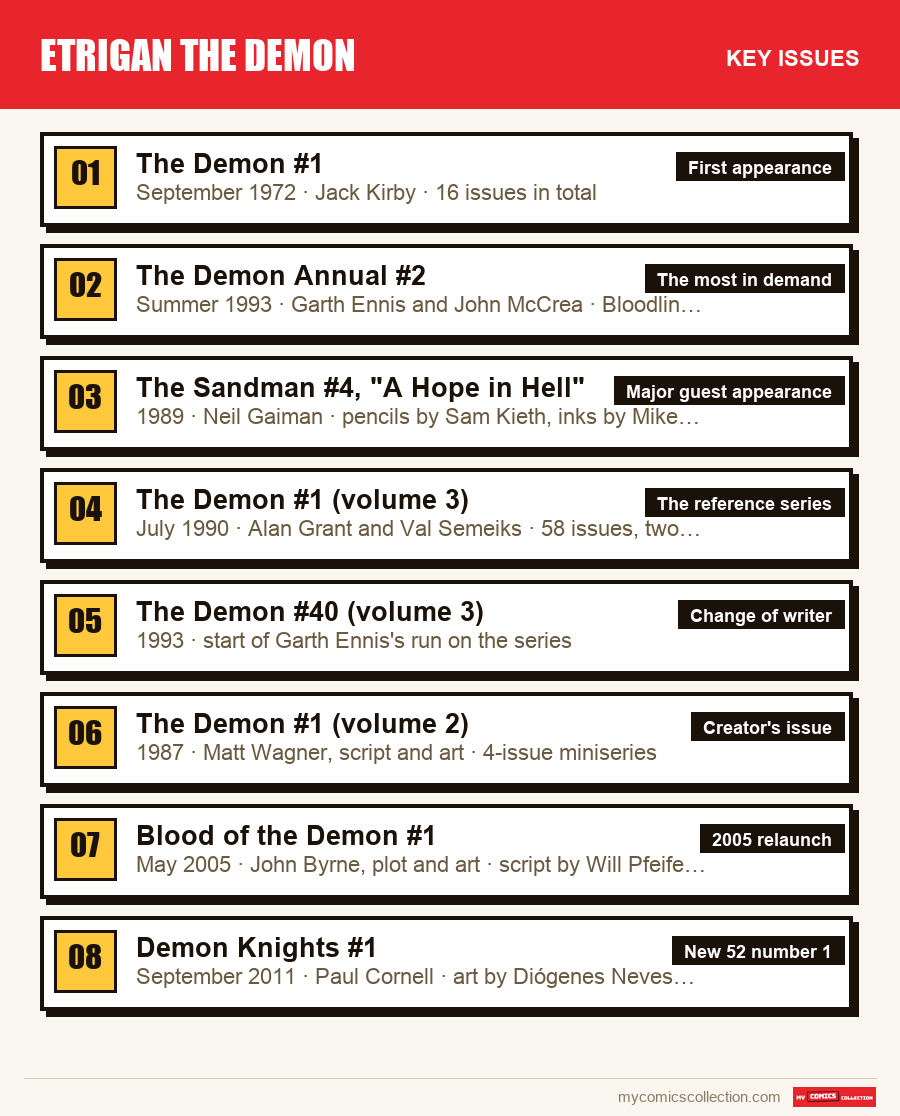
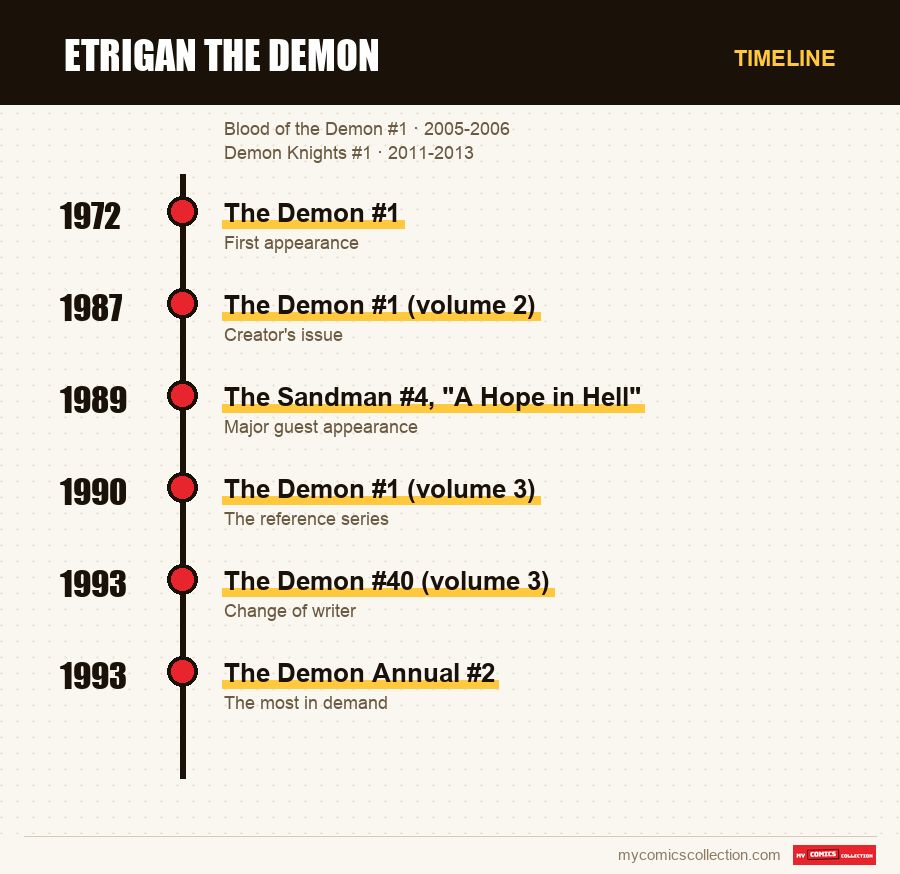
Etrigan first appears in The Demon #1, dated September 1972, a series created by Jack Kirby for DC after his Fourth World titles ended. It is the founding issue and the most expensive of the character. But the most in-demand issue in his whole publishing history owes him nothing: The Demon Annual #2, summer 1993, contains the first appearance of Tommy Monaghan, by Garth Ennis and John McCrea. In between: sixteen issues in 1972-1974, a Matt Wagner miniseries in 1987, a 58-issue series launched in July 1990 by Alan Grant and Val Semeiks, Blood of the Demon (17 issues, 2005-2006) and Demon Knights (19 issues, 2011-2013). On October 7, 2026, DC relaunches The Demon with James Harren alone on script and art, centered on Jason Blood.
Etrigan is a rare case in the DC catalog: a character whose market value does not follow his popularity. He has never carried a series beyond five years, he has never been the hero of a film, and yet his name constantly comes up in collector discussions. The reason is simple and structural: his key issues are key for four different reasons that have almost nothing to do with each other.
There is the creator issue, because Kirby drew it. There are the guest issues, because two of DC's biggest adult series borrowed him. There is the relaunch issue, because each decade gives him a new first issue. And there is the accidental issue, the one whose value rests entirely on a secondary character created in its pages who went off to make a career elsewhere. Collecting Etrigan without distinguishing these four logics is buying at random.
This article takes inventory as of October 2, 2026, five days before the launch of the new series. It gives the hierarchy of issues, explains where demand comes from on each, and flags what is not verifiable today. No dollar figure appears in it: on a character whose public sales are rare and scattered, an isolated number would mislead more than it would inform.
1972: why Kirby ended up drawing a demon
The editorial context explains the character better than any summary of his origin. Jack Kirby arrives at DC in the early 1970s and builds the Fourth World there, a set of ambitious titles whose commercial career ends markedly earlier than planned. DC then asks him for a horror character. The Demon is born from this commission, and carries the September 1972 cover date.
The origin fits on a page. Merlin, presented as the demon's half-brother, summons Etrigan and binds him to Jason Blood, an arrogant knight of Arthur's court. The bond makes Jason immortal and puts the demon out of reach of Morgan le Fay, who covets the magician's secrets. The rest follows: a man of the present who carries a medieval demon, and a switch between the two as soon as the formula is spoken.
Two things deserve to be noted for a collector. First, Etrigan does not speak in verse under Kirby. The rhymed diction, today the character's signature, appears later, and the in-story explanation is a promotion obtained in Hell. A reader who opens The Demon #1 expecting couplets will be disappointed: they will find pure Kirby, graphic and brutal, not theater in rhyme.
Second, the series is short: sixteen issues, from 1972 to 1974. That is a scarcity fact in itself. A sixteen-issue series was printed and distributed over barely two years, in a period when paper and newsstand print runs forgave nothing. The surviving copies in good condition are few, and it is not a question of demand but of available population.
One last calendar landmark, which places The Demon in a larger movement: Swamp Thing #1, by Len Wein and Bernie Wrightson, carries the cover date of November 1972, two months later. DC was then opening a horror front across several titles at once. The two series have the same strategic origin, and that is why they will end up crossing paths.
The hierarchy of Etrigan's key issues
Here are the issues that matter, ranked by solidity of demand rather than in chronological order. For each, the question asked is the same: why does someone look for it.
The Demon #1
The only issue whose status will never be debated. First appearance of Etrigan and Jason Blood, by Kirby, in a short series of the early 1970s. It combines the three criteria that hold over time: an indisputable first appearance, a creator whose name alone carries demand, and a population of copies limited by the brevity of the series.
The Demon Annual #2
The most sought-after issue in the character's whole history, and it barely concerns him. This is where Tommy Monaghan is born, a Gotham hitman who will get his own series in 1996. An Etrigan collector who buys it pays for a character they do not collect. We do not cover Hitman here: everything is in the guide to Tommy Monaghan's key issues.
The Sandman #4, "A Hope in Hell"
Etrigan guides Dream through Hell. It is, by far, the character's appearance that the greatest number of readers has actually read, because it belongs to the first eight issues of a series that became a bookstore classic. An Etrigan collector and a Sandman collector look for the same issue for two unrelated reasons, which lastingly supports demand.
The Demon #1 (volume 3)
The character's longest series, and the only one that established him as a regular figure of the DC universe rather than a curiosity. Alan Grant and Val Semeiks launch it in July 1990; the duo will later reunite on Lobo, which says enough about the register. It runs to 1995 and it is this one, not Kirby's series, that defines the Etrigan that today's readers know.
The Demon #40 (volume 3)
Ennis takes over the series at issue 40. It is the entry point for a readership that did not come for Etrigan but for the writer, and it is also the moment when the series welcomes the character who will outlive it. A change-of-writer issue is not a first appearance and is not treated as such, but it is the first issue that readers of a bibliography look for.
The Demon #1 (volume 2)
Thirteen years after Kirby, DC entrusts the character to Matt Wagner, who writes and draws all four issues alone. It is the first modern attempt at a revival, and the model DC would then repeat: a complete creator, a short duration, a rereading rather than a sequel. The kinship with what James Harren is doing in 2026 is striking.
Blood of the Demon #1
Byrne takes up the character while setting aside much of what was added after Kirby's series. It is a deliberate reading choice, and it explains this series' place in the hierarchy: it interests those who want the original Etrigan, not those who followed the previous fifty-eight issues.
Demon Knights #1
The most unexpected relaunch. Paul Cornell asked to turn the Etrigan title into a medieval team series, citing The Magnificent Seven as a model. The team gathers Etrigan and Jason Blood, Madame Xanadu, Vandal Savage, Shining Knight, the Horsewoman, Al Jabr and Exoristos. Robert Venditti follows Cornell before the stop at issue 19.
The detour through the adult imprint, 1984-1993
This is the part of Etrigan's history most useful to understand, because it explains why some of his key issues do not carry his name on the cover.
Alan Moore uses him twice in The Saga of the Swamp Thing: in issues 26 and 27, dated July and August 1984, then in issues 49 and 50, dated June and July 1986. Yet this series is precisely the one that completely abandoned Comics Code approval, a first for a mainstream title. Etrigan thus finds himself, without changing nature, in a story freed from the framework that had governed comics for thirty years. It is also in this same series, at issue 37, that John Constantine formally appears, whose career will open the adult occult side of the catalog.
Three years later, in 1989, Gaiman borrows him for Sandman #4. Then comes January 1993: DC launches Vertigo and transfers six ongoing series to it, with cover dates of March 1993, including Sandman at issue 47 and Swamp Thing at issue 129. All carry the notice recommending reading for an adult audience.
The point that matters to a collector is this: Etrigan does not leave. The two series that had borrowed him move under the adult imprint, but the character stays in DC's main line. His own 1990 series continues its course in ordinary continuity, and it is inside this ordinary continuity that Ennis arrives at issue 40, in 1993, with a register more associated with Vertigo. The summer 1993 annual is born exactly from this situation: an adult tone in a general-line title, attached to a house crossover.
Concretely, this means the Etrigan collection is spread over two shelves that most people treat separately, superhero series on one side and adult series on the other. A collector who looks at only one of the two shelves will miss the character's most-read appearance of all.
Why the 1993 annual dominates, and what it teaches
Let us return to the character's most instructive case, without encroaching on the subject of Tommy Monaghan.
Bloodlines, in 1993, is a crossover that runs through DC's annuals in four chapters: "Outbreak" over nine annuals, "Earthplague" over eight, "Deathstorm" over six, then a two-issue concluding miniseries. Twenty-three titles take part, and the operation introduces about thirty new characters, the New Bloods, whose powers awaken after an attack by extraterrestrial parasites.
The result is known: almost none found a lasting readership, and many were liquidated during the events of the following decade. Only one came out of it with an autonomous career, and he was born in Etrigan's annual.
Three lessons, which go well beyond this character.
An issue's value says nothing about the quality of the series that contains it. The Demon Annual #2 is in demand for eight pages that do not concern the title's hero. Conversely, the best issues of the 1990 series have no particular demand. Confusing the two leads to buying issues that do not rise and ignoring those that do.
A key issue can appear twenty years after its publication. In 1993, nothing distinguished this annual from the twenty-two others. Its status comes from what happened afterward, in 1996, then in the 2010s when the character was rediscovered in collected editions. No key-issue list drawn up in 1993 could have predicted it, and no list drawn up today can predict the equivalent for 2046.
Annuals are the black hole of collections. They carry no continuous numbering, they do not appear in current-issue lists, and they come out once a year. On Etrigan, the most in-demand issue of the bibliography is precisely an annual. That is why an issue-by-issue tracking that covers ancillary formats is worth more than a handwritten list.
October 7, 2026: The Demon by James Harren
DC relaunches The Demon on October 7, 2026, with James Harren alone on script and art, and Jason Blood at the center of the story. It is the fifth time since 1972 that the character receives a first issue.
What is established stops there, and it must be said frankly. As of October 2, 2026, no copy is in circulation. Nobody knows the real print run, nobody knows whether the series will last six issues or sixty, and anyone announcing today the future value of this issue is making it up. The New York convention takes place October 8 to 11, 2026: announcements are expected there, but nothing had been said yet at the time these lines are written.
What you can do, however, is read the precedent. The four earlier relaunches draw a clear pattern. The format that best succeeded for the character is that of the complete creator over a short duration, Wagner's in 1987. The format that best established him is that of the long series with a stable duo, Grant and Semeiks's in 1990. The format that carried least is the relaunch inserted in a big editorial movement, because the character is drowned there in a massive simultaneous offering. Harren arrives in the first configuration, the most favorable on paper.
The month of October 2026 is, moreover, busy at DC, with Jonah Hex and the Shadow of Death #1 the same October 7, also entrusted to a complete creator, then a dense end of month on October 28. A first issue of a secondary character launched in a busy month does not get the attention it would have had on a quiet Wednesday. That says nothing about its quality, it says something about the number of copies shops will order.
Building the collection without mistakes
Decide first what you collect
The character, a creator, or a series. The three answers give three different lists that overlap only partly. If you collect the character, the 1993 annual is mandatory; if you collect Kirby, it has no interest. Making this decision first avoids three quarters of regretted purchases.
Start with the 1990 series, not 1972
It is abundant, inexpensive, and it is what defines the modern character. Fifty-eight issues provide real reading for a modest budget, and you will then know whether you really want to go back to Kirby. The reverse, starting with the most expensive piece, amounts to paying for the founding issue before knowing whether the character interests you.
List the ancillary formats before buying
Zero issue, two annuals, backup stories in Action Comics Weekly issues 636 to 641. These are the lines missing from collections, and they are the ones that cost the most to find once the series is complete, because nobody offers them spontaneously.
Treat guest appearances as a separate shelf
Sandman #4, The Saga of the Swamp Thing #26, #27, #49 and #50: these issues are not sold as Etrigan comics and appear in no list devoted to the character. They are sought under the other series' name, and that is why they so often escape collections that are otherwise complete.
Judge condition before judging price on the 1972 issues
On a comic distributed at newsstands more than fifty years ago, the gap between two copies of the same issue is far wider than the gap between two different issues. Look at the spine, the corners and the flatness of the cover before comparing anything. A grading is justified on this issue, much less on the 2005 and 2011 relaunches.
For October 2026, wait for the third issue
Take the first issue in standard cover if the series interests you as a reader, it is the only use whose return is certain. The question of which copy to keep is usefully asked around issue 3, when you know whether the series holds. The sell-outs of 2026 have shown that a highly demanded title is reprinted anyway.
Where Etrigan appears elsewhere, and what that changes
Two extensions deserve a mention, because they feed demand coming from outside paper.
The character joined Justice League Dark, DC's occult team: his membership goes through a backup story published in Justice League #60 in 2021, the 2018 to 2021 Justice League Dark series having been written by James Tynion IV and drawn notably by Alvaro Martinez. And the animated film 2017's Justice League Dark, rated for an adult audience, gives him a role, with Ray Chase in the double role of Jason Blood and Etrigan.
The effect on the collection is modest but real. An adaptation does not create demand on a 1972 first appearance among the general public, because that public does not buy 1972 comics. It does, however, create it on easy entry points: collected editions, recent number 1s, and team series where the character appears. It is reader demand, not collector demand, and it is measured in collected-edition availability rather than in the price of single issues.
Finally, to be complete on the bibliography, let us mention the miniseries Demon: Driven Out, which follows the 1990 series. We give neither its precise dates nor its creative team: the sources consulted for this article do not establish them with certainty, and it is preferable to flag its existence than to put forward a false detail. If you are building an exhaustive bibliography, it is a line to check against a publisher catalog before buying.
What to remember about value
No dollar figure appears in this article, and that is a choice. On Etrigan, public sales of certified copies are rare and spaced out, which makes any average misleading: two transactions a few months apart can diverge strongly without any trend being at play. What is solid, however, is the relative hierarchy, and it has not moved in years.
The Demon #1 of 1972 is at the top and will stay there, because a Kirby first appearance in a sixteen-issue series cannot be replaced. The Demon Annual #2 follows closely and surpasses it in search intensity, for a reason external to the character. Sandman #4 occupies a stable middle position, supported by another series. Everything else, the first four relaunch issues and the fifty-eight issues of 1990, belongs to the category of comics you buy to read.
If you already hold some of these issues and want to know where you stand before October 7, an estimate and a clean inventory are worth more than a sum of listed prices. And if you are starting from zero, the good news is that this character can still be collected seriously without an unreasonable budget, with the exception of exactly two issues.