In 2026, none of the big public collectible records is a comic book. A Pokémon Illustrator card set on September 25, 2026 a record for a CGC-certified copy at $2.8 million, a summer card sale exceeded $18 million, a sports magazine carrying Michael Jordan's first NBA cover went for $378,200 on September 24, and a sealed video game graded CGC 9.9 A++ broke its own record on October 1st. On the comics side, the news is no longer the printed single issue but original art and the authenticated signed object. This shift does not say comics are worth less: it says spectacular money goes to unique or frozen-condition pieces, and that the single issue has again become an abundant reading object.
There is a lazy way to read a records list, and it consists of drawing from it a ranking of passions. If the card beats the comic, then the card is worth more. If the sealed game beats the card, then you should buy sealed games. This reading is comfortable because it turns news into a buying instruction, and it is false because a record never measures a market: it measures a single object, a single day, before a single buyer determined to win.
What is interesting in the fall 2026 sequence is therefore not the hierarchy of amounts. It is that four public records in a row concern objects whose value rests on the same mechanism, and that this mechanism is not that of the comic single issue. Understanding which one is understanding why a comics collector can look at these figures with curiosity without drawing the slightest conclusion about their own collection.
It is October 2, 2026. The facts cited here are dated and public, and none is a projection. However, I will give no price, no value estimate and no figure for price movement on the secondary comics market: this data is not published, and inventing it would be the only truly costly thing I could do in this article.
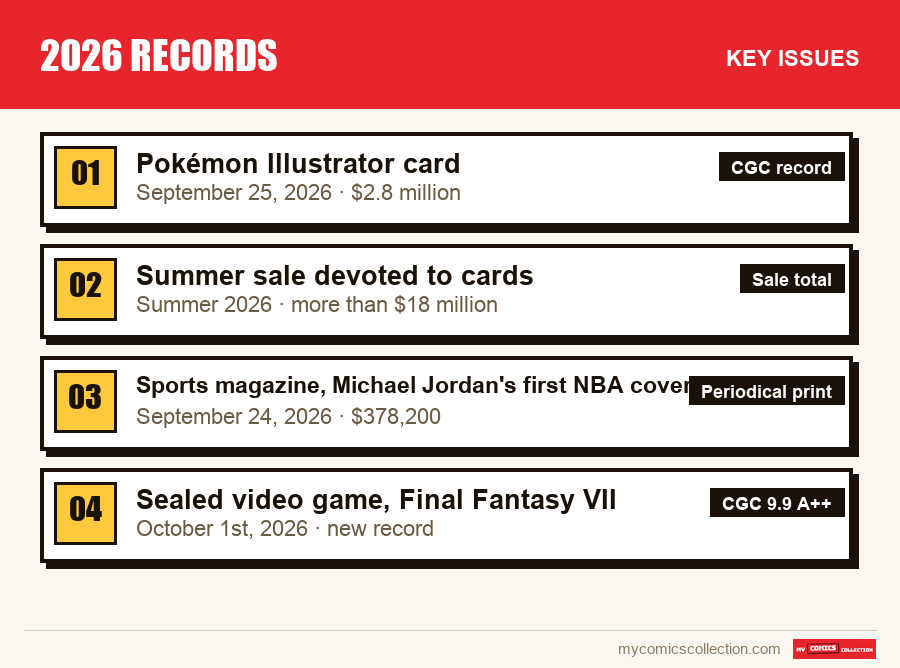
The four fall 2026 records, wording by wording
Before any analysis, the announcements must be read exactly as made. Most misreadings of these records come from a word skipped in the original sentence.
Pokémon Illustrator card
The amount is a record, but a record for a CGC-certified copy, which is a narrower category than "record for this card" and far narrower than "record for a card." The card itself was never sold in shops: it is a prize from the drawing contests organized in 1997 and 1998 by a Japanese manga magazine, printed in only a few dozen copies.
Summer sale devoted to cards
This one is not an object record but a session total, with several lots above half a million. It is information about the depth of the audience, not about the value of a piece: eighteen million spread across hundreds of lots says nothing of the unit ceiling, it says there were many solvent buyers in the room.
Sports magazine, Michael Jordan's first NBA cover
This is the most instructive case for us, because it is the only one of the four that is a periodical print, therefore a direct cousin of the single issue. A magazine is not rare at release: it is printed in bulk, read, folded, thrown away. Its long-term value comes not from the print run but from the fact that it carries a first and that almost nobody kept it in presentable condition.
Sealed video game, Final Fantasy VII
The grade has two parts: the condition of the box and the quality of the original seal. An opened game, even intact, changes category and audience. The value therefore rests less on the game than on the proof that nobody ever played it, which is a rather dizzying definition of scarcity when you think about it: the object is worth a lot because it has not been used.
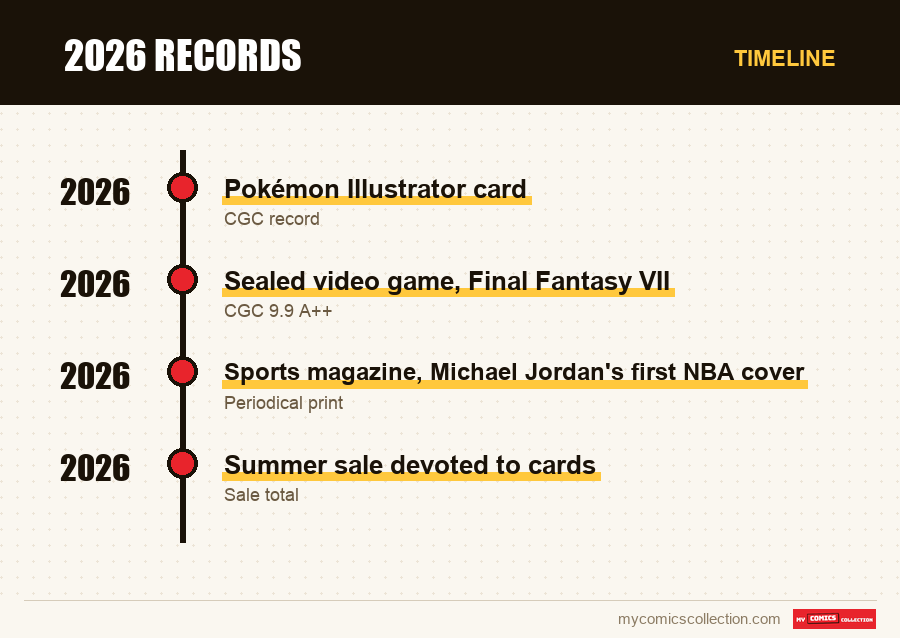
The four's common point: a scarcity legible at a glance
Let's put the four objects side by side and look for what lets a buyer sign a seven-figure check without hesitation. It is not affection, which is spread everywhere. It is the possibility of answering a single question, immediately and without discussion: how many exist, in this exact condition?
The contest card answers with a few dozen copies, a known and closed figure because the series was never marketed. The sealed game answers with the number of copies still under film, a decreasing and irreversible figure, since each opening permanently removes one unit from the count. The sports magazine answers with the number of surviving copies in fine condition, a figure nobody knows exactly but everybody guesses is tiny. In all three cases, the scarcity is one-dimensional: one criterion, one scale, one grade, and the object compares to its siblings effortlessly.
That is exactly what the comic single issue does not offer, and it is not a flaw. A comic comes in multiple covers, incentive ratios, reprints, convention editions, local variants, blank versions meant for drawing. The same issue exists in ten forms whose hierarchy is debated, and this hierarchy is not reducible to a number. The phenomenon is not marginal: for Amazing Spider-Man #1000, released September 30, 2026 with 104 pages and a main story by Joe Kelly and Pepe Larraz, the publisher allocated nine covers and sent them back to press, those of Bermejo, McGuinness, Medina, Ramos, Martin, Young, Momoko, Campbell, a remastered Ditko and a Miller. Nine possible answers to the question "I have the issue," and nine distinct scarcity trajectories. Our guide to cover variants details this tree, and the one on 1:25 and 1:100 ratios explains how it is made.
A seven-figure market does not like this richness. It likes a piece, a grade, a census. The comic's complexity, which is all its interest for whoever collects it, is a friction for whoever wants to buy it as an asset.
What the printed single issue lost, and it lost it in 1992
The other half of the explanation is less flattering, and it is old. The comic single issue lost its capacity to produce scarcity by accident, and it lost it the day the public understood that an issue could be worth a lot.
The canonical example is before our eyes this year. Superman #75, published November 18, 1992, written and drawn by Dan Jurgens with Brett Breeding on inks, is the issue where Superman dies. Retailers ordered five million copies, the publisher shipped between two and a half and three million on release day, and the issue finally sold more than six million copies, best seller of 1992. Hundreds of thousands of these copies were bought in duplicate, sealed in their bag, stored upright and never opened, precisely because their buyers anticipated a gain.
The result is mechanical. An object preserved en masse in anticipation never becomes rare, whatever its narrative importance. It is the paradox a whole generation of single issues suffers, and it is also why a 1984 magazine nobody thought to protect can exceed an event comic printed at six million. Value does not reward importance, it rewards collective neglect.
And this is what makes the 2026 comics news coherent. The object that concentrated attention this year, on the comics side, is not Superman #75: it is a set of original art from Superman #75, put back on sale for the first time in about thirty years, whose closing was scheduled for April 12, 2026 and which had gathered three million dollars in bids in its first 72 hours. Final prices were not published, and I will not invent them. But the direction of movement is limpid: same story, same artist, same month of 1992; on one side six million copies printed, on the other a series of pages of which exactly one of each exists. Money goes where the count stops at one. The comparison between the two logics is developed in our file on original art versus collectible issues.
The second movement on the comics side confirms the first. A copy of TMNT #1 signed by its two co-creators, certified by CGC with signature authentication, was expected at six figures in an October 2026 sale. Expected: it is a catalog estimate, not a result, and it must be treated as such. What matters here is not the amount but the nature of the object. A signed, authenticated issue stops being a copy among thousands: it becomes a piece whose number is, itself, closed. Our pages on the TMNT key issues and on the Signature Series label cover both parts of this case.
What the single issue kept, and which is not measured in records
If we stopped there, we would write a depressing and false article. For while spectacular money migrates toward the unique, the comic single issue is succeeding at something neither the card nor the sealed game knows how to do: it sells massively to be read.
The 2026 orders of magnitude are unambiguous. Absolute Batman runs, according to its writer, around 500,000 copies a month. Amazing Spider-Man #1000 recorded more than 400,000 preorders, sold out on release day despite a second printing already scheduled, and its unfilled orders were announced for November 4, 2026. Terminal #1, written by Robert Kirkman and Joe Casey with art by Andy Kubert, came out at 300,000 copies where its publisher hoped for a hundred thousand, with a second printing from August 26, 2026. Ben 10, written by Joe Casey, passed half a million copies in five months. And sellouts chained all year, from Absolute Green Arrow sold out a week before release to Mind MGMT: New & Improved #1 and The Exorcism at Buckingham Palace #1 sold out at the distributor before even coming out.
These figures are excellent for the medium and neutral, even unfavorable, for the future scarcity of the issues concerned. Half a million copies a month is a title in full health and an object nobody will lack in fifteen years. The dynamics of the new and of the secondary market do not pass on to each other, a question we covered in detail in our analysis of the rise in specialty-shop sales.
The fact remains that the single issue keeps three assets no record measures. First an entry ticket at cover price: you start a comics collection with the price of a sandwich, which is true of none of the four record objects. Next a cumulative narrative density: a comic calls the next, a run holds together, a character is traversed over forty years, and the collection acquires a coherence that forty disjointed cards will never have. Finally an abundance that protects the collector: when an object exists in large quantity, nobody can organize its shortage, and you buy it when you want, at the price you want.
Read the record before commenting on it
Spot in the announcement the exact category: object record or sale total, absolute record or record for a given certification service, result obtained or catalog estimate. Three of the four fall records come with a restriction of this type, and it entirely changes their scope.
First check what you own
A publicized records list almost always triggers a desire to buy, rarely an inventory. Do the opposite: look at what sleeps at home, in what condition, and what is missing to close a series begun. Issue-by-issue tracking is the tool of this reflex.
Separate the two budgets
A reading budget and a rare-piece budget are not managed together. The first is spent every month with no expected return, the second is kept immobile for several months awaiting a precise occasion. Mixing them leads to buying new releases with the rare-piece money, which is the most discreet way of never acquiring anything important. Our guide to how to allocate a collection proposes several sharing keys.
Certify only with a reason
Certification only adds value where it answers an open question: the authenticity of a signature, the reality of a high grade on an old, sought-after piece. On a recent single issue printed in several hundred thousand copies, it documents a condition without creating scarcity. The page devoted to grading details the cases where the calculation holds.
Treat resale as a skill, not an outcome
An object only has value if you know how to part with it without urgency. That is prepared: purchase documentation, condition described honestly, patience. The subject is covered in our file on liquidity and resale.
Three misreadings these records almost always provoke
First misreading: believing a record reveals a trend. A record is a point, and a point does not draw a curve. The four fall 2026 announcements come from four different object universes, with four different audiences, and nothing lets us draw a common direction from them. To know whether a market is moving, you need a series of comparable transactions over time, which nobody publishes today for the secondary comics market. It is unpleasant, but it is the state of information, and our guide on detecting market trends details what can still be observed.
Second misreading: concluding that comics "are losing." What the sequence shows is that records migrate toward closed-count objects. Yet the comics world also produces them, and they are precisely those talked about in 2026: original pages, signed and authenticated copies, pieces of documented provenance. The medium has not left the top of the market, it is represented there by objects other than the newsstand single issue. Saying comics are receding because the single issue does not break records is like saying painting is receding because posters do not sell for much.
Third misreading: buying the winning category. It is the costliest. Entering a market of objects you do not know, at the exact moment a record draws the general public's attention, amounts to buying at the point of maximum visibility and minimum competence. The warning signs of a frenzy are fairly constant from one universe to another, and we listed them in our article on the signs of a speculative bubble. The most reliable is this: when a category becomes obvious, the informational advantage is already consumed.
What it concretely changes for a comic collection in 2026-2027
Let's move to the practical. If spectacular money goes to the unique and the frozen, what should a comics collector do differently? Honestly: very few things, but those few things count.
On the new, buy to read and stop hoping. The 2026 volumes are too high for a contemporary single issue to become rare, and print runs are in any case no longer public for several years, which makes any claim about a new release's scarcity purely declarative. A very dense winter program is coming, from the return of Brian Michael Bendis and Michael Gaydos on Jessica Jones: Alias in December 2026 for the character's 25th anniversary, to Paul Jenkins' return on Wolverine: Origin III a quarter century after Origin, via the conclusion of Tom King and Daniel Sampere's run on Wonder Woman #40 and the return of Garth Ennis and John McCrea on Hitman after twenty-five years. These are excellent reasons to buy. They are not reasons to buy in duplicate.
On the old, aim for condition rather than title. The lesson of the 1984 sports magazine holds for comics: what creates value on a periodical print is the combination of a first and an improbable survival. Between two old acquisitions at the same budget, the one in better condition on a less prestigious title is often sturdier than the reverse, because fine copies grow scarce by attrition while the list of prestigious titles does not move.
On the signed, demand traceability. The 2026 movement shows it: a signature only has market value if authenticated by a trusted third party and the authentication travels with the object. A dedication obtained at a convention, undocumented, remains a fine souvenir and is not a resale argument.
On the whole, keep the register. It is the least spectacular and most useful lesson. The four record objects share an invisible quality: their history is known. We know where they come from, through how many hands they passed, in what condition they were kept. A comic collection whose contents, price and date of acquisition are known is structurally better placed than an equivalent but opaque collection, and this holds as much for insurance as for an estate or a partial sale. The collection management app exists first for that, and the estimate follows from it rather than the reverse.
A last word on the comparison with the card universe, because it comes up in all the fall conversations. We covered it for itself, with figures and trade-offs, in our comparison between the comics market and the card market. The article you are reading does not redo it: it observes that the 2026 records do not reward one category against another, but a property that some objects have and others do not. A single issue can acquire it, through authenticated signature or provenance. A comic cannot acquire it by simply being important.