A ratio variant is an alternate cover that a retailer must order in a fixed proportion relative to the standard cover: a 1:25 requires 25 copies of the A cover to order 1 copy of the variant, a 1:50 requires 50 base issues, a 1:100 requires 100. For a comic with a print run of 100,000 copies, that works out to 4,000, 2,000, and 1,000 copies of the variant respectively. Value increases exponentially: a 1:500 often sells for 10 to 30 times the price of a 1:25.
The American comics market shifted around 2010 into an economy of artificial scarcity, with ratio variants becoming the central engine of speculation. Marvel, DC, and Image use these incentives to push retailers into ordering more copies of a title's base cover, in exchange for limited-print alternate covers by in-demand artists: Skottie Young on his Baby Variants at 1:50, Stanley Lau (Artgerm) on his 1:25s and 1:50s, J. Scott Campbell on 1:100s, David Finch or Greg Land on 1:200s. Understanding the exact mechanics behind each ratio lets you read the secondary market, evaluate a buying opportunity on eBay or Whatnot, and avoid the pitfalls of artificially inflated ratios. This guide breaks down print run calculations, observed value ranges for 2025-2026, and the top ratios every serious variant collector should know.
How ratio variants work: what the numbers actually mean
A ratio variant operates on a simple rule set by distributors (historically Diamond, and Lunar and Penguin Random House since 2020). The ratio is expressed as 1:X, where X is the number of copies of the standard cover A a retailer must order in order to be eligible to order one copy of the variant. A 1:25 ratio means a shop that orders 25 base copies of Amazing Spider-Man #50 can order 1 copy of the 1:25 variant. For two copies of the variant, they need 50 base issues. For five copies, 125 base issues.
This rule has two direct consequences. First, only retailers with significant volume can access higher ratios. A neighborhood comic shop that sells 5 copies of an average Marvel title will never unlock a 1:50, and barely has a shot at a 1:25. Second, the total print run of a variant is mechanically tied to the total print run of the cover A: the more a title sells, the more variants exist. A high-print-run comic at 100,000 copies generates far more ratio variants than a niche title at 10,000.
Ratios in practice range from 1:10 (very common) to 1:1000 (extremely rare, reserved for major Marvel or DC events like Secret Wars , Dark Crisis , or House of X). In between sit the standard tiers: 1:15, 1:25, 1:50, 1:75, 1:100, 1:200, 1:500. Each tier represents a different level of effort demanded from the retailer, and therefore a different level of scarcity on the secondary market.
One important nuance: the ratio alone doesn't guarantee absolute rarity. If a title ships 200,000 copies, a 1:25 produces 8,000 variants: not particularly rare. Conversely, an indie title that sells only 8,000 copies generates just 80 copies of a 1:100, making it genuinely scarce. To properly evaluate any variant, you always need to cross-reference the ratio with the cover A print run. The guide on understanding comic print runs breaks down this logic in detail.
Calculating variant print runs: the formula you need to know
The calculation is simple arithmetic, but it's often misapplied. For a comic whose cover A has a print run of T copies, a 1:X ratio theoretically produces T/X copies of the variant. A sample table for a standard 100,000-copy cover A print run:
Variant print run breakdown at 100,000 base copies:
1:10 → 10,000 variants
1:15 → 6,667 variants
1:25 → 4,000 variants
1:50 → 2,000 variants
1:75 → 1,333 variants
1:100 → 1,000 variants
1:200 → 500 variants
1:500 → 200 variants
1:1000 → 100 variants
In practice, these numbers are theoretical. Retailers don't order every variant they're entitled to, because they have to front the cash for extra base copies. A rational retailer who normally sells 30 copies of a title isn't going to order 75 or 100 copies just to secure 2 or 3 copies of a 1:25 variant. As a result, the actual print run of a 1:25 on an average Marvel title typically lands between 60% and 80% of the theoretical number. For higher ratios (1:100 and above), the order rate can fall as low as 40-50% of theoretical potential.
For ultra-high-volume titles like Amazing Spider-Man , Batman, or major crossover events, the gap narrows: large retailers nearly always order their full allotment for prestige ratios (Artgerm, Skottie Young, J. Scott Campbell). For mid-tier titles, the gap can be significant. The rule of thumb: multiply the theoretical print run by 0.7 for a realistic estimate. At 100,000 base copies, a 1:100 variant likely has 600-700 copies in actual circulation, not 1,000.
This calculation is critical for estimating secondary market value. A comic with only 200 copies in circulation will mechanically command prices in the hundreds of dollars if demand is there: while a variant with 4,000 copies in circulation will rarely break $50 except in exceptional circumstances (key issue, first appearance, character death).
Market value: the exponential curve
The relationship between ratio and value isn't linear: it's exponential. A 1:50 variant doesn't sell for twice a 1:25: it typically fetches 3 to 5 times as much. A 1:100 doesn't sell for four times a 1:25: it usually commands 8 to 15 times as much. This acceleration comes from three compounding factors: absolute scarcity, artist prestige (high ratios are assigned to the most sought-after artists), and the signaling effect within the collector community.
Observed price ranges in 2026 for an average Marvel title with no particular key issue (Raw, Near Mint condition):
Typical value ranges (Raw NM, 2026):
1:10 → $8-$15
1:25 → $20-$40
1:50 → $50-$120
1:100 → $100-$300
1:200 → $250-$600
1:500 → $700-$2,000
1:1000 → $1,500-$5,000
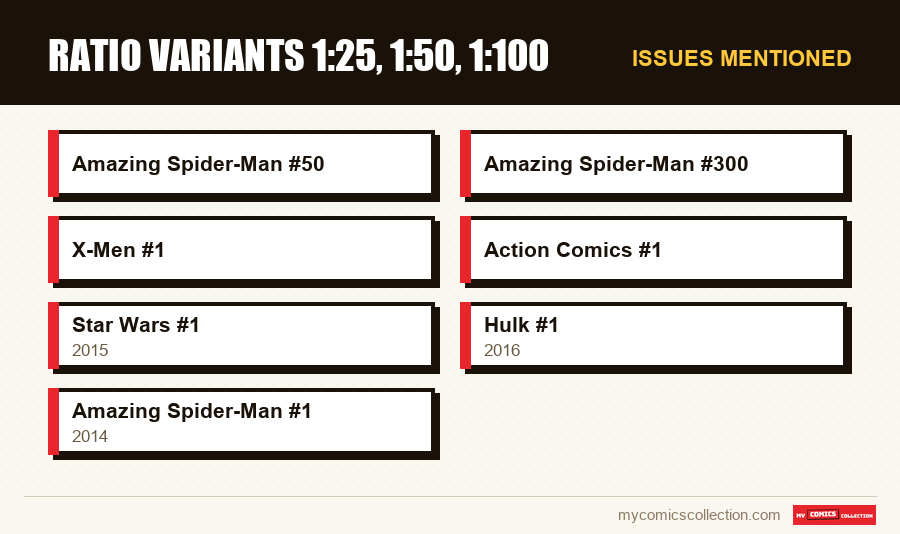
These ranges explode when additional factors come into play. A CGC 9.8 grade typically multiplies value by 2 to 3.5x depending on demand. A major character's first appearance adds a multiplier of 5 to 20x. A homage cover referencing a historic issue (Amazing Spider-Man #300 , X-Men #1 , Action Comics #1) adds a 50-150% premium. A CGC Signature Series (SS) authenticated by the cover artist adds 30-80%.
A concrete example: the 1:200 variant of Star Wars #1 (2015) by John Cassaday, with roughly 1,200 copies on a massive print run, traded between $800 and $1,500 in CGC 9.8 during 2020-2023, with a peak of $2,100 in 2021. The 1:500 variant of the same book, with approximately 480 copies, reaches $3,500 to $5,000 in CGC 9.8.
Systematic pricing for these variants is handled by the free appraisal tool, which aggregates closed eBay sales from the past 90 days by CGC grade. For a structured investment strategy around variants, see investing in comics: a strategic guide.
Top ratios to know: artists and sought-after signatures
Not all ratios are created equal. Value depends as much on the artist as it does on the number. Three names have dominated the ratio variant market since 2012-2015 and remain dominant in 2026.
Skottie Young Baby Variants 1:50
Since 2010, Skottie Young has been producing a series of cartoon-style variants depicting the main character as a baby. These Baby Variants started at 1:50 and have since shifted between 1:25 and 1:50 depending on the title. Marvel now uses this format as a near-standard across virtually all of its series launches. Early Baby Variants (pre-2015) regularly hit $150-$400 in CGC 9.8. The rarest ones, featuring first appearances or cult characters, can reach $800-$1,500. The 1:50 Baby Variant of Hulk #1 (2016) remains a benchmark at $600-$900.
Stanley Lau "Artgerm" 1:25 and 1:50
Stanley Lau, known by the handle Artgerm, has been producing female-focused covers in a hyper-realistic style since 2014, and they're among the most sought-after in the market. His ratios typically fall between 1:25 (common on mid-tier titles) and 1:50 or even 1:100 for events. Artgerm 1:25s typically sell between $40 and $120 Raw NM, and $100-$300 in CGC 9.8. His 1:100s reach $300-$800 in CGC 9.8. His runs on X-23 , Captain Marvel , Black Cat , and Mary Jane remain the most prized. The Artgerm market peaked in 2021, corrected 30-40% through 2023, and has stabilized since 2024.
J. Scott Campbell 1:100 and 1:200
J. Scott Campbell occupies the high end of the ratio variant market. His covers are almost always assigned at 1:100 or 1:200 ratios, sometimes 1:500 for anniversary issues. The Amazing Spider-Man #1 (2014) 1:100 variant by Campbell sold for $1,200-$1,800 in CGC 9.8 between 2022 and 2024. His Mary Jane series, homage covers referencing classic Spider-Man issues, regularly reaches $1,500-$3,000 for 1:200 ratios. Campbell is a recognized quality signal, and his variants hold their value better than average during market corrections.
Other ratio artists worth tracking
Beyond the dominant trio, several artists are worth following: David Finch (1:50 to 1:200, dark style highly prized on Batman and X-Men), Greg Land (1:100 to 1:500, controversial but collected), Adam Hughes (rare, 1:200 to 1:500, very high value), Olivier Coipel (1:50, European aesthetic widely respected), Jim Cheung (1:25 to 1:100), Mark Brooks (1:25 to 1:50, rising), Peach Momoko (1:25 to 1:100, strong Japanese and US market since 2020).
Ratio variants vs. retailer incentives: a common source of confusion
The vocabulary of the variants market breeds widespread confusion. The terms ratio variant and retailer incentive variant are often used interchangeably, but they're not strictly equivalent. A ratio variant is a subcategory of retailer incentive variants. All ratio variants are incentives, but not all incentives are structured as ratios.
A retailer incentive variant can take three main forms. The classic ratio form (1:25, 1:50, 1:100), the tier form (the retailer orders X copies to unlock a unique variant without an explicit ratio), and the convention exclusive form (variants sold only at certain shows or through specific retail partners). Convention exclusive variants represent a parallel economy that doesn't follow ratio mechanics at all.
Another common mix-up: store variants or retailer exclusive variants. A specialized retailer commissions an artist directly to produce a variant printed in a specific quantity (often 3,000 or 5,000 copies), sold exclusively through that store. This is not a ratio variant: the retailer pays the artist and printing costs directly, and no Marvel or DC distributor imposes a proportion requirement. These store variants are collected differently, following an absolute print run logic rather than a ratio. The retailer incentive variants guide details all the subcategories.
To precisely identify a variant, three data points appear on the back of the comic or in databases: the exact ratio listed on the indicia page (sometimes absent), the cover code (B, C, D, E for ordered variants), and the Diamond or Lunar SKU number. Any serious Comics Manager models all three data points for each variant. See cataloguing comics: method and guide.
Pro tip: on eBay or Whatnot, be wary of listings that claim a ratio without backing it up. Some sellers label a standard cover B as a "1:25 variant" to artificially inflate the price. Always verify the claimed ratio against ComicBookRealm, Comic Book Round-Up, or Mile High Comics, which list official SKUs.
Collection strategy: which ratios to prioritize by budget
Building a ratio variant collection requires a strategy. Buying ratios at random without a framework leads to a pile of second-tier covers that will lose value within five years. Three structured approaches exist depending on budget.
On a budget of $50-$100 per month, the optimal strategy is to target 1:25 variants by established artists (Artgerm, Mark Brooks, Peach Momoko) on mid-tier titles. You pick up 2-3 variants a month in Raw condition, gradually building a collection of 30-50 variants over 18 months, with a total invested capital of $1,500-$3,000. The guide on collecting comics on a small budget details this progressive approach.
On a budget of $200-$500 per month, you gain access to 1:50 and 1:100 ratios on major titles. The targets: Skottie Young Baby Variants 1:50 on historic #1 issues, J. Scott Campbell 1:100s on Amazing Spider-Man, Artgerm 1:100s on DC events. Over 24 months, the accumulated capital can reach $8,000-$15,000 with solid selection. See collecting comics on a larger budget.
On a budget above $1,000 per month, the strategy shifts to CGC 9.8 slabs and 1:200 to 1:500 ratios. At this level, each purchase is an individual investment decision requiring research into eBay comparables, review of GoCollect sales history, and timing relative to Marvel/DC film or TV adaptation announcements. Systematic tracking becomes essential: a dedicated tool like a comics collection app tracks each acquisition, its purchase price, and its current value in real time.
Pitfalls and common mistakes
Several recurring mistakes cost beginner ratio variant collectors real money. First mistake: confusing a 1:10 or 1:15 incentive with a true ratio variant. These low ratios (10 to 15) are essentially distributed by default across all major Marvel and DC titles, and their actual print runs often exceed 20,000 copies. Their value stays modest, typically $5-$15, and they don't appreciate over time.
Second mistake: overestimating a ratio on a low-print-run title. A 1:100 on an Image comic that only ships 5,000 copies produces just 50 variants in circulation, which sounds rare. But without demand, an indie title without a big enough fanbase, those 50 copies are hard to move at even $30-$60. Absolute scarcity doesn't create value without corresponding demand.
Third mistake: ignoring condition. A 1:100 variant in VG or Fine grade loses 70-85% of its value compared to the same variant in Near Mint. For high-ratio variants, the collector market consistently requires a minimum CGC 9.6, ideally 9.8. See CGC grading guide for grading logic.
Fourth mistake: pre-ordering without knowing the artist. A 1:50 by an unknown artist with an unappealing cover can drop 50% in value within 6 months of release. Conversely, a 1:25 by Artgerm or Campbell holds its value even 3-5 years out. The artist's signature carries more weight than the ratio itself in price formation.
Fifth mistake: neglecting storage. A $300 variant that develops a corner crease or spine tick instantly loses 40-60% of its value. For high-ratio variants, bagging in Mylar with an acid-free board is mandatory from the moment of purchase. The guide on protecting your comics covers the full storage protocols.
Catalog your ratio variants automatically
My Comics Collection scans the barcode, identifies the exact variant (cover B, C, D, or ratio incentive), pulls the estimated print run, and retrieves live eBay pricing by CGC grade. For a collection of 100 ratio variants, value tracking is fully automated.
Ratio variant market trends: 2020-2026
The ratio variant market has gone through three distinct phases since 2020. A speculative boom from March 2020 through August 2021, when prices on 1:50 to 1:200 variants tripled or even quadrupled, driven by a wave of new collectors during lockdowns. A correction from September 2021 through the end of 2023, with drops of 30-50% on mid-tier variants and 15-25% on premium ones (Artgerm, Campbell, Young). A phase of stabilization and selective recovery since 2024, with premium variants climbing 10-20% per year while secondary-tier variants remain flat.
The 2025 market recap (see 2025 comics market review) confirms this segmentation: high ratios (1:200 and above) by major artists are outperforming, mid-range ratios (1:25 to 1:50) on mid-tier titles are stagnant, and low ratios (1:10, 1:15) are essentially out of the collectible market. Looking ahead to 2026-2027, analysis (see comics poised to rise in 2026-2027) anticipates acceleration on older Skottie Young variants and pre-2018 J. Scott Campbell pieces.
Three factors will shape what comes next. The impact of Marvel and DC live-action adaptation announcements (a variant tied to a character heading to the big screen often doubles within 3 months). The effect of major conventions (San Diego Comic-Con, NYCC) which create sharp spikes in visibility. The effect of new resale platforms like Whatnot, which are reshaping liquidity for variants under $500.
FAQ: ratio variants 1:25, 1:50, 1:100
What does 1:25 mean on a comic?
A 1:25 means the retailer had to order 25 copies of the standard cover A to be eligible to order 1 copy of the 1:25 variant. On a comic with a 100,000-copy base print run, the 1:25 theoretically produces 4,000 variants, with 2,500 to 3,200 actually in circulation after accounting for retailer ordering behavior.
Is a 1:100 always rarer than a 1:50?
Yes, on the same title. The 1:100 demands twice the effort from the retailer compared to a 1:50, and its print run is mechanically half as large. On a comic with 100,000 base copies, the 1:50 produces 2,000 variants and the 1:100 produces 1,000. The 1:100 typically sells for 2 to 4 times the price of the 1:50.
How do I know if a variant is really a 1:25 or 1:50?
Check the Diamond or Lunar SKU on ComicBookRealm.com or directly on the distributor's website. Marvel and DC also publish official listings when solicitations are announced. Be skeptical of eBay listings that claim a ratio without a SKU to back it up.
Are all Skottie Young Baby Variants 1:50s?
No. Skottie Young started at 1:50 around 2014, but Marvel has alternated since then between 1:25 (more common from 2020-2023) and 1:50 (for events and anniversary issues). Always check the exact ratio on the comic's SKU. The 1:50s typically sell for 2 to 3 times what the 1:25s do.
Should I get a 1:100 variant CGC graded?
Yes, if you intend to sell. A Raw NM 1:100 variant typically sells for $100-$300. The same book in CGC 9.8 reaches $250-$700. The cost of grading ($35-$65 depending on the service tier) is easily recouped. That said, don't submit a variant with visible defects (corner crease, spine tick): the grade will come back 8.5-9.0 and the ROI will be negative.
Is a 1:500 variant always worth more than $500?
Not necessarily. Value depends on the title, the artist, and demand. A 1:500 by Greg Land on a mid-tier title might trade between $300 and $600 in CGC 9.8. A 1:500 by J. Scott Campbell or Adam Hughes on Amazing Spider-Man easily clears $2,000-$4,000. The ratio alone doesn't guarantee the price.
Where's the best place to buy ratio variants?
Three channels dominate. eBay remains the reference market with maximum liquidity: check closed comparables from the past 90 days. Whatnot for live auctions, often below eBay market price for variants under $400. Physical comic shops in France and Belgium for variants still in stock at cover price. See buying and selling comics in France: a guide.
How do I catalog a ratio variant in an app?
You need to distinguish the cover (B, C, D, or a specific ratio incentive) from the standard issue. A serious app like My Comics Collection models each cover separately via its Diamond/Lunar SKU, allowing you to track the value of each variant independently. Simply logging "Amazing Spider-Man #50" without specifying the cover isn't sufficient for meaningful collection management.