
Spotting comic market trends before they hit mainstream awareness is the single most profitable skill in comic investing. The best trend-spotters use a combination of entertainment industry tracking (casting calls, trademark filings, production schedules), market data analysis (CGC census shifts, eBay volume changes), and community intelligence (dealer chatter, convention floor observations). This guide teaches you the exact methodology experienced speculators use to get in early.
Disclaimer: This information is provided for informational purposes only. My Comics Collection is not an investment advisor. Values vary based on condition, rarity, and market trends.
In the comic market, information is money. The collector who knows about an upcoming Marvel Studios project six months before the public announcement buys the relevant first appearance at baseline prices. The collector who learns about it from a YouTube thumbnail buys at the peak. The difference in entry price between these two collectors can be 200-500%. Learning to detect trends early is not optional for serious investors -- it's the core competency that separates profitable investors from everyone else.
This guide breaks down the complete trend-detection methodology into four signal categories: entertainment industry signals, market data signals, community signals, and macro signals. Master all four, and you'll consistently buy before the crowd and sell into their demand.
Signal Category 1: Entertainment Industry Tracking
The single most powerful price driver in the modern comic market is media adaptation. When a character gets a movie, TV series, or major video game appearance, their first appearance comic spikes in value. The key is identifying these adaptations before they're publicly announced.
Trademark and patent filings
Marvel and DC routinely file trademarks for character names months or years before publicly announcing projects. These filings are public record and can be searched on the USPTO (United States Patent and Trademark Office) website.
- Search for Marvel or DC filing new trademarks under entertainment services categories (IC 041)
- When Marvel trademarks a previously obscure character name for "motion picture films" or "streaming entertainment," a project is likely in development
- Filing-to-announcement lead time is typically 6-18 months -- giving you a significant window to buy at pre-hype prices
Casting calls and production tracking
Film and TV productions leave digital footprints long before official announcements:
- Casting calls on sites like Backstage, Breakdown Services -- Studios use coded character names, but descriptions often match known comic characters
- Production office registrations -- When a production company rents office space or applies for filming permits, it often uses a working title that can be traced to a known property
- Tax incentive filings -- States that offer film tax credits publish lists of approved productions, often months before public announcement
- Domain registrations -- Studios register web domains for upcoming films. Monitoring new domain registrations related to Marvel, DC, or comic properties can reveal projects in development
Comic book storyline analysis
Marvel and DC frequently use their comic books to "set the stage" for upcoming media projects. When a previously obscure character suddenly gets a new solo series, a prominent role in a team book, or a major storyline featuring their origin, it often signals a media adaptation in the pipeline.
- Track Marvel and DC solicitations (announced 3 months ahead of publication) for new series featuring characters without recent titles
- Watch for sudden "reinvention" mini-series that modernize older characters
- Pay attention to which characters are getting prominent cover placements across multiple titles
Signal Category 2: Market Data Analysis
Raw market data reveals trends before the narrative catches up. Learning to read these signals gives you an edge over investors who rely on news and opinions.
eBay volume analysis
One of the most reliable early signals is a sudden increase in search volume and sales frequency for a specific book, even before prices move. When a book that normally sells once or twice a month suddenly sells five times in a week at stable prices, someone knows something.
How to track eBay volume:
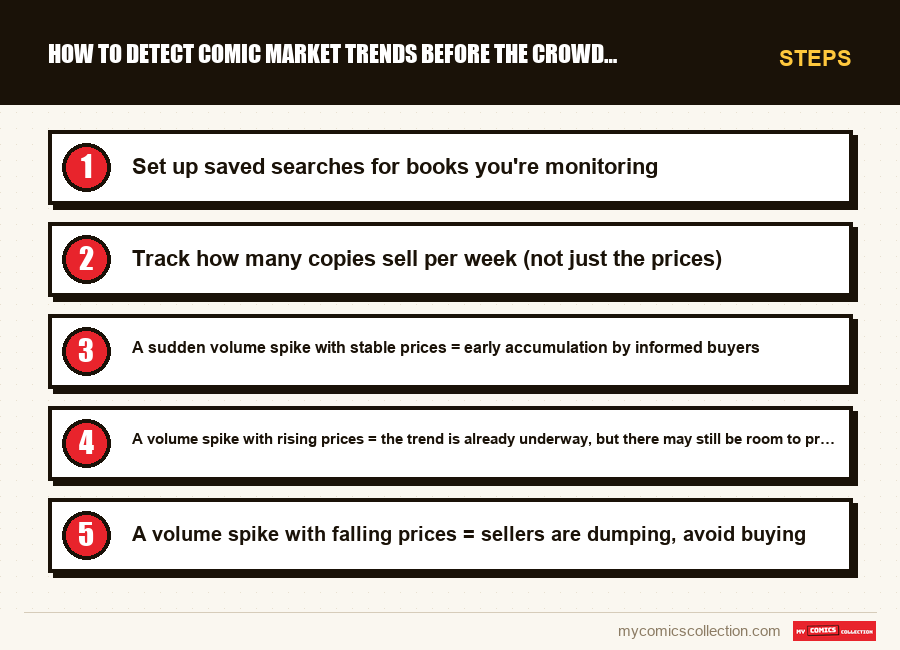
- Set up saved searches for books you're monitoring
- Track how many copies sell per week (not just the prices)
- A sudden volume spike with stable prices = early accumulation by informed buyers
- A volume spike with rising prices = the trend is already underway, but there may still be room to profit
- A volume spike with falling prices = sellers are dumping, avoid buying
CGC census analysis
The CGC census (publicly available on CGC's website) shows how many copies of each book have been graded at each grade. Sudden increases in submission volume for a specific book indicate that collectors are grading copies in anticipation of higher prices.
- If the CGC census for a book increases by 20%+ over a quarter, someone is betting on future demand
- Disproportionate submissions in high grades (9.6+) suggest dealers preparing inventory for retail sale
- Mass submissions of a previously under-graded book signal incoming demand that hasn't yet reached prices
Price velocity tracking
Rather than watching absolute prices, track the rate of price change. A book that moves from $50 to $55 (10%) in a month is more interesting than a book that stays at $500 for six months. Small, steady increases often precede larger moves because they indicate genuine demand growth rather than a single speculative spike.
Use a comic collection tracker to monitor the value changes of books on your watchlist over time and detect acceleration patterns.
Signal Category 3: Community Intelligence
The comic collecting community is a rich source of early intelligence if you know where to listen and how to filter noise from signal.
Dealer behavior at conventions
Experienced dealers are among the best-informed participants in the market. Their behavior at conventions reveals what they expect:
- Aggressive buying of a specific character's books across multiple booths signals that the dealer expects prices to rise
- Pulling books from display or moving them behind the counter suggests the dealer has received intelligence about upcoming demand
- Sudden repricing of books that have been at the same price for months indicates new information
Reddit and forum analysis
Subreddits like r/comicbookcollecting, r/MarvelStudiosSpoilers, and r/comicspeculation are valuable sources, but require careful filtering:
- High-signal sources: Users with long posting histories who share specific, verifiable information (trademark filings, casting news, production intel)
- Low-signal sources: Hype posts, "this book is going to moon" claims without supporting evidence, and influencer shills promoting their own inventory
- Best practice: Follow the data-backed posts and ignore the emotional ones. Cross-reference any claim with independent sources before acting
Comic store owner intelligence
Local comic shop owners who attend industry events (Diamond/Lunar retailer summits, publisher presentations) often learn about upcoming projects months early through NDAs that eventually leak through changed ordering patterns. If your local shop suddenly orders deep on a title they've never stocked before, ask why.
Signal Category 4: Macro and Cultural Signals
Broader cultural shifts create slow-moving but powerful trends that affect entire categories of comics rather than individual books.
Generational nostalgia cycles
Each generation reaches peak earning power (ages 35-55) and begins nostalgic collecting of the media they consumed in childhood (ages 8-16). This creates predictable demand waves:
- Currently peaking (2025-2035): Millennials (born 1981-1996) collecting 1990s and 2000s comics they grew up with. Books from this era are in their appreciation window right now.
- Upcoming wave (2030-2040): Gen Z (born 1997-2012) will drive demand for 2000s-2010s comics, particularly those tied to the MCU and animated properties they watched as children.
- Winding down: Gen X nostalgia (1980s comics) has been a dominant force for the past decade and is slowly plateauing as this generation ages past peak collecting years.
Diversity and representation trends
The increasing cultural emphasis on diverse representation creates demand for first appearances of characters from underrepresented groups. Books like Ms. Marvel #1 (2014, 1st Kamala Khan), America #1 (2017, 1st solo America Chavez), and Ironheart #1 (2019, 1st solo Riri Williams) have all benefited from this long-term cultural shift.
Technology and format shifts
Changes in how people consume media create ripple effects in the comic market:
- Streaming platform competition for comic book properties has expanded the pool of characters being adapted, benefiting obscure first appearances that were previously overlooked
- Video game adaptations (Marvel's Spider-Man, Wolverine) reach audiences that don't watch traditional media, creating demand from non-traditional collector demographics
- International market growth in Asia, Europe, and South America is expanding the buyer pool for high-grade key issues
Building Your Trend Detection System
Assembling these signals into a practical system requires organization and discipline. Here's a framework for daily and weekly monitoring:
Daily (15 minutes)
- Check r/MarvelStudiosSpoilers and entertainment news for casting or production announcements
- Review your eBay saved searches for volume and price changes
- Scan comic news sites (Bleeding Cool, CBR) for solicitation and creator announcements
Weekly (30 minutes)
- Review USPTO new trademark filings for Marvel and DC
- Check CGC census for submission volume changes on your watchlist books
- Review GoCollect or GPA trend data for books you're monitoring
- Update your watchlist and portfolio values in your collection management app
Monthly (1 hour)
- Analyze 3-month price velocity trends across your watchlist
- Review upcoming Marvel and DC solicitations for character promotion patterns
- Assess macro signals: any generational or cultural shifts affecting demand
- Adjust your portfolio allocation based on trend analysis
When to Act -- and When to Wait
Detecting a trend early is valuable, but acting at the right moment is equally important. Follow these guidelines:
- Act immediately when you have high-confidence information (a confirmed casting announcement, a verified trademark filing for a specific character) and the book hasn't moved yet
- Accumulate gradually when the signal is suggestive but unconfirmed (production rumors, increased CGC submissions) -- buy small positions and scale up as evidence strengthens
- Wait for confirmation when the signal is ambiguous (vague rumors, single-source claims) -- the risk of acting on bad intelligence often exceeds the cost of a slightly higher entry price
- Sell into strength when the trend becomes mainstream knowledge. Once a book is trending on social media, the informed money is exiting, not entering. This is your signal to take profits, not to buy more.
Frequently Asked Questions
Entertainment industry signals (trademark filings, production intel) can give you 6-18 months of lead time before public announcements. Market data signals (volume increases, CGC census shifts) typically provide 2-6 weeks of early warning. Community signals vary widely -- from days (dealer convention behavior) to months (retailer ordering pattern changes). The best investors combine all three for comprehensive coverage.
Confirmed media adaptation announcements (official studio announcements of films or series featuring specific characters) are the most reliable single signal. They have a near-100% hit rate for causing at least a temporary price spike in the character's first appearance. However, the magnitude and duration of the spike depend on the character's existing popularity and the quality of the adaptation.
For a serious part-time investor, 30-60 minutes per day is sufficient. The daily routine (15 minutes of news and eBay monitoring) plus weekly analysis (30 minutes of data review) plus monthly strategic assessment (1 hour) totals roughly 3-4 hours per week. This is enough to stay ahead of casual collectors without becoming a full-time job.
Professional speculators typically use: GPA Analysis for historical CGC price data, GoCollect for trend analysis and alerts, eBay saved searches with email notifications for volume monitoring, USPTO TESS database for trademark research, Google Alerts for character and property name mentions, and a comic collection management tool for portfolio tracking and performance analysis.
The best defense against false signals is requiring corroboration from multiple independent sources before committing significant capital. A single Reddit rumor is not enough. A trademark filing combined with production office activity combined with increased eBay volume is a much stronger signal. Start with small positions on single-source intelligence and only scale up when additional evidence confirms the trend.