The Origin line has six founding issues, Wolverine: The Origin #1 to #6, put on sale starting September 5, 2001, cover-dated November 2001 to April 2002, at $3.50. Script by Paul Jenkins on a plot co-credited to Bill Jemas and Joe Quesada, art and inks by Andy Kubert, colors by Richard Isanove. Public preorder reports put #1 at 135,651 copies and the last issue ordered at 179,251: the series sold better and better, which is very unusual and changes the whole scarcity reasoning. To this are added Origin II in five issues (2014), then Wolverine: Origin III, The Dark Age #1, five issues announced for December 16, 2026, with the return of Paul Jenkins and CAFU on art.
Twenty-five years separate two dates that are going to collide this winter. On September 5, 2001, a $3.50 issue announced it would answer the one question Marvel had refused to address for almost thirty years. On December 16, 2026, the author of that issue returns to the same ground, with a title that explicitly takes up the series' name and its Roman numbering.
This anniversary poses a precise collecting problem, and it is not the one you think. The six 2001 issues are not hard to find. They were ordered in the tens of thousands, reprinted in at least ten different editions, and the story they tell is readable today without owning a single issue. In other words, the question is not "where to find them" but "what, in this abundant set, can legitimately behave like a key issue."
This article therefore sticks to the Origin line, not to Logan in general. It documents the six founding issues with their verified order figures, what the series locked into continuity, what Origin II did differently, what the December 2026 announcement changes and does not change, and it deals head-on with the question specific to this case: can a heavily printed book become rare, and if so, in which condition window.
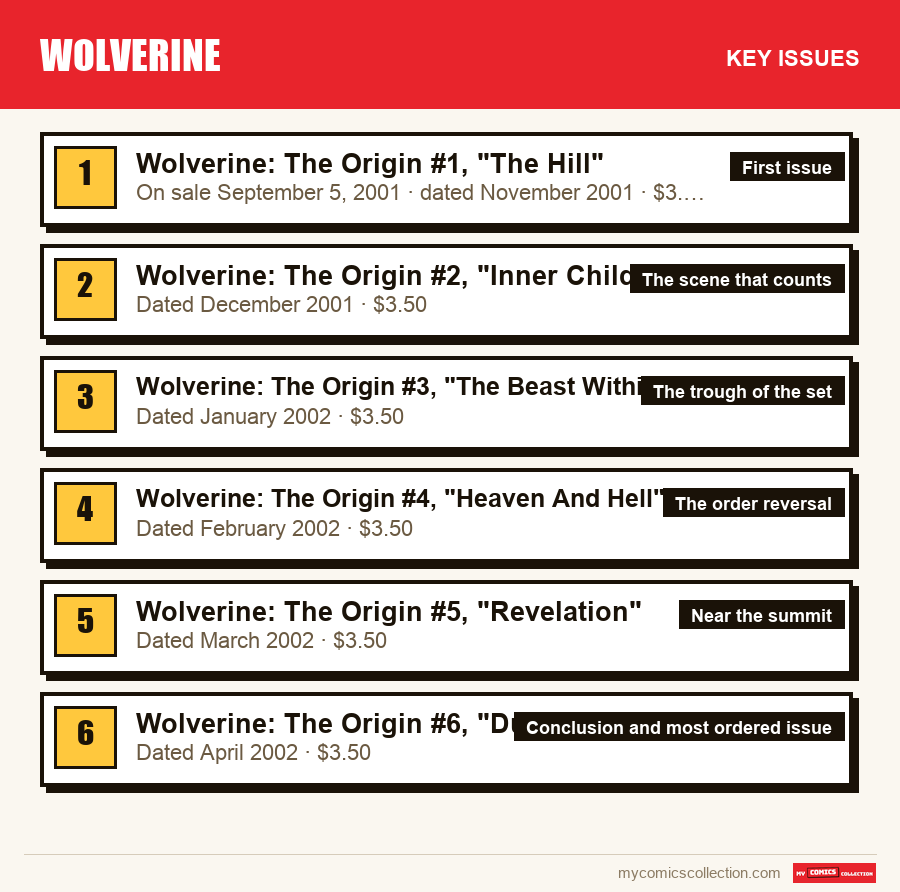
The six founding issues, verified facts
Let us begin with what is established and sourceable, because this series' bibliography is regularly approximate. The official title of the issue is Wolverine: The Origin, not just Origin, even if the cover logo and the collections have installed the short name. It is a limited series in six parts, bounded from the start.
The credits are identical on all six issues. Paul Jenkins signs the script, Bill Jemas and Joe Quesada are co-credited on writing for the plot, Andy Kubert handles pencils and inks, Richard Isanove the color. The covers of the six issues are by Joe Quesada and Richard Isanove. The cover price is $3.50, clearly above the going rate of a 2001 issue, which places the project in the category of carefully formatted publications.
A dating point deserves to be spelled out, because it creates confusion in collection lists. The cover dates of the six issues run from November 2001 to April 2002. The on-sale date of #1 is September 5, 2001, two months before its cover date, which was the practice of the time. For the following issues, the recorded on-sale dates stretch until May 2002, hence beyond the last cover date: the series fell behind along the way, and the month numbering stops matching the real calendar. If you file by date, decide which of the two you use and stick to it across the six lines.
Here are the six issues, with the chapter title and the order figure publicly recorded on the North American direct market, order month by order month.
Wolverine: The Origin #1, "The Hill"
The setup chapter. Rose O'Hara arrives at the Howlett estate, in Alberta, as the young master's playmate. We meet Dog Logan, his father Thomas, the housekeeper, grandfather Howlett. Almost nothing spectacular happens, and that is deliberate: the issue sells a setting and a tone, not a revelation. Recorded first appearances of John Howlett Sr., Thomas Logan, Elizabeth Howlett and the character of James Howlett in the chronological order of his life.
Wolverine: The Origin #2, "Inner Child"
This is where the story tips over and, narratively, the most important issue of the series. Thomas Logan kills John Howlett in front of the child. James throws himself at the killer, and the bone claws come out for the first time, covered in the blood of the man he has just killed without understanding what he has done. The issue also records the end of the protected world of the first chapter: several deaths, the expulsion of the Logans, the flight.
Wolverine: The Origin #3, "The Beast Within"
The flight and the settling elsewhere, the shift from the name Howlett to the nickname that will stay. It is the issue people talk about least, and consequently the one incomplete sets are most likely to still have.
Wolverine: The Origin #4, "Heaven And Hell"
At the midpoint, word of mouth has done its work and stores correct their orders upward. This issue is the series' statistical breaking point.
Wolverine: The Origin #5, "Revelation"
Penultimate chapter, and the series' second highest figure. The order curve keeps rising even as the series ends, which almost never happens on a miniseries.
Wolverine: The Origin #6, "Dust to Dust"
The conclusion, in British Columbia. A fighting tournament, a deliberate dive, then Rose's accidental death on Logan's claws, and the departure for the mountains. The story's last gesture is a gesture of erasure: Rose's journal, which served as the narrative voice of the whole series, is destroyed, so that nobody, Logan first of all, will be able to reconstruct the story as she saw it.
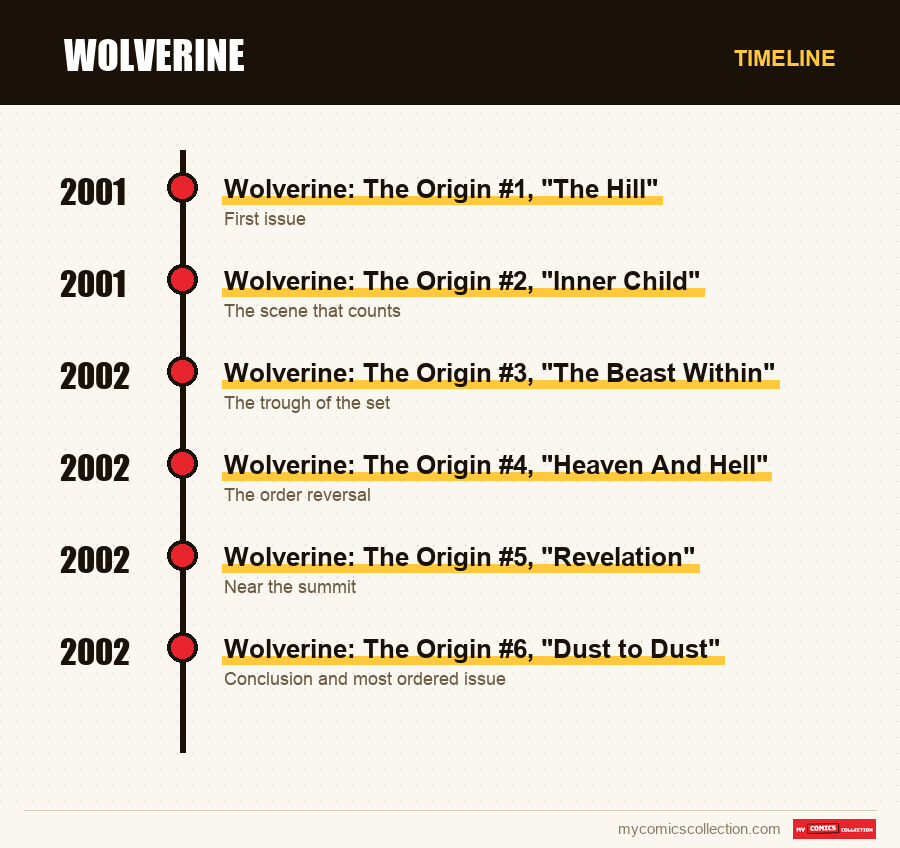
Why this order curve changes the reasoning
Put the six figures together and the shape jumps out: 135,651, 131,582, 128,978, 168,460, 178,231, 179,251. The series dips slightly at the start, then climbs by more than 50,000 copies between its low point and its end. The last issue was ordered about a third more than the first.
A miniseries normally behaves the opposite way. Stores order number 1 widely, see the attrition, and cut with each following issue. It is the classic attrition, and it is what produces the usual hierarchy of sets: the last issue is the hardest to find because it is the least printed. On Origin, this mechanic does not apply. The least ordered issue is #3, in the middle, and the last two issues are the most abundant.
Three practical consequences, all directly exploitable.
First, #1 is not the rare issue of the set. It is simply the desirable issue, for a reason that has nothing to do with quantity: it is the one carrying the logo, the identifiable cover and the status of first issue. Demand concentrates on it by convention, not by shortage. Our guide on how to understand a print run details this dissociation between printed volume and observed price.
Next, #3 is the most interesting candidate for anyone who wants to play relative scarcity within the set. It is the least ordered of the six, it is also the one nobody talks about, so the one sellers keep least carefully. The gap between "little printed" and "little valued" is exactly the space in which a patient collector works.
Finally, and it is the point most key-issue lists miss, these figures are not print runs. They are preorders from North American specialty stores. They do not include copies sent to newsstands, restocks or foreign markets, and they say nothing of the number of copies that survived. They serve to compare the six issues with each other, which is their real use, and not to announce an absolute volume.
What the series locked into continuity
A key issue is rarely one for its cover. It is one because it contains something that cannot be undone afterward. On this criterion, Origin is an editorial locking operation, and it is worth naming precisely what it fixed.
The birth name, James Howlett, and with it a social origin: son of a great landowning family in late-19th-century Alberta, a sickly, sheltered child. An entourage that became permanent: Rose O'Hara as the figure of lost attachment, Dog Logan as a long-term antagonist, Thomas Logan as the trigger, Elizabeth Howlett and her scars as a clue never fully resolved. A bodily mechanism: the claws are bone and native, which retroactively reorganizes everything people thought they knew about adamantium. A memory device: the story closes on the destruction of the only written source, which legitimizes in advance the gaps, contradictions and false memories that three decades of publications had accumulated.
This last find is the cleverest, and it is what makes everything that came after possible. By destroying the journal, the series gives itself the right to leave a gray zone, and gives its sequels the right to fill it. Origin II and The Dark Age both exploit precisely this door left open.
That leaves the reason Marvel gave in after so many years of silence. It is documented and external to comics: the character had just become a movie star, and the publisher judged it better to fix the origin itself rather than let the films answer in its place. It is also what explains the form of the credits, where the then-president and the editor-in-chief are co-credited on the plot alongside the writer. It is not an isolated creator's project, it is a leadership decision staged as an event, and that shows in the care given to the format as in the cover price. To place this moment in the character's editorial trajectory, our pages on Wolverine and on Incredible Hulk #181 cover the earlier period, the one where the origin did not exist.
Origin II, 2014: same house, not the same value
Twelve years later, Marvel publishes a sequel, this time under the title Origin II, in five issues, with cover dates from February to June 2014 and the first issue going on sale in late December 2013. Entirely renewed team: Kieron Gillen on script, Adam Kubert on pencils and inks, Frank Martin Jr. on color, Joe Caramagna on lettering.
The content directly extends the end of the first series. We find Logan in 1907, living with a pack of wolves, far from all civilization, and it is an outside intervention that brings him back toward men: an animal released into the forest and marked by a certain Essex. The series therefore sets up a direct link between Logan's prehistory and the figure known as Mister Sinister, and lays the first markers of the path that will lead to Weapon X.
For a collector, the interest of Origin II is first demonstrative. Same house, same franchise, same displayed lineage, an artist bearing the same family name as the 2001 one, and yet the series does not behave at all like its elder. The reason is structural rather than qualitative: a sequel locks nothing. It adds material to an already fixed frame, and nobody needs to own it to understand the character. The first issue of a sequel is not a first issue, it is a seventh.
An honest limit must be added to any numeric comparison between the two series. Monthly per-title reports exist for 2001 and 2002 and allow the table above. They no longer exist in the same form today, and they were already less usable in 2014 than in 2001, for reasons of distribution scope. Comparing the order curve of Origin with that of Origin II would therefore be comparing two different measuring instruments, and we abstain.
Origin III, The Dark Age: what is announced, and only that
On August 19, 2026, Marvel announced Wolverine: Origin III, The Dark Age, a five-issue limited series, first issue on sale December 16, 2026. Paul Jenkins returns on script, CAFU is on art, the main cover is signed by Wes Burt and a variant cover by Josemaria Casanovas. The publisher explicitly presents the operation as the celebration of the 2001 series' twenty-fifth anniversary.
The published pitch places the plot in the 1950s, after two world wars lived through by Logan. It deals with a period of peace and service, a young woman doctor who helps him understand his own workings, and a story deliberately oriented toward the mechanics of memory and repression. Jenkins says he wants to answer two questions left open: where Logan went, and which parts of his history vanished before Weapon X.
That is the whole of what is public as of the date of this article, October 2, 2026. We found no confirmed cover price, no page count, no complete list of alternate covers, no dates for issues 2 to 5. We do not invent them. A major convention is held October 8 to 11, 2026 and it is reasonable to expect additions then, but nothing has yet been said there.
What to take from it for the six 2001 issues is more interesting than the solicitation itself. An author's return to his own series twenty-five years later produces a known and measurable effect: it puts the title back in conversations, hence in searches, hence in shopping lists. It produces no effect on supply, since there is not one more 2001 copy than before the announcement. Demand rising on a fixed supply pushes prices, it is arithmetic. But this push has three characteristics to name frankly: it is concentrated on #1, it is temporary, and it is far stronger on high-grade copies than on reading copies. We have already observed it on other 2026 announcements, and our article on Wolverine: Paradise details the method for measuring an announcement effect without overestimating it.
The real question: can a heavily printed book become rare?
It is the question specific to Origin, and it deserves better than a yes or a no. A set ordered between 128,000 and 179,000 copies per issue, then reprinted in at least ten distinct editions, cannot be rare in the common sense of the word. But the scarcity that sets prices on the secondhand market is not the title's scarcity, it is the scarcity of an object in a given condition. These two things have almost no relation.
Let us set the distinction properly, because it holds for any comic after 1990.
The story's scarcity is zero, and will stay so
The first chapter of Origin has been reissued in a softcover collection, a deluxe collection, a hardcover omnibus, an anthology collection, a mass-market newsstand collection, another omnibus, a reduced-price edition meant as an introduction, and a biweekly reprint put out only a few weeks after the original issue. Ten editions recorded for #1 alone. Nobody will ever be obliged to buy a 2001 issue to read this story, and that puts a definitive ceiling on reading demand. The subject is covered more broadly in our comparison between omnibus and original issues.
The object's scarcity in low and middle grade is zero too
A read, complete copy with no major accident is found without effort and will still be found in twenty years. In this part of the market, the number of survivors far exceeds the number of interested buyers. Buying there is about reading and the pleasure of a dated object, not about building a store of value.
Scarcity starts at the top of the scale, and only there
On a 2001 issue, high grade is not a question of preservation at the collector's, it is a question of factory condition and in-store handling. The flaws that cost the last grading points, micro-creases on the spine, blunted corners, cutting defects, print off-centering, are present or absent from day one. A print run of 150,000 copies does not produce 150,000 candidates for the top grade: it produces a fraction, and that fraction has been fixed for twenty-five years. Our guide on CGC grading explains how this hierarchy is built.
This series' format aggravates the phenomenon
Origin is an issue at a raised price, with paper and finish more careful than ordinary 2001 production, and its covers are very dark digital paintings. A dark flat tone and a smooth finish forgive far less the slightest mark than a light, line-printed cover. It is not a market opinion, it is a physical property of the object, and it explains the price gap between the two or three highest grades.
Operational conclusion
Origin will never become rare. Copies of Origin at the top of the grading scale, for their part, are finite in number and decreasing, since each handling of a raw copy can knock it out of that category and no copy ever enters it. It is the only window in which the word scarcity makes sense here, and it is also the one most exposed to announcement effects like December 2026's. Our file on the resale premium of graded copies quantifies this gap on other series.
We must also say what this logic forbids. It forbids presenting the purchase of a raw 2001 copy as a lottery ticket to high grade. Submitting a copy to grading costs, takes months, and creates no quality: it only reveals the quality that was already there. It also forbids treating reprints as investment substitutes, since they are by construction reproducible at will. Our articles on first printing and reprint and on estimating an issue's real scarcity develop these two safeguards.
Building the Origin line without getting it wrong
If the anniversary makes you want to complete this set, here is the priority order that flows from everything above, and it is not the one you will be offered spontaneously.
The foundation is the complete set #1 to #6 in decent reading condition. It is the purchase with the best ratio between what you get and what you spend, and the only one that gives you the object in its original form, with the six-part cut, the letters pages and the 2001 ads that collections remove. Buy the set at once if you find it assembled: six issues sold together by the same seller have almost always lived the same story, hence the same condition.
The second level is choosing a single issue to upgrade in quality. If your criterion is resale and liquidity, it is #1, no discussion, because it is the one buyers look for. If your criterion is consistency with the content, it is #2, which contains the founding scene. If your criterion is measured scarcity, it is #3, the least ordered of the six. These three answers are defensible and mutually exclusive: choose your criterion before choosing your issue, not the reverse.
The third level is Origin II in five issues, to be treated as a reading supplement and not as an extension of the foundation. And the fourth, from December 16, 2026, will be The Dark Age, of which it must be recalled that no copy exists at the time of writing and that no value can therefore be attributed to it.
In every case, the least risky decision remains to know exactly what you already own before buying anything. A set of six issues is precisely the size where you buy the same one twice without noticing, especially when one of the copies sleeps in a collection. Our issue-by-issue tracker is made for that, and our free estimate tool will give you a range based on observed sales rather than on an impression.