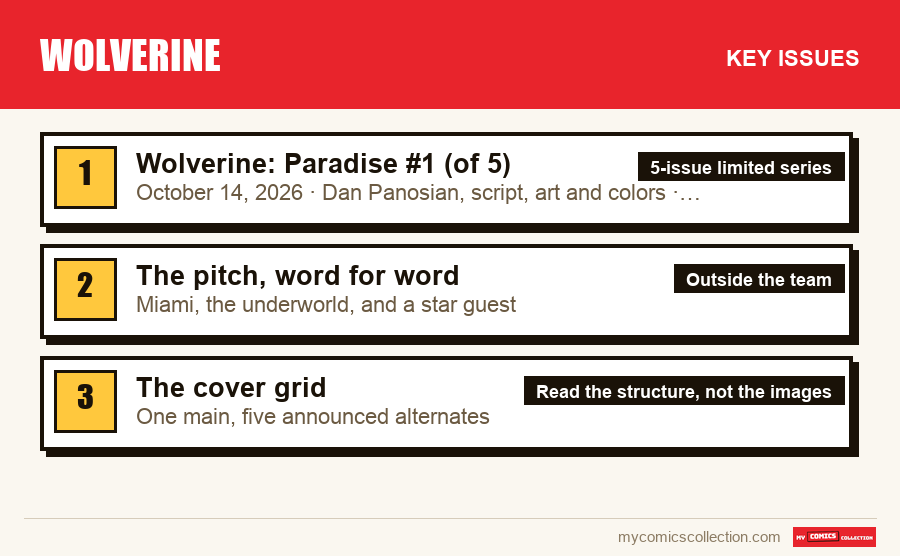
Wolverine: Paradise #1 comes out on October 14, 2026. It is the first of a 5-issue limited series, written, drawn and colored by Dan Panosian alone, at the announced cover price of $4.99 for 32 pages. The pitch fits on one line: Logan moves away from the X-Men and lands in Miami, where the postcard setting hides a well-established underworld. Dazzler is announced as a guest, and the publisher mentions a new supervillain pulling the strings. That is the facts. The real collecting question is not "will it be good" but "why would this one matter, when the franchise puts out a title with this name almost every quarter". This article measures the abundance, explains what it does to the value of an issue #1, and gives the criteria that separate a landmark title from a filler title.
A collector who has followed Logan for twenty years has learned a reflex: faced with a new issue #1 in his name, the first question is not editorial but arithmetic. How many series already carry this name this year? How many came out last year? How many stopped without leaving a trace in continuity? This reflex is not cynicism, it is market memory. No Marvel character has been spun out as often, as fast, and under as many different labels.
This article is written on October 1st, 2026, thirteen days before release. No copy exists, no price guide exists, and nobody can honestly announce what this issue will be worth. What does exist is a published solicitation, a named team, a dated calendar, and a recent editorial history that can be counted. It is on these three things that we work.
The angle is therefore twofold. First, document precisely what Paradise is. Then use this case to set out a reusable method for all the issues #1 to come, because there will be others, probably before next summer.
What is confirmed about Wolverine: Paradise
The official October 2026 solicitation is explicit on the essentials, and silent on a few points you need to identify as such.
Wolverine: Paradise #1 (of 5)
The "of 5" notation appears from the solicitation's title: it is a limited, bounded series, and not a relaunched regular series. Panosian is credited with the script, the art and the main cover. The French-language trade press that relayed the announcement also credits him with the coloring. It is therefore a single-creator book, which is rare on a character of this commercial size and is the first really interesting fact of the file.
The pitch, word for word
Logan moves away from the X-Men. Beneath Miami's glitz simmers a criminal underworld that will serve as a crucible and bring out the warrior. Dazzler is announced as a guest. The announcements add an element absent from the short solicitation: a mysterious new supervillain would be at work behind the criminal empire. The announced aesthetic is retro, with a Logan on a motorcycle in the first images released.
The cover grid
Besides Panosian's cover, the solicitation announces a foil variant by Phil Noto, and variants by Áthila Fabbio, ACO and Francesco Mobili, plus a "virgin" variant by Panosian. A listing detailing the ratios puts the latter at 1:100; the official solicitation gives no ratio, so that point remains to be confirmed in shops.
Measuring abundance: what the franchise has produced recently
People gladly repeat that Wolverine is "overexploited" without ever putting down numbers. Let us put some down, sticking strictly to what is verifiable.
First layer, the main solo series. The title Wolverine has had eight successive volumes. The first runs from November 1988 to 2003 and stops at issue 189. Then come a volume 2 in 2003, a volume 3 in 2007, a volume 4 in August 2010 that lasts forty issues, a volume 5 in 2013 stopped at the thirteenth, a volume 6 from February 2014 to February 2015, a volume 7 in 2020, then a volume 8 launched in 2024 and still ongoing. Eight resets of the numbering for one and the same title: that is a collecting fact in itself, because it means eight issues #1 carrying exactly the same name on the spine.
Second layer, the recent parallel series carrying his name or that of a direct spinoff. Without claiming to be exhaustive, here are those whose format and dates we were able to verify:
- Hellverine volume 1, four issues from May to August 2024, by Benjamin Percy and Julius Ohta.
- Hellverine volume 2, ten issues from December 2024 to September 2025, by Benjamin Percy and Raffaele Ienco, this time as a regular series.
- Wolverine: Revenge, limited series spread over 2024 and 2025.
- Wolverine: Deep Cut, four issues, with Chris Claremont on script and a collective of artists, collected in April 2025.
- Ultimate Wolverine, sixteen issues from January 2025 to April 2026, by Chris Condon and Alessandro Cappuccio, in the Ultimate universe reopened in 2023.
- Laura Kinney: Wolverine, a 2025 series devoted to the heir to the name.
- Weapon X-Men, five issues in 2025, where Logan is in the regular cast.
- Wolverine: Weapons of Armageddon, four-issue limited series that was announced for February 2026 with Chip Zdarsky on script and Luca Maresca on art.
- Wolverine: Origin III, The Dark Age, five issues announced from December 16, 2026.
Count it another way: over the single window from May 2024 to December 2026, thirty-two months, this partial list contains nine distinct launches, to which the ongoing regular series must be added. And it is partial by construction, since we only kept the titles whose format and dates we could confirm.
Third layer, often forgotten in this kind of count though it weighs heavily: appearances outside his own titles. In October 2026 alone, the solicitations place Logan in Tomb of Apocalypse #3, in Uncanny X-Men #37 and in X-Men #39, in addition to his solo issue #1. A reader who wanted "all Wolverine" for the month therefore buys at least four comics, only one of which carries his name as its main title.
What abundance does to the value of an issue #1
This arithmetic has three very concrete consequences, and they all go in the same direction.
It dilutes the event's scarcity. The value of a first issue historically rests on a form of singularity: it is the entry point, the object you look for when you want to begin. When eight volumes of the same title and about ten parallel series each offer their own entry point over three decades, the very notion of "entry point" dissolves. A buyer who discovers Logan through a film or a video game has no reason to look for one precise issue #1 rather than another, unless one of them carries an identifiable narrative singularity.
It shifts value toward old, irreplaceable issues. It is the logical counterpart. The more abundant the contemporary production, the more the few issues that cannot be remade concentrate demand. Incredible Hulk #181 will never be reissued as a 1974 object; a 2026 limited series will, for its part, be available in collected form for years. We detailed this hierarchy in our tier list of Wolverine key issues, and the gap between the two ends has not stopped widening.
It makes release speculation structurally a losing bet. Buying five copies of an issue #1 hoping for a quick resale assumes demand that exceeds supply. On a character who gets a new issue #1 every few months, supply is on the contrary elastic: retailers order with full knowledge, and the secondhand market fills up within weeks. The only unknown worth anything concerns content, not print volume. Hence the criteria that follow.
Six criteria to separate a title that matters from a filler title
These criteria can be applied before reading the book, from the solicitation alone. They do not predict literary quality; they estimate the probability that an issue leaves a reusable trace elsewhere, which is the real engine of long-term demand.
Does the title create something reusable?
A character first appearance, a new costume, a change of status, a death. An issue that adds nothing to the franchise's shared heritage will never be cited by another title, therefore never sought by a reader coming from elsewhere. It is the most discriminating criterion on the list, by far.
Is the book in main continuity?
A story set on the margins can be excellent and remain without descendants. The question is not whether the story "counts", but whether other creators will be able to use it. A title outside continuity is collected as a creator's object, which is a different and perfectly respectable logic, but it is not the same economy.
Who signs it, and over how many pages?
A complete creator who carries script, art and colors alone over five issues produces an identifiable object, which will later be designated by his name rather than by its number. That is precisely what happened with the 1982 miniseries, which nobody calls "the limited volume" but "the Claremont-Miller". Our overview of solo runs shows that this signature logic holds up better over time than the event logic.
Is the format bounded and announced as such?
A limited series whose number of issues is known from the first solicitation can be completed. A regular series can stop at the tenth issue and leave an arc unfinished, which durably penalizes the interest of the complete collection. Paradoxically, the boundary is an asset for the collector and a handicap for the speculator, who prefers open-ended numbering.
What does the cover grid say about market anticipation?
A handful of variants signals a standard release. A very wide grid, with several high-ratio incentives, signals that the publisher and retailers expect a peak. This signal reads backwards from what you think: a massively variant-ed release is a massively ordered release, therefore rarely scarce. We explain this reversal in our article on the variant cover trap.
Does the calendar cross an outside event?
An adaptation, a game, a line relaunch. This crossing creates an influx of the curious, therefore short demand and supply rising in parallel. Historically, this kind of peak benefits old issues rather than new releases, because the curious look for the origin, not the news.
Applying it to Paradise, criterion by criterion
The result of this grid, applied to published facts alone, is nuanced and that is precisely why it is useful.
On criterion 1, there is a real point of attention: the announcements mention a new supervillain. If this character is indeed introduced in issue #1 and not later in the series, that comic contains a first appearance. It is the only thing that, on paper, could set Paradise apart from dozens of other limited series. Beware, though: "new villain introduced in a creator's miniseries" is a historically very ungrateful category. The great majority of these creations never reappear. The value will not be played out at release but two or three years later, depending on whether another creator picks the character up or not.
On criterion 2, the information is missing. The solicitation does not say whether the story is in main continuity or on the margins, and the vocabulary the publisher uses leaves both readings open. Logan's departure from the team and Dazzler's presence suggest an anchor in the shared universe, but nothing explicitly confirms it, and the press's comparison with out-of-continuity creator series suggests the opposite. We do not decide.
On criterion 3, the file is solid. A single creator over five issues, with an art direction announced as retro and embraced, is the profile of a book that will be talked about by its name. It is the most serious argument in favor of this series, and it is editorial in nature before being financial.
On criterion 4, the boundary is clear: five issues, announced from the start. A reader knows exactly what they commit to buying, which is comfortable and makes completion easier.
On criterion 5, the grid is average. Six visuals, including a foil and a "virgin", with no ratio officially quantified in the solicitation. Nothing indicates out-of-the-ordinary anticipation.
On criterion 6, the French-language press noted the calendar proximity with the release of a video game devoted to the character, while specifying that the two projects have no connection. We could not independently verify the exact date of that game, so we limit ourselves to flagging that the question arises and that, if there is a coincidence, market history suggests it will mostly benefit the founding issues of the 1970s.
What to watch precisely on this one
Four concrete points, in chronological order.
At release, the page where the villain appears. If the character appears in issue #1, note the page number and the nature of the appearance: silhouette, cameo, or full presence. This distinction is exactly the one that separates, in a character's heritage, a three-figure issue from a five-figure one. If the villain only appears in issue 2 or 3, that issue will become the series' key issue, and it will be printed in fewer copies than the first. It is a classic asymmetry on limited series, and it is regularly ignored.
In the following weeks, how issue 2 behaves. The print-run drops between the first and second issue of a limited series are the most honest measure of real interest. An issue 2 hard to find in a shop six weeks after its release says more than all the commentary published on issue 1's release day.
In the medium term, the villain's reuse elsewhere. It is the only event able to retroactively turn this issue #1 into a sought-after piece. Watch the X-Men titles' solicitations over the following twelve to twenty-four months. If the name reappears, the market will know before you; if you read it in a solicitation, you will know at the same time as it does.
At all times, your own duplicate. On a franchise that stacks same-named series, the first loss of money is not speculative, it is logistical: buying the same comic twice under two different covers, or rebuying an issue you already own in a collection. That is the role of issue-by-issue tracking, and it is also why the Wolverine hub and collection tracking exist side by side.
The general case: how to approach the late 2026 launches
October 2026 is a month heavy with issues #1 at this publisher, and Paradise is not the most talked-about launch. Our guide to the Midnight line covers a radically different setup, where three series start the same day in a new shared universe. The comparison is instructive, because both cases are judged with the same criteria and get opposite answers on criteria 1 and 2.
The method's lesson is simple to state and hard to hold: in a saturated franchise, a collector gains more by reading solicitations than by reading forecasts. Solicitations contain dated facts, bounded formats and names. Forecasts contain hopes. And on a character who has received a new first issue every quarter for three years, hopes recycle faster than facts.
That leaves reading, which is not a valuation variable but should remain the first. A five-issue book carried from end to end by a single creator, on a character everyone believes they have seen everything of, is exactly the kind of proposition that sometimes produces the franchise's best surprises. It is not an investment argument. It is a sufficient reason.