
La tier list Wolverine 2026 places four blue-chips at the top: Incredible Hulk #180 (October 1974, last page cameo by Len Wein and Herb Trimpe), Incredible Hulk #181 (November 1974, first full appearance), Giant-Size X-Men #1 (May 1975, entry into the X-Men, Wein and Dave Cockrum) and Wolverine #1 (September 1982, 4-issue limited series by Chris Claremont and Frank Miller). Tier A includes X-Men #94 (August 1975, Claremont start with Cockrum), X-Men #98, Marvel Comics Presents #72-84 (1990, Weapon X by Barry Windsor-Smith) and Wolverine Vol 2 #1 (November 1988). Tiers B and C cover sleepers and spec 2026-2027.
La tier list Wolverine 2026 prioritizes the key issues of the character by expected yield, actual rarity and rating resilience at 36 months. The method is not limited to classifying first appearances in chronological order: a serious tier ranking crosses four dimensions, heritage value (a cult comic will always sell, regardless of the MCU cycle), market liquidity (how many monthly CGC sales on eBay and Heritage), spec adaptation potential (Deadpool & Wolverine 2024 relaunched the entire chain) and the ratio of raw entry price / CGC rating. The four pieces of Tier S alone concentrate more than 60% of the historical value of the character in the collection.
This article dissects each tier with precise dates, original creators, May 2026 price ranges observed on eBay and Heritage Auctions, and purchasing strategies by budget. Wolverine is one of the most counterfeited, poorly restored and misunderstood Marvel characters on the key issues market: the distinction between Incredible Hulk #181 newsstand and direct edition, the trap of the Canadian Price Variant, or the recognition of an undeclared restoration deserve a dedicated section. The 2026-2030 follow-up indicates the likely resale windows and arcs to anticipate for the long-term spec.
Wolverine tier list methodology: how to classify a key issue?
A tier list comics is not a subjective opinion, it is an analytical grid. The S, A, B, C classification used here is based on four weighted criteria. First criterion, historical value. A key issue that marks the first full appearance of an iconic character (Tier S by default) carries more weight than a speculative variant cover. Incredible Hulk #181 falls into this category without possible debate. Second criterion, observed liquidity. The eBay and Heritage market publishes between 8 and 20 CGC sales each month for Tier S Wolverine pieces, compared to 1 to 3 for Tier B sleepers. This liquidity determines the ease of resale and therefore the quality of investment.
Third criterion, resilience in the face of spec cycles. A Tier S comic maintains its rating even if Marvel Studios postpones a film. Giant-Size X-Men #1 changed little between 2018 and 2024 then exploded with Deadpool & Wolverine in July 2024, without ever falling back to its pre-buzz level. A Tier C, on the other hand, can fall by 50% in 6 months if the adaptation disappoints. Fourth criterion, the raw entry price / CGC 9.6 rating ratio. A comic whose raw NM represents 15 to 25% of the CGC 9.6 rating remains accessible to a beginner collector. Beyond 40%, the grading gap makes the raw investment less relevant.
The weighting retained for this 2026 tier list attributes 40% to historical value, 25% to liquidity, 20% to resilience and 15% to the entry ratio. With this grid, the four Tier S pieces obtain a score greater than 85/100. Tier A is between 70 and 84. Tier B between 55 and 69. Tier C, more speculative, oscillates between 40 and 54. This hierarchy is revised each year based on sales documented over 12 rolling months and official Marvel Studios announcements. To understand the general methodology applied to other characters, see the X-Men 2026 tier list.
The tier list does not exempt you from reading the key issues Wolverine complete nor a comparative analysis of the major arcs like Weapon X. It serves as a prioritization tool: where to start a Wolverine collection with 500, 2,000, 10,000 or 50,000 euros? The answer changes depending on the preferred tier, risk tolerance and hold horizon (3 years, 7 years, 15 years). The following sections provide the exact numbers for refereeing each tier.
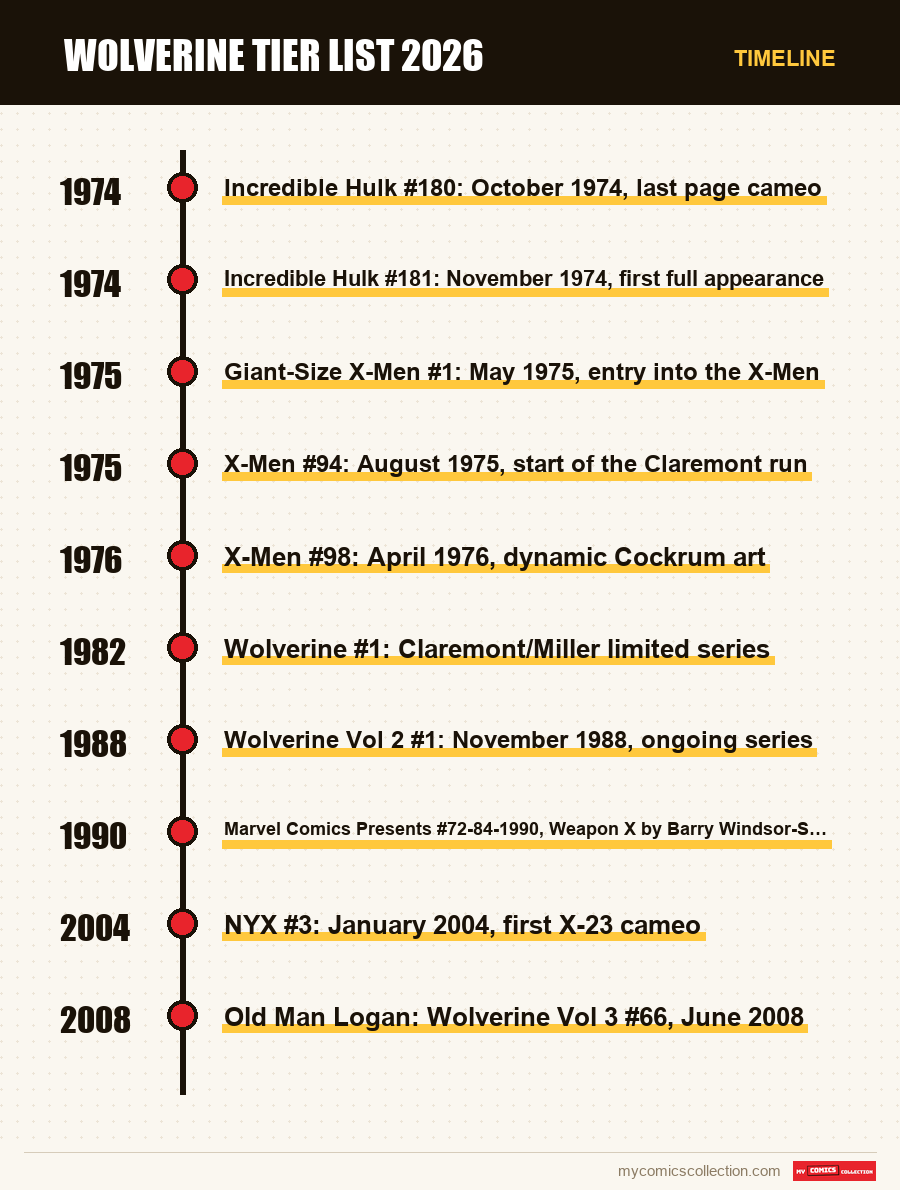
Tier S. The four unassailable Wolverine blue-chips
Le Tier S Wolverine brings together the four comics whose absence in a serious Wolverine collection is prohibitive. These coins concentrate the historical value of the character, dominate the secondary market in terms of liquidity, and resist speculative cycles. Buying these four issues, in whatever grade suits the budget, constitutes the heritage foundation of a collection.
Incredible Hulk #180: October 1974, last page cameo
Incredible Hulk #180, dated October 1974, written by Len Wein and drawn by Herb Trimpe, contains Wolverine's very first cameo, in a single panel, on the last page of the issue. The character appears there with his claws out, identified only by his Canadian silhouette in a forest setting. This unique box transformed an anonymous Hulk issue into one of the most coveted Bronze Ages on the market. The distinction between #180 (cameo) and #181 (full first) is crucial: serious collectors own both, but the speculator market often wrongly overlooks #180.
Rating May 2026: CGC 9.8 between $18,000 and $26,000 according to Heritage sales observed in March and April 2026. CGC 9.6 between $7,500 and $11,000. CGC 9.4 between $3,800 and $5,500. CGC 8.0 between $1,200 and $1,800. CGC 6.0 between $550 and $850. Raw VF (CGC 8.0-8.5 equivalent) between 700 and 1,100 euros. Raw F (CGC 4.0-5.0 equivalent) between 200 and 350 euros. The CGC 9.6 / raw VF ratio is around 12, which fully justifies the grading for copies in very high condition.
Incredible Hulk #181: November 1974, first full appearance
Incredible Hulk #181, dated November 1974, by Len Wein and Herb Trimpe, is the absolute Holy Grail Wolverine. This is the first full appearance, on the cover, with dialogue, action and clear character identification. The issue contains the Hulk vs Wolverine vs Wendigo fight in the Canadian forests, a sequence which forged the original iconography of the character. No other comic depicts Wolverine in a more historical way. To understand the specific pitfalls of this issue (newsstand vs direct, restoration, MVS Marvel Value Stamp intact or cut), see the dedicated file Hulk #181 Canadian Price Variant prime.
Price May 2026: CGC 9.8 between 45,000 and 72,000 dollars depending on presence of the MVS and provenance. CGC 9.6 between $18,000 and $28,000. CGC 9.4 between $8,500 and $13,000. CGC 9.0 between $4,500 and $6,800. CGC 8.0 between $2,200 and $3,200. CGC 6.0 between $900 and $1,400. CGC 4.0 between 450 and 700 dollars. Raw VF between 1,800 and 2,800 euros, raw F between 500 and 900 euros, raw GD between 200 and 400 euros. The CPV (Canadian Price Variant) range commands a premium of 30 to 80% depending on the grade. The number is one of the most counterfeited on the bronze age market, CGC authentication is non-negotiable above 3,000 euros of investment.
Giant-Size X-Men #1: May 1975, entry into the X-Men
Giant-Size X-Men #1, dated May 1975, written by Len Wein and drawn by Dave Cockrum, marks the character's major turning point: Wolverine leaves his role as a Canadian anti-Hulk villain to join the new X-Men team alongside Storm, Colossus, Nightcrawler, Thunderbird and Banshee. The issue is also the first full appearance of Storm, Nightcrawler, and Colossus, making it one of the most historically dense comics of Bronze Age Marvel. This density is unique: no other Marvel issue contains so many simultaneous major first appearances. Deadpool & Wolverine in July 2024 directly revived the rating, which never returned to its pre-film level.
Rating May 2026: CGC 9.8 between $28,000 and $42,000. CGC 9.6 between $9,500 and $14,500. CGC 9.4 between $4,500 and $7,000. CGC 9.0 between $2,200 and $3,200. CGC 8.0 between $1,100 and $1,700. CGC 6.0 between 480 and 750 dollars. Raw VF between 900 and 1,500 euros. Raw F between 300 and 500 euros. The issue is massively collected but the limited edition (compared to the regular series of the time) maintains a relative rarity. It is the Tier S coin with the most relevant liquidity/rating ratio on the market.
Wolverine #1 (1982): Claremont/Miller limited series
Wolverine #1, dated September 1982, written by Chris Claremont and drawn by Frank Miller, is the first Wolverine solo limited series, in 4 issues. This is the arc that established Wolverine as a character capable of carrying his own franchise, outside of the X-Men. Japanese history (Yashida, Mariko, Silver Samurai) has forged part of the lore which will be used in the films The Wolverine (2013) and several subsequent arcs. Frank Miller, at the top of his art after Daredevil, signs a cult cover which is among the most reproduced in the Marvel catalog.
Rating May 2026: CGC 9.8 between $1,800 and $2,800. CGC 9.6 between $650 and $1,000. CGC 9.4 between 280 and 450 dollars. CGC 9.0 between 150 and 230 dollars. Raw NM between 80 and 140 euros. Raw VF between 35 and 60 euros. The issue remains budget-friendly compared to the other three Tier S pieces, often making it the first acquisition in a serious Wolverine collection. The complete raw NM limited series (the 4 issues) costs between 200 and 350 euros, an excellent heritage value for a constrained budget. The cover of #1 remains a visual reference for all reissues.
Tier A: Wolverine secondary essentials
Le Tier A Wolverine brings together comics that immediately follow Tier S in importance, without reaching absolute blue-chip status. These four pieces are important for a coherent collection of the character and often offer a better entry price / upside potential ratio than the Tier S already historicized.
X-Men #94: August 1975, start of the Claremont run
X-Men #94, dated August 1975, marks the start of the legendary run by Chris Claremont (who wrote the script) with Dave Cockrum on the drawings. This is the first issue of the regular X-Men series with the new team formed in Giant-Size X-Men #1. The series, dormant since #66 (reprints since 1970), returns to its original numbering, which makes #94 conceptually crucial: it is the starting point for the entire golden age of the X-Men 1975-1991. Wolverine is a regular member of the team there, which consolidates his commercial integration.
Rating May 2026: CGC 9.8 between $9,500 and $14,000. CGC 9.6 between $4,200 and $6,500. CGC 9.4 between $1,800 and $2,800. CGC 9.0 between $900 and $1,400. CGC 8.0 between 450 and 700 dollars. CGC 6.0 between 220 and 350 dollars. Raw VF between 380 and 600 euros. Raw F between 130 and 220 euros. The CGC 9.4 / raw VF ratio is around 4 to 5, which makes grading profitable even on intermediate grades. The number appears in all lists Wolverine key numbers.
X-Men #98: April 1976, dynamic Cockrum art
X-Men #98, dated April 1976, contains some particularly dynamic Cockrum art on Wolverine, with the first iconic depiction of the character in a yellow-blue costume outside of a mask, and one of the first full-page demonstrations of his claws in action. The issue is part of the Sentinels/Steven Lang sequence which culminates in X-Men #100. Its rating is driven by the key issue art + arc Phoenix building combination.
Rating May 2026: CGC 9.8 between $3,800 and $5,800. CGC 9.6 between $1,400 and $2,200. CGC 9.4 between 650 and 950 dollars. CGC 9.0 between 280 and 450 dollars. CGC 8.0 between 140 and 220 dollars. Raw NM between 150 and 240 euros. Raw VF between 65 and 110 euros. Budget-friendly number in raw, with moderate but constant upside potential over 5-10 years. Long hold position preferred to short term spec.
Marvel Comics Presents #72-84-1990, Weapon X by Barry Windsor-Smith
Marvel Comics Presents #72 to #84, published between 1990 and 1991, contain the Weapon X arc written and drawn entirely by Barry Windsor-Smith. This arc is the first detailed revelation of Wolverine's origins and his adamantium augmentation in the Weapon X program. It is the arc that founded the modern iconography of the character and directly inspired the film X-Men Origins: Wolverine (2009) and several sequences of Logan (2017). #72 is the absolute key number in the sequence, marking the start of the arc.
Rating May 2026 for MCP #72: CGC 9.8 between 280 and 450 dollars. CGC 9.6 between 110 and 180 dollars. Raw NM between 25 and 45 euros. Raw VF between 12 and 20 euros. The complete series #72-84 in raw NM costs between 150 and 280 euros, making it the cheapest essential arc in the entire Wolverine mythology. For a complete Weapon X collection, details of the issues and side arcs are documented in Weapon X key numbers. This is the most relevant entry point for a Wolverine narrative collection.
Wolverine Vol 2 #1: November 1988, ongoing series
Wolverine Vol 2 #1, dated November 1988, written by Chris Claremont and drawn by John Buscema, launches the first monthly ongoing solo Wolverine series. This is the natural evolution of the 1982 limited series: Marvel validates the commercial viability of an autonomous series and invests in the long term with Claremont on the screenplay and Buscema, veteran of Conan, on the drawings. The series will run until #189 in 2003 and constitutes the character's reference solo run. The issue contains the introduction of the Patch identity and the Madripoor environment, which will remain central to the Wolverine mythology.
Rating May 2026: CGC 9.8 between 380 and 580 dollars. CGC 9.6 between 130 and 200 dollars. CGC 9.4 between 60 and 95 dollars. Raw NM between 30 and 50 euros. Raw VF between 12 and 22 euros. The issue remains very accessible in raw, which makes it a natural target for beginning collectors. The 36-month spec is moderate but the number deserves its Tier A place for its historical centrality.
Tier B: Wolverine Sleepers and Underrated Bows
Le Tier B Wolverine brings together the sleepers, that is to say the issues which deserve the attention of informed collectors but whose value the general market has not yet fully recognized. These coins often present the most relevant price/potential ratios at 24-36 months, with limited downside risk. Three typical examples in 2026.
NYX #3: January 2004, first X-23 cameo
NYX #3, dated January 2004, contains the first cameo of Laura Kinney aka X-23, female clone of Wolverine created for the animated series X-Men: Evolution before being included in the comics. The room became central after Logan (2017) with Dafne Keen and remains relevant for any spec around the future X-Men MCU reboot. NYX #3 is the cameo. The first full and cover appearance can be found in NYX #4, which sells for more in CGC 9.8 but is often a better tactical buy. For a detailed analysis of the franchise, see X-23 story in comics.
Rating May 2026 for NYX #3: CGC 9.8 between $800 and $1,300. CGC 9.6 between 320 and 480 dollars. CGC 9.4 between 150 and 230 dollars. Raw NM between 80 and 130 euros. Raw VF between 35 and 60 euros. The complete raw NM series (the 7 issues) costs between 280 and 450 euros, a likely increase if the X-Men MCU reboot includes X-23. The downside risk is low: even without adaptation, the rating doubled between 2018 and 2024 without any specific buzz.
Old Man Logan: Wolverine Vol 3 #66, June 2008
The bow Old Man Logan starts in Wolverine Vol 3 #66, dated June 2008, written by Mark Millar and drawn by Steve McNiven. The arc takes place over 8 issues (#66 to #72 plus annual #1) and presents a dystopian future where the villains have won. This is the direct inspiration for the film Logan (2017) and one of the most influential Wolverine arcs of the 21st century. #66 is the absolute key issue of the arc, first appearance of the Old Man Logan universe and several alternative characters.
Rating May 2026: CGC 9.8 between 180 and 280 dollars. CGC 9.6 between 75 and 120 dollars. Raw NM between 18 and 30 euros. Raw VF between 8 and 14 euros. The complete bow in raw NM costs between 100 and 180 euros, exceptional for such an influential modern bow. The upside potential comes from a future Old Man Logan TV adaptation mooted by Marvel Studios. Classic Tier B sleepers with excellent 5-year price/hold ratio.
Logan: A Distant Soil and independent arcs
Several Wolverine sleepers come from independent arcs or side series with little following in the general market. Logan (limited series 2008, Brian K. Vaughan / Eduardo Risso) in 3 issues offers a quality standalone arc with moderate speculative upside potential. Wolverine: Origins #10 (March 2007) contains the first appearance of Daken, Wolverine's biological son. Daken is a character who could return to the MCU. CGC 9.8 rating between 180 and 280 dollars in 2026, raw NM between 20 and 35 euros.
Sleepers Tier B to anticipate: everything related to the major antagonists that are still poorly adapted. Lady Deathstrike's first appearance in Daredevil #197 (August 1983) remains underpriced at 60-100 euros raw NM, despite its role in X2 (2003). The Mariko and Silver Samurai arc in Wolverine Vol 2 #1-10 also remains under-collected. To follow the evolution of sleepers, see comics investment update 2027 strategy pillar.
Tier C: Spec 2026-2027 and high-risk bets
Le Tier C Wolverine brings together high-risk speculative bets, the odds of which mainly depend on cinema or TV announcements not yet confirmed. These pieces should not exceed 5-10% of a Wolverine collection budget, but can outperform if the right catalyst arrives. Three speculative axes dominate in 2026.
Wolverine vs Sabretooth: modern arcs
The Wolverine/Sabretooth relationship remains one of the most exploitable rivalries in the Marvel catalog. Several recent arcs have revived the mythology: Wolverine Vol 7 #1 (March 2020) with Benjamin Percy, Sabretooth limited series 2022 by Victor LaValle, and the post-Reign of X Krakoa arcs. If Marvel Studios confirms a Sabretooth adaptation in the X-Men MCU reboot, Sabretooth's first appearances and major arcs could outperform. To understand the full history of the villain, see Sabretooth story in comics.
Key issues spec Sabretooth: Iron Fist #14 (August 1977) first appearance Sabretooth, already listed (CGC 9.6 between 1,800 and 2,800 dollars), therefore rather Tier A for Sabretooth, Tier C in the speculative Wolverine context. Mutant Massacre tie-in 1986 more accessible (raw NM 15-30 euros per issue). The speculative arc plays out at 12-24 months if a Sabretooth series is announced. Without announcement, these pieces retain their basic value.
Legacy Deadpool & Wolverine 2024
The movie Deadpool & Wolverine released in July 2024 revived the entire Wolverine rating chain. The upward effect remains partially active in 2026 on certain secondary key issues. The 2026 spec consists of anticipating possible sequels or spin-offs. Marvel Studios has not confirmed Deadpool & Wolverine 2, but the commercial success of the film (more than a billion dollars at the box office) makes a sequel likely. If it is confirmed at the end of 2026 or in 2027, the rating effect on the Deadpool / Wolverine crossover key issues could be significant.
Tier C spec parts to watch out for: New Mutants #98 (February 1991, first Deadpool) already very high (CGC 9.8 between 4,500 and 7,500 dollars), therefore Tier S in the Deadpool context, Tier C for pure Wolverine spec. Cable & Deadpool #43-44 (2007) with Wolverine appearance, raw NM 5-10 euros per issue, low cost spec with negligible downside. Wolverine/Deadpool: Decoy oneshot 2011, raw NM 8-15 euros.
Spec modern bows 2025-2026
Several recent arcs deserve Tier C monitoring. The new series Wolverine 2024 post-Krakoa, with screenwriter to be confirmed for the long-term run, can generate key issues if the arc meets critical success. The 1:25 and 1:50 incentive variants on the first issues offer a spec entry point at 80-180 euros, with a potential increase of 200 to 400% if the arc becomes cult. The downside risk remains high: a modern arc that does not score can see its variants drop by 60% in 18 months.
Rule of thumb Tier C 2026: do not exceed 100-300 euros per individual spec bet, diversify across 5-8 different coins, set a resale threshold at +100% gross. For a spec portfolio discipline, see investment strategy update 2027.
Collecting this series?
Track what you own, what you are missing and what your collection is worth. 7 day trial.
Start my trial →Purchasing strategy by budget: 500, 2,000, 10,000, 50,000 euros
La Wolverine purchasing strategy depends directly on the available budget and the hold horizon. Four budget profiles are rational for 2026, each with an optimal mix of tiers.
Budget 500 euros: Wolverine beginner collection
At 500 euros, the objective is heritage access without grading. Suggested allowance: 80 euros for Wolverine #1 (1982) raw VF, 60 euros for Wolverine Vol 2 #1 (1988) raw NM, 30 euros for X-Men #98 raw VF, 150 euros for the complete series MCP #72-84 raw NM (Weapon X), 80 euros for Old Man Logan full bow raw NM, 100 euros for 4-5 key secondary issues bronze age and modern. This allocation covers all major character arcs without grading, at an affordable budget. The complete raw collection constitutes an excellent reading and heritage base.
Budget 2,000 euros: Wolverine intermediate collection
At 2,000 euros, the introduction of grading on key parts becomes relevant. Suggested allowance: 800 euros for X-Men #94 raw F-VF or CGC 6.0-7.0, 250 euros for Wolverine #1 (1982) CGC 9.0-9.2, 150 euros for Wolverine Vol 2 #1 CGC 9.4, 200 euros for MCP #72 CGC 9.6, 250 euros for Old Man Logan full bow plus CGC 9.6 on Wolverine Vol 3 #66, 250 euros for 8-10 Tier B raw NM sleepers (NYX, Wolverine Origins #10, Sabretooth bows). This allocation builds a serious collector's collection with grading accents on key narrative pieces.
Budget 10,000 euros: Wolverine investor collection
At 10,000 euros, the purchase of a Tier S part becomes possible. Suggested allocation: 5,000 euros for Incredible Hulk #181 CGC 6.0 (the cardinal part), 2,000 euros for Incredible Hulk #180 CGC 7.0-8.0, 1,200 euros for Giant-Size X-Men #1 CGC 7.0-8.0, 800 euros for X-Men #94 CGC 8.0, 500 euros for the complete Tier A raw NM collection, 500 euros for 5-7 Tier B sleepers. The portfolio combines investment (authenticated Tier S grading) and complete narrative collection. Hold target for 7-10 years with rebalancing every 24 months.
Budget 50,000 euros: Wolverine heritage collection
At 50,000 euros, the objective becomes the creation of a museum collection. Suggested allocation: 25,000 euros for Incredible Hulk #181 CGC 9.0-9.2, 8,000 euros for Incredible Hulk #180 CGC 9.0-9.2, 7,500 euros for Giant-Size X-Men #1 CGC 9.2-9.4, 3,500 euros for X-Men #94 CGC 9.0-9.2, 2,000 euros for Wolverine #1 (1982) CGC 9.8, 1,500 euros for Wolverine Vol 2 #1 CGC 9.8 and MCP #72 CGC 9.8, 2,500 euros for complete Tier B collection in CGC 9.6-9.8, cash reserve for opportunities. For the logistical management of this level of collection, see comics manager complete guide.
Cautious method. Whatever the budget bracket, do not exceed 60% of the envelope on a single Tier S part. Incredible Hulk #181 monopolizes a budget, the collection loses its narrative coherence. Diversification between Tier S, A and B remains the key to a balanced Wolverine collection.
Wolverine pitfalls: CPV, newsstand vs live, catering
Four technical pitfalls characterize the Wolverine market and cause the most costly mistakes among beginning and intermediate collectors. Identifying them determines the quality of any Tier S investment.
Trap 1: Incredible Hulk #181 newsstand vs direct edition
For bronze age post-1973, two versions are circulating: the newsstand (sold on newsstands, with UPC barcode) and the direct edition (sold in comic shops, without barcode or with specific mention). On Incredible Hulk #181, the distinction mainly concerns later reissues and first circulations. The original 1974 issue does not have a standardized direct edition since the practice of direct market only appeared from 1979. But the Marvel facsimile editions from the 2010s and 2020s reproduce identically, and some unscrupulous sellers present them as originals. Systematically check the copyright notice and the cover price (25 cents original, 35 cents Canadian Price Variant).
Trap 2: Canadian Price Variant (CPV)
The Canadian Price Variant designates a limited series of copies distributed in Canada from the end of 1974, with a specific cover price in Canadian cents (35 cents instead of 25 cents for Incredible Hulk #181). The CPV circulation represents approximately 10% of the total circulation, which justifies a significant odds premium. In CGC 9.8, a Incredible Hulk #181 CPV sells for between $80,000 and $120,000, 50-80% above the standard US version. The CPV distinction is noted explicitly on the CGC slab. For technical details of identification, see Hulk #181 Canadian Price Variant prime.
Trap 3: undeclared catering
Bronze Age Marvel, in particular Incredible Hulk #180 and #181, are massively restored on the secondary market. Restoration consists of recoloring, regluing, rewhitening or retouching a copy to artificially increase its visual grade. CGC systematically identifies the restoration, which appears on the slab with the purple label "Restored" rather than blue label "Universal". A restored example is typically worth 30 to 60% of a Universal example of equivalent grade. On the raw market, detection is complex: UV lighting, observation of edges, checking the whiteness of pages. Buying raw for more than 1,000 euros without expertise is risky.
Trap 4: Marvel Value Stamp die cut
Marvel comics from 1974-1976 contained a Marvel Value Stamp (MVS), a sticker to cut out and paste into a collector's album. Many copies of Incredible Hulk #181 were cut by their original owners, which automatically makes them ineligible for grades above 1.8 at CGC. Check the presence of intact MVS before any raw purchase. On the rating, a #181 with cut MVS loses 30 to 50% compared to an intact MVS, even if the rest of the issue is in excellent condition.
Monitoring 2026-2030: resale windows and cycles to anticipate
Le long-term follow-up Wolverine over 2026-2030 must integrate several probable catalysts. Marvel Studios has not confirmed a firm date for the X-Men MCU reboot, but internal projections point to 2027 or 2028. This window constitutes the likely speculative peak for Tier S Wolverines, with a potential increase estimated between 15 and 35% on blue-chips (already high rating, limited margin) and between 40 and 90% on Tier A and B linked to secondary characters.
Indicative calendar 2026-2030. Year 2026: residual effect Deadpool & Wolverine 2024 still partially active, optimal purchasing window on Tier B and C before escalation. Year 2027: if announcement closes X-Men MCU reboot, start of the major speculative cycle, purchase window closes on Tier S and A. Year 2028: probable speculative peak around the release of the Year 2029: post-peak digestion, rating stabilized or slightly decreasing, waiting for the next catalyst. Year 2030: new cycle possible with sequel or spin-off.
The empirical rule observed on major Marvel key issues over 15 years: 60% of the pre-film increase occurs in the 12 months preceding the release, 25% at the release, 15% in the following 6 months. Beyond that, partial descent of 15 to 30%. For Tier S Wolverines, the 2028 peak should represent a partial resale opportunity (particularly on parts purchased in 2024-2026 at still reasonable prices). The optimal resale window extends from May to December 2028 according to this cycle.
Daily monitoring of Tier S ratings requires a tracking tool. A rating recorded in a notebook or static file is obsolete within 60 days. A Comics Manager whose estimates follow each grade on eBay provides the necessary refreshment to manage a 36-60 month hold strategy, and saved eBay searches cover the alert side. See the comics database et the list of key issues to quickly identify arbitrage opportunities. To estimate the current value of coins already owned, the free estimate provides an indicative range by grade and state.
FAQ: Wolverine 2026 Tier List
Why are Incredible Hulk #180 and #181 both Tier S?
Because they represent two distinct and complementary stages of the first appearance. #180 contains the last page cameo (a single panel), #181 contains the first complete appearance, on the cover, with action and dialogue. Both are historically necessary for serious collecting. The market prioritizes them (#181 remains 2 to 3 times more expensive in CGC 9.8), but no accomplished Wolverine collector is satisfied with just one of the two. Full narrative density requires ownership of both issues.
Is Wolverine #1 (1982) really Tier S at $1,800-$2,800 in CGC 9.8?
Yes, and this is precisely what makes it the most accessible Tier S part. The entry price/historical value ratio is exceptional: for a quarter of the price of a Hulk #180 in equivalent grade, you gain access to the start of the Wolverine solo franchise, a legendary Claremont/Miller arc, and a cult cover. This is the first logical Tier S acquisition for an intermediate budget (5,000-10,000 euros). Beyond grade 9.8, #1 from 1982 remains accessible up to CGC 9.0 under $250, unlike the other three Tier S.
Does Marvel Comics Presents #72-84 really deserve Tier A?
Without hesitation. Barry Windsor-Smith's Weapon X arc is one of the most narratively important Wolverine arcs ever published, founding the character's entire origin mythology. The market undervalues these issues (raw NM at 12-45 euros) because it is an anthology series and not a dedicated solo series, but the historical importance is confirmed at level A. The entry cost/narrative value ratio is one of the best in the Marvel Bronze Age and Early Modern catalog. This is the most relevant recommendation for a beginner collector.
Is Old Man Logan Wolverine Vol 3 #66 a better buy than the 2010s arcs?
Yes, due to its direct influence on the film Logan (2017) and the fact that it represents a major narrative tipping point in the character's history. The Wolverine arcs of the 2010s (Death of Wolverine 2014, Return of Wolverine 2018) have their interest but do not have the cultural impact of Old Man Logan. The ratio of entry price at 18-30 euros raw NM compared to the narrative importance and the potential future TV adaptation makes it a perfect Tier B sleepers.
Should we favor raw or CGC for a Wolverine 2026 collection?
The rule depends on the tier. For Tier S, CGC grading is non-negotiable above 1,500 euros investment per piece: undeclared counterfeits and restorations make raw too risky. For Tier A, CGC grading is justified from CGC 9.4-9.6, where the raw price / CGC price ratio justifies the cost of grading (60 to 100 dollars per copy). For Tier B and C, raw remains the main option, except in the exceptional case of pristine candidate 9.8. For the CGC submission method from France, see the dedicated guide in the Wolverine cluster.