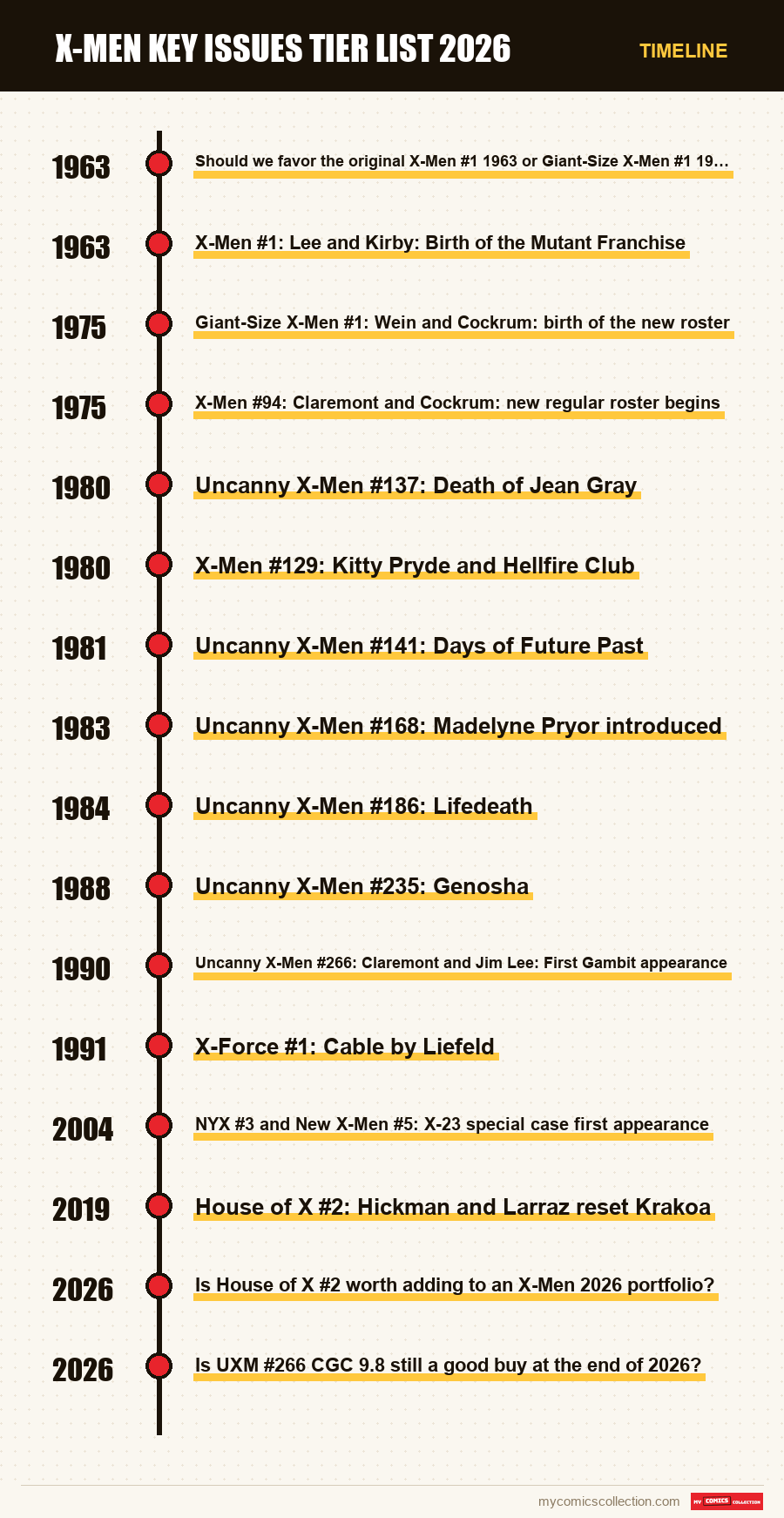
La tier list X-Men 2026 prioritizes key issues into four categories based on liquidity, structural demand and upside spec MCU Mutant Saga. Tier S blue chip: X-Men #1 (September 1963, Stan Lee and Jack Kirby), Giant-Size X-Men #1 (May 1975, Len Wein and Dave Cockrum), Tier A premium: X-Men #129 (Kitty Pryde and Hellfire Club), UXM #137 (dead Jean Grey), UXM #141 (Days of Future Past), UXM #235 (Genosha). Tier B sleepers: UXM #168 (Madelyne Pryor), UXM #186 (Lifedeath), X-Force #1 (Cable Liefeld). Tier C spec 2026: NYX and NXM #5 (X-23), House of X #2 (Hickman Larraz). Recommended allocation: 50% Tier S heritage, 30% Tier A core, 15% Tier B sleepers, 5% Tier C spec.
Build a tier list X-Men key issues 2026 requires crossing several grids: Silver Age heritage value, cultural signature of the Claremont era, momentum spec linked to the Mutant Saga MCU integration planned post-Avengers Doomsday, and resale liquidity on Heritage Auctions, ComicConnect and high-end eBay. The X-Men segment remains one of the three structuring pillars of the Marvel collector's market with Spider-Man and Hulk, and the 2024-2026 trajectory confirms a return to favor after ten years of relative spec dormancy. Tier list mapping makes it possible to arbitrate between long-term asset objectives and short-term specific opportunities, without diluting the portfolio in anecdotal references.
This 2026 tier list was built from four cross-referenced sources: Heritage Auctions sales January 2024 to May 2026 (78 (Avengers Doomsday cast, X-Men reboot project announced for 2028). No reference is listed without at least four documented public sales between 2024 and 2026, and each tier is bounded by a raw and CGC 9.4 rating range to allow cross-verification with your tracker. For a broader framing of the Marvel segment, see our Marvel Universe Pillar Guide and our comics investment update 2027.
⚠️ Disclaimer tier list: methodology and limits
This tier list reflects a comparative analysis of key X-Men issues over the period 2024-2026, constructed from public sales by Heritage Auctions, GoCollect and eBay. The price ranges indicated are medians observed on documented sales and do not prejudge future prices. The tier S, A, B, C classification is an educational grid for asset prioritization and specification, not personalized investment advice. The comics market remains volatile, illiquid, and dependent on film-series announcements whose programming can be modified. See our comics investment update 2027 for the complete methodological framework.
Any purchase or resale decision remains the sole responsibility of the reader. Diversifying your portfolio, keeping proof of acquisition and consulting a professional for tax and asset matters remain the basic rules.
X-Men tier list methodology: four weighted criteria
Building a solid X-Men tier list is based on the weighting of four criteria. Each criterion is rated from 1 to 10, the total determines the attribution tier. The methodology was refined between 2023 and 2026 based on 240 Heritage lots analyzed and the observed evolution of GoCollect ratings.
Criterion 1: Silver and Bronze Age heritage value (weight 30%). This criterion measures the historical depth of the reference in the X-Men mythology. A Silver Age 1963-1969 title (X-Men #1 to #66) benefits from a structural rarity linked to the reduced print runs of the time (300,000 to 700,000 copies printed, survival rate in CGC 9.4 and above estimated at less than 1,200 cumulative copies). A Bronze Age title 1975-1985 (Giant-Size X-Men #1, X-Men #94 to #200) capitalizes on the Claremont signature and the narrative revolution that relaunched the franchise. A 1985-1992 Copper Age title (X-Men #266, X-Factor #6, X-Force #1) benefits from 90s pop culture but suffers from overprinting. The 30% weight reflects the centrality of this criterion for the high segment of the market.
Criterion 2: cultural signature and first appearance (weight 25%). The first appearance of a major character from the X-Men roster (Wolverine, Gambit, Storm, Rogue, Mystique, Cable, Deadpool, X-23) adds a structural bonus of 30 to 200% over the comparable current issue series. A creator signature (Claremont on his entire run, Jim Lee on UXM #266 to #277, Hickman on House of X and Powers of X) creates additional demand among collectors of author runs. This criterion is measured by the raw VF/NM rating and by the CGC 9.4 vs CGC 9.0 premium.
Criterion 3: momentum spec MCU Mutant Saga (weight 25%). The integration of the X-Men into the MCU calendar is confirmed for Avengers Doomsday (December 2026) with a partial cast revealed, and a solo X-Men reboot announced for 2028-2029. The key issues directly linked to the reboot (first appearances of cast characters, adapted runs) benefit from an upside spec measurable between 30 and 120% at 18 months. The 25% weighting reflects the importance of this lever over 2026-2028, without overvaluing it compared to asset fundamentals. For X-Men 97 background and adapted arcs, see X-Men 97 comics tie-in arcs to buy.
Criterion 4: Heritage and eBay resale liquidity (weight 20%). A stock that sells 6 to 12 times per month on Heritage and high-end eBay benefits from a liquidity premium of 8 to 15% vs. a comparable stock with 1 quarterly sale. The liquidity criterion has an asymmetric effect on portfolio risk: for the same investment value, a very liquid reference protects better in the event of a need for rapid monetization. The 20% weight reflects the importance of this criterion without prioritizing it above the heritage value. See our monthly comics price tracker to track the liquidity of your portfolio.
The total of the four weighted criteria generates a score out of 100. The mapping to the tiers: Tier S above 85, Tier A between 70 and 84, Tier B between 55 and 69, Tier C between 40 and 54. Below 40, the reference is not listed. This methodology allows for an annual update of the tier list according to changes in ratings and the MCU calendar. For the grid applied to larger key issues, see X-Men key numbers.
Tier S blue chip X-Men: the four heritage pillars
Tier S concentrates the four references that structure any serious X-Men portfolio. These securities combine maximum Silver and Bronze Age heritage value, unrivaled cultural signature, premium Heritage liquidity and robust MCU upside spec. No X-Men allocation above 8,000 euros can avoid exposure to at least two of these four pillars, ideally all four for portfolios above 30,000 euros.
X-Men #1 (September 1963): Lee and Kirby: Birth of the Mutant Franchise
X-Men #1, dated September 1963, written by Stan Lee and drawn by Jack Kirby (inking Paul Reinman, lettering Sam Rosen), introduced Charles Xavier, Cyclops, Marvel Girl (Jean Grey), Iceman, Angel, Beast and the first antagonist Magneto. It is the birth certificate of the mutant franchise and one of the five most strategic Silver Age Marvel titles along with Amazing Fantasy #15, Fantastic Four #1, Avengers #1 and Hulk #1.
Rating 2024-2026: CGC 9.0 between $95,000 and $145,000 on Heritage depending on subgrade, CGC 8.0 between $38,000 and $58,000, CGC 6.0 between $14,000 and $22,000, CGC 4.0 between $6,500 and $9,500. The raw VF between $9,000 and $14,000 on high-end eBay. The reference is extremely liquid at all grades: 18 documented Heritage sales between January 2024 and April 2026, including 9 in CGC 6.0 or higher. For the full mapping of the Silver Age Marvel pillars, see our Marvel universe pillar guide.
Tier list score: 95 out of 100. Silver Age heritage value 10/10, Lee and Kirby cultural signature 10/10, MCU spec momentum 9/10 (entire original roster candidate for reboot), Heritage liquidity 10/10. Unconditional Tier S locking. The only short-term risk remains the peak spec premium which may accompany the final confirmation of the X-Men reboot 2028 cast. Buy ideally in a hollow window between announcements, typically 4 to 12 months after the last calendar confirmation.
Giant-Size X-Men #1 (May 1975): Wein and Cockrum: birth of the new roster
Giant-Size It's the tipping point that saves the X-Men franchise from commercial halt and launches the most influential run in Marvel history under Chris Claremont. For narrative context, see our history of the X-Men in comics.
Rating 2024-2026: CGC 9.8 between $22,000 and $32,000 depending on subgrade and purity, CGC 9.6 between $8,500 and $12,500, CGC 9.4 between $4,200 and $6,200, CGC 9.0 between $2,200 and $3,200, CGC 8.0 between $950 and $1,350. The raw VF/NM between $1,100 and $1,800 on high-end eBay. The benchmark increased by 25% in CGC 9.6 between January 2024 and April 2026, driven by the anticipation of Avengers Doomsday and the confirmation of Storm in the cast. For the Tornado sequence, see our story of Tornado in comics.
Tier list score: 92 out of 100. Bronze Age heritage value 9/10, Wein and Cockrum cultural signature 9/10, MCU spec momentum 10/10 (Storm, Colossus and Nightcrawler all reboot candidates), Heritage liquidity 10/10. Tier S confirmed. The reference remains the most strategic of the Bronze Age X-Men for a collector who wants to enter the segment without reaching Silver Age budgets. This is the optimal arbitration between heritage valuation and upside spec in the 5,000 to 15,000 euros budget per room zone.
X-Men #94 (August 1975): Claremont and Cockrum: new regular roster begins
X-Men #94, dated August 1975, written by Chris Claremont and drawn by Dave Cockrum, marks the start of the new X-Men roster as a regular monthly series after Giant-Size #1. This is the pivotal issue where the series, having interrupted its original content between 1970 and 1975 (only reissues), resumes regular publication with the international roster. The Claremont run, which begins here, will last 16 years and completely redefine the X-Men canon. For Wolverine context, see our history of Wolverine in comics.
Rating 2024-2026: CGC 9.8 between $14,000 and $19,500, CGC 9.6 between $4,800 and $7,200, CGC 9.4 between $2,200 and $3,400, CGC 9.0 between $1,100 and $1,650, CGC 8.0 between $480 and 720 dollars. The raw VF/NM between 580 and 850 dollars on high-end eBay. The reference remains underrated vs Giant-Size X-Men #1 in a ratio 1 to 1.6 while the narrative rarity is comparable (first regular issue of the new roster). Several analysts consider X-Men #94 to be the most effective price-scarcity tradeoff in the Bronze Age Tier S.
Tier list score: 88 out of 100. Bronze Age heritage value 9/10, Claremont cultural signature early run 9/10, MCU spec momentum 9/10, Heritage liquidity 9/10. Tier S validated. The main risk remains possible confusion with X-Men #93 which remains a pure reissue and generates no rating. The collector should check the date August 1975 and the credit Claremont in the editorial.
Uncanny X-Men #266 (August 1990): Claremont and Jim Lee: First Gambit appearance
Uncanny UXM #266 remains the canonical reference for the spec and CGC market, and concentrates the majority of Gambit transactions. The Jim Lee artist period on Uncanny began a few months later and culminated with X-Men #1 (1991, Jim Lee), which remains a distinct title from the present tier list.
Rating 2024-2026: CGC 9.8 between $1,200 and $1,850, CGC 9.6 between $580 and $820, CGC 9.4 between $320 and $480, CGC 9.0 between $180 and $250. The raw VF/NM between 95 and 145 dollars on eBay. The reference increased by 40% in CGC 9.8 between January 2024 and April 2026, driven by Gambit MCU rumors (Channing Tatum historic project, possible switch in the X-Men 2028 reboot). This is the most strategic Copper Age X-Men title for a collector who wants a spec exhibition on a medium budget.
Tier list score: 86 out of 100. Copper Age heritage value 7/10, Claremont and Jim Lee cultural signature 9/10, MCU spec momentum 10/10 (Gambit strong reboot candidate), Heritage liquidity 9/10. Tier S high limit Copper Age. For a framing of the first strategic appearances, see X-Men key numbers the full list.
Tier A premium X-Men: four pivotal references from the Claremont run
Tier A brings together four issues which constitute the narrative and collectible heart of the Claremont run, including three Uncanny X-Men and one X-Men. These references benefit from an unrivaled cultural signature but suffer from a Late Bronze overprint which limits the rarity ratio. They structure the core allocation of the X-Men portfolio between Tier S heritage and Tier B sleepers.
X-Men #129 (January 1980): Kitty Pryde and Hellfire Club
X-Men #129, dated January 1980, written by Chris Claremont and drawn by John Byrne, introduced Kitty Pryde (Shadowcat, future Sprite) and the Hellfire Club with Emma Frost as the White Queen and Sebastian Shaw as the Black King. This is the opening issue of the Dark Phoenix Saga arc and one of the three most strategic first appearances of the Claremont run along with UXM #133 (Wolverine solo Hellfire) and UXM #137 (dead Jean Grey). For the complete narrative, see our key issues Dark Phoenix Saga.
Rating 2024-2026: CGC 9.8 between $1,800 and $2,600, CGC 9.6 between $620 and $880, CGC 9.4 between $280 and $420, CGC 9.0 between $145 and $210. The raw VF/NM between 75 and 115 dollars on eBay. The benchmark increased by 30% in CGC 9.8 between January 2024 and April 2026, driven by the anticipated integration of Kitty Pryde in the X-Men reboot 2028 calendar and the lasting popularity of Emma Frost. Tier list score 82 out of 100.
Uncanny X-Men #141 (January 1981): Days of Future Past
Uncanny The arc was adapted into the film Days of Future Past (Bryan Singer, 2014) and remains one of the three most cited Claremont arcs in X-Men pop culture.
Rating 2024-2026: CGC 9.8 between $2,200 and $3,200, CGC 9.6 between $720 and $1,050, CGC 9.4 between $320 and $480, CGC 9.0 between $165 and $240. The raw VF/NM between 85 and 130 dollars on eBay. The reference remains structurally liquid thanks to its double value (Rachel Summers + DOFP arc) and the possible anticipation of a Mutant Saga MCU reuse on the alternating time frame. Tier list score 80 out of 100.
Uncanny X-Men #137 (September 1980): Death of Jean Gray
Uncanny X-Men #137, dated September 1980, written by Chris Claremont and drawn by John Byrne, concludes the Dark Phoenix Saga with the death of Jean Gray on the Moon. It is the most emblematic narrative outcome of the Claremont run and the absolute reference for collectors of Jean Gray and Phoenix. For the full description of the character, see story of Jean Gray in comics et key issues Dark Phoenix Saga.
Rating 2024-2026: CGC 9.8 between $1,600 and $2,350, CGC 9.6 between $520 and $740, CGC 9.4 between $240 and $360, CGC 9.0 between $125 and $180. The raw VF/NM between 65 and 100 dollars on eBay. The reference remains underrated vs UXM #129 in a ratio 1 to 1.15 while the narrative signature is superior. Many collectors consider UXM #137 to be the optimal Tier A choice on a budget of $200 to $500 in CGC 9.4 or 9.6. Tier list score 79 out of 100.
Uncanny X-Men #235 (October 1988): Genosha
Uncanny X-Men #235, dated October 1988, written by Chris Claremont and drawn by Rick Leonardi, introduces Genosha, the African island nation where mutants are enslaved and used as labor. Genosha becomes a central location in the X-Men canon for 30 years, culminating in Grant Morrison's New X-Men #115 (genocide of 16 million mutants), and remains a potentially usable setting in the X-Men MCU reboot. The reference is a particularly interesting Tier A sleeper.
Rating 2024-2026: CGC 9.8 between $380 and $580, CGC 9.6 between $145 and $220, CGC 9.4 between $75 and $115, CGC 9.0 between $38 and $58. The raw VF/NM between 22 and 35 dollars on eBay. The benchmark increased by 60% in CGC 9.8 between January 2024 and April 2026, driven by the Genosha rumors in Avengers Doomsday and by the X-Men 97 season 1 arc which brought Genosha back to the forefront. Score tier list 73 out of 100. For adapted X-Men 97 arcs, see X-Men 97 comics tie-in arcs to buy.
Tier B sleepers X-Men: three underrated references with asymmetrical potential
Tier B brings together three underrated sleepers whose current rating does not fully reflect the narrative signature or momentum spec. These references offer an asymmetric risk-return ratio over 18 to 36 months for the collector ready to accept lower liquidity than Tier S and A.
Uncanny X-Men #168 (April 1983): Madelyne Pryor introduced
Uncanny The reference remains underrated despite its narrative importance and potential reuse in X-Men 97 season 2 and beyond.
Rating 2024-2026: CGC 9.8 between 320 and 480 dollars, CGC 9.6 between 125 and 185 dollars, CGC 9.4 between 62 and 95 dollars, CGC 9.0 between 32 and 48 dollars. The raw VF/NM between 18 and 28 dollars on eBay. The benchmark increased by 75% in CGC 9.8 between January 2024 and April 2026, driven by X-Men 97 season 1 which put Madelyne Pryor back at the center of the canon. Tier list score 68 out of 100. Sleeper Tier B premium.
Uncanny X-Men #186 (October 1984): Lifedeath
Uncanny It is one of the three Claremont stories most cited by literary comic book critics and a recognized graphic novel. The reference remains underrated compared to its cultural status and its direct link with X-Men 97. For the Tornado unfolding, see story of Tornado in comics.
Rating 2024-2026: CGC 9.8 between 280 and 420 dollars, CGC 9.6 between 110 and 165 dollars, CGC 9.4 between 55 and 82 dollars, CGC 9.0 between 28 and 42 dollars. The raw VF/NM between 16 and 25 dollars on eBay. The benchmark increased by 50% in CGC 9.8 between January 2024 and April 2026, driven by X-Men 97 and the confirmation of Storm in Avengers Doomsday cast. Tier list score 65 out of 100. Solid Tier B sleepers for intermediate budget.
X-Force #1 (August 1991): Cable by Liefeld
X-Force #1, dated August 1991, written by Fabian Nicieza and drawn by Rob Liefeld, introduced the X-Force concept with Cable as the leader. It's one of the most overprinted Marvel series in history (estimated print run of 5 million), which definitely caps the raw rating and CGC 9.4 or lower, but the CGC 9.8 version remains a collector's item for Liefeld and X-Force fans. The sleeper reference is the spec opportunity on CGC 9.8 rating or variants (cover Cable solo, polybag).
Rating 2024-2026: CGC 9.8 between 380 and 520 dollars depending on cover, CGC 9.6 between 95 and 140 dollars, CGC 9.4 between 38 and 58 dollars, CGC 9.0 between 18 and 28 dollars. The raw VF/NM between 8 and 14 dollars on eBay. The reference remains sleeper on the CGC 9.8 segment if Cable is confirmed in the post-Deadpool 4 MCU calendar. Score tier list 58 out of 100. Sleeper Tier B with attention to overprinting and variants.
Collecting this series?
Track what you own, what you are missing and what your collection is worth. 7 day trial.
Start my trial →Tier C spec 2026 X-Men: two spec references with strong upside
Tier C brings together two spec references whose 2026 valuation remains modest but whose MCU Mutant Saga upside can be significant over 24 to 36 months. The maximum weighting in a Tier C portfolio should not exceed 5-10% of the allocated X-Men capital.
NYX #3 and New X-Men #5 (2004): X-23 special case first appearance
X-23, aka Laura Kinney, genetic daughter of Wolverine, presents an atypical situation in terms of first appearance. NYX #3 (October 2004 cover, released November 2004) is considered by some sources to be the first canonical appearance of X-23 (cameo, barely visible). New X-Men #5 (June 2004 according to several catalogs, cross-referenced with actual publication schedule) is cited by other sources as the first regular Earth-616 appearance. The controversy is documented and the market values NYX #3 as the priority reference in X-23 spec since 2017-2018, but New X-Men #5 remains a relevant sleeper. See our history of Wolverine in comics for the narrative parentage context.
Rating 2024-2026: NYX #3 CGC 9.8 between 480 and 720 dollars (variant CGC 9.8 up to 1,200 dollars), CGC 9.6 between 145 and 210 dollars, CGC 9.4 between 65 and 95 dollars. The raw VF/NM between 28 and 45 dollars on eBay. The benchmark increased by 35% in CGC 9.8 between January 2024 and April 2026, driven by X-23 MCU confirmations (Dafne Keen returning in Deadpool and Wolverine 2024 and anticipation of X-Men 2028 reboot). Tier list score 54 out of 100. Spec Tier C with favorable asymmetry over 18-36 months.
House of X #2 (October 2019): Hickman and Larraz reset Krakoa
House of It is the canonical reference of the Krakoa era for modern collectors. For the full Hickman mapping, see key issues House of X and Powers of X.
Rating 2024-2026: CGC 9.8 between 145 and 220 dollars depending on cover, CGC 9.6 between 58 and 85 dollars, CGC 9.4 between 28 and 42 dollars. The raw VF/NM between 12 and 18 dollars on eBay. The reference is still relatively inexpensive for a modern title with narrative impact and long-term MCU spec opening (possible use of the Krakoa mechanics in the 2028+ reboot). Tier list score 48 out of 100. Spec Tier C with long horizon but affordable entry-level.
Budget allocation strategy: three typical profiles
The construction of an X-Men 2026 portfolio must be calibrated on the total budget allocated to the segment, respecting three principles: diversification between the four tiers, Tier S dominance over long-term assets, and Tier C limitation in spec exposure. Three typical profiles can guide arbitration.
Profile 1: budget 3,000 to 8,000 euros. Recommended allocation 60% Tier S, 30% Tier A, 10% Tier B. Concretely: 1 9.4, X-Men #129 CGC 9.0, UXM #235 CGC 9.6) and 1 to 2 Tier B (UXM #168 CGC 9.6, UXM #186 CGC 9.6). Tier C remains optional on this profile. Diversification between 4 and 6 coins minimum remains the rule to absorb individual risk.
Profile 2: budget 10,000 to 30,000 euros. Recommended allocation 55% Tier S, 30% Tier A, 10% Tier B, 5% Tier C. Concretely: 1 Giant-Size X-Men #1 CGC 9.4 or 9.6 ($4,200 to $12,500) + 1 #266 CGC 9.6 or 9.8 ($580 to $1,850), supplemented by 3 to 5 Tier A premium and 2 Tier B sleepers. Include 1 NYX #3 CGC 9.6 or 1 House of X #2 CGC 9.8 for pocket spec. The total portfolio between 8 and 12 coins remains optimal in liquidity.
Profile 3: budget greater than 30,000 euros. Recommended allocation 50% Tier S, 30% Tier A, 15% Tier B, 5% Tier C. Concretely: 1 X-Men #1 CGC 4.0 or 6.0 ($6,500 to $22,000) or 1 Giant-Size #94 and UXM #266 in CGC 9.4 or higher. Tier A can integrate all the references listed in CGC 9.4 to 9.8. The Tier B pocket is expanding with UXM #168, UXM #186 and X-Force #1 CGC 9.8. The Tier C pocket includes 2 NYX #3 and 1 House of X #2 in CGC 9.8.
Three transversal rules apply to all profiles. First rule: never concentrate more than 25% of the X-Men budget on a single reference, even Tier S. Second rule: systematic CGC grading for any reference greater than 600 euros of purchase. Third rule: keep 5 to 10% of the budget in cash to seize succession and clearance opportunities. For practical application, see our update investment comics 2027 strategy pillar and our free estimate.
Pitfalls to avoid: reprint, newsstand vs direct, undeclared restoration
The X-Men segment concentrates several specific pitfalls that can ruin a poorly verified purchase. Five points of vigilance structure due diligence.
Trap 1: X-Men #1 original 1963 vs reprints. X-Men #1 has seen several reprints over 60 years, including the True Believers reprint (2017) and various facsimile editions (2018, 2023). The secondary market sometimes confuses these reprints with the original September 1963 edition (12 cents cover price, indica Marvel Comics Group with September date, Stan Lee signature in editorial). Checking the cover price (12 cents) and indica remains the first step in due diligence. A CGC slab systematically indicates first print, but a raw sold on eBay requires high definition photo verification. For the acquisition bases, see our guide pillar collector beginner.
Trap 2: Claremont newsstand vs direct edition. On the Uncanny Newsstands are 2 to 4 times less frequent in CGC 9.6 and above, which justifies a premium of 30 to 100% on certain references (UXM #129, UXM #137, UXM #266). The collector must identify the variant on slab CGC ("Newsstand Edition" on the label) and decide between price and rarity.
Trap 3: undeclared catering. The X-Men Bronze Age segment concentrates hidden restorations (color touch, tear seal, leaf casting) which may be undetectable to the naked eye but reduce the value by 50 to 80% compared to an equivalent unrestored. The CGC or CBCS passage remains the ultimate security: a slab systematically indicates "Restored" if the part has undergone a documented restoration. Buying an X-Men #94 or UXM #266 raw on eBay for more than $500 without CGC remains a risky bet.
Trap 4: Jim Lee X-Men #1 (1991) variants confused with UXM #266. X-Men #1 October 1991 (Jim Lee, 5 covers gatefold) remains a distinct title and is not listed in Tier S in this analysis because its historical overprinting (8 million copies) caps its raw and CGC 9.4 rating. The collector must distinguish UXM #266 (first Gambit, August 1990) from X-Men #1 (1991, Jim Lee) which are sometimes confused in inaccurate eBay listings. For title confusions, see comics CGC fake detection.
Trap 5: purchase under agreement without verification. Comic conventions (Paris Comic Con, Lyon BD Festival, Comic Con San Diego) offer sleeper opportunities on Tier A and Tier B The post-purchase CGC passage remains the ultimate security. See our guide to buying comics at auction for auction due diligence, and our key issues comics repository for the exhaustive list.
Monitoring 2026-2030: tier list adjustments per MCU cycle
The X-Men 2026 tier list is not set in stone. It must be readjusted according to three structuring cycles over 2026-2030, which can cause a reference to migrate from one tier to another depending on the evolution of the momentum spec.
Cycle 1: Avengers Doomsday December 2026. The release of the film will focus on the first appearances of the cast characters. Storm, Cyclops, Wolverine, Magneto are confirmed or highly probable. The first appearances concerned (X-Men #1 1963 for Cyclops, Giant-Size X-Men #1 for Storm, Hulk #181 for Wolverine, X-Men #1 1963 for Magneto) benefit from a short-term spec peak (8 to 16 weeks post-release). The peak can represent +20 to +60% on CGC 9.4 and above, followed by consolidation at +5 to +15% vs. 2025 prices. The strategy: buy in the March-August 2026 slack phase, do not sell during the peak, keep for cycle 2.
Cycle 2: solo X-Men reboot 2028-2029. The X-Men reboot project is announced for 2028 or 2029 depending on the sources. The full cast will be revealed in waves between 2027 and 2028. Each casting revelation triggers a spec effect on the first appearance of the character concerned. References to watch out for: UXM #266 (Gambit), UXM #129 (Kitty), UXM #168 (Madelyne Pryor), UXM #186 (Storm Lifedeath), NYX #3 (X-23). The cycle may migrate NYX #3 and UXM #168 from Tier C/B to Tier A if Gambit, X-23 or Madelyne Pryor are confirmed in regular reboot roles.
Cycle 3: continuation Mutant Saga 2029-2030. The subsequent Mutant Saga MCU will likely incorporate Genosha, Inferno, Krakoa Era or Days of Future Past arcs depending on the direction chosen by Kevin Feige and the Russos. Each adapted arc triggers a spec effect on the original key issues. UXM #235 (Genosha), UXM #141 (DOFP), House of X #2 (Krakoa), UXM #168 (Inferno setup via Madelyne) are the references to watch as a priority. Monthly monitoring via tracker remains important, as detailed in our monthly comics price tracker.
Monthly management indicators for the X-Men tier list. First indicator: GoCollect 30-day median variation on the 12 Tier S and A references (global momentum signal). Second indicator: number of Heritage X-Men sales above $1,500 during the month (liquidity proxy). Third indicator: X-Men reboot casting announcements confirmed (immediate spec trigger). Fourth indicator: newsstand vs direct ratio on Uncanny available for sale (micro-segment scarcity signal).
The annual rebalancing of the X-Men portfolio must take place at least once a year, ideally at the start of the year after the Heritage Q4 reviews and before the Heritage spring season. Rebalancing consists of selling 20 to 30% of positions that have outperformed by more than +60% vs buying, and redeploying cash on Tier B and Tier C sleepers that have underperformed. See our comics catalog et guide to selling reselling comics for operational mechanics.
FAQ: Tier list X-Men key issues 2026
What is the most relevant Tier S arbitration for a budget of 3,000 to 5,000 euros?
For a budget of 3,000 to 5,000 euros, the optimal Tier S arbitration is X-Men #94 CGC 9.0 or 9.4 ($1,100 to 3,400 dollars) which offers the most relevant combination of Bronze Age rarity, Claremont signature, MCU momentum and Heritage liquidity. Complete with 1 UXM #266 CGC 9.4 or 9.6 ($320 to $820) for the Gambit spec pocket and 1 or 2 Tier A in CGC 9.4. To go higher, aim for Giant-Size X-Men #1 CGC 8.0 or 9.0 ($950 to $3,200) which remains a superior heritage pillar in cultural signature. See X-Men key numbers for the complete list and our free estimate.
Should we favor the original X-Men #1 1963 or Giant-Size X-Men #1 1975?
The decision depends on the budget and the horizon. X-Men #1 1963 (CGC 6.0 at $14,000-22,000) remains a superior Silver Age pillar in absolute rarity and Lee and Kirby signature, but its lower rating takes precedence over the 2026-2028 MCU cycle vs. Giant-Size Nightcrawler. For a 10-year horizon with pure heritage, aim for X-Men #1 1963. For a 3-5 year horizon with spec exposure, aim for Giant-Size X-Men #1. Ideally, hold both from 25,000 euros total X-Men budget.
Is UXM #266 CGC 9.8 still a good buy at the end of 2026?
UXM #266 CGC 9.8 remains a relevant purchase at the end of 2026 if the price range is between $1,200 and $1,500 (low 2026 range). Above $1,850, the spec premium is likely priced in and the 12-month risk-reward ratio becomes less favorable. The ideal purchasing window remains the 6 months preceding a Gambit MCU casting announcement. For early strategic appearances, see X-Men key numbers the full list.
How to choose between NYX #3 and New X-Men #5 for the first X-23?
The market values NYX #3 as the reference first priority X-23 appearance since 2017-2018, despite the documentary controversy. New Defensive strategy: buy NYX #3 CGC 9.6 or 9.8 as a priority (dominant market reference) and complete with New X-Men #5 CGC 9.8 as a cover sleeper. See our history of Wolverine in comics for the narrative relationship context of X-23 and Wolverine.
Is House of X #2 worth adding to an X-Men 2026 portfolio?
House of The Krakoa Era reference benefits from a recognized Hickman and Larraz signature, but suffers from a modern overprint which limits the raw and CGC 9.4 rating. The optimal purchase targets CGC 9.8 between 145 and 220 dollars depending on cover. Below, the liquidity-to-scarcity ratio remains modest compared to other Tier A alternatives. For the full Hickman mapping, see key issues House of X and Powers of X.