
The variant cover has become one of the most divisive topics in comics. For publishers, it's a devastatingly effective marketing tool. For some collectors, it's a chance to find rare gems. For many others, it's a source of frustration and genuine financial losses.
The variant cover has become one of the most divisive topics in comics. For publishers, it's a devastatingly effective marketing tool. For some collectors, it's a chance to find rare gems. For many others, it's a source of frustration and genuine financial losses. The reality is that the vast majority of variant covers aren't worth much: and knowing how to separate the wheat from the chaff can save or earn you hundreds of dollars.
In this guide, we dissect every variant type, explain the mechanics that create (or don't create) value, identify the variants that actually have a secondary market, and give you the tools to stop getting burned on eBay or at the shop.
Variant types: an essential glossary
Before judging a variant's value, you have to understand exactly what it is. Publishers (Marvel, DC, Image, IDW) use sometimes similar terminology for very different realities. Here's the baseline vocabulary, without which the market makes no sense.
Incentive (ratio) variants
This is the most important category for serious collectors. The principle: to receive one copy of the variant, a shop must order a certain number of copies of the standard A cover. A 1:10 variant requires 10 A-cover orders. A 1:25 requires 25. A 1:50 requires 50. A 1:100 requires 100.
This mechanic creates artificial but real scarcity. If a shop typically sells 30 copies of a title, it can order a 1:25 but not a 1:50. The result: high-ratio variants arrive on the market in very small quantities, which can create significant secondary value.
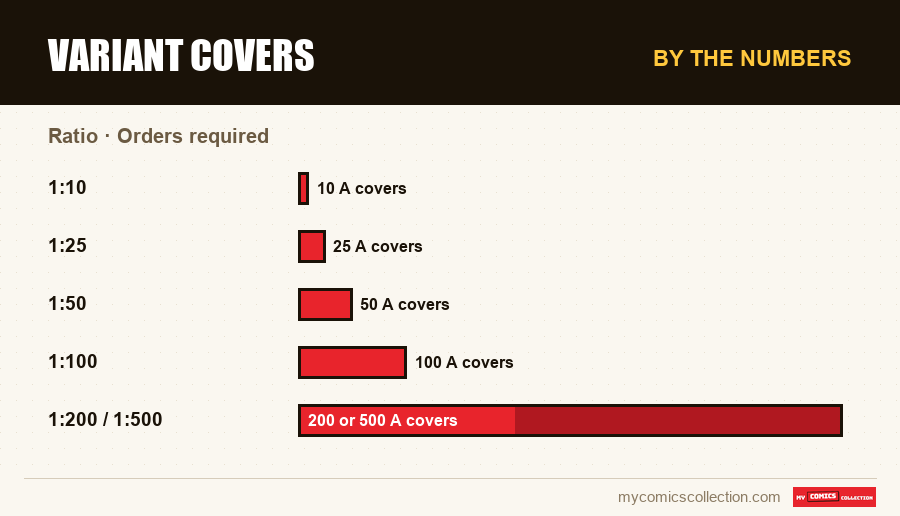
| Ratio | Orders required | Approximate scarcity | Potential value |
|---|---|---|---|
| 1:10 | 10 A covers | Low to moderate | Slight premium (1.5×: 3×) |
| 1:25 | 25 A covers | Moderate | Real premium (3×: 8×) |
| 1:50 | 50 A covers | High | Significant premium (8×: 25×) |
| 1:100 | 100 A covers | Very high | Major premium (25×: 100×+) |
| 1:200 / 1:500 | 200 or 500 A covers | Extreme | Highly variable by title |
Virgin variants
A virgin variant (also called "textless variant") is a cover with no text: no title, no publisher logo, no issue number, no word balloons. Just the artist's raw illustration. Collectors love them because they let you appreciate the artwork without the editorial chrome.
Virgin variants are almost always produced at a higher ratio than the "titled" version of the same artwork. A 1:25 with titles might have a virgin version at 1:50 or 1:100. They generally carry an additional premium over the titled equivalent.
Sketch variants
Sketch variants show the cover art in black and white, without color: sometimes as pencils, sometimes inked. They appeal to a specific audience that enjoys seeing the artist's "naked" work. Values vary widely: highly sought artists (Jim Lee, Adam Hughes, J. Scott Campbell) produce sketch variants that are very collectible, while sketch variants from lesser-known artists generate little demand.
Sketch virgin variants
The combination of both: pencils or inks with no text or color. These are the rawest and often rarest variants. They sometimes land on key issues and can reach high prices when both the artist and the issue are significant.
Store exclusives and convention exclusives
These variants are produced exclusively for a specific shop (Midtown Comics in New York, Forbidden Planet in London, etc.) or a specific event like San Diego Comic-Con (SDCC). Print runs are limited by geographic distribution and sometimes by numbering. SDCC exclusives from major publishers often carry real secondary value since they're only available on-site.
The most common trap: confusing "rare" with "valuable." A variant can be rare (limited print run) without being worth anything if nobody wants it. Variant value depends on demand as much as on scarcity.
Variants that actually hold value
The golden rule of the variant market: a variant only has value if the underlying issue has value. A 1:100 variant of an ordinary mid-run issue will stay in the dollar bin. But a 1:25 variant on a key issue can resell for a hundred times its cover price.
Variants on key issues: the magic combination
Key issues are the books that contain important events: character first appearances, major deaths, identity changes, first editions. When an unexpected key issue emerges and demand explodes, variants instantly become very valuable: because they were printed in small quantities with no anticipation of the demand.
Concrete examples of variants that became very valuable:
- Amazing Spider-Man #14 (2014), 1:75 sketch variant: first appearance of Silk. After a film announcement, this variant's value went up 10×.
- Venom #3 (2018), high-ratio variants: first appearance of Knull, the King in Black. The 1:50 and 1:100 variants multiplied 10× to 20× within months.
- Donny Cates on Thor, Venom, Cosmic Ghost Rider: early issues of his runs often contained incentive variants that exploded alongside the author's popularity.
Variants by cult artists
Regardless of the key-issue angle, some artists have fanbases so dedicated that their variants sell well on any series. J. Scott Campbell, Adam Hughes, Artgerm (Stanley Lau), Frank Cho, and Alex Ross are in this category. An Artgerm variant cover on an average issue can sell for 3× to 5× cover simply because of the artist.
Documented ultra-low-print-run variants
A few variants are produced with official documentation of their print run (printed on the comic or in the publisher's announcement). A documented run of 1,000 copies or fewer creates absolute, traceable scarcity: which is very reassuring for secondary-market buyers.
Identify your rare variants in your collection
My Comics Collection lets you catalog each variant with precision (type, ratio, artist, current value) so you know exactly what rarities you own.
Identify my variants →7-day trial, no commitment.
Variants that are (almost) worth nothing
This is where many collectors, especially less experienced ones, get trapped. The industry heavily used variants as a marketing tool in the 1990s, creating a speculative bubble that burst and destroyed entire collections. Those past mistakes still repeat today in new forms.
The 1990s variants: the bitter lesson
In the 1990s, Marvel and DC multiplied alternate covers, holograms, foil variants, and "collector's edition" covers: often multiple versions for a single issue. These gimmicks attracted speculators who ordered dozens of copies thinking they'd strike rich. Result: these comics exist in astronomical quantities and are worth almost nothing today. X-Men #1 from 1991 with its 5 different covers sold 8 million copies. It trades for under $5 raw.
"Limited editions" without real limits
The term "limited edition" on a cover means nothing without a specific number. Many publishers have abused the term for runs of 50,000 copies or more. If you see "limited edition" without a specific print-run number, treat it as marketing.
1:5 and 1:10 variants on common titles
A low-ratio variant on an undemanded title has no special value. If the A cover sells for $3.99, the 1:10 might be worth $8-$15, barely double, and you still have to find a buyer. After a few years, once interest fades, these variants often return to cover price or below.
Reprints disguised as variants
Some "variants" are just reprints with a slightly modified cover: color tweak, different logo, white background. These "facsimile editions" and "reprint variants" generally have no collecting value. Read the description carefully: if the interior content is identical to a current edition, value is negligible.
Collecting this series?
Track what you own, what you are missing and what your collection is worth. 7 day trial.
Start my trial →How to tell a real variant from a fake
eBay and comic shows are full of sellers who pass ordinary covers off as "rare variants" or fail to specify exactly what they're selling. Here's how to verify before buying.
Check the barcode
Variants are almost always identifiable by their barcode. The standard code carries a numeric suffix or modification that identifies the variant. Cross-check against an online collaborative database or ComicBookDB. If the seller doesn't photograph the barcode, that's a red flag.
Consult the official variant list for the issue
MyComicShop, CBCS, and online collaborative databases list the officially published variants for each issue. If the cover you're looking at isn't listed there, it's not a real variant: it might be a fake, a foreign edition, or a mislabeled reprint cover.
Beware "variants" with no markings on the comic
A real incentive variant usually carries a marking on the cover or an interior page (sometimes just a code or letter in the corner). If nothing distinguishes the copy from a standard cover except the seller's photo, ask for additional photos.
Check recent eBay sold listings
eBay lets you look at completed sales (Sold Items). That's the most reliable reference for current market value on a specific variant. If nobody has sold one recently at the asking price, be suspicious of fanciful valuations.
Always request specific photos
For any online purchase of a supposedly rare variant: ask for the full cover, the back, the barcode, and an interior page with credits. A serious seller agrees without hesitation. A seller who refuses or sends blurry photos should alarm you.
Variant-specific eBay traps
eBay is both the best place to find rare variants and the favorite hunting ground for unscrupulous sellers. Here are the most common variant-specific scams.
The unverifiable "incentive variant"
The seller claims their copy is a "1:25 incentive variant" but can't prove it. Without CGC certification or clear documentation, you have no way to verify whether the copy is actually the incentive variant or just the ordinary B cover of the same issue. CGC certification is the only reliable guarantee here: the CGC label precisely identifies the variant.
The foreign edition sold as a US "variant"
UK, Canadian, Australian, or European editions of Marvel and DC comics often have different barcodes and sometimes prices printed in local currencies. These editions are occasionally sold as "rare variants" when in fact they sold normally in shops abroad without any scarcity.
Artificial bid-rigging on auctions
Some sellers use secondary accounts to bid up their own auctions and create a false sense of demand. Always check the bid history: bidders with zero feedback, or recent profiles systematically bidding on the same seller, are warning signs.
Variants that genuinely exploded in value (documented examples)
- Venom #3 (2018) 1:100 virgin: from $30 off the shelf to over $800 in 2021
- Something is Killing the Children #1 (2019): rare first-print variant, went from $4 to $150+
- King in Black #1 1:50 Jonboy Meyers: from ~$70 to $400+ during the Knull peak
- Immortal Hulk #1 1:50 variant: from $80 to $300+ on the back of the series' critical success
Collection strategy: integrating variants intelligently
The best approach to variants isn't to chase every variant of every title you follow, but to target intelligently based on specific criteria. Here's the strategy experienced collectors use.
Rule 1: Never buy a variant purely to speculate on a title you don't read. If you don't understand why an issue might become a key issue, you can't anticipate demand.
Rule 2: On series you follow, pre-ordering high-ratio variants through your shop is almost always cheaper than buying on the secondary market after publication. Shops often sell their incentive variants at or slightly above cover price.
Rule 3: Document each variant precisely in your catalog: exact type, ratio, artist, condition, price paid, date acquired. Without that data, you can't evaluate performance or make informed sell decisions.
Rule 4: Cult-artist variants on established series are generally safer bets than variants on new series with uncertain futures. Artist recognition is a more stable value driver than speculation on a potential key issue.
FAQ: Variant covers: your questions
Catalog every variant with precision
On My Comics Collection, log each variant with its exact type, ratio, cover artist, condition, and estimated value. Finally know exactly what your variant collection is worth.
Create my catalog →No charge during the 7-day trial.