IDW's monthly Teenage Mutant Ninja Turtles series changes creative team at issue 25, in January 2027: Matthew Rosenberg on script and Juann Cabal on art succeed Gene Luen Yang, whose run stops at issue 24 after twelve episodes. The handoff was announced on July 25, 2026, during IDW's panel at the San Diego convention. Rosenberg announces a street-level story, spread over a single night, where the four brothers cross New York hunted by a large number of old and new adversaries. For a collector, the stake is not issue 25 itself: it is this series' tricky numbering, which has already produced two number 1s at the same publisher and an issue 20 sold under the "300th issue" label, and it is the handful of recent episodes that this team change abruptly puts back into circulation.
A creative team change on an ongoing series is the most misread event in the collecting market. It is talked about as a launch, when it is not a launch. People expect a number 1, when there will be none. And almost always forgotten is the only truly reliable mechanical effect: a new writer brings his predecessor's episodes back into the conversation, because his first page assumes you have read them.
The case of the Ninja Turtles at IDW is particularly clear, for a calendar reason. Between July 2024 and January 2027, the monthly series will have gone through three teams in thirty months, an anniversary issue with its own numbering, and a long story that spills over several other titles of the same line. That makes for plenty of chances to pick the wrong episode.
This article is written on October 2, 2026. Issue 25 does not yet exist and nobody can announce its future value. What does exist is a published calendar, named teams, interviews given by the two writers concerned, and a series whose numbering history you can read without guessing.
What exactly changes at issue 25
IDW announced the handoff on July 25, 2026, during its panel at the San Diego convention. The publisher named the team, the issue and the year, and nothing else: no on-sale day, no cover structure, no number of episodes.
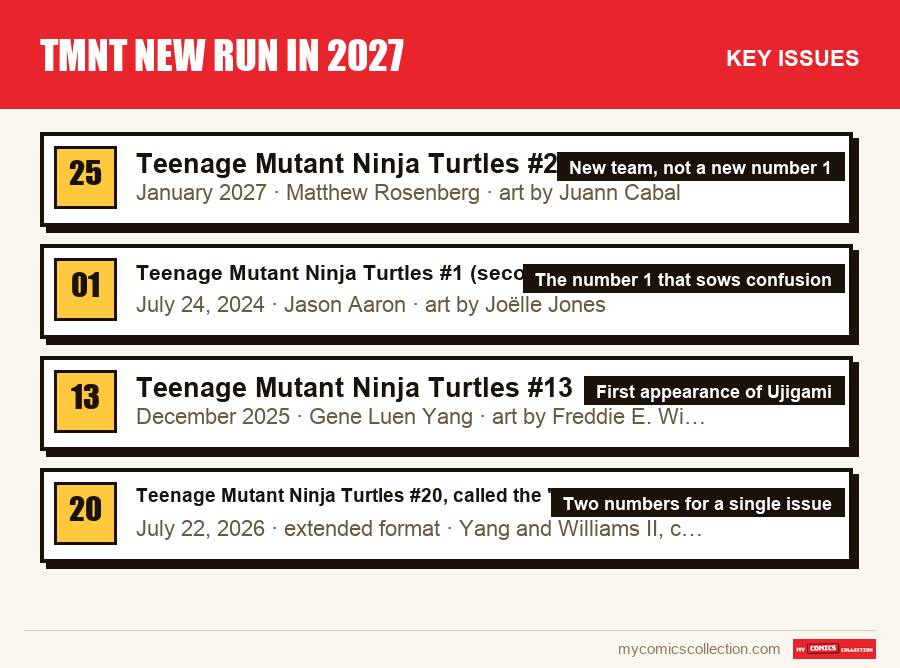
Teenage Mutant Ninja Turtles #25
The pitch published by the publisher fits in one sentence: the four brothers must cross New York without getting shot, pursued by a long list of classic and new adversaries who have allied to hunt them, all within the span of a single night. Rosenberg specified his intention in his first interview on the series: return to the street register, make the city itself a character with its real neighborhoods and subway lines, and recover the feel of the original episodes, where the Turtles were permanently outnumbered and fought to survive.
A circumstantial detail deserves to be known, because it says how fast these decisions are made. Rosenberg told how his former editor on Punisher, Jake Thomas, who moved to IDW, had offered him the series a first time, and he had refused for lack of time. A few months later, with Yang having to step away from the title, the same editor called back. The issue 25 team was therefore not planned years ahead: it is a succession decided along the way.
On the art side, Juann Cabal arrives with a track record on urban superhero series, notably Daredevil, Elektra and Friendly Neighborhood Spider-Man. Rosenberg explained his choice by two very concrete criteria: an artist capable of making a fight legible without a single line of dialogue, and capable of drawing creatures as well as humans. For a series where half the cast is mutant, this second criterion is not decorative.
How we got here: three teams in thirty months
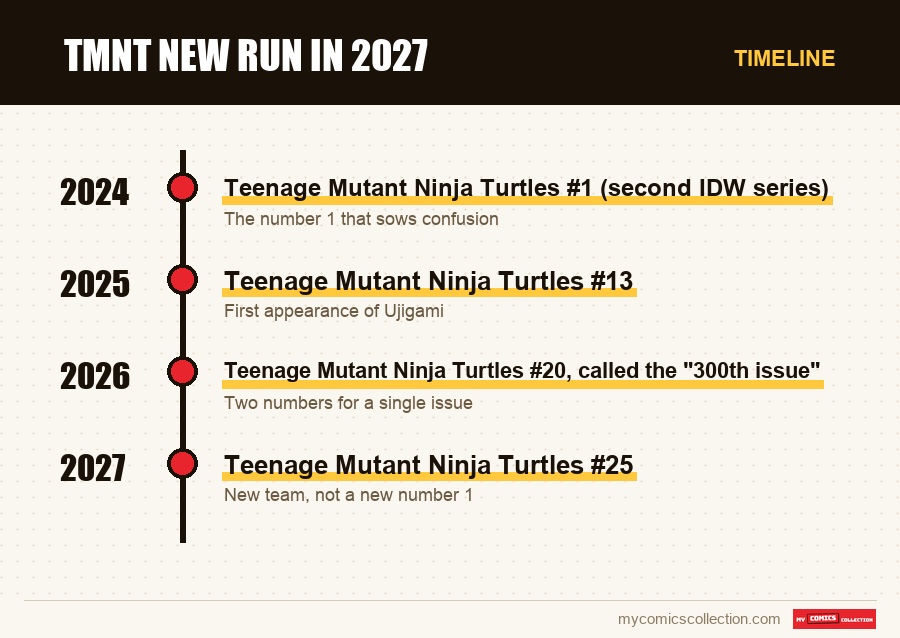
To understand what issue 25 puts back in play, you need the series' recent chronology. It is short and it is public.
Teenage Mutant Ninja Turtles #1 (second IDW series)
IDW's first monthly series stopped at its issue 150 in April 2024, after starting in August 2011. Three months later, the publisher relaunched a new title at number 1, entrusted to Jason Aaron. The launch setup was unusual: the first five episodes drawn by five different artists, Joëlle Jones, Rafael Albuquerque, Cliff Chiang, Chris Burnham and Darick Robertson, the first four each devoted to one Turtle and the fifth bringing them together, before Juan Ferreyra took the second arc at issue 6. Aaron wrote the first twelve episodes.
Teenage Mutant Ninja Turtles #13
Yang took over from Aaron at issue 13, with Freddie E. Williams II on art, an artist who had already approached the Turtles on three crossovers with Batman and on Turtles of Grayskull, but never on the parent series. The episode brings together the Hamato clan and introduces a masked figure named Ujigami, who claims to act for the Turtles while massacring their adversaries. The identity behind the mask changes a central relationship of the franchise, and it is from there that all of Yang's run departs.
Teenage Mutant Ninja Turtles #20, called the "300th issue"
It is the hardest episode to reference in the whole series. The publisher conceived it as its 300th Turtles issue, communicated it under the number 300, and put it on sale on July 22, 2026, while designating it in its own records as issue 20 of the ongoing series, with a special-issue notation. A single issue, two references. It opens the long story "The City That Never Dies", which brings Splinter and Tang Shen back from the land of the dead, and includes a complementary story by Kevin Eastman and Tom Waltz around the time traveler Renet, drawn by a group of former artists of the franchise including Ben Bates, Eric Talbot, Chris Allan, Frank Fosco, Jim Lawson and Dan Duncan.
The real collecting subject: one series, four ways to get the number wrong
A creative team change is a good time to audit your series, because it is the moment when you go back. And on this particular title, four confusions come up constantly.
First confusion: the number 1s. There are at least three that matter, published forty years apart, two of them at the same publisher thirteen years apart. The 1984 founder is treated in detail elsewhere on this site, with its issue record and the tracking of its reprints; the 2011 relaunch and the 2024 one are modern objects, printed in industrial quantities and with no scarcity relationship to the former.
Second confusion: issue 20 and issue 300. A catalog that records them as two distinct lines produces a permanent gap in the series, and an invisible duplicate in the count. It is exactly the kind of defect that tracking by series and number fixes in a minute, and that a handwritten list never fixes.
Third confusion: the spin-off series that carry the main story. "The City That Never Dies" is not read only in the parent series. The one-shot TMNT: The Hunger, out on September 30, 2026, written by Paul Allor and drawn by Gavin Smith, brings Hun back from the dead facing Slash and Ninjara. Dan Watters's TMNT: Shredder series joined the same story at its issue 13, on October 28, 2026, drawn by Sid Kotian. A reader who collects only the numbered series will have a complete but gapped story.
Fourth confusion: parallel series that have nothing to do with it. At the same time, the publisher is releasing TMNT: Journeys, written by Peter Laird and drawn by Jim Lawson, which extends the original era and moves on its own calendar, with an issue 15 on November 4, 2026 and an issue 16 on January 6, 2027. Same starting universe, no continuity relationship with issue 25. Shelving them together because the title starts the same is a common filing error.
Create one series entry per volume, not per franchise
The 2011 series stopped at issue 150 and the 2024 one are two series. Merging them produces duplicate issues and makes any completeness calculation wrong. The rule holds for any relaunched franchise, and it is the first setting to make before buying anything.
Record the special issue under its series number
For the July 22, 2026 issue, keep number 20 as the main reference and note the 300th-issue notation as a comment. The reverse breaks the reading order and makes the episode vanish between 19 and 21.
Mark the two ends of Yang's run
Issue 13 on one side, issue 24 on the other, twelve episodes in all. A complete writer's run is resold and reread as a set; half-filled, it is worth only its isolated episodes.
Decide before January 2027 for the linked series
Joining a crossover story late always costs more than following it as it goes. And keep a standard cover on each of the four boundary markers of the period, issues 13, 20, 24 and 25: a coherent set is worth more than a series of mismatched variants.
What a team change really does to the price
Three effects must be distinguished, because they have neither the same strength nor the same duration.
The attention effect is immediate and weak. A writer's first episode is ordered more than the previous one, read more, then falls back. It creates no scarcity: it is printed for the demand of the moment, which is at its highest.
The first-appearance effect is lasting but rare. What gives an episode long-term value is not the writer's signature, it is what that episode introduces and that survives elsewhere. A new character taken up by following writers, an identity taken up on screen, a costume adopted. For the recent period, the clearest candidate is issue 13 and its Ujigami, because the figure then structures all of Yang's run. Candidate does not mean certainty: a character may very well never be reused after issue 24.
The narrative dependency effect is the most underestimated. Rosenberg indicated that Yang's finale reopens the door to long-absent characters. Yang, for his part, confirmed that the land of the dead from which Splinter and the others return is the one imagined by Mateus Santolouco in his miniseries Shredder in Hell, published in 2019. A recent story that reactivates a seven-year-old miniseries makes that miniseries reappear in readers' searches. It is a demand movement, not a new scarcity, and it is measured in months, not years.
Three other signals are useful for judging what follows, and none requires guessing. Rosenberg cites as claimed influences Erik Larsen, Jim Lawson, Sophie Campbell, Tom Waltz, Jason Aaron, Juan Ferreyra, Gene Luen Yang and Freddie E. Williams II: a writer who names his predecessors announces a continuity, not a clean slate. Sophie Campbell had held the writing alone on the first series from its issue 101, a direct precedent of a single writer installed for the long term. And the fact that the publisher keeps the ongoing numbering indicates it is not seeking the launch effect.
What is not yet known, and must not be invented
As of October 2, 2026, four unknowns remain open, and they weigh more than everything else on a buying decision.
The on-sale day of issue 25. January 2027 is confirmed, the precise date is not. Issue 24's date does not appear either in the order documents published to date.
The cover structure of issue 25. Nothing is announced. On this title, this point is anything but anecdotal: the July 2026 special issue came with the first Turtles covers signed by Frank Miller and J. Scott Campbell, an unpublished image by Eastman and Laird penciled by the second and inked by the first decades later, and a system of opaque bags in which some free-order covers become full-page variants. A comparable system on issue 25 would completely change how to buy it.
The announcements expected in October 2026. The New York convention takes place October 8 to 11, 2026. The publisher has scheduled a panel on Friday, October 9 from 11:15 a.m. to noon, in room 406.2, with Rosenberg among the speakers, and promises two reveals. It also indicated, in July, that further announcements tied to 2027 would come within the year. Nothing had been said there yet at the time these lines are written: anything circulating today as "announced" is not.
The length of Rosenberg's run. No number of episodes is announced. The two precedents give an order of magnitude, twelve episodes for Aaron, twelve for Yang, but an order of magnitude is not information.
One last point, which holds for this whole period: no public source publishes a recent numerical price guide on these episodes. There is a readable scarcity hierarchy, order volumes announced by the publisher, and observable demand. There is no amount you can honestly cite. If you want a range on a specific copy you already own, the only serious method remains to start from its real condition and the sales actually observed for that condition, which our free estimate lets you do without guessing.
The practical decision, by type of collector
If you are currently reading the series, finish Yang's run up to issue 24 and let issue 25 follow on its own. Its first arc will be judged around issue 27 or 28, when we know whether the pace holds. If you are arriving now, issue 25 is precisely designed to be readable without an archive, and issue 24 suffices as context.
If you buy with a preservation logic, the right question is not whether issue 25 will rise, but which episode of this period introduces something that will still exist in five years. The most defensible answer today is issue 13, and it is fragile. If you collect the franchise as a whole, this team change is above all the occasion for an inventory, since it arrives right after a double-reference issue and in the middle of a story scattered across several titles.
To place all this in the long term, our editorial history of the franchise tells the five successive publishers, our Ninja Turtles key issues list the founding episodes, our guide to print runs and our file on reprints cover identifying the different printings of the 1984 founder, whose detailed issue record is on Teenage Mutant Ninja Turtles #1. For the relative hierarchy of episodes across all eras, see our ranking of key issues. And since Stan Sakai is among the cover artists of the July 2026 special issue, the crossovers between Usagi Yojimbo and the Turtles shed light on an older kinship than you might think, documented on the Usagi Yojimbo #1 page.