The key issues of Marvel Zombies number four. The zombie universe first appears in the "Crossover" arc of Ultimate Fantastic Four #21 to #23 (2005), by Mark Millar and Greg Land. Next comes the founding miniseries, Marvel Zombies #1 to #5, published from December 2005 to April 2006, written by Robert Kirkman, drawn by Sean Phillips, with covers by Arthur Suydam. Then Marvel Zombies: Dead Days, the prequel by the same duo. But the piece the market really seeks is not an issue: it is a printing. Each reprint of the miniseries received a different tribute cover, and #1 alone has four. For that reason the franchise is the textbook case, in French and American comics alike, of the variant as a value engine. The ongoing series, Marvel Zombies: War Zone, started on September 2, 2026.
There are few Marvel franchises whose collecting value rests more on the packaging than on the content. Marvel Zombies is one. Robert Kirkman's story is good, Sean Phillips does remarkable drawing work on it, and the idea of turning the house heroes into ravenous devourers has lasted twenty years. But what collectors have been fighting over since 2006 is not issues: it is covers, and more precisely cover printings.
The reason lies in an editorial decision made at launch. Arthur Suydam did not draw one cover per issue: he drew one cover per reprint, and each replays a famous cover from Marvel's catalog, undead in place of the heroes. The consequence is arithmetic: five issues produced at least eleven distinct covers, and the collection six more. A copy of Marvel Zombies #1 is therefore not described by its number but by its printing, and ignoring this distinction is enough to buy the wrong piece.
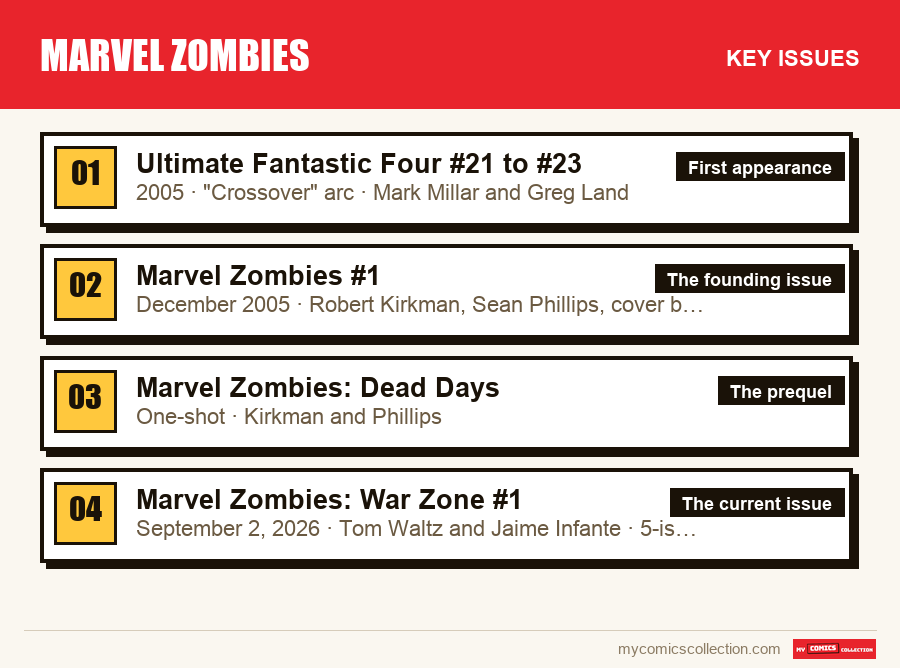
The four entry points of the franchise
Before talking covers, you must distinguish what is historically first from what is commercially sought. The two do not always coincide, and on Marvel Zombies they coincide poorly.
Ultimate Fantastic Four #21 to #23
This is where the zombie universe exists for the first time. In this arc, the infected Reed Richards of a parallel Earth manipulates his Ultimate-universe counterpart into opening a passage to his home. The plot is a classic invasion tale, but it founds everything else. Greg Land fixes the look of the zombified heroes there, and Sean Phillips will then take up these designs and costumes in his own style for the miniseries.
Marvel Zombies #1
The real turning point. Marvel had solicited proposals for a spin-off of Millar's arc, and Robert Kirkman got it, while already writing The Walking Dead since 2003. Kirkman builds his story to be readable without having read a line of Ultimate Fantastic Four, which makes it a standalone entry point. A production detail says a lot about the initial improvisation: the idea of making Luke Cage the last surviving human was dropped along the way, because they realized he had already been drawn as a zombie in Millar's issues.
Marvel Zombies: Dead Days
Same creative duo, and the story that shows the outbreak's start rather than its consequences: for someone discovering the franchise, it is paradoxically the best chronological start. For a collector, it is a one-shot, hence an object simpler to acquire than a complete miniseries, and its tribute cover replays Jim Lee's X-Men volume 2 issue 1, one of the best-selling comics of all time.
Marvel Zombies: War Zone #1
The 2026 installment. The action takes place on Earth-4775, where an outbreak hits Manhattan: the most powerful heroes fall, a barrier is raised around the island to contain the infection, and the inside becomes a war zone. The Punisher leads a group of street-level heroes, with Luke Cage, Elektra, Iron Fist and other figures of the same register. The announced schedule is irregular: #1 on September 2, 2026, #2 on October 21, #3 on November 25, #4 on December 9.
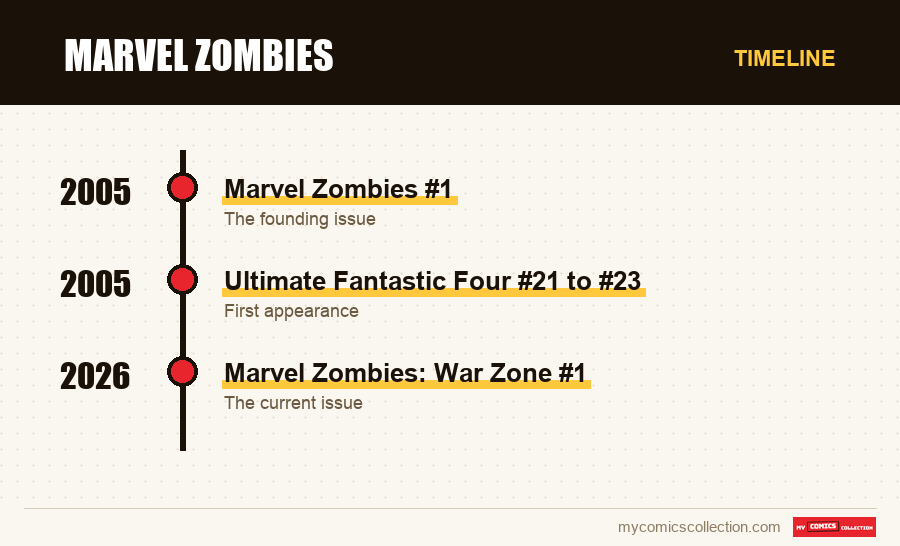
The Suydam mechanics, printing by printing
Arthur Suydam produced for this franchise one of the most systematic series of covers in Marvel's editorial history: each image takes up the composition of a famous cover of the house, substituting the undead. And since a new tribute accompanied each reprint, the same issue exists in several visually unrelated objects. For the 2005 and 2006 miniseries, the recorded correspondence is as follows.
- Marvel Zombies #1, first printing: tribute to Amazing Fantasy #15, by Steve Ditko.
- #1, second printing: tribute to Spider-Man #1, by Todd McFarlane.
- #1, third printing: tribute to The Amazing Spider-Man #50, by John Romita Sr.
- #1, fourth printing: tribute to The Incredible Hulk #1, by Jack Kirby.
- #2: tribute to Avengers #4, by Jack Kirby.
- #3, first printing: tribute to The Incredible Hulk #340, by Todd McFarlane.
- #3, second printing: tribute to Daredevil #179, by Frank Miller.
- #4, first printing: tribute to X-Men #1, by Jack Kirby.
- #4, second printing: tribute to Amazing Spider-Man #39, by John Romita Sr.
- #5, first printing: tribute to Amazing Spider-Man Annual #21, by John Romita Sr.
- #5, second printing: tribute to Silver Surfer #1, by John Buscema.
The collection received the same treatment, over six printings: Secret Wars #1 by Mike Zeck, Amazing Spider-Man #316 by McFarlane, Fantastic Four #49 and Avengers #1 by Kirby, Mary Jane #2 by Takeshi Miyazawa and Iron Man #128 by Bob Layton.
The device then spread, to the variants of issues 30 to 32 of Ultimate Fantastic Four that replay Fantastic Four #1, #51 and #8, then to Marvel Zombies vs. The Army of Darkness in 2007, where the tributes target among others John Byrne's X-Men #141 and #137, Kirby's Captain America #1 and Frank Miller's 1982 Wolverine #1, then to Marvel Zombies 2, with Don Heck's Tales of Suspense #39 and Jim Steranko's Nick Fury, Agent of SHIELD #4. Put end to end, this set forms an anthology of the covers that matter at Marvel, revisited by a single artist, to the point that a collection was devoted in 2007 to the franchise's covers alone.
Why it is a textbook case of the variant
Most variant-heavy franchises multiply covers to sell more copies of the same issue, at the same time. Marvel Zombies does something else, and that is what makes it an object of study.
The variant there is indexed on sellout, not on preorder. A ratio cover rewards a retailer who orders a lot before release. A new Suydam tribute, for its part, exists only because the previous print run was sold through. The information carried by the object is therefore radically different: a ratio cover says "someone ordered in bulk," a fourth printing says "three printings were exhausted." The second statement is proof of real demand, the first proof of commercial anticipation.
It creates a naturally decreasing scarcity hierarchy. The first printing is calibrated on initial orders, therefore the most abundant; the following ones serve to fill a shortage, at a lower volume. Relative scarcity did not need to be decreed by the publisher, it fell out of the commercial cycle. It is the exact opposite of a scarcity announced before release.
It detaches value from content. The five issues tell a single story, but exist in at least eleven objects. A story collector buys five comics; an object collector buys eleven, without reading a page more. This dissociation is the very definition of the variant as a value engine, and the visual gap between two printings of the same issue exposes it here without ambiguity.
It borrows its value from issues the reader will never own. It is the subtlest mechanism. A tribute cover transfers part of the desire attached to the original. A collector who will never have the means for an Amazing Fantasy #15 or an Incredible Hulk in very high grade can own the quotation, printed in 2006 and accessible. The tribute variant works as a substitute, and this function has its own price, independent of the quality of the story it wraps.
And it was copied. The tribute cover existed before 2006, but its systematic practice across an entire franchise proved it could hold a whole catalog. Anyone who wants to understand today's multiple-cover releases does well to look first at how Marvel Zombies went about it, with a single artist and without simultaneity.
The sequels, and what they are worth as objects
The franchise has produced some twenty titles since 2006, and it would be dishonest to present them all as key issues. Here is the useful reading.
The Kirkman and Phillips period ends with Marvel Zombies 2, published from October 2007 to February 2008. It is the coherent block, the one readers mean when they speak of Marvel Zombies without specifying. From Marvel Zombies 3, in 2008, Fred Van Lente and Kev Walker take over, then Marvel Zombies 4 in 2009 and Marvel Zombies 5 in 2010 with Kano on art. Between the two, Marvel Zombies Return, five 2009 one-shots exploring separate facets of the outbreak.
The 2010s branches widen the concept beyond Earth-2149, from Marvel Zombies Supreme in 2011 to the series tied to the 2015 Secret Wars event. They are found without difficulty and belong to completeness, not to the sought-after piece.
The recent relaunches matter more for a contemporary collector. Marvel Zombie, in the singular, resets the counters in October 2018. Marvel Zombies: Resurrection follows in October 2019 as a one-shot, then in 2020 as a four-issue miniseries, with a strong idea: the corpse of Galactus drifts to the edge of the solar system and serves as a vessel for an interstellar terror. Then come Marvel Zombies: Dawn of Decay in 2024, where a new virus makes Groot patient zero, and Marvel Zombies: Red Band, a five-issue miniseries published from September 17, 2025 to January 28, 2026 by Ethan S. Parker, Griffin Sheridan and Jan Bazaldua, which imagines that the Fantastic Four's cosmic rays zombified them instead of giving them powers.
The rule is constant over twenty years: what trades here are the first titles and the scarce printings, not the franchise's volume. Aiming for exhaustiveness across the twenty series amounts to accumulating abundant paper; aiming for the four entry points and the identified printings of #1 is holding the essentials.
How to approach these issues as a collector
Decide whether you collect the story or the covers
These are two projects, two budgets and two levels of difficulty. The story fits in a five-issue miniseries and a prequel, findable in collected form. The cover collection means chasing eleven objects for the same five issues, then six more on the collection. Choosing before buying avoids ending up with reading duplicates and collection gaps.
Learn to read a printing before buying a #1
The printing notice is in the interior credits, not on the cover. Before any purchase of a Marvel Zombies #1, identify the tribute: the Amazing Fantasy #15 pastiche signals the first printing, that of McFarlane's Spider-Man #1 the second, and so on. A listing without a cover photo does not allow a conclusion.
Do not confuse the first appearance with the star piece
Historically, the first appearance of the zombie universe is in Ultimate Fantastic Four #21. Commercially, the most sought-after object is Marvel Zombies #1. Both statements are true at the same time, and a seller who picks one to justify the price of the other is telling you a story. If precedence interests you, it is the Ultimate Fantastic Four arc you should buy, and it is generally much more discreet on the secondary market.
Reserve certification for the scarce printings
Having a copy certified has a fixed cost, whatever the piece. On a widely distributed first printing, the operation is rarely justified. On a third or fourth printing, it has another interest: certification locks in the printing information on the label, verifiably for a future buyer. It is the only case in the franchise where grading provides a service the bare copy does not.
The traps specific to this franchise
Believing a later printing is a worthless reprint. It is the most costly mistake here, and it comes from a generalization that is right elsewhere. On most series, a second printing reproduces the same cover and is worth less. On Marvel Zombies, each printing carries a new cover and comes out at a lower volume than the previous one. The usual reasoning reverses.
Taking a tribute variant for the cited original. The risk seems absurd until you see a hastily written listing. A cover that replays Amazing Fantasy #15 remains a 2006 comic, and no part of the original's value is transmitted to it. The kinship is visual, nothing more.
Buying a sequel believing you are buying the start. Robert Kirkman also wrote The Walking Dead in the same period, at another publisher, and the genre counts many other series. Within the Marvel franchise alone, the titles resemble each other to the point of ambiguity: Marvel Zombies, Marvel Zombie, Marvel Zombies 2, Marvel Zombies Return, Marvel Zombies: Resurrection in two versions a year apart. Always check the publication year in addition to the title, especially on a #1.
Assuming TV news makes old issues rise. An animated series aired in September 2025, preceded by an anthology episode. These adaptations broaden the audience, but create no scarcity on comics printed twenty years earlier. The effect of an adaptation is measured after the fact, never at the announcement.
Tracking a multi-printing franchise
Marvel Zombies poses an inventory problem that ordinary series do not: a copy's identifier does not fit in a number. You need the series, the year, the number and the printing. A hand-kept list loses the fourth piece of information within months.
In the app, three reflexes settle the question. Record each copy with its printing at purchase, while you have the object in hand and the credits before your eyes. Separate same-named series by their publication year, so that the 2019 Marvel Zombies: Resurrection and the 2020 one do not occupy the same line. And keep apart the list of tributes already owned, which is your real list of gaps on this franchise.
For the ongoing series, the work is different and simpler: it is a matter of not missing a deadline. With issues announced for September 2, October 21, November 25 then December 9, 2026, release tracking usefully replaces memory. The two-week gap between the third and fourth issues is precisely the kind of detail that escapes anyone counting in months.
What to remember
Marvel Zombies is a franchise whose collecting interest has outgrown its narrative interest, and has done so through a cover decision rather than a marketing stunt. The four issues to know are the Ultimate Fantastic Four arc for precedence, Marvel Zombies #1 for status, Dead Days for the told origin, and War Zone #1 for current events.
But the lesson goes beyond the franchise: the scarcity that holds up is the one that stems from an observed sellout, not the one announced before release. Anyone who has understood it here will carry it over to contemporary variants, whose promotional talk is much noisier.