The best zombie comics are, at the top, The Walking Dead by Robert Kirkman, Marvel Zombies , DCeased by Tom Taylor and Blackest Night. This tier list classifies undead stories in comics according to their quality, influence and intensity, from survival cult to niche series. Facts (authors, publishers, dates) checked, no invented ratings.
The zombie is a genre in its own right: it allows for survival, social satire and pure horror. This tier list brings together the series that best exploit the living dead (tension, characters, strong ideas) from monuments of the genre to more confidential nuggets. Criterion: the success of the zombie story, not just notoriety.
Editorial Ranks, Facts verified. Each entry refers to a site file when it exists.
Collecting this series?
Track what you own, what you are missing and what your collection is worth. 7 day trial.
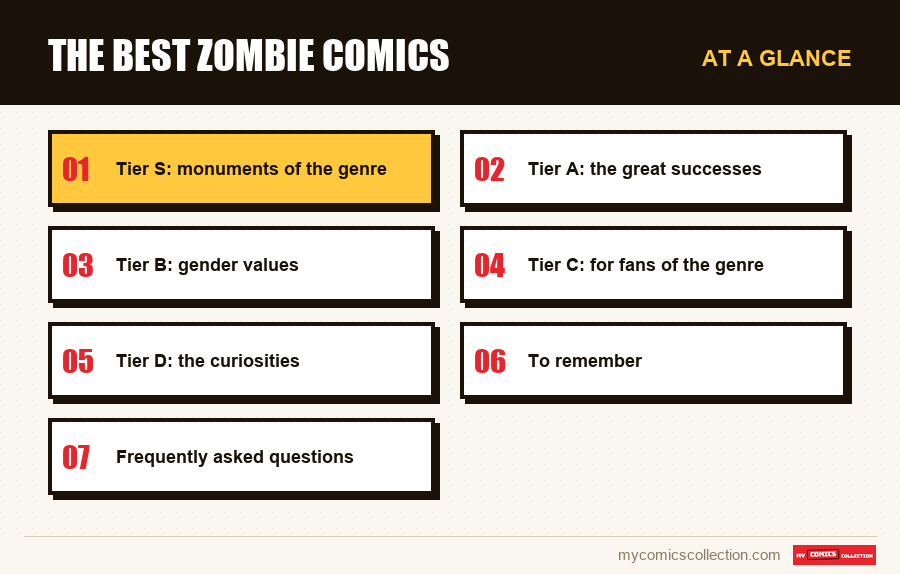
Start my trial →Tier S: monuments of the genre
The Walking Dead (2003) redefined the zombie narrative over nearly 200 issues, shifting the horror from the dead to the living. Marvel Zombies (2005) transforms Marvel superheroes into hungry devourers: a satirical concept that has become cult. DCeased by Tom Taylor applies the same idea to the DC universe with rare intensity. And Blackest Night (2009) offers the cosmic variant: the dead of the DC universe resurrected as Black Lanterns.
Tier A: the great successes
Afterlife with Archie amazed everyone by plunging Riverdale into zombie horror. Crossed by Garth Ennis takes the violence to the extreme. iZombie by Chris Roberson (adapted into series) and Revival by Tim Seeley bring a more intimate and police approach to the living dead.
Tier B: gender values
Zombie World by Mike Mignola (Dark Horse) and Deadworld (1986), one of the very first zombie comics, are milestones for fans. The Last Zombie and Raise the Dead complete this tier with solid survivals.
Tier C: for fans of the genre
Escape from the Living Dead , Zombie Christmas Carol (rereading Dickens), Night of the Living Dead (version of Romero's film) and Zombie Tramp offer niche readings, reserved for fans of the living dead.
Tier D: the curiosities
Xombi (Milestone, 1994), Tales of the Zombie (Marvel magazine from the 70s) and The Zombies That Ate the World (French series) close this selection: historical or offbeat curiosities, more difficult to access but real.
To remember
- Robert Kirkman dominates the genre (Walking Dead, Marvel Zombies).
- The zombie often serves as a social mirror more than just a monster.
- It's a very indie genre (Image, Dark Horse, Avatar) as much as mainstream.
- The Walking Dead #1 is the big key issue of the genre in terms of collecting.
Where to start depending on your appetite for zombies
The tier list ranks by success, but the best entry point depends on what you are after. The genre is more varied than it seems: survival, satire, investigation, black humor, extreme horror. Here is how to find your bearings, staying within the titles of the selection.
If you want survival and characters
Start with Robert Kirkman's The Walking Dead (2003). Over nearly 200 issues, the series shifts the horror from the dead to the living and remains the genre's reference. For a more intimate tone, Revival by Tim Seeley and Mike Norton (2012) treats the return of the dead with a detective's eye.
If you prefer infected superheroes
Marvel Zombies (Kirkman and Phillips, 2005) turns Marvel's heroes into ravenous devourers and embraces a satirical streak. DCeased by Tom Taylor and Trevor Hairsine (2019) applies the idea to the DC universe with rare intensity. Blackest Night (Geoff Johns and Ivan Reis, 2009) offers a cosmic variant, with the dead of the DC universe resurrected as Black Lanterns.
If you are looking for humor or investigation
iZombie by Chris Roberson and Michael Allred (2010) is rather a detective comedy. Afterlife with Archie, by Roberto Aguirre-Sacasa (2013), plunges Riverdale into zombie horror and surprises with its tone. These two titles suit readers who find the genre too dark.
If you want extreme horror
Crossed by Garth Ennis and Jacen Burrows (2008) pushes the violence dial very far. It is aimed at a mature audience and is not a good first purchase for discovering the genre.
For the curious about the genre's history
Deadworld (1986) is one of the very first zombie comics, and Mike Mignola's ZombieWorld (Dark Horse, 1997) a milestone for enthusiasts. Tales of the Zombie, a Marvel magazine from the 1970s, and Xombi (Milestone, 1994) are historical curiosities, harder to find but very real.
Tips for collectors
- The genre is very independent: many titles come from Image, Dark Horse or Avatar as much as from the big publishers.
- The Walking Dead #1 is the genre's great key issue, and the 2003 first edition is highly sought after in certified high grade.
- Always check the edition and condition before buying, including for niche series, where copies are sometimes few.
- For niche series, search for the exact title and year: several adaptations have similar names (Night of the Living Dead, Zombies Christmas Carol).
A three-step path
To explore without getting lost, first read a tier S monument, then a tier A success in a different register, and finally a tier B or C curiosity. You will quickly know which register suits you before investing in a wider collection.
Frequently asked questions
The Walking Dead by Robert Kirkman is the absolute reference of the genre. For a superhero variant, Marvel Zombies and DCeased are the most striking.
Yes, it's one of the great modern key issues: the first edition of The Walking Dead #1 (2003) is highly sought after, especially in certified high grade. Always check the edition and condition before purchasing.
No. If Crossed is extreme horror, iZombie is more of a detective comedy and Marvel Zombies is a superheroic satire. The genre is more varied than it seems.
Do you own a The Walking Dead #1 or another key zombie issue? Estimate its value for free with our tool based on current eBay listings.