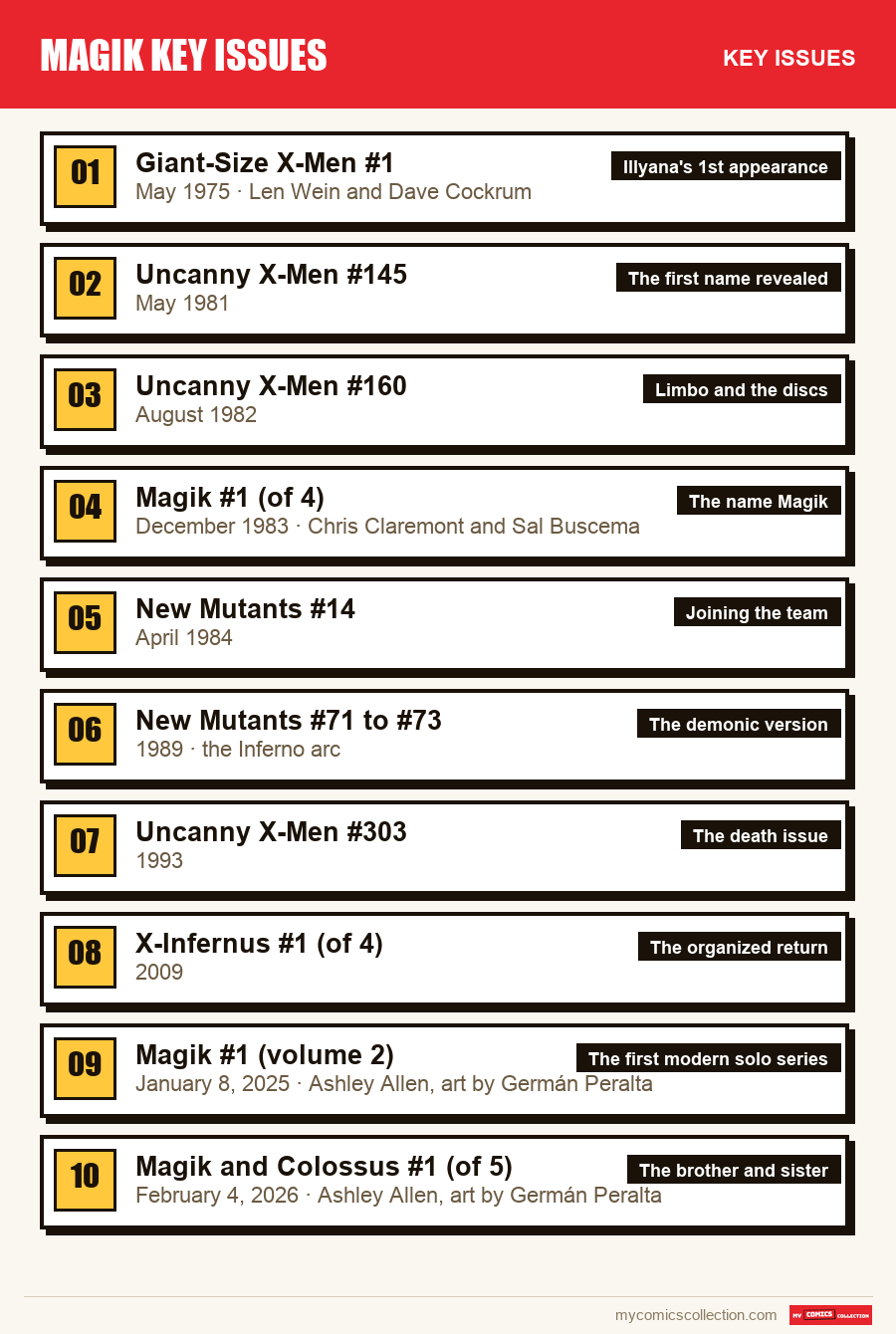
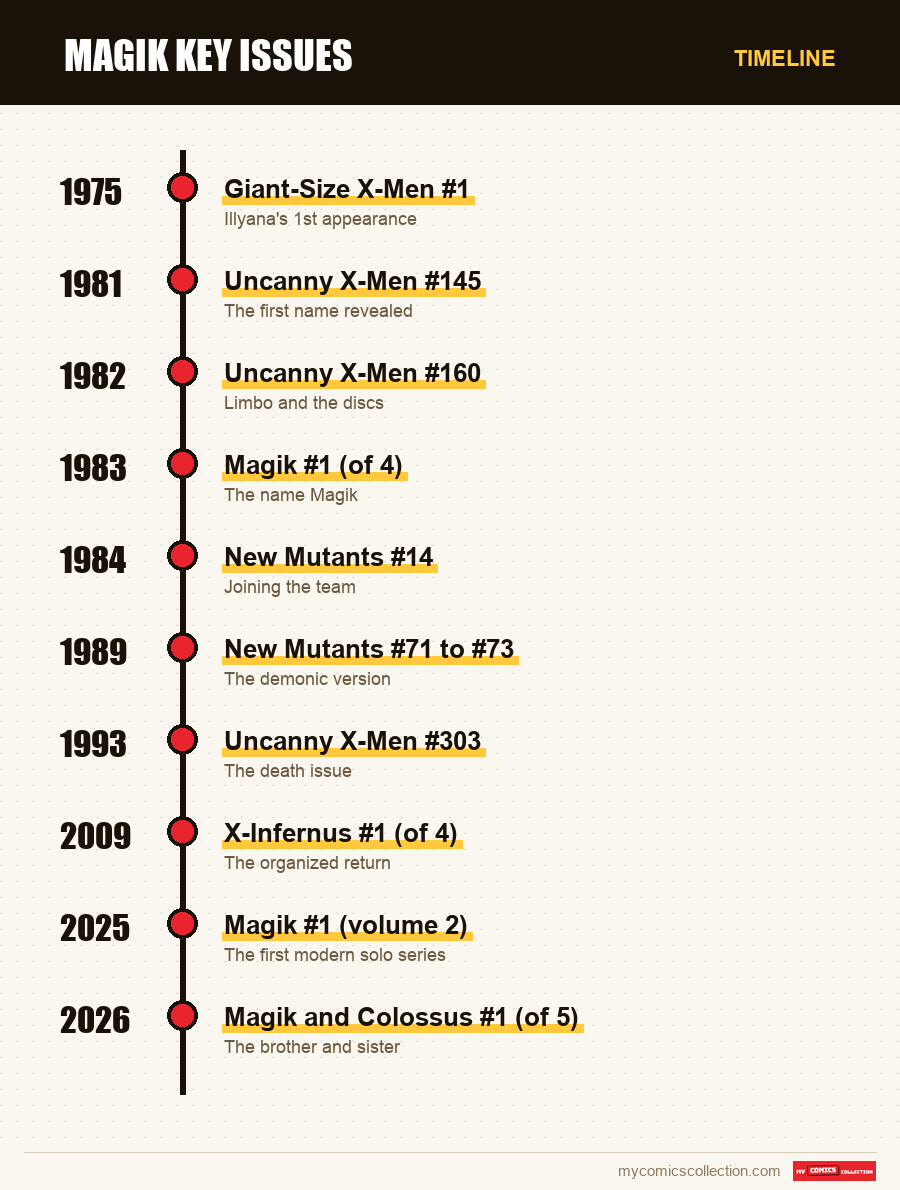
Illyana Rasputin first appears in Giant-Size X-Men #1 (May 1975), by Len Wein and Dave Cockrum, but as a six-year-old girl with no first name: it is only revealed in Uncanny X-Men #145 (May 1981). She comes back as a teenager and sorceress in Uncanny X-Men #160 (August 1982), receives the name Magik in Magik #1 (December 1983) and joins the New Mutants in costume in New Mutants #14 (April 1984). Four issues, four different "firsts": that is the source of almost every cataloging mistake on this character. She dies in Uncanny X-Men #303 (1993), returns in 2007, and comes back to the forefront with X-Orcists #1, announced for November 18, 2026 alongside Juggernaut and Madelyne Pryor.
Few Marvel characters force you to specify what you are talking about as much. Saying "I have Magik's first appearance" means nothing until you have said which of the four candidate issues you own, and what you mean by first appearance: that of the person, of the name, of the adult face, or of the costume. These four questions have four different answers, published over nine years, and none of them makes the other three obsolete.
This confusion is not a scholar's curiosity. It determines what you look for in a shop, what you enter in your inventory, and what you believe you hold. A collector who writes "Magik 1st appearance" on their copy of New Mutants #14 is not wrong in the common sense, and not right in the strict sense. Both positions are defensible, provided you know which one you hold.
The time is right to sort it out. The character has been going through a dense editorial sequence since January 2025, with a regular series in her name, a miniseries shared with her brother, and a team title scheduled for November 2026. In other words: the old issues are becoming objects of search again, and labeling errors circulate all the faster.
A six-year-old girl in a founding issue
Giant-Size X-Men #1, published under the date of May 1975, is one of the most discussed issues in the publisher's history, for a reason that has nothing to do with Illyana: it is the issue that recomposes the team and introduces Storm, Colossus and Nightcrawler. Illyana is nonetheless there, in the background, as the little sister of the Russian farm boy Charles Xavier comes to recruit. She has no memorable line, no power, no name.
This status as a background child lasts a very long time. Her first name is only printed six years later, in Uncanny X-Men #145 dated May 1981. For the first eight years of her editorial existence, she is only "Colossus's little sister", summoned when the script needs a family stake, then sent back off-screen.
For a collector, this raises a question of principle: does an appearance with no name, no power and no narrative intent constitute a first appearance? Market practice answers yes, because the rule applied everywhere else is that of the character's identity, not that of its importance. The 1975 child and the 1983 sorceress are the same person, so the 1975 issue is the first appearance. It is also, incidentally, the costliest answer, since that issue is already sought for three other reasons.
Seven years on one page: the 1982 pivot
Uncanny X-Men #160, dated August 1982, is the issue that transforms everything. Illyana is drawn into a paranormal dimension called Limbo, ages seven years there, and comes out a sorceress with a mutant power of her own: creating teleportation discs. She enters the issue a child, she leaves it a teenager.
That is the very definition of a key issue: an irreversible event that creates the character as she will be used for the next forty years. And yet this issue remained underrated for a long time, for an instructive reason. Nothing in it is explained. The writers set up the transformation and leave it hanging: for more than a year, Illyana remains a supporting character of whom we only know that she has changed. The word Magik does not appear.
This gap between the event and its exploitation is common at Marvel in the early 1980s, and it systematically produces the same collecting effect: the issue that contains the fact is less in demand than the one that names it. It is an asymmetry worth remembering, because it is repeating today on other characters.
The key issues, in order of publication
Here are the verifiable stages, series by series. No price guide is given: the hierarchy among these issues is stable, the amounts are not.
Giant-Size X-Men #1
First appearance of the character, as a child with no first name. The issue is also the one that recomposes the team, which means it is never bought for Illyana alone and its relative scarcity does not depend on her.
Uncanny X-Men #145
The issue where the character stops being anonymous. It is not a key issue in the market sense, but it is a useful marker in an inventory: between 1975 and 1981, all her appearances are nameless appearances.
Uncanny X-Men #160
The transformation issue: seven years of aging in Limbo, appearance of sorcery and of the mutant power of teleportation. It is the first appearance of the teenage version, and the starting point of everything that follows.
Magik #1 (of 4)
The miniseries Magik (Illyana and Storm) tells the Limbo years, that is, the character's origin, and it is in its first issue that she receives the name Magik for the first time. It is also her first cover in her child version, and her second complete appearance in the strict sense.
New Mutants #14
She joins the New Mutants' regular cast and stays until issue 77, dated July 1989. It is the first cover of adult Magik in costume, and by far the issue most often presented as "Magik's first appearance" in sales listings.
New Mutants #71 to #73
The three New Mutants issues that make up the central part of Inferno, where the character's demonic side takes over. The arc closes on a radical reversal: she becomes a child again, and leaves the team at issue 77 to go home to her family in Russia.
Uncanny X-Men #303
She dies of the Legacy Virus. The issue belongs to a particular category, that of supporting character deaths treated as emotional issues rather than franchise events: it remained accessible for a long time, and its status rests entirely on the character's later career.
X-Infernus #1 (of 4)
The miniseries that reinstalls the character in current continuity after her return began in New X-Men #38 to #41 (2007). It serves as a launching pad for the third New Mutants series, launched in May 2009 and continued to its fiftieth issue in October 2012.
Magik #1 (volume 2)
Ten issues, from January 8 to September 17, 2025, colors by Arthur Hesli. It is the first regular series in the character's name since the 1983 miniseries, and it sets up a lasting duo: Illyana and Dani Moonstar, with Cal Isaacs in the main cast.
Magik and Colossus #1 (of 5)
Five issues, from February 4 to June 17, 2026. The miniseries puts back at the center the relationship that has existed since 1975, the one with Piotr Rasputin, and closes the cycle opened by the 2025 regular series.
The incarnations, and how not to confuse them
The character has existed in several successive forms, and each has left traces in sales listings. Telling them apart is not a stylistic exercise: three of them carry the name Magik.
Child Illyana, from 1975 to 1982. No power, no name before 1981, no heroic activity. All appearances from this period are cataloged as appearances of Illyana Rasputin, never as appearances of Magik.
Magik, from 1982 to 1989. The teenage then adult version, sorceress of Limbo, bearer of the Soulsword and the armor. It is the canonical version, the one in costume, the one that served as the model for almost all figures and all adaptations.
The Darkchilde, the demonic side. She emerges during Inferno in 1989, then becomes a central subject again at the 2007 return, when a summoning by Belasco brings what remains of Illyana back into Limbo in this corrupted, soulless form. The important point for an inventory: the Darkchilde is not another character, but she is treated in listings as a distinct variant, with her own covers and her own notations.
Child Illyana, back, after 1989. The regression at the end of Inferno produces a period where the character exists in her first form, and it is in that form that she dies in 1993. Confusing the 1990 appearances with those of 1985 is the most common mistake on this character.
The parallel versions, finally. An Illyana exists in Age of Apocalypse, another in the Exiles under the label of a numbered Earth, yet another in both generations of the Ultimate universe. None is the Magik of main continuity, and none belongs in the same inventory line.
The other Magik, the one who is not Illyana
This is the cleanest trap of the character, because it stems not from a reading error but from an editorial fact. After Illyana's death, another woman takes up the name and role: Amanda Sefton, whose real name is Jimaine Szardos, created by Chris Claremont and Dave Cockrum and first appearing in X-Men #98 dated April 1976.
Also a sorceress, adoptive sister and former partner of Nightcrawler, she had first carried the name Daytripper. Having become Magik, she rules over Limbo, learns to command the teleportation discs and wields the Soulsword, before being driven out by Belasco. Everything that visually defines the function is thus found in a second character, for several years.
Practical consequence: a search by character name mechanically brings back two series of appearances. In a serious inventory, Magik is not a character name, it is a role, and you have to note which of the two holds it. The rule is the same as for a shared identity like that of Captain Marvel, except that it is much less documented.
The Krakoa era, or the queen who wants to abdicate
The most recent sequence before the solo series deserves to be understood, because it directly explains the November 2026 title. During the mutant nation period, the character holds a captain's rank on the council, teaches magic at the sorcery school opened in Strange Academy #1 (2020) alongside Doctor Strange, and is among the nine sword-bearers chosen for the X of Swords tournament in 2020.
Then comes the decisive gesture. Tired of combining teaching, political rank and the crown of a demonic dimension, and wanting to detach from a traumatic past, she decides to stop ruling Limbo. She needs a successor. Against the advice of her New Mutants teammates, she offers the throne to Madelyne Pryor, because of her old tie to that dimension.
Remember that name. It is not chosen at random in the 2026 announcement, and it is exactly the kind of detail that turns a schedule announcement into collecting information: the upcoming title does not bring three characters together because they are popular, but because a handover of a crown has linked them since the early 2020s.
2026: what X-Orcists #1 changes, and what it does not
X-Orcists #1 is announced for November 18, 2026, written by Ashley Allen and drawn by Germán Peralta, with Magik, Juggernaut and Madelyne Pryor. Three observations stand out, and only one concerns the old issues.
First observation: it is not an improvised meeting. Magik and Juggernaut share the main cast of the X-Men series written by Jed MacKay since its first issue of July 10, 2024, and Madelyne Pryor is the sovereign installed by Illyana herself. The team is the logical conclusion of two threads laid down for years, which makes it a project markedly less fragile than a gathering of convenience.
Second observation: the creative team is the same as that of the 2025 solo series and the February 2026 miniseries. Three consecutive titles entrusted to the same tandem is an indicator of editorial confidence far more reliable than any rumor of a screen project.
Third observation, and the one that should temper enthusiasm: a November 2026 announcement creates no value on a 1982 issue. It creates attention, which is not the same thing. Attention raises the number of searches and the number of simultaneous listings; what durably shifts a character's hierarchy is a wide-audience adaptation, and none is scheduled to date for this one. The only screen portrayal remains that of the 2020 film devoted to the New Mutants, with Anya Taylor-Joy in the role.
Building a Magik path without picking the wrong issue
Here is the approach I recommend on this specific character, because its chronology trips up the usual methods.
First decide what you call "first"
First appearance of the person, of the name, of the adult face or of the costume. The four answers are defensible, they cost very different efforts, and they do not target the same issues. Write down your choice before buying anything, because a decision made in a shop is always the most expensive.
Start with the 1983 miniseries
Four issues, December 1983 to March 1984, a complete story that is the character's origin, and the issue where the name appears. It is the most coherent and most readable set of the path. All four can still be found together, which is not true of every set from that era.
Treat 1982 as a piece apart
Uncanny X-Men #160 is not part of a set, it is not collected in lots, and it is never sold as a Magik issue since the name does not appear in it. That is precisely why you have to look for it separately, with its own inventory line and its own alert.
Note the character's form, not just her name
Child, teenager, adult in costume, Darkchilde, Illyana become a child again. Five states for a single catalog line is too many. Use a variant field: it is the only way to find out, three years later, why you bought two seemingly identical issues.
Separate the two bearers of the name
Create a distinct entry for Amanda Sefton. Without it, any search on Magik in your own collection will bring back a mix of two characters, and you will end up buying an issue thinking you fill a gap that did not exist.
Check the spelling before concluding an issue is missing
Raspoutine, Rasputin, Rasputina: the three spellings circulate depending on the language of the edition and the period. A search on a single spelling systematically leaves appearances outside the net. This point is covered in detail right after.
The cataloging traps specific to this character
The family name has three spellings. French editions write Raspoutine, English editions long wrote Rasputin, and the feminine form Rasputina has more recently become the reference spelling. An inventory that only records one of these forms produces invisible gaps: the issues are there, they just do not come up in the search. It is exactly the kind of blind spot that our page on missing comics lets you clear, by reasoning by series and issue rather than by character name.
The word Magik is not a misspelling. It is written with a k, and internal search engines gladly correct it to "magic". On a catalog of several thousand issues, this automatic correction is enough to make an entire character disappear.
The notation on a certification label matters as much as the grade. Two copies of the same issue, certified by CGC at the same grade, do not necessarily carry the same first-appearance notation: one may mention Illyana Rasputin, the other Magik, the other nothing at all. On an issue where four "firsts" coexist, the difference is not cosmetic. If you are considering certification, first read our guide to CGC grading and decide which notation you request.
Limbo sets get broken up. The 1983 miniseries has only four issues, and the third is the one most often missing from lots offered on the secondhand market. A lot advertised as complete is not always so; count the issues before paying.
Three series carry the title New Mutants. The original series begun in 1982, the third launched in May 2009 and the fourth published from November 2019 to December 2022, thirty-three issues, in addition to a short volume from the early 2000s. A New Mutants #14 can therefore designate Magik's entry into the team in 1984, or a 2020 episode. In an inventory, the publication year is not decorative information, it is the sort key.
How I would rank the five issues to look for
If the goal is to build a defensible path without devoting a decade to it, the following logic holds up. It rests on no value projection, only on what each issue brings that cannot be substituted.
First Magik #1 of December 1983, because it is the issue of the name, the origin and the first cover, three things in a single purchase. Then Uncanny X-Men #160, because it is the transformation issue and no other contains it. Then New Mutants #14, because it is the entry into the team, the costume, and by far the most recognizable image of the character. In fourth position Giant-Size X-Men #1, which is the first appearance stricto sensu but is bought for many other reasons and at an entirely different level of effort. Finally Magik #1 of January 2025, because a modern first regular series is a clean, available starting point, written by the team that still writes the character today.
The rest belongs to the reading path rather than the hunt: the three Inferno issues, the death issue in 1993, the 2007 to 2010 return sequence. They are found without difficulty, and they give the path its narrative coherence. To organize all this, an issue-by-issue tracking avoids buying the same episode twice under a different cover, and a collection app makes the whole consultable in a shop, that is, at the only moment when the question really comes up.
One last word on the editorial neighborhood. Winter 2026-2027 is dense on the mutant side, and several characters of the same generation are returning to the forefront at the same time: we cover the Phoenix's return separately in our article on Jean Grey's key issues. The temptation to follow everything in parallel is strong, and that is generally how you end up with five series started and none complete.