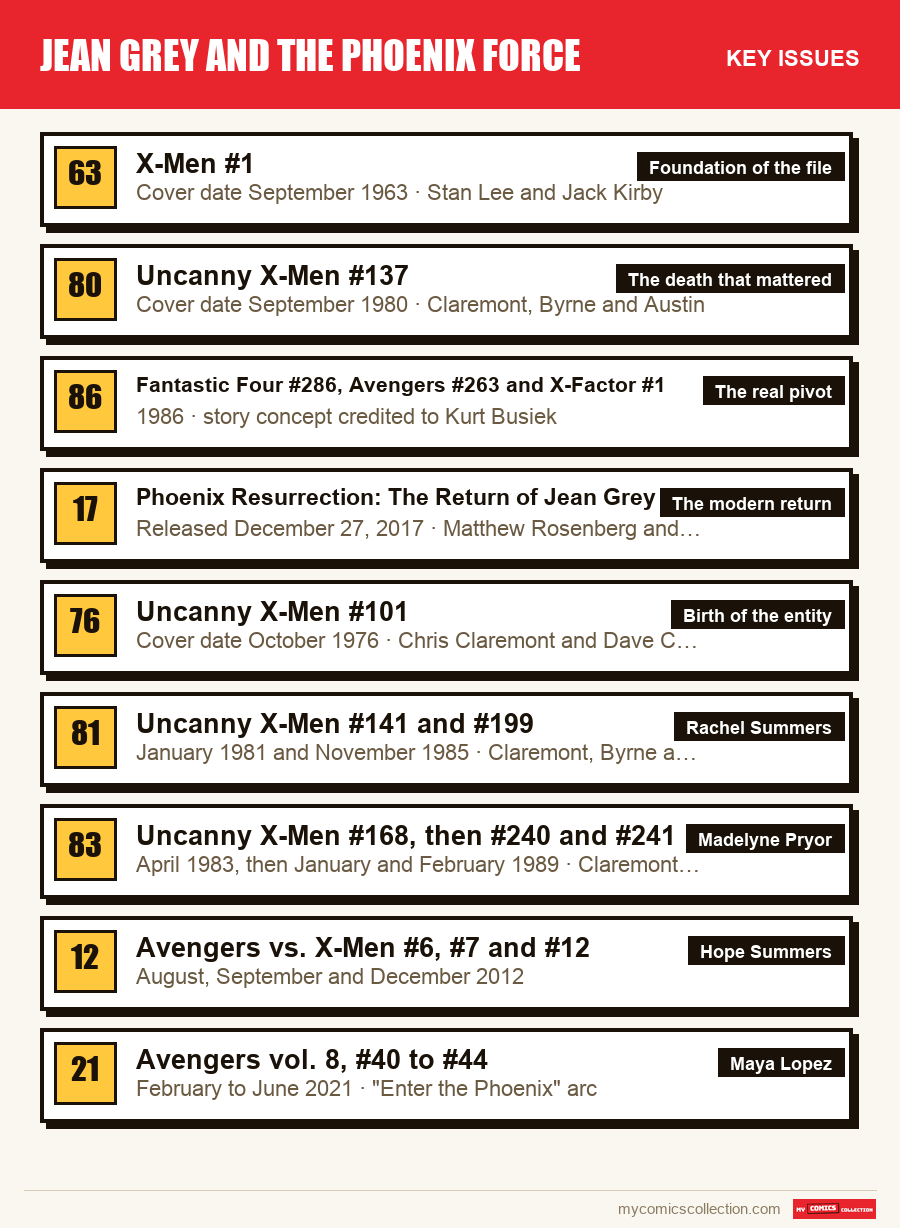
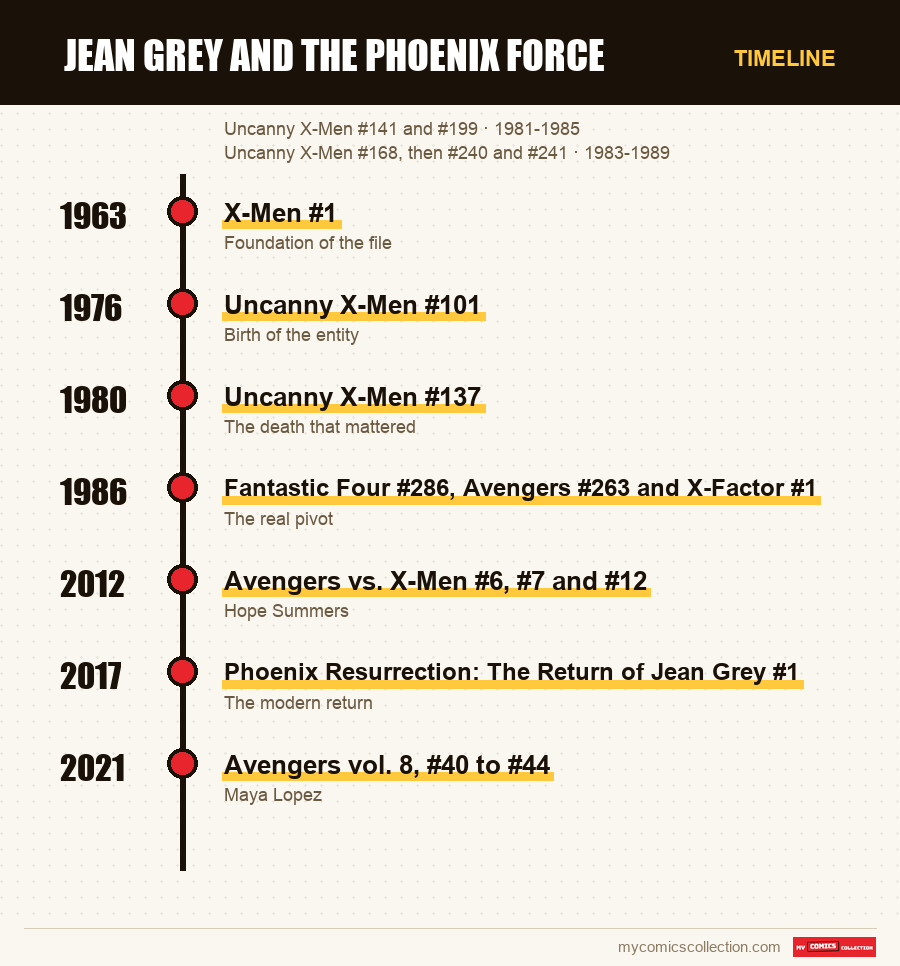
The Jean Grey file is really collected on two distinct lines that the market constantly confuses: that of the person, which starts at X-Men #1 (September 1963) by Stan Lee and Jack Kirby, and that of the Phoenix entity, which starts at Uncanny X-Men #101 (October 1976) by Chris Claremont and Dave Cockrum. The two overlap from 1976 to 1980, then separate for good in 1986, when Fantastic Four #286, Avengers #263 and X-Factor #1 establish that the Phoenix Force, not Jean, bore responsibility for the Dark Phoenix's acts. Since then, the entity has had its own hosts and therefore its own first appearances. In November 2026, Marvel publishes Jean Grey #1, a five-issue miniseries by Jed MacKay and drawn by Antônio, following the Phoenix's arrival at the end of DNX. This article sorts the issues according to whether they belong to the woman or to the fire.
Few files are as old, as documented and as badly classified as this one. Ask five collectors for the list of key Jean Grey issues: you will get five lists that mix, without saying so, issues where she appears and issues where something appears that carries her face, her code name or her legacy. This is not an exegete's subtlety. It is the reason two neighboring issues in the same series can have opposite market trajectories.
The confusion has a precise, dated editorial cause. For four years, from 1976 to 1980, Marvel let readers believe that Phoenix was a nickname, a power-up, a career step. In 1986, the publisher rewrote this period: Phoenix was an autonomous entity that had taken Jean's place and imitated her memory. With a stroke of the pen, half the file changed owner. And since the entity survived that rewrite, it kept producing key issues that no longer concern Jean Grey at all.
November 2026 puts exactly this question back on the table, and it is the occasion to sort things out. The miniseries Marvel publishes that month is titled Jean Grey, whereas the previous solo series of the same file, published from 2024 to 2025, was titled Phoenix. The title changed sides.
November 2026: what we know, and what nobody knows yet
Let's start with what is established. Jean Grey #1 opens a five-issue miniseries in November 2026. Jed MacKay is the writer, Antônio the artist. The story follows the Phoenix's arrival at the end of DNX.
MacKay is no stranger to this franchise: he writes the parent series X-Men, the seventh volume of the title, launched in 2024 with Ryan Stegman on art as part of the From the Ashes relaunch. Entrusting the architect of the main title with a short miniseries on a specific character is not an idle gesture: it generally signals that the story has consequences for the parent series, not the other way around.
What nobody knows, and what you must treat as unknown: the exact content of what DNX establishes about the Phoenix's status, the characters present in issue 1, the possible first appearances it might contain, and the print run. None of this information is published as of October 2, 2026. Any claim about this issue's future value is therefore pure invention, and plenty will be written in the coming weeks.
The dividing line: three tests to know who an issue belongs to
Before listing issues, let's set the sorting tool. Faced with an issue you are told is "key for Jean Grey," three questions are enough to classify it.
Who is in the body?
From 1976 to 1980, the creature wearing the green and gold costume is not Jean Grey, according to continuity as rewritten in 1986. Jean's real body sleeps in a cocoon at the bottom of a bay. An issue from that period is therefore an issue of the entity playing Jean, not an issue of Jean. That takes nothing away from it: it simply changes what it documents.
Is the power transferable?
Jean Grey's own abilities, telepathy and telekinesis, are genetic and are not passed on. The Phoenix Force, on the other hand, chooses hosts and leaves them. If an issue's landmark fact is an ability someone else will be able to receive later, the issue belongs to the entity. If the landmark fact is a decision, a relationship or a definitive death, it belongs to the person.
Does later storytelling cite this issue, or work around it?
A real key issue is cited constantly by subsequent stories. A supposed key issue is worked around: its image is kept, not its content. Forty years of publication settle it for you, and the issues the publisher reprints and references are not always those that speculation lists put forward.
This sorting has an immediate practical consequence. Two buyers can aim at the same file with almost disjoint lists, and both be right. The one who collects the person stops at 1963, 1980, 1986 and 2017. The one who collects the entity starts in 1976 and continues to 2021. Decide which you are before spending anything.
The person's issues: Jean Grey, from 1963 to today
X-Men #1
Jean Grey appears there for the first time, under the name Marvel Girl, as a founding member of the team. She is, in fact, the first female mutant in the Marvel catalog, and the only woman on the original team. It is an issue that belongs simultaneously to five character files and to that of the team, which explains its position and relative scarcity: nobody buys it only for her.
Uncanny X-Men #137
Conclusion of the Dark Phoenix saga, run through Uncanny X-Men #129 to #138 between January and October 1980. Jean dies there by triggering an ancient Kree weapon, after a farewell to Cyclops. This issue is the only one of the period that passes the three tests above without ambiguity: the decision is the person's, it is definitive at the moment it is published, and forty years of stories cite it without ever working around it.
Fantastic Four #286, Avengers #263 and X-Factor #1
Three issues, three series, a single movement: Jean's body is found, she returns, and the story establishes that the Phoenix Force, not she, bore responsibility for the Dark Phoenix's acts. It is the editorial operation that creates the separation this whole article is about. The collector who does not own these three issues owns a file missing its founding act.
Phoenix Resurrection: The Return of Jean Grey #1
After a long absence of the adult Jean Grey, replaced in the meantime by a teenage version from the past in the series All-New X-Men launched in 2012, this miniseries brings the original character back. It opens the sequence that gives Jean her first solo series in 2017, as part of the ResurrXion relaunch, then a headlining role in X-Men Red from 2018, then a seat on the Quiet Council during the Krakoan era.
If you want the issue-by-issue detail of this first line, our dedicated pages cover it: the key issues of Jean Grey, the character's editorial history and the reading path do not do the same job as this page and complement each other without overlapping.
The entity's issues: the Phoenix Force and its hosts
Here is the second line, the one "Jean Grey" lists wrongly swallow. Each host of the Phoenix Force has its own first appearance, and these issues are key issues in their own right, but of another file.
Uncanny X-Men #101
First appearance of the Phoenix Force. This is where the entity enters the catalog, at the opening of the sequence retroactively dubbed the Phoenix saga, extending from Uncanny X-Men #101 to #108 between 1976 and 1977. For forty years, this issue was sold as "Jean Grey becomes Phoenix." Since 1986, it more exactly documents the arrival of a cosmic entity that will take Jean's place.
Uncanny X-Men #141 and #199
#141 contains the first appearance of Rachel Summers, in an alternate future, without her family name being revealed at this stage. #199 is the one where she fully unites with the Phoenix Force. Two issues, two functions: one is a character's first appearance, the other is the entity's first attested transmission to someone other than Jean.
Uncanny X-Men #168, then #240 and #241
#168 introduces Madelyne Pryor, at first as a disturbing lookalike. #240 and #241, published during Inferno which runs from Uncanny X-Men #233 to #243 between November 1988 and April 1989, reveal that she is a clone created from Jean's genetic material, and that the clone stayed inert until a part of the Phoenix Force awakened it. The resolution goes through X-Factor #38, in March 1989.
Avengers vs. X-Men #6, #7 and #12
The 2012 event revolves around the question of the host. In #6 and #7, the Phoenix Force, instead of possessing Hope Summers as the whole story announced, spreads across the five X-Men present. In #12, Hope briefly contains it. Her first appearance is earlier: X-Men #205, cover date January 2008, by Mike Carey and Chris Bachalo.
Avengers vol. 8, #40 to #44
A tournament designates the entity's next host. Maya Lopez, known as Echo, is defeated there, and it is precisely her refusal to give up that draws the entity to her. Her first appearance is much earlier, in Daredevil #9, cover date December 1999, by David Mack and Joe Quesada.
Other hosts exist, less well documented: the Stepford Cuckoos in X-Men: Phoenix: Warsong in 2006, Emma Frost on several occasions, and bearers prior to Jean cited in isolated stories, including a Shi'ar mentioned in Uncanny X-Men #479. On these entries the source is a mention, not an established first appearance: reading leads, not buying targets.
What a series' title says about the file
Let's return to November 2026, with the sorting tool in hand. From 2024 to 2025, Marvel published fifteen issues of a series titled Phoenix, written by Stephanie Phillips and drawn by Alessandro Miracolo, announced in April 2024 as part of the From the Ashes relaunch. The title was the entity's, and the register was cosmic.
In November 2026, the miniseries is called Jean Grey. Not Phoenix. It is a change of cover name, therefore a commercial decision as much as an editorial one, and it says something: the publisher judges that the woman's name sells better than the fire's name, or that it has something to tell that the entity did not allow telling.
For a collector, this shift is more informative than a preorder figure. A series bearing the entity's name generally produces entity key issues: hosts, manifestations, cosmic rules. A series bearing the character's name rather produces person key issues: relationships, decisions, status.
This reasoning has a limit that must be stated: it describes a tendency observed across the catalog, not a law. The November 2026 issue 1 could contain a host's first appearance and send this whole paragraph to the storehouse of good ideas. That is why you buy it to read it, not to bet on it.
The four concrete traps of this file
All four come up, in this order of frequency.
The double numbering. The parent series is called X-Men until around issue 141, then Uncanny X-Men on the cover, with no break in numbering. A seller announcing "X-Men #101" and a seller announcing "Uncanny X-Men #101" are talking about the same object. Conversely, X-Men #205 from 2008 has nothing to do with the original series: it is the title's second volume. Always check the year before the number.
The facsimile. The most in-demand issues of 1963, 1976 and 1980 exist in faithful reprints, cover included. The marker is on the back, in the legal notices and the barcode. Bought knowingly, it is an excellent reading solution; bought by mistake at the original's price, a dead loss.
The first-appearance slip. You will be sold Uncanny X-Men #129 as a Jean Grey issue. It does open the Dark Phoenix saga, and it contains other first appearances that make up the bulk of its demand. It contains no first appearance of Jean, which dates from 1963, nor the birth of the entity, which dates from 1976. It is a key issue, but of another file than this one.
The confusion of faces. Rachel Summers, Madelyne Pryor and the teenage Jean of 2012 share a face and, for two of them, a genetic heritage. Covers do not always distinguish them, titles even less. Before buying a 1980s or 1990s issue presented as "Jean Grey on the cover," read the contents. The contents settle where the cover maintains doubt.
Building both lines without going broke
The method that works on this file comes down to an inversion: start with the end, not the beginning. The beginning is the most expensive issue in the mutant catalog; the end is accessible and reads better.
Concretely: first Phoenix Resurrection and the 2017 solo series, which are bought without effort. Then the 1986 trio, undervalued and central. Then Uncanny X-Men #137 and #138, in the grade your budget allows, a readable low grade being better than an absence. Then #101, when the opportunity arises. X-Men #1 last, or never: many excellent collections stop before it.
For the second line, the entity's, the logic is different: you are not looking for expensive issues, you are looking for a continuity. #141 and #199, #168 then #240 and #241, the three issues of Avengers vs. X-Men, the 2021 arc at the Avengers. Almost none of it is rare. All of it is hard to find again, because it is scattered over six series and forty years. It is exactly the use case for an issue-by-issue tracker: the problem is not price, it is memory.
Finally, if you already own part of this file without knowing what it represents, an estimate and a clean inventory will tell you which of the two lines you started without meaning to.