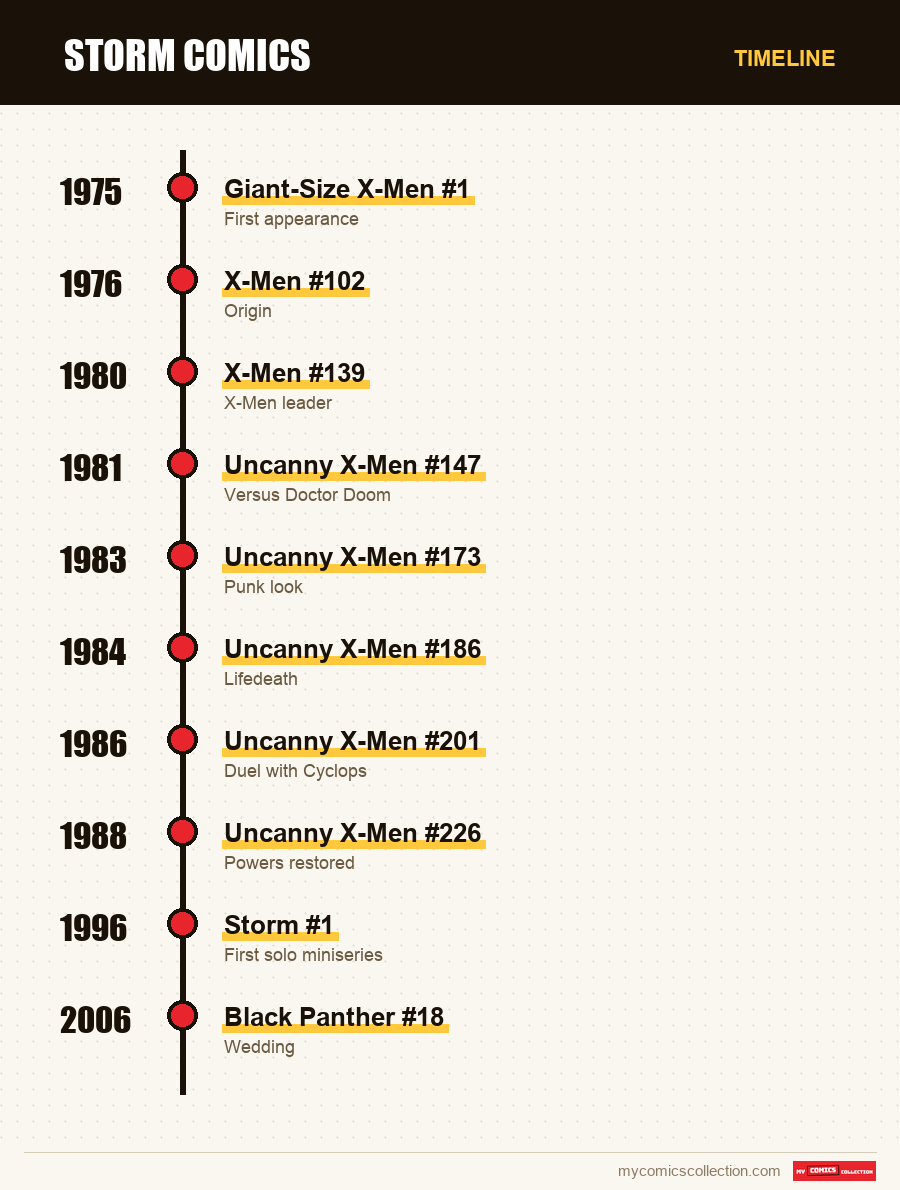
Tornado (Ororo Munroe) is created by screenwriter Len Wein and artist Dave Cockrum, and first appears in Giant-Size X-Men #1 (May 1975), the founding number which relaunched the franchise with an international team. She quickly becomes leader of the X-Men, goes through significant arcs such as the loss of her powers in Uncanny X-Men #185-186 (“Lifedeath”, 1984) and her marriage to Black Panther in Black Panther #18 (2006). The founding comic, Giant-Size X-Men #1, remains the most sought-after piece by collectors, with a CGC 9.8 example selling for $22,860 at an auction in 2025.
There are few characters in Marvel history whose appearance has had as lasting an impact as that of Storm. When Len Wein and Dave Cockrum imagined this African priestess capable of mastering the elements, they were not content with creating a new superhero: they were laying the foundation stone for a completely redesigned X-Men team, more international, more adult, and which would dominate the comic book market for the following decades. Tornado is the most visible symbol, the one who goes from the status of a simple recruit to that of leader, then queen consort of Wakanda.
This article traces the complete editorial history of Tornado in comics: its creation in 1975, the issues which have shaped the character over the decades, its evolution of costume and status within the X-Men, as well as useful references for collectors who are interested in vintage copies linked to this character. We also discuss the impact of audiovisual adaptations, cinema and animation, on the notoriety and demand around the original comics.
Unlike many superheroes whose genesis takes place in a handful of pages, Ororo Munroe's journey is built on several narrative arcs spread over nearly fifty years of Marvel history, with emblematic screenwriters like Chris Claremont who have shaped the character over a long period of time. It's this rare continuity that explains why specific issues, and not just its first appearance, have become sought-after pieces.
The origins of Tornado: the creation of a mutant goddess
At the beginning of the 1970s, the original X-Men series was slowing down: Marvel was republishing old stories for lack of new adventures, and the title was close to being discontinued altogether. It is in this context that the publisher entrusted Len Wein with the writing of a one-shot intended to relaunch the franchise with a completely renewed team, drawn by Dave Cockrum, an artist who had already considered similar character concepts for a project that remained unpublished at DC Comics. According to research into the character's genesis, Storm was born from the fusion of two concepts that Cockrum had already sketched: a heroine called Black Cat and another called Typhoon. It is from this mixture that the definitive silhouette of Ororo Munroe emerges, with his white hair, his piercing blue eyes and his flowing cape. A detail circulated for a long time behind the scenes of creation: Cockrum's collaborators feared that white hair would give the character a grandmotherly appearance. The artist held on, convinced that he could draw Tornado in a way that preserved his visual youth: a gamble that paid off since the white hair is today one of the character's most recognizable attributes.
The code name “Storm” (Tornado in French) was given to her by Professor Charles Xavier himself, when he came to find her in Kenya to form his new team. In the story, Xavier must form a group of mutants capable of rescuing the original X-Men, held prisoner on the living island of Krakoa. He thus recruits characters from the four corners of the world (Nightcrawler (Germany), Colossus (USSR), Sunfire (Japan), Thunderbird (United States, Native American reserve) and Tornado (Kenya)) joining Cyclops among the veterans. This international dimension, unprecedented for a Marvel superhero team at the time, is one of the elements which allowed the X-Men franchise to lastingly distinguish itself from the publisher's other titles.
Ororo Munroe before the X-Men: a youth between Cairo and the Serengeti
Storm's personal history, developed over subsequent issues by Claremont, is one of the most detailed origins in the Marvel Universe. Ororo was born in the United States, the daughter of David Munroe, an African-American journalist, and N'Daré, a princess from a line of Kenyan priestesses renowned for their white hair, blue eyes and their mastery of ancestral rituals. Six months after his birth, the family moved to Cairo, Egypt. Five years later, while the region was gripped by armed tensions, a plane crashed into the family home. Ororo survives, protected by her mother's body: a trauma which explains the character's chronic claustrophobia, a character trait regularly exploited in later storylines.
Left to her own devices in the streets of Cairo with only a ruby that belonged to her mother, young Ororo is taken in by a gang led by a certain Achmed El-Gibar, who makes her a fearsomely gifted pickpocket. As a teenager, she undertook a long journey on foot to the south of the African continent and finally reached the Serengeti plains in Kenya, where her powers of climate manipulation were fully manifested. Revered as a goddess by the local populations for her ability to end droughts, she lives several years in this role before Charles Xavier comes to reveal to her her true nature as a mutant and asks her to join his new team. It is this past as a revered “goddess” which explains the extra gravity and dignity that Claremont attributes to the character from his first appearances, in contrast with the more youthful profile of the other recruits.
Giant-Size X-Men #1: the new team that changed Marvel
Giant-Size X-Men #1 appeared with a cover date of May 1975, but was distributed on newsstands in April of the same year. This giant 68-page issue, written by Len Wein and drawn by Dave Cockrum, features the new team's fight against the mutant island Krakoa in order to free the original X-Men. It is today considered one of the most important founding comics in the history of Marvel, in the same way as the origins of characters like Spider-Man or the Fantastic Four, because it relaunched a moribund franchise and laid the foundations for what would become, under the pen of Chris Claremont who took over from the following issue, one of the most read titles in the entire comic book industry during the 1980s.
For collectors, this issue occupies a special place: it marks not only the first appearance of Storm, but also those of Nightcrawler, Colossus, Thunderbird and the first appearance as X-Man of Wolverine, whose character had already technically appeared in The Incredible Hulk #181 a few months earlier. This accumulation of notable first appearances makes it one of the most sought-after comics on the vintage market, with a particularly strong premium on high-preservation copies. A copy graded CGC 9.8 sold for $22,860 at an auction held in September 2025, with an estimate range of $20,000 to $30,000, illustrating the continued strength of demand for the highest grades of this issue fifty years after its publication.
The reign of Chris Claremont: Storm becomes leader of the X-Men
Beginning with the following issue, Chris Claremont took over writing duties for the series for what would become one of the longest and most influential runs in American comics history, spanning nearly seventeen consecutive years. It is under his pen that Tornade evolves most radically, going from the status of an impressive but insecure new recruit to that of the undisputed leader of the team.
The fight against Doctor Doom (Uncanny X-Men #145-147)
In the story arc covering Uncanny X-Men #145 à #147, drawn by Dave Cockrum with inkings by Joe Rubinstein, Tornado finds herself at the heart of an intrigue where she is both courted and martyred by Doctor Doom. Issue 147, titled “Rogue Storm,” gives her a much more central role than usual in a story that puts her in direct confrontation with one of the greatest antagonists in the Marvel universe. This arc is often cited by long-time readers as one of the first moments where Storm truly establishes himself as a character in his own right rather than just a member of a choral ensemble.
The punk look of Uncanny X-Men #173
In September 1983, Uncanny X-Men #173 introduces one of the most significant appearance changes in the character's entire history: Storm abandons his classic cape and costume for a black leather jumpsuit, mohawk crest, and lightning bolt earrings. The story of this transformation, since told by several of the artists involved, is particularly tasty: the designer Paul Smith had submitted this design almost anecdotally, inspired by the look of the actor Mr. T, among a batch of more conventional sketches. It was the editor Louise Simonson who chose precisely this version, judging it to be more daring and more in line with the evolution of the character towards the status of a leader freed from the classic codes of the superhero. The cover of this issue, by Paul Smith, has since influenced numerous reinterpretations of the character, including adaptations outside of the comics.
Lifedeath: The Loss of Powers (Uncanny X-Men #185-186)
One of the most critically acclaimed arcs remains "Lifedeath", published in Uncanny X-Men #185 and above all #186 in 1984, with designs by Barry Windsor-Smith. In this story, government agent Henry Peter Gyrich accidentally shoots Storm with a mutant-neutralizing weapon, originally intended for the fugitive Rogue. The double issue that follows explores the intimate reconstruction of the character, now deprived of her control of the climate, and her budding relationship with the mutant inventor Forge: who reveals himself to be, without initially knowing it to her, the designer of the weapon responsible for her loss of powers. This story, hailed for its rare psychological depth in a superhero comic of the time, had a lasting impact on the characterization of the character; Tornado would only regain his powers three years later, in Uncanny X-Men #226 cover-dated February 1988. The subject was also taken up almost literally in the animated series X-Men '97 in 2024, proof of the place that this arc still occupies in the collective memory of readers.
Marriage to Black Panther: the 2006 event
After decades of status as a central character in the X-Men universe, Storm experienced one of the most publicized editorial events of his career in 2006: his marriage to T'Challa, the king of Wakanda also known as the Black Panther. The ceremony takes place in Black Panther #18 (September 2006), from the pen of screenwriter Reginald Hudlin, as part of a crossover with the “Civil War” event then in progress at Marvel. The miniseries Storm (second volume), the sixth and final number of which serves as a direct prelude to the ceremony, prepares the narrative ground for this union. At the time, Marvel editor-in-chief Joe Quesada compared the scale of the event to the wedding of Prince Charles and Lady Diana, as the mobilization around this story crossing two of the most popular characters of the publishing house had been significant. The couple will then be separated in more recent stories, but this arc remains a milestone in the character's continuity and a point of reference for collectors who are interested in issues linked to Wakanda as much as the X-Men.
Collecting this series?
Track what you own, what you are missing and what your collection is worth. 7 day trial.
Start my trial →The impact of adaptations on the rating
Tornado is one of the rare Marvel characters present in almost all of the major audiovisual adaptations of the X-Men franchise, which maintains a constant interest in the original comics among a renewed audience with each film or series release. Halle Berry plays the character in the feature films produced by 20th Century Fox: X-Men (2000), X2 (2003), X-Men: The Last Stand (2006) and X-Men: Days of Future Past (2014). A younger version of the character is then entrusted to actress Alexandra Shipp in X-Men: Apocalypse (2016), Deadpool 2 (2018) and X-Men: Dark Phoenix (2019).
On the animation side, Alison Sealy-Smith lends her voice to Tornado in the cult series X-Men: The Animated Series, broadcast from 1992 to 1997, a production which introduced the character to a whole generation of spectators outside of comic book readers. She reprises this role more than twenty-five years later in the direct sequel X-Men '97, launched in 2024, as well as in an episode of What If…? the same year. Each new media appearance of the character automatically leads to a renewed interest in the founding comics, in particular Giant-Size X-Men #1 and the issues of the Claremont-Cockrum-Byrne era, which remain the essential historical reference for anyone wishing to trace the evolution of the character on paper rather than on screen.
Buying guide
For collectors who wish to build or complete a collection around Tornade, a few concrete points of reference can help guide research and avoid unpleasant surprises:
- Favor the first appearance : Giant-Size X-Men #1 (May 1975) remains the absolute reference piece; systematically check the authenticity and condition of the spine, an area particularly sensitive to wear on this giant 68-page issue.
- Distinguish between prints and reissues: many key Tornado stories (Lifedeath, the Doctor Doom arc, the marriage to Black Panther) have been the subject of reissues in omnibus or trade paperback; a collector looking for vintage copies should check the original cover date on the issue itself.
- Monitor costume transition numbers : Uncanny X-Men #173 (the punk/mohawk look) is sought after not only for the story but for the emblematic cover signed Paul Smith, a criterion which weighs on the price independently of the state of conservation alone.
- Check the condition of staples and corners on issues from the 1970s-1980s: these are the most physically fragile period comics, and the difference in value between a copy in Fine (FN) and a copy in Near Mint (NM) can be considerable on key issues.
- Use a comparison of recent sales before buying: the prices displayed in stores or on sales platforms do not always reflect the actual sales concluded; comparing several completed transactions over a recent period gives a more reliable image of the current rating.
- Do not neglect the narrative numbers without being “firsts” : numbers like Uncanny X-Men #185-186 (Lifedeath) or #147 (the Doctor Doom arc) are sought after for their importance in the character's story, even without being first appearances, which often makes them relative bargains compared to their narrative importance.
If you already have any Tornado related issues in your collection: whether it's a Giant-Size X-Men #1
Key issues to know
Giant-Size X-Men #1
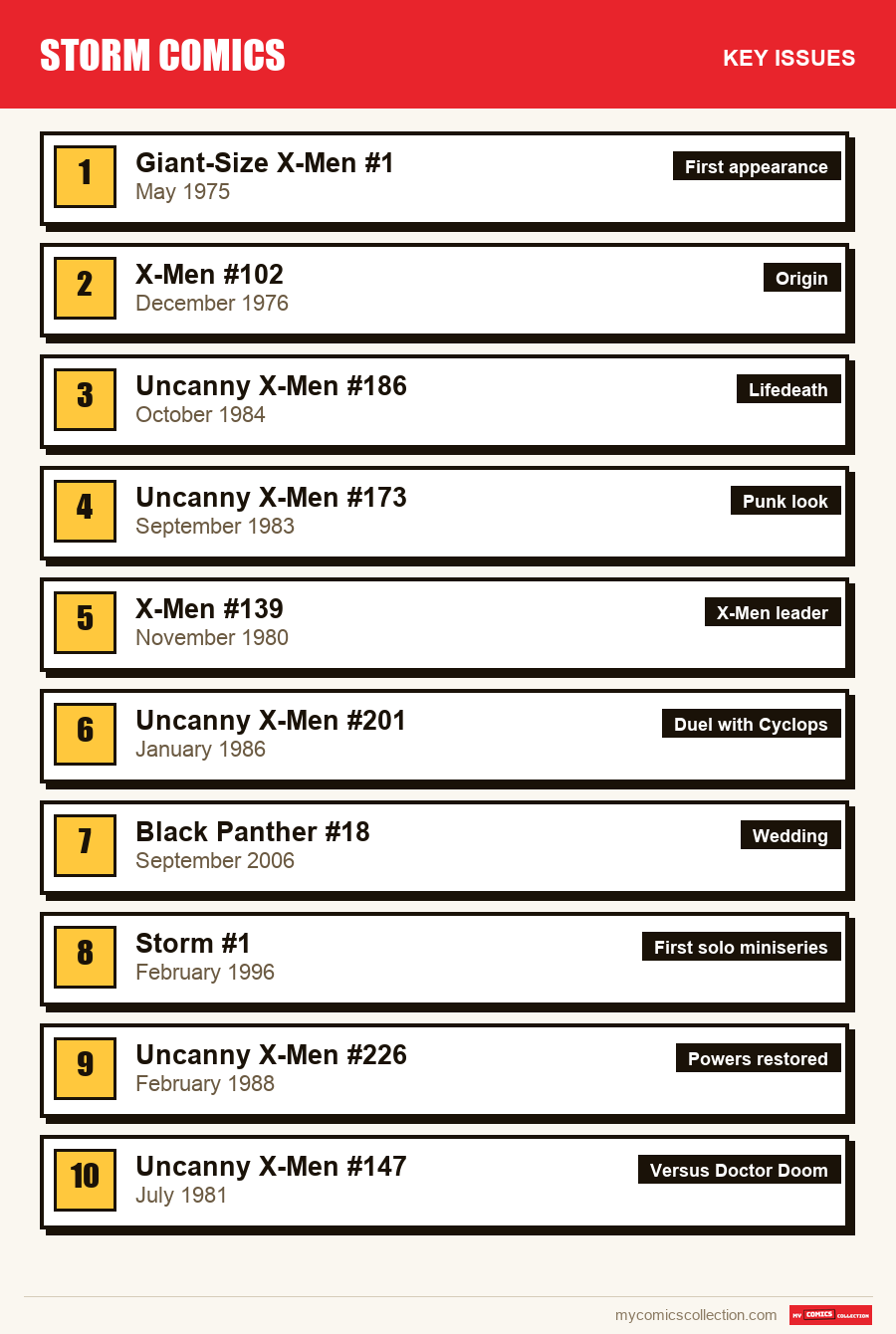
Len Wein and Dave Cockrum create Ororo Munroe, recruited in Kenya by Charles Xavier to rescue the X-Men held captive by the living island Krakoa. The same issue launches Nightcrawler, Colossus and Thunderbird, and brings Wolverine onto the team. It is the centerpiece of any Storm collection.
X-Men #102
Chris Claremont and Dave Cockrum finally reveal Ororo's past: paralyzed by a claustrophobic attack while facing the Juggernaut, she relives her childhood in Cairo as a young thief. This issue also reveals her surname, Munroe, for the first time.
Uncanny X-Men #186
Stripped of her powers in the previous issue by Henry Peter Gyrich's neutralizer, Storm rebuilds herself alongside Forge, unaware that he designed the weapon. Written by Chris Claremont and drawn by Barry Windsor-Smith, "Lifedeath" remains one of the character's most acclaimed stories.
Uncanny X-Men #173
At Wolverine and Mariko's wedding in Japan, Storm shows her teammates her new rebellious look: a mohawk and black leather outfit drawn by Paul Smith, from a Chris Claremont script. This radical change of appearance remains one of the most striking in her history.
X-Men #139
After Cyclops leaves in the previous issue, Chris Claremont and John Byrne hand the leadership of the X-Men to Storm. She becomes the first woman and the first Black character to lead a Marvel superhero team. The issue also marks Kitty Pryde's official welcome to the team, with Ororo taking her under her wing.
Uncanny X-Men #201
Still without her powers, Storm faces Cyclops in a Danger Room duel to decide who will lead the X-Men, and wins. A high point of the Claremont era, drawn by Rick Leonardi. The issue also features the first appearance of Nathan, the baby of Cyclops and Madelyne and the future Cable.
Black Panther #18
Written by Reginald Hudlin and drawn by Scot Eaton, this issue sees Storm marry T'Challa, king of Wakanda, in the middle of the Civil War crisis. Released in July 2006, it makes Ororo queen of Wakanda. The marriage would be annulled a few years later, but it remains a major milestone for collectors.
Storm #1
Her first title, this four-issue miniseries is written by Warren Ellis and drawn by Terry Dodson. Storm is pulled into another dimension where she faces Mikhail Rasputin, Colossus's older brother.
Uncanny X-Men #226
At the heart of "Fall of the Mutants", Storm and Forge are trapped in another reality by the Adversary. There Forge builds a device that gives Ororo back the command of the elements she lost in Uncanny X-Men #185. Cover-dated February 1988, the issue hit newsstands in autumn 1987.
Uncanny X-Men #147
The conclusion of the arc pitting the X-Men against Doctor Doom, "Rogue Storm" is written by Chris Claremont and drawn by Dave Cockrum, inked by Josef Rubinstein. Storm takes the lead role against one of Marvel's greatest villains, a step in her rise as a central character.