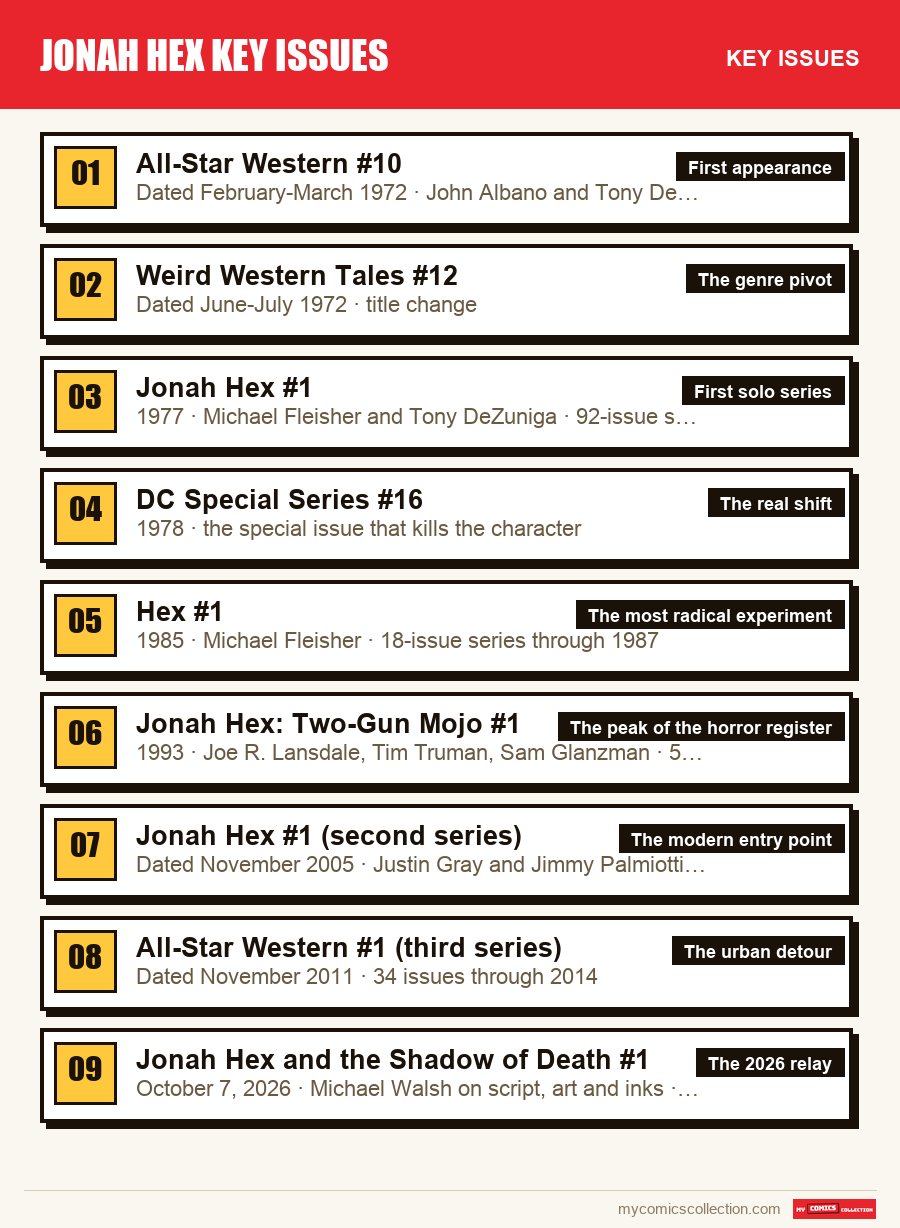
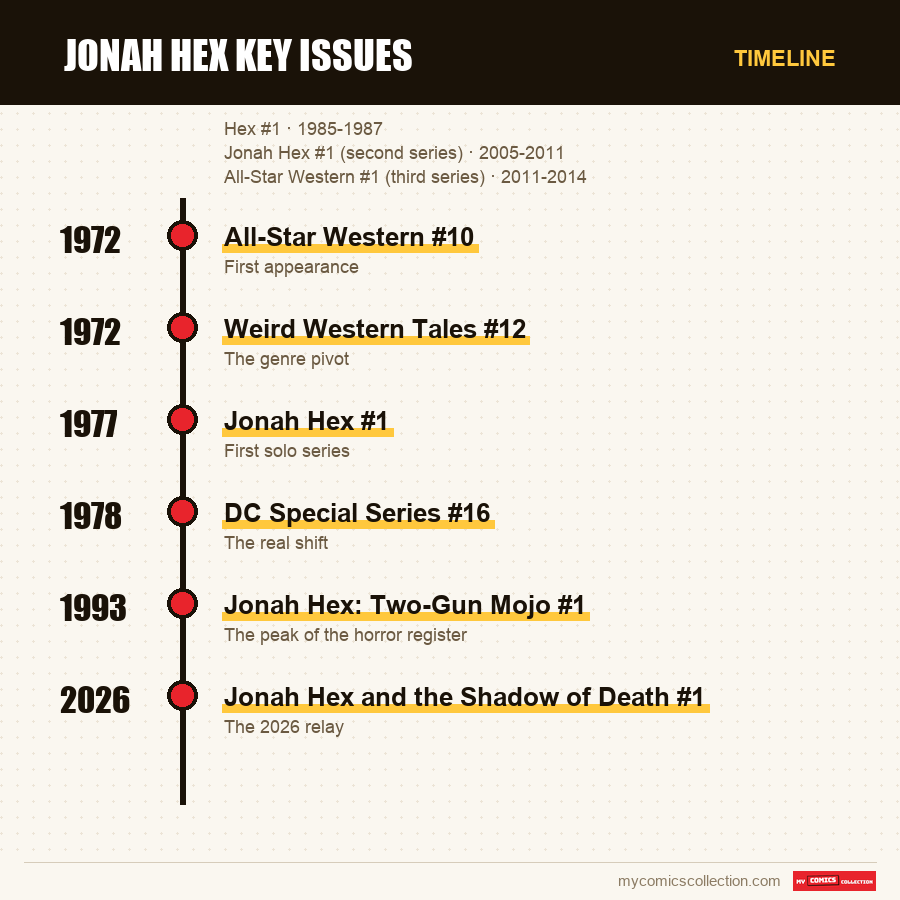
Jonah Hex's key issues read in two columns: the western and the horror. On the origin side, All-Star Western #10 (dated February-March 1972, by John Albano and Tony DeZuniga) remains the only true first appearance, followed by Weird Western Tales #12, the issue where the title changes its name and register. On the shift toward horror, three milestones matter: DC Special Series #16 (1978), which kills the character and has his corpse stuffed, Hex #1 (1985), which sends him into a ravaged future, and above all Jonah Hex: Two-Gun Mojo #1 (1993) by Joe R. Lansdale and Tim Truman, which won a Bram Stoker Award. The 2026 relay is called Jonah Hex and the Shadow of Death #1, on October 7, 2026, written, drawn and inked by Michael Walsh. This article ranks these issues, explains why horror has stuck to this character for fifty years, and says frankly what collecting a minority genre is worth.
At DC there is a handful of characters whose vital statistics fit on one line and whose bibliography fits into four different editorial regimes. Jonah Hex is one of them. A bounty hunter with a ravaged face, he is born in a western comic dated 1972, survives the commercial shipwreck of the genre, goes through a post-apocalyptic period, returns in stories for adult readers, goes through a long regular series of seventy issues, and finds himself in October 2026 headlining a miniseries his publisher presents as a tale of terror.
This path is not an anomaly. It is the mechanical consequence of a situation: when a genre loses its audience, the characters that survive in it are those that can be moved elsewhere. The newsstand western is dead, horror has thrived, and Jonah Hex served as a bridge. For anyone who collects, this story has an immediate practical interest: it explains why some of his issues are hard to find without being expensive, and why others are expensive without being scarce.
It is October 2, 2026, five days before the new issue #1 comes out. No copy is in circulation, so no price exists for it, and this article will not invent one. What does exist, on the other hand, is a technical sheet published by the publisher, a creator whose career is documented, and fifty-four years of publications from which a reliable hierarchy can be drawn.
The horror western is not a fad: at DC, it is survival
We have to start by setting one thing straight, because it determines everything that follows. Jonah Hex was not conceived as a horror character. He is born in 1972 in a pure western comic, in an anthology format, at a time when that genre still occupied the spinner racks. Albano writes him, DeZuniga draws him, and the only concession to the strange is his face, the right half of which is destroyed.
What changes is the market. In the early 1970s, the newsstand western clearly declines, while horror returns in force after the loosening of the industry's self-censorship code. DC reacts in the most direct way possible: two issues after Jonah Hex's arrival, the anthology that hosts him changes its name. All-Star Western becomes Weird Western Tales from issue 12, dated June-July 1972, keeping the numbering. The word "weird" is not decorative: it aligns the title with an editorial vocabulary that was then working very well at the same publisher, on the side of strange war stories.
In other words, the character was pushed toward horror by the magazine's cover before he was by his own stories. This priority of packaging over content is a useful data point, because it comes back with each new attempt, including the 2026 one. It also explains why readers of the time did not find the thing incoherent: the twilight western and the tale of terror already share a lot, an isolated setting, violence with no legal recourse, and characters that nobody will come to save.
If you want to place this shift in the general calendar of collecting eras, the reference point is in our overview of the ages of American comics: Jonah Hex is a Bronze Age character, created in the exact window when publishers were testing every genre to see which ones would hold.
The key issues, from most structuring to most accessory
Here is the hierarchy. It is ranked by historical importance, not by difficulty of sourcing, and each entry says which of the two columns it feeds, western or horror.
All-Star Western #10
The only first appearance that counts, and there is no ambiguity about it. It is also the most sought-after issue of the character's entire bibliography, for an obvious reason: it is the only one sought at the same time by western collectors, those who follow the character and those who build sets of Bronze Age first appearances. Three different demands on a single supply.
Weird Western Tales #12
The issue where the western officially becomes strange. It is not a first appearance, and it is regularly treated as an ordinary series issue. Yet it is the most telling document of the whole set if your collection tells an idea rather than a character: it carries the material trace of a commercial decision, the moment a publisher renames a genre to save it.
Jonah Hex #1
The moment the character stops being an anthology feature and becomes a franchise. The series runs until 1985 and totals 92 issues, which is considerable for a western published in the decade when the genre disappears from the newsstand. Fleisher writes it continuously, and that is where the character's color truly sets: a darkness of tone that goes well beyond what the comic western practiced before him.
DC Special Series #16
Here is the issue that key lists forget and that tells the horror angle better than anything. It shows the death of Jonah Hex: shot in 1904, at sixty-six, in a saloon, while looking for his glasses. What follows is even more striking. After revenge, his body is stolen, entrusted to a taxidermist, dressed in a garish costume and displayed as an attraction in a Wild West theme park, before passing from hand to hand.
Hex #1
The textbook case of the relaunch by displacement. Fleisher tears the character from his century and sets him in a ruined twenty-first century, around a post-apocalyptic Seattle. Commercially, the operation remains modest in the United States; critically, it was better received in Europe and Asia. Eighteen issues, then a halt.
Jonah Hex: Two-Gun Mojo #1
The most important piece of the horror column, by far. Lansdale, a novelist whose work is massively awarded in the field of horror, writes a western populated by the dead reanimated by magic, including a historical figure of the West brought back from the dead. The whole received a Bram Stoker Award in 1993, in a category dedicated to media other than the novel.
Jonah Hex #1 (second series)
Seventy issues largely conceived as complete stories, with artists who change often. It is the series recommended to anyone who wants to read the character without facing half a century of continuity, and it is also the simplest to build in collected editions. Its economic model, stories closed in one or two issues, is precisely what let it last six years in a genre without a mass audience.
All-Star Western #1 (third series)
In the great reset of the DC universe in 2011, the character reappears under the historic title, but transplanted: we find him in the Gotham of the 1880s, partnered with an alienist whose surname will ring a bell for any Batman reader. The western becomes a gothic investigation in an urban setting.
Jonah Hex and the Shadow of Death #1
A six-issue miniseries. The sheet published by the publisher gives 26 pages, a US cover price of $3.99 and a rating of teen plus parental guidance. The official synopsis speaks of a small town named Ashecott, of something bad arriving there, older than the town, from a world foreign to the only one its victims know, and of a child with mysterious abilities that this thing seeks to capture. The publisher presents Walsh as a master of horror.
Why Michael Walsh is a coherent choice, not a gamble
When a publisher itself calls a creator a master of horror in its own sales pitch, prudence says to check. In this particular case, the check holds up.
Walsh is the constant artist of The Silver Coin, a horror anthology launched at Image Comics in 2021, aimed at an adult readership, built on a simple principle: each issue tells a distinct tale of terror in the same supernatural universe, around a cursed coin, and the story opens in 1978 with a rock band that discovers it. The device rotates writers, among them Chip Zdarsky, Kelly Thompson, Ed Brisson and Jeff Lemire, while Walsh provides visual continuity from start to finish. The publisher of Shadow of Death also credits him on Exquisite Corpses, likewise at Image.
This profile matters for three reasons. First, a horror anthology artist knows how to build a fear that must work in twenty pages, which matches exactly the format of a miniseries episode. Second, a complete creator produces a unity of tone that the horror western demands more than other genres, since everything in it rests on atmosphere rather than action. Finally, his career was made outside the big superhero titles, which brings him closer to the 1993 Lansdale model: a horror specialist invited to go through the western, and not a house writer tasked with adding monsters.
What this does not say, however, is the quality of the result. Nobody has read it. Any claim about the artistic success of this miniseries, five days before its release, would be an opinion disguised as information.
Collecting a minority genre: the four realities to accept
This is the heart of the practical question, and it deserves clear answers rather than vague encouragement. Collecting the western, at a publisher whose output is 95% costumed, follows rules that are not those of the big franchises.
First reality: original print runs are low, but so is demand. A comic western from the mid-1970s was printed in far smaller quantity than a contemporary superhero title, and was less preserved, because its readership did not collect. Supply is therefore narrow. But demand is narrow too, and the two largely cancel out. The typical result is an issue that is hard to find in nice condition, without being especially expensive. It is the exact opposite of the profile of a superhero key issue, easy to find and expensive.
Second reality: condition is the real subject, more than the issue number. A 1970s newsstand comic has lived. In a genre where nobody bagged copies, the distribution of conditions is heavily skewed downward. A clean copy of any random issue of Weird Western Tales is sometimes harder to get than an average copy of a famous piece. It is precisely in this configuration that the question of grading becomes relevant, and our guide to CGC grading explains how to weigh it without spending more than the comic's value.
Third reality: liquidity is limited. A minority genre resells slowly. On the secondhand market, a western issue waits longer for its buyer than a Batman issue, because the number of people looking for it at a given moment is small. That does not make the collection less interesting, but it disqualifies the speculative approach: if your horizon is to resell in eighteen months, this is not the right aisle.
Fourth reality: the bibliography is scattered across several titles. This is the most painful peculiarity of the character. His editorial history passes from an anthology to a renamed anthology, then to a solo series, then to a shortened title, then to miniseries under another editorial label, then to a new solo series, then to a recycled historic title. Seven containers for a single character. That is why a manual list in a notebook always ends up derailing, and why a issue-by-issue tracking structured by series, not by character, is here a necessity rather than a comfort.
A five-step method to approach this character
Read before buying old issues
Start with the 2005 series, whose stories are largely self-contained and whose collected editions are accessible. You will know in three or four readings whether the character really interests you, for minimal financial commitment. Many western collections stall after a key bought by reflex and never read.
Choose your column
Western or horror. Both are legitimate, but they do not point to the same issues or the same budgets. The western column leads to 1972 and 1977, the horror column leads to 1978, 1985 and 1993. A collection that pursues both at once costs twice as much and tells half as well.
Check the year, systematically
Two series carry the title All-Star Western, two series carry the title Jonah Hex, and a third is simply called Hex. Before any transaction, demand the publication year. It is the most frequent mistake on this character, and it happens in good faith in both directions.
Treat the 1990s miniseries as sets
Five issues, five issues, three issues. These stories cannot be understood in isolated issues, and their collecting interest lies in the complete set. An orphan first issue of Two-Gun Mojo is a curiosity; all five together are a coherent piece.
Approach 2026 as a reader, not an investor
A recent miniseries is judged by reading it. Take issue 1 because the project interests you, record the following five in your missing issues list so as not to miss one, and leave the question of value for later. It will come up in a few years, or never.
What the horror western brings to a general collection
Last point, less technical but more decisive over time. A collection made entirely of superheroes ends up looking alike. It is evaluated by comparison with thousands of other identical collections, and measured by the single criterion of the most expensive piece owned. Introducing a minority genre changes the nature of the object.
The horror western is a good candidate for this, and not only at DC. The crossover has produced, outside the big historic publishers, structuring series like Jonathan Hickman and Nick Dragotta's East of West, an apocalyptic science-fiction western, or Garth Ennis and Steve Dillon's Preacher, which blends the road, the West and theology. On the horror-without-western side, the 1972 Swamp Thing, born the same year as Jonah Hex, shows that DC was then testing several emergency exits in parallel. Our ranking of western comics places these titles relative to one another, and our guide to collectible horror comics does the same work on the other side of the border.
Finally, there is a concrete advantage, rarely mentioned: in a little-followed genre, your knowledge is worth more than your budget. Nobody will fight you for an issue 47 of a 1970s western series. Knowing which one matters, and why, is enough. That is the central argument of our guide on the value of diversifying beyond the two big publishers, and it applies perfectly inside DC's own catalog, as soon as you leave the costumes.
For the rest, Jonah Hex got a film adaptation in 2010, of which we have detailed elsewhere what it keeps and what it invents: our comparison of the 2010 film versus the comics covers that question in full, and there is no reason to redo it here. Let us simply point out one thing that concerns collecting: a screen adaptation remains, for a minority-genre character, the only event able to abruptly widen the number of people looking for his first appearance. It is a data point to keep in mind, without drawing a prediction from it.
What we do not know, and must refuse to write
For honesty, here is the list of what cannot be claimed today on this subject, and which you will nonetheless see claimed elsewhere.
The print run of Jonah Hex and the Shadow of Death #1 is not public. No preorder figure has been communicated, and the available sales reports cover weeks already past, not an upcoming release. An article that announces a print run for this issue is manufacturing a number.
The current price guides for the 1972 and 1977 keys are not repeated here, because no source consulted publishes a dated and verifiable record of them at the scale of this article. What can be said without risk is relative: the 1972 first appearance dominates the whole bibliography, the 1977 issue #1 comes next, and everything else sits clearly below. This hierarchy has been stable for a long time. The amounts, for their part, depend on condition, timing and place, and none appears in this text for lack of being datable.
Finally, the rest of the program is not known. A major convention runs from October 8 to 11, 2026, the day after issue 1 comes out, and announcements are expected there. None had been made as of this writing. If you read somewhere that a sequel, a crossover or a relaunch has been announced for this character, check the article's publication date before believing it.