
Jonah Hex (2010) Jimmy Hayward , with Josh Brolin, adapts the disfigured bounty hunter (All-Star Western #10, 1972), figure from the DC western. The film stays true to his appearance and tone but adds supernatural elements absent from the character's debut. Here is the detailed comparison, film versus comics.
A rare foray of the western into comic book cinema, Jonah Hex brings the scarred anti-hero of the Wild West to the screen. It draws from a little-known but rich DC tradition. Source-by-source decryption.
As in each article in this series, only verified information (creators, distribution, dates, comic numbers) is stated; the comparative analysis is ours, without reproducing dialogue or protected images.
Title : Jonah Hex (2010)
Director: Jimmy Hayward
Actors: Josh Brolin (Jonah Hex), Megan Fox (Lilah), John Malkovich (Quentin Turnbull)
Exit : June 2010
Studio: Warner Bros.
All-Star Western #10 (1972): Jonah Hex's first appearance
A bounty hunter: scarred, from the Wild West
A former Confederate: haunted by his past
The Palmiotti-Gray run: his modern series (2006)
- Jonah Hex, bounty hunter with a scarred face.
- Her past as a confederate soldier and his demons.
- The decor of Wild West post-war American.
- Its status as antihero lonely and violent.
- His mastery of firearms.
- A power of communicate with the dead, absent from the beginning.
- Of the anachronistic weapons (mounted machine guns).
- A plot of super weapon threatening the nation.
- The tone supernatural amplified.
- The original story condensed and modified.
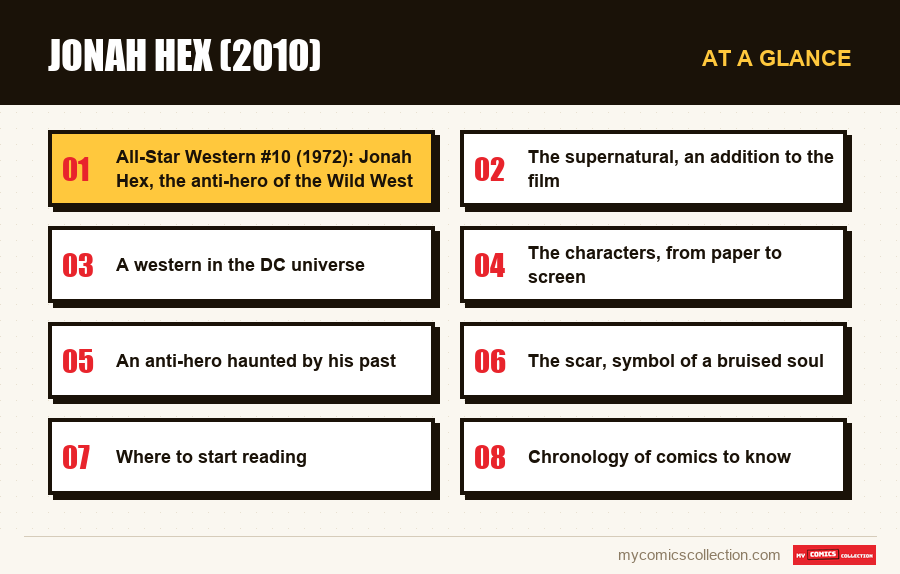
All-Star Western #10 (1972): Jonah Hex, the anti-hero of the Wild West
Jonah Hex brings to the screen the eponymous character, appearing in All-Star Western #10 (1972), created by John Albano and Tony DeZuniga. A bounty hunter operating in the post-Civil War Wild West, Jonah Hex is recognizable by his horribly scarred face on the right side, the result of a significant punishment. A former Confederate soldier haunted by his past, he is a solitary, violent and cynical anti-hero, but with a personal moral code. A formidable sniper, he tracks criminals across the Wild West, pursued by his reputation and his demons. An atypical DC character, Jonah Hex embodies the twilight western, far from costumed superheroes, in a universe of dust, violence and redemption.
The film faithfully reproduces the appearance and tone of the character: Josh Brolin plays a scarred, taciturn and brutal Jonah Hex, a bounty hunter haunted by the loss of his family. The film retains the Wild West setting, the Confederate past, the anti-hero status and the mastery of firearms, faithful to the spirit of the comics. This base respects the visual and thematic identity of the character. The film, however, adds a marked supernatural dimension and anachronistic elements absent from the first stories, transforming the original sober western into a fantastic action blockbuster.
The supernatural, an addition to the film
The film's main freedom lies in adding supernatural powers to Jonah Hex. In the film, having come close to death, Hex acquires the ability to communicate with the deceased by touching them, a power which helps him in his investigations. This fantastical element is absent from the character's debut in the comics, where Jonah Hex is an ordinary man, without the slightest power, whose strength lies in his skill and determination. The film thus amplifies the supernatural dimension, present in a more measured way in certain later stories, to make it a central driving force of the plot and give the character a mystical aura.
This reinvention transforms the nature of the story. The twilight, realistic western of the original comics becomes a fantasy action film, mixing ghosts, anachronistic weapons, like horse-mounted machine guns or sophisticated explosives, and a super-weapon plot threatening the young American nation. These additions, motivated by a desire for spectacle, move away from the sobriety of the first stories. Where the Jonah Hex of the comics draws his strength from his realism and his darkness, that of the film veers into fantasy. For the reader, this gap illustrates the liberties taken by the adaptation, and invites us to discover the character in the comics, where the western takes precedence over the supernatural, particularly in the founding stories of the 1970s and the modern run of Palmiotti and Gray.
A western in the DC universe
Jonah Hex represents a little-known facet of DC: the western. Before the era of dominant superheroes, the publisher published many genre stories, including westerns featuring cowboys, outlaws, and bounty hunters. Jonah Hex is the most famous figure in this tradition, embodying the Wild West in all its violence and desolation. The character has spanned the decades, even appearing in post-apocalyptic science fiction stories, proof of his flexibility. He reminds us that the DC universe is not limited to capes and tights, but encompasses a diversity of genres, from western to horror.
The film, by bringing Jonah Hex to the screen, highlights this DC western dimension, rare in superhero cinema. Despite its flaws, it offers a foray into a different genre, with its settings of saloons, deserts and duels. This generic diversity is a wealth of the DC universe, often eclipsed by superheroes. For the reader, the film is a gateway to the western in comics, a genre which had its hour of glory and of which Jonah Hex remains the ambassador. He recalls that American comics have explored all genres, and that characters like Jonah Hex offer stories anchored in the history and myth of America, far from the futuristic megacities of classic superheroes.
Collecting this series?
Track what you own, what you are missing and what your collection is worth. 7 day trial.
Start my trial →The characters, from paper to screen
- Jonah Hex: The scarred bounty hunter, faithful to All-Star Western #10.
- Quentin Turnbull: Antagonist and personal enemy, adapted for the film.
- Lilah: Ally and love interest, character fleshed out for the film.
- The Confederate Past: Source of Hex's scar and demons.
- The deceased: Those with whom Hex communicates, a power invented for the film.
An anti-hero haunted by his past
What makes Jonah Hex fascinating is his psychology as a tormented anti-hero. A former Confederate soldier, marked on his face and in his soul, he carries a past of betrayals, losses and violence. His scar is the physical symbol of his inner torment. Cynical and solitary, he is neither a virtuous hero nor a pure villain, but a complex man guided by a rough moral code and an impossible quest for redemption. This moral ambiguity, central to the comics, makes Jonah Hex a deeply human character, whose darkness reflects that of the Wild West itself.
The film captures this tragic dimension. Josh Brolin's Jonah Hex is haunted by the murder of his family, driven by revenge but consumed by pain. This tormented psychology, faithful to the comics, gives the character depth beyond the action. The theme of the haunting past and impossible redemption resonates throughout the story. For the reader, this darkness is the essence of Jonah Hex, an anti-hero who stands out from the luminous figures of DC. The film, despite its supernatural additions, preserves this tormented soul, inviting us to discover in the comics a character of remarkable depth, whose stories explore the violence, guilt and quest for meaning of a man broken by war and destiny.
The scar, symbol of a bruised soul
Jonah Hex's scarred face is more than a distinctive feature: it is the very symbol of his identity. The right side of his face, marked by a hideous scar, is the result of a cruel punishment inflicted in his past, an indelible legacy of the betrayal and violence that mark his life. This disfigurement makes Hex a pariah, a man feared and rejected, condemned to solitude. But it also reflects his inner wounds: the outer scar is the mirror of a soul bruised by war, loss and guilt. This powerful symbolism, central to the comics, makes the character an unforgettable, recognizable tragic figure.
The film faithfully recreates this striking appearance, making the scar a strong visual element of its incarnation by Josh Brolin. This disfigurement anchors the character in the tradition of broken anti-heroes, whose physical appearance reflects inner torment. The film understands the importance of this trait, which distinguishes Jonah Hex from any other western or comic book hero. For the reader, the scar is inseparable from the character: it alone tells his story of pain and survival. It illustrates the talent of comic book creators to give their characters a meaningful visual identity. Jonah Hex, with his scarred face, remains one of DC's most memorable characters, proof that a simple scar can embody the entire tragedy of an existence.
Where to start reading
To discover Jonah Hex, All-Star Western #10 (1972) features his first appearance. The Jonah Hex series by Justin Gray and Jimmy Palmiotti (2006) offers an acclaimed modern retelling, with comprehensive and accessible stories. Classic stories from the 1970s reveal the original twilight western. This journey reveals a much more realistic character than the film.
Chronology of comics to know
- 1972: All-Star Western #10: The first appearance of Jonah Hex.
- 1977: Jonah Hex #1: the start of his first solo series.
- 2006: Jonah Hex (run by Palmiotti-Gray): a major modern rereading.
Collection side: what numbers to aim for after the film
Jonah Hex points to Bronze Age keys. All-Star Western #10 (1972, first appearance of Jonah Hex) is the key sought after by collectors. Jonah Hex #1 (1977, his first solo series) is another interesting target. The run collections by Palmiotti and Gray (2006) are accessible modern targets. These numbers cover affordable budgets. As always, condition and gradation determine value; relying on real recent sales is strongly recommended.
Its place in the saga and for the collector
Jonah Hex will remain as a rare foray of the western into comic book cinema, despite an unfavorable reception. For the collector, it highlighted All-Star Western #10, key to the character and the western genre at DC. It illustrates the liberties taken by the adaptations, notably the addition of the supernatural. Beyond this failure, Jonah Hex remains a fascinating character, ambassador of a little-known DC genre. By playing the scarred anti-hero of the Wild West, he recalls the diversity of the DC universe, well beyond costumed superheroes.
The verdict: a faithful western tinged with the supernatural
- Loyalty: Jonah Hex, his scar, his Confederate past, the Wild West setting, his anti-hero status and his mastery of weapons come from the comics.
- Freedoms: the power to speak to the dead, the anachronistic weapons, the superweapon plot, the amplified supernatural tone, the condensed narrative.
- Collectible numbers: All-Star Western #10 (Jonah Hex), Jonah Hex #1 (1977).
Jonah Hex brings to the screen the scarred bounty hunter of the Wild West, a former Confederate haunted by his past. Faithful to its appearance, its tone and its anti-hero psychology but adding supernatural powers and anachronistic weapons absent from the beginning, the film transforms the sober western of the origins into fantastic action. For the reader and the collector, it is an invitation to discover All-Star Western #10 and the modern run.
Frequently asked questions
From All-Star Western #10 (1972), created by John Albano and Tony DeZuniga. A bounty hunter with a scarred face, a former Confederate soldier, he lives in the post-Civil War Wild West. The film faithfully reproduces its appearance and tone.
At the beginning, no: he is an ordinary man, a sniper without powers. The film adds the ability to communicate with the dead, absent from the first stories. This supernatural element, more present in certain later stories, is amplified on screen.
No, he's a western anti-hero. He embodies a little-known facet of DC, the publisher having long published genre stories. Solitary, violent and cynical but endowed with a moral code, he stands out from the classic costumed superheroes of the DC universe.
Partially. It respects the appearance, the tone, the Confederate past and the tormented psychology of the character, but adds supernatural powers, anachronistic weapons and a super-weapon plot which distance it from the realistic western of the origins.
All-Star Western #10 (1972, first appearance of Jonah Hex) is the key you're looking for. Jonah Hex #1 (1977, his first solo series) is another target. The run collections by Palmiotti and Gray (2006) are accessible modern targets.
Does the film make you want to collect? Estimate the value for free of your numbers (All-Star Western #10, Jonah Hex #1…) with our tool based on current eBay listings.