Constantine (2005) Francis Lawrence , with Keanu Reeves , adapts John Constantine (Saga of the Swamp Thing #37, 1985), the cynical exorcist of the Vertigo universe. The film transposes the character from Liverpool to Los Angeles and Americanizes him, while retaining his fight against demons. Here is the detailed comparison, film versus comics.
A rare foray into the adult occult from DC/Vertigo in cinema, Constantine brings to the screen the most disillusioned supernatural detective in comics. It draws from a dark and mature mythology. Source-by-source decryption.
As in each article in this series, only verified information (creators, distribution, dates, comic numbers) is stated; the comparative analysis is ours, without reproducing dialogue or protected images.
Title : Constantine (2005)
Director: Francis Lawrence
Actors: Keanu Reeves (John Constantine), Rachel Weisz (Angela Dodson), Tilda Swinton (Gabriel)
Exit : February 2005
Studio: Warner Bros.
Saga of the Swamp Thing #37 (1985): 1st appearance of John Constantine
Hellblazer (1988): his solo series Vertigo
A British exorcist: cynical and disillusioned
Occultism: demons, Hell and magic
- John Constantine, a cynical and disillusioned exorcist.
- His fight against demons and infernal forces.
- Sa damnation and his tormented relationship with the afterlife.
- His mastery of occultism and rituals.
- Her lung cancer linked to cigarettes.
- Constantine becomes American (Liverpool → Los Angeles).
- His appearance blonde comics disappear.
- The tone punk and politics from Hellblazer is toned down.
- The plot is a original story, not a precise arc.
- Catholic mythology is emphasized.
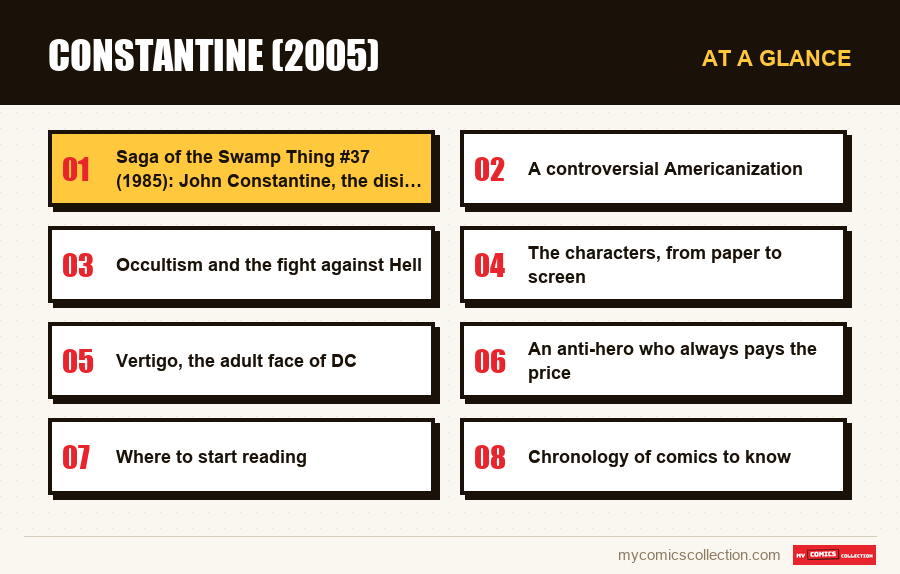
Saga of the Swamp Thing #37 (1985): John Constantine, the disillusioned exorcist
Constantine stars John Constantine, who appeared in Saga of the Swamp Thing #37 (1985), created by Alan Moore, Stephen Bissette and John Totleben. First a secondary character in the Swamp Thing series, this British occult detective was so successful that he got his own series, Hellblazer, in 1988, a pillar of the Vertigo universe. A cynical, manipulative and disillusioned exorcist from Liverpool, Constantine is an anti-hero surveying the supernatural underbelly of our world. Master of magic and cunning rather than strength, he faces demons, angels and infernal forces, often paying a heavy price. Damned, haunted by his errors and by the death of those close to him, he embodies an adult, dark and deeply human occultism.
The film captures the essence of the character: Keanu Reeves plays a cynical exorcist John Constantine, fighting against the demons that infiltrate the world. The film preserves his tormented relationship with the afterlife, his damnation, his mastery of the occult and his lung cancer linked to cigarettes, an iconic trait of the character. This basis respects Constantine's supernatural anti-hero identity. The film, however, makes major changes, notably the Americanization of the character, transposed from Liverpool to Los Angeles and deprived of his British accent and appearance, which caused debate among readers attached to the original Constantine from Hellblazer.
A controversial Americanization
The main freedom of the film is the Americanization of John Constantine. In the comics, Constantine is profoundly British: blond, originally from Liverpool, marked by punk culture and the English working class of the 1980s, he embodies a typically British cynicism and insolence. The film, by giving the role to Keanu Reeves and situating the action in Los Angeles, erases this identity. Constantine becomes a brown American, without an English accent or cultural roots. This choice, motivated by commercial considerations, disappointed many readers for whom Constantine's “Britishness” is inseparable from the character. It illustrates the tensions between fidelity to the original material and mainstream adaptation.
Beyond the appearance, the film also tones down the punk, political and provocative tone of Hellblazer. The Vertigo series stood out for its harsh social criticism, political engagement and adult horror, anchored in British reality. The film favors a Catholic mythology of good and evil, more classic and spectacular, moving away from the subversive spirit of the original. This reorientation transforms a social horror story into a more conventional supernatural thriller. For the reader, this gap illustrates the difficulty of adapting a work so anchored in a culture and an era. The film nevertheless invites us to discover the real Constantine in Hellblazer, where his cynicism, his commitment and his darkness find all their power, carried by the greatest authors of British comics.
Occultism and the fight against Hell
The heart of Constantine, in the comics and in the cinema, is his fight against infernal forces. Unlike superheroes who face criminals, Constantine evolves in a world of demons, angels, the damned and black magic. His strength does not lie in physical powers but in his intelligence, his cunning, his knowledge of occult rituals and his ability to manipulate both men and supernatural entities. Often, he wins through deception rather than force, even if it means sacrificing those around him. This approach makes him a unique character, a resourceful occultist navigating the gray areas between Heaven and Hell.
The film exploits this dimension, showing Constantine exorcising demons, summoning sacred relics and literally going to Hell. It depicts the struggle between heavenly and infernal forces for human souls, with Constantine as the cynical intermediary. This imagery, faithful to the occult universe of comics, offers a dark and atmospheric spectacle. The film captures the idea of an ordinary man, without superpowers, standing up to the powers of the beyond through his knowledge alone. For the reader, this occult dimension is the essence of Constantine, developed with remarkable richness and darkness in Hellblazer. The film offers a more accessible version, supported by a careful aesthetic, inviting us to explore a little-known and adult part of the DC universe, where magic and horror replace capes and tights.
Collecting this series?
Track what you own, what you are missing and what your collection is worth. 7 day trial.
Start my trial →The characters, from paper to screen
- John Constantine: The cynical exorcist, faithful in spirit but Americanized.
- Angela Dodson: Allied policewoman, character adapted for the film.
- Gabriel: The ambiguous angel, reinterpreted for the story.
- Chas: Constantine's assistant, present in the comics.
- Lucifer: The master of Hell, key figure in the mythology of Constantine.
Vertigo, the adult face of DC
Constantine is owned by Vertigo, DC's adult label launched in 1993, which redefined what mainstream comics could be. Bringing together mature, dark and sophisticated series like Hellblazer, Sandman and Swamp Thing, Vertigo was aimed at an adult readership, exploring horror, fantasy, politics and psychology with unprecedented freedom. John Constantine, with his cynicism and darkness, is one of its emblematic figures. This label allowed the emergence of major British authors and proved that comics could deal with adult subjects with depth and audacity, far from the codes of the traditional superhero.
The film, by bringing Constantine to the screen, highlights this little-known side of DC. Even if it waters down the subversive spirit of Vertigo, it offers a glimpse of a darker and more adult universe than that of classic superheroes. This dimension distinguishes Constantine from other DC adaptations, anchored in heroic action. For the reader, the film is a gateway to the Vertigo universe, the richness of which has marked the history of comics. It reminds us that DC is not limited to Superman and Batman, but encompasses daring works exploring the darkest corners of the imagination. Discovering Constantine is opening up to this adult and demanding comic book, where characters like him embody a moral complexity and darkness rare in the superheroic genre.
An anti-hero who always pays the price
What makes John Constantine so unique among DC characters is that he loses almost as much as he wins. Unlike triumphant superheroes, Constantine achieves his victories at a terrible cost: his friends die, his loved ones are damned, and his manipulation, however brilliant, leaves a trail of guilt behind it. This tragic dimension is at the heart of Hellblazer: Constantine is a haunted man, consumed by the consequences of his choices, condemned to survive where others perish. His cunning saves him, but it makes him a lonely and tormented being, incapable of protecting those he loves. This moral darkness, rare in mainstream comics, makes him an anti-hero of remarkable depth.
The film partly captures this dimension, showing a damned Constantine, sick and cynical, ready to sacrifice himself. His redemption is, however, more readable and redemptive than in comics, where moral ambiguity is total and no victory is ever pure. This attenuation illustrates the choices of a general public adaptation, which tempers the darkness of the original. For the reader, the real Constantine of Hellblazer is a much darker and more complex character, whose every triumph comes at a high price. This tragic dimension, essential to the character, invites us to discover the original series, where Constantine embodies an adult occultism, desperate and profoundly human, far removed from the luminous and invincible heroes of the traditional superheroic universe.
Where to start reading
To discover John Constantine, Saga of the Swamp Thing #37 (1985) features his first appearance. The Hellblazer series (1988), especially the early runs by Jamie Delano and Garth Ennis, fully develops the character: it's the ideal read. Alan Moore's run of Swamp Thing, where Constantine appears, is a masterpiece. This journey reveals the true British exorcist.
Chronology of comics to know
- 1985: Saga of the Swamp Thing #37: the first appearance of John Constantine.
- 1988: Hellblazer #1: the start of his solo series, pillar of Vertigo.
- 1993: The launch of the Vertigo label: the adult face of DC.
Collection side: what numbers to aim for after the film
Constantine points to keys to the DC occult. Saga of the Swamp Thing #37 (1985, first appearance of John Constantine) is the key sought after by collectors. Hellblazer #1 (1988, his first solo series) is another important and accessible target. The collections of Moore's run on Swamp Thing are unavoidable targets. These numbers cover various budgets. As always, condition and gradation determine value; relying on real recent sales is strongly recommended.
Its place in the saga and for the collector
Constantine will remain as a rare adaptation of the occult and adult universe of DC/Vertigo, despite a controversial Americanization. For the collector, it highlighted Saga of the Swamp Thing #37 and Hellblazer, keys to the character. It illustrates the challenges of adapting a work so rooted in culture. Beyond these freedoms, John Constantine remains one of the most fascinating figures of DC, to discover in the comics. By playing the cynical exorcist, he recalls the richness of adult comics, far from costumed superheroes.
The verdict: a faithful exorcist in spirit, Americanized
- Loyalty: John Constantine, his cynicism, his fight against demons, his damnation, his occultism and his cancer come from the comics.
- Freedoms: the Americanization (Liverpool → Los Angeles), the brown appearance, the attenuated punk and political tone, an original plot, the accentuated Catholic mythology.
- Collectible numbers: Saga of the Swamp Thing #37 (Constantine), Hellblazer #1 (1988).
Constantine brings to the screen the cynical exorcist John Constantine, standing up to demons through his cunning alone. Faithful to his disillusioned spirit and his occult fight but Americanizing the character and attenuating the punk spirit of Hellblazer, the film offers a glimpse of the adult universe of DC/Vertigo. For both the reader and the collector, it is an invitation to discover Saga of the Swamp Thing #37 and Hellblazer.
Frequently asked questions
From Saga of the Swamp Thing #37 (1985), created by Alan Moore, Stephen Bissette and John Totleben. First a secondary character in Swamp Thing, this British exorcist got his own series, Hellblazer, in 1988. The film takes its spirit while Americanizing it.
The film, with Keanu Reeves, transposes the character from Liverpool to Los Angeles and erases his British identity (blond, English accent, punk culture). This commercial choice disappointed readers for whom Constantine's “Britishness” is inseparable from the character of Hellblazer.
No. His strength lies in his intelligence, cunning, and mastery of the occult and rituals. He confronts demons and angels through deception rather than force, even if it means sacrificing his loved ones. The film retains this dimension of a resourceful occultist without physical powers.
DC's adult label, launched in 1993, bringing together mature and dark series like Hellblazer, Sandman and Swamp Thing. John Constantine is an emblematic figure. The film offers a glimpse of this adult universe, even if it waters down its subversive and political spirit.
Saga of the Swamp Thing #37 (1985, first appearance of John Constantine) is the key you're looking for. Hellblazer #1 (1988, his first solo series) is another accessible target. The collections of Moore's run on Swamp Thing are essential.
Does the film make you want to collect? Estimate the value for free of your issues (Saga of the Swamp Thing #37, Hellblazer #1…) with our tool based on current eBay listings.