The Suicide Squad (2021) James Gunn relaunches the squad of supervillains (Legends #3, 1987) in an ultra-violent and crazy tone, more faithful to John Ostrander's run. The film brings together Bloodsport , Peacemaker (Fightin' 5 #40, 1966), King Shark, Harley Quinn and the Extra-Terrestrial Starro (The Brave and the Bold #28, 1960). Faithful to the disposable spirit of the team, he embraces his darkness. Here is the detailed comparison, film versus comics.
A semi-independent reboot of the 2016 film, James Gunn's The Suicide Squad fully embraces the violence and absurdity of The Squad. It draws on the cult run of John Ostrander. Source-by-source decryption.
As in each article in this series, only verified information (creators, distribution, dates, comic numbers) is stated; the comparative analysis is ours, without reproducing dialogue or protected images.
Title : The Suicide Squad (2021)
Director: James Gunn
Actors: Idris Elba (Bloodsport), Margot Robbie (Harley Quinn), John Cena (Peacemaker), Viola Davis (Amanda Waller)
Exit : August 2021
Studio: Warner Bros.
Legends #3 (1987): the modern Suicide Squad (Ostrander)
Fightin' 5 #40 (1966): 1st appearance of Peacemaker (Charlton)
The Brave and the Bold #28 (1960): Starro's first appearance
John Ostrander's run: the disposable villain squad
- The concept of disposable villains on a suicide mission.
- Amanda Waller and explosive charges.
- La unpredictable mortality members.
- A gallery of dark villains (Peacemaker, King Shark, Polka-Dot Man).
- Starro, the alien, the League's first enemy.
- The plot (the island of Corto Maltese) is original.
- The tone is ultra-violent and crazy, Gunn's signature.
- Some naughty are reinvented or obscure.
- Starro becomes a threat of end of film.
- The composition almost changes entirely.
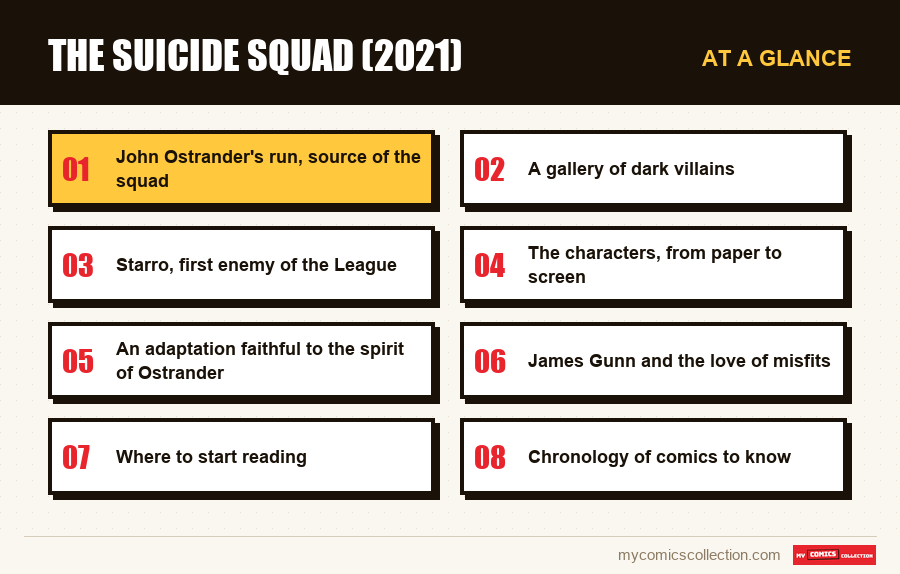
John Ostrander's run, source of the squad
The Suicide Squad draws more faithfully than its predecessor from John Ostrander's run, the modern reference of the squad born in Legends #3 (1987). This run established the codes of the concept: supervillains recruited for clandestine and suicidal missions, under the constraint of an explosive charge and the ruthless authority of Amanda Waller. The great particularity of Ostrander's series is the unpredictable mortality of its members: anyone can die at any time, including a priori central characters. James Gunn's film fully embraces this premise, killing several members of the squad without warning right from the opening, in a display true to the team's throwaway spirit.
The film faithfully takes up the heart of the concept: the expendable villains, Amanda Waller (still played by Viola Davis), the explosive charges, the moral ambiguity of using criminals as soldiers. It also takes on the darkness and cruel humor of Ostrander's run, in an ultra-violent and crazy tone that contrasts with the 2016 film. James Gunn, a filmmaker with a taste for marginal characters and the absurd, captures the spirit of the series: a team of losers and monsters, whose improbable heroism is born from their desperate condition. This fidelity to Ostrander's tone and spirit makes The Suicide Squad an adaptation closer to its source.
A gallery of dark villains
One of the film's trademarks is its gallery of obscure villains, drawn from the corners of the DC universe. Peacemaker (Christopher Smith), who appeared at Charlton Comics in Fightin' 5 #40 (1966) before being integrated into DC, is a fanatical pacifist ready to kill in the name of peace, played by John Cena. King Shark , shark man, Polka Dot Man , Ratcatcher and other little-known figures make up the squad. This predilection for secondary and absurd characters is a signature of James Gunn, who likes to reveal the potential of the most improbable villains. The film thus draws on the unsuspected richness of the DC universe.
This motley gallery illustrates the spirit of the Suicide Squad: a team made up of second-rate villains, disposable and often grotesque, whose humanity emerges despite their condition. By choosing obscure characters rather than stars, the film remains faithful to the original concept, where the squad is made up of expendable criminals. This approach also makes it possible to create real suspense about their survival, with everyone being able to die at any moment. For the reader, this gallery is an invitation to explore the corners of the DC universe, populated by improbable and fascinating characters. James Gunn, by highlighting them, celebrates the richness of a universe that is not limited to its icons, and pays homage to the spirit of Ostrander's squad.
Starro, first enemy of the League
The film's final threat is Starro, a gigantic telepathic alien starfish who appeared in The Brave and the Bold #28 (1960): the very first enemy faced by the Justice League. This choice is a nod to the origins of DC: Starro, one of the publisher's oldest cosmic villains, capable of controlling minds by projecting spores onto the faces of his victims, becomes the squad's ultimate adversary. The film brings him to the screen with spectacular scale, transforming this classic and improbable villain into a fearsome late-film threat. This choice illustrates James Gunn's love for atypical characters in the DC universe.
The use of Starro, historical enemy of the Justice League, by a team of disposable villains, creates a tasty contrast: where the greatest heroes of DC faced this threat, here it is second-rate criminals who oppose it. This discrepancy, faithful to the spirit of the Suicide Squad, underlines the absurdity and improbable heroism of the squad. The film thus pays homage to the origins of DC while embracing its crazy tone. For the reader, Starro is an invitation to discover the first stories of the Justice League in the comics, where this cosmic villain marked the history of the publisher. The film, by summoning him, weaves a link between the squad of villains and the rich mythology of DC.
Collecting this series?
Track what you own, what you are missing and what your collection is worth. 7 day trial.
Start my trial →The characters, from paper to screen
- Bloodsport: Hitman, leader of the squad, from the Superman comics.
- Harley Quinn: Back in the squad, true to his star status.
- Peacemaker: Fanatical pacifist ready to kill, faithful to Fightin' 5 #40.
- Amanda Waller: Ruthless leader of Task Force X, true to her role.
- Starro: Telepathic alien, first enemy of the League (Brave and the Bold #28).
An adaptation faithful to the spirit of Ostrander
The Suicide Squad is widely considered a more successful and faithful adaptation than the 2016 film. By fully embracing the violence, dark humor and disposable spirit of the squad, James Gunn captures the essence of John Ostrander's run: a team of desperate villains, whose improbable heroism is born from their condition. The ultra-violent and crazy tone, the unpredictable mortality of the members, the gallery of obscure characters: everything contributes to honoring the spirit of the original series. This fidelity, combined with Gunn's talent for marginal characters, was praised by critics and fans, making the film a success of the genre.
This achievement illustrates the importance of fully embracing the identity of one’s source. Where the 2016 film hesitated between darkness and lightness, Gunn's frankly assumes the tone of the squad, between extreme violence, absurd humor and unexpected emotion. This consistency of vision makes all the difference. For the reader, The Suicide Squad is an invitation to discover Ostrander's run in the comics, where the squad of villains is explored with remarkable depth and boldness. The film proves that DC antiheroes, with their moral ambiguity and unexpected humanity, can carry captivating stories, provided they fully embrace their darkness and absurdity.
James Gunn and the love of misfits
The success of The Suicide Squad owes a lot to the sensitivity of its director, James Gunn. A filmmaker recognized for his talent for highlighting marginal and improbable characters, he brings an unexpected humanity to the squad, behind the violence and the absurd. In Gunn, losers, monsters and second-rate criminals become endearing, revealing their fragility and their need to belong. This approach, which finds emotion in the grotesque, infuses the film with a surprising tenderness for its disposable villains. The director thus transforms a team of expendable criminals into a gallery of surprisingly human characters.
This sensitivity is perfectly in line with the spirit of the Suicide Squad comics, where moral ambiguity and the humanity of the villains are at the heart of the concept. By giving depth to these obscure characters, Gunn honors John Ostrander's run while adding his own personal touch. This alliance between fidelity to the material and author's vision explains the critical success of the film. For the reader, it is an invitation to discover the richness of the squad's characters in the comics, where even the most unlikely criminals have touching stories. The Suicide Squad proves that a director with a strong vision can reveal the hidden depths of the DC Universe's most marginal figures, transforming disposable villains into unforgettable heroes.
Where to start reading
To extend the film, Legends #3 (1987) introduces John Ostrander's modern Suicide Squad, whose regular series is the benchmark. Fightin' 5 #40 (1966) introduced Peacemaker. The Brave and the Bold #28 (1960) features Starro and the Justice League. This course covers the sources of a film faithful to the spirit of the squad.
Chronology of comics to know
- 1960: The Brave and the Bold #28: Starro's first appearance.
- 1966: Fightin' 5 #40: the first appearance of Peacemaker (Charlton).
- 1987: Legends #3: John Ostrander's modern Suicide Squad.
Collection side: what numbers to aim for after the film
The Suicide Squad points to various keys. The Brave and the Bold #28 (1960, premiere of Starro and the League) is a highly sought after issue of the Silver Age. Legends #3 (1987, Modern Suicide Squad) is a modern key for enthusiasts. Fightin' 5 #40 (1966, Peacemaker) will be of interest to Charlton collectors. The first few issues of Ostrander's run offer other leads. These targets cover various budgets. As always, condition and gradation determine value; relying on real recent sales is strongly recommended.
Its place in the saga and for the collector
The Suicide Squad offered a more faithful and acclaimed adaptation of The Squad, in the tone of Ostrander's run. For the collector, it reignited interest in Legends #3, The Brave and the Bold #28, and obscure DC characters. It illustrates the effect of adaptations on the market. Beyond speculation, the film invites you to discover Ostrander's run and the unsuspected richness of the DC universe. By fully assuming the darkness and absurdity of the squad, he reminds us that DC villains and antiheroes can carry stories of great originality.
The verdict: a loyal and crazy squad
- Loyalty: the concept of disposable villains, Amanda Waller, unpredictable mortality, dark villains and Starro come from comics.
- Freedoms: the plot of Corto Maltese, the ultra-violent tone, the almost entirely new composition, Starro as a final threat.
- Collectible numbers: The Brave and the Bold #28 (Starro), Legends #3 (Suicide Squad), Fightin' 5 #40 (Peacemaker).
The Suicide Squad relaunches the squad of villains in an ultra-violent and crazy tone, more faithful to John Ostrander's run. Faithful to the disposable spirit of the team and its gallery of obscure villains (Peacemaker, King Shark, Starro) the film embraces its darkness. For both the reader and the collector, it is an invitation to discover Legends #3 and The Brave and the Bold #28.
Frequently asked questions
James Gunn's The Suicide Squad fully embraces the violence, dark humor and disposable spirit of the squad, more faithful to Ostrander's run. Where the 2016 film faltered on tone, this one frankly embraces darkness and absurdity.
Christopher Smith, a fanatical pacifist willing to kill in the name of peace, appeared at Charlton Comics in Fightin' 5 #40 (1966) before being integrated into DC. Played by John Cena, he was entitled to his own television series.
A gigantic telepathic alien starfish, appearing in The Brave and the Bold #28 (1960): the very first enemy of the Justice League. The film makes him the final threat, a nod to DC's origins.
It's a signature of James Gunn and a loyalty to the concept: the squad is made up of second-rate, disposable villains. Choosing obscure characters creates real suspense about their survival and celebrates the little-known richness of the DC universe.
The Brave and the Bold #28 (1960, Starro and the League) is a key to the Silver Age. Other targets include Legends #3 (1987, Modern Suicide Squad) and Fightin' 5 #40 (1966, Peacemaker).
Does the film make you want to collect? Estimate the value for free of your issues (The Brave and the Bold #28, Legends #3…) with our tool based on current eBay listings.