Birds of Prey (2020) Cathy Yan , with Margot Robbie , follows Harley Quinn (Batman Adventures #12, 1993) after his breakup with the Joker, alongside Black Canary (Flash Comics #86, 1947), Huntress and Renée Montoya, facing the Black Mask (Batman #386, 1985). Faithful to the spirit of the DC women's team, he reinvented the formation. Here is the detailed comparison, film versus comics.
A spin-off centered on Harley Quinn and a team of heroines, Birds of Prey brings to the screen the emancipation of a character who has become cult. It draws on several figures from the Gotham universe. Source-by-source decryption.
As in each article in this series, only verified information (creators, distribution, dates, comic numbers) is stated; the comparative analysis is ours, without reproducing dialogue or protected images.
Title : Birds of Prey (2020)
Director: Cathy Yan
Actors: Margot Robbie (Harley Quinn), Mary Elizabeth Winstead (Huntress), Jurnee Smollett (Black Canary), Ewan McGregor (Black Mask)
Exit : February 2020
Studio: Warner Bros.
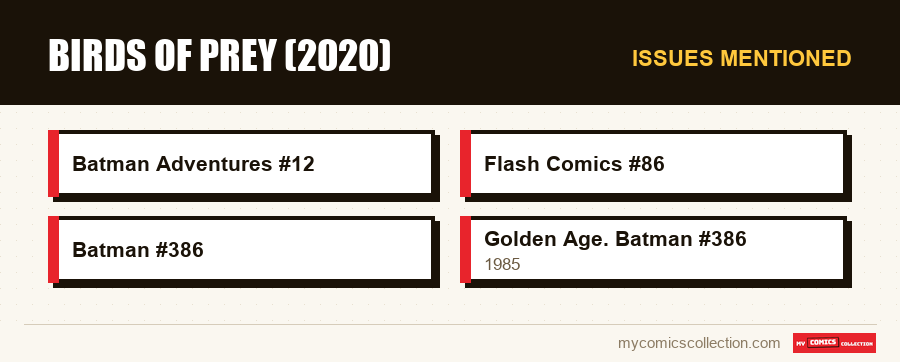
Batman Adventures #12 (1993): Harley Quinn's first comic appearance
Flash Comics #86 (1947): Black Canary's first appearance
Batman #386 (1985): 1st appearance of the Black Mask
The Birds of Prey: the DC heroine team
- Harley Quinn emancipated from the Joker, as an antiheroine.
- Black Canary and his sonic cry.
- Huntress, vigilante armed with a crossbow.
- Renee Montoya, Gotham's detective.
- Le Black Mask (Roman Sionis), Gotham villain.
- The team is formed differently comics (no Oracle).
- The plot (Cassandra's Diamond) is original.
- The tone is crazy and colorful, like Harley.
- Le Black Mask is reinvented for the film.
- Cassandra Cain is reinvented as a young pickpocket.
Harley Quinn, emancipated from the Joker
The film continues the character of Harley Quinn, who appeared in comics in The Batman Adventures #12 (1993) after her debut in the animated series Batman: The Animated Series. After being revealed in Suicide Squad, Harley here becomes the central character of a film dedicated to her emancipation. The story begins with her breakup with the Joker, who frees her from the toxic relationship that defined her. Left to her own devices, Harley must learn to exist on her own, as an independent antiheroine. Margot Robbie returns to the role that made her iconic, carrying the film with her chaotic energy and crazy charm. This emancipation is at the heart of the story.
This trajectory is faithful to the evolution of the character in the comics. Born as an accomplice of the Joker, Harley Quinn gradually emancipated herself to become an antiheroine in her own right, with her own successful series. The film captures this pivotal moment: that of Harley breaking away from the Joker to forge her own path. This dimension of emancipation, dear to modern rereadings of the character, gives the film its thematic coherence. For the reader, it is an invitation to discover Harley Quinn's solo series in the comics, where the character, freed from her past, displays a complex personality, between madness, humor and quest for independence. The film celebrates this emancipated Harley and fully herself.
Black Canary, Huntress and Renée Montoya
The film brings together several heroines from the DC universe around Harley. Black Canary (Dinah Lance), appeared in Flash Comics #86 (1947), is a fighter with the “canary cry”, a devastating sonic power, historical member of the Birds of Prey in the comics. Huntress (Helena Bertinelli), a vigilante armed with a crossbow driven by family vengeance, is another figure in the team. Renee Montoya, Gotham police inspector, embodies law in the face of crime. These characters, all from the comics, gradually form the Birds of Prey team, united by the need to protect a young girl and fight the Black Mask.
These heroines enrich the universe of the film and connect it to the mythology of Birds of Prey. The team, born in the comics in the 1990s, brings together vigilantes from Gotham in an exclusively female formation, an innovative concept for the time. The film takes several of its members, while reinventing their gathering: in the comics, the team is notably brought together by Oracle (Barbara Gordon), absent from the film. This free adaptation preserves the spirit of the team: strong and independent women joining forces. For the reader, Black Canary, Huntress and Renée Montoya are invitations to discover the Birds of Prey in the comics, where these heroines carry very rich stories of action and sorority.
The Black Mask, villain of Gotham
The film pits the team against Black Mask (Roman Sionis), who appeared in Batman #386 (1985). Leader of Gotham's underworld with his face hidden under a black skull mask, he is a recurring and sadistic villain in the Batman universe. The film reinvents him as an eccentric and cruel gangster, played by Ewan McGregor, who tracks down a young girl who has stolen a coveted diamond. This rereading, more flamboyant than the character in the comics, offers the film an antagonist who matches its crazy tone. The Black Mask embodies the criminal threat that pushes the heroines to unite, while bringing a disturbing dimension to the colorful story.
This character anchors the film in Gotham's gallery of enemies, while adapting to the particular register of the story. The Black Mask of the comics is a dark and brutal figure; the film retains its cruelty while surrounding it with an eccentricity in line with the world of Harley Quinn. This reinvention illustrates how the film draws on the mythology of Gotham to compose its plot. For the reader, the Black Mask is an invitation to discover Batman's rich gallery of villains in the comics, where Roman Sionis embodies one of the most ruthless figures in Gotham's underworld. The film offers a colorful version, faithful to its cruelty but adapted to its singular tone.
Collecting this series?
Track what you own, what you are missing and what your collection is worth. 7 day trial.
Start my trial →The characters, from paper to screen
- Harley Quinn: Emancipated from the Joker, central antiheroine, faithful to its modern evolution.
- Black Canary: Fighter with a sonic scream, faithful to Flash Comics #86.
- Huntress: Vigilante with a crossbow, driven by family vengeance.
- Renee Montoya: Gotham Detective, embodiment of the law.
- The Black Mask: Underworld leader, faithful to Batman #386, reinvented as an eccentric gangster.
A celebration of female emancipation
Birds of Prey is distinguished by its crazy, colorful and resolutely feminine tone, like its central character. Directed by a woman, Cathy Yan, the film celebrates emancipation and sisterhood, bringing together strong, independent heroines in an energetic action story. This approach, in line with the spirit of Harley Quinn and the Birds of Prey, brings freshness and singularity to the DC universe. The film fully embraces its identity, mixing humor, stylized violence and female empowerment, in a register that contrasts with other productions in the DC cinematic universe.
This dimension is faithful to the spirit of the Birds of Prey in the comics, a pioneering team in the representation of strong and united heroines. By bringing these complex and independent female characters to the screen, the film is part of a welcome evolution in the representation of women in the genre. For the reader, Birds of Prey is an invitation to discover the rich history of the team and its members in the comics, where sisterhood and action have combined since the 1990s. The film, by celebrating the emancipation of Harley Quinn and the union of these heroines, recalls the vitality and diversity of the Gotham universe, beyond its most famous male figures.
A growing cult for Harley Quinn
Birds of Prey is part of the meteoric rise of Harley Quinn to the rank of cult and essential DC character. Born from an animated series, revealed in the cinema by Margot Robbie, Harley has become in a few years one of the publisher's most popular figures, carrying her own series of comics, films and animated series. The film participates in this enthusiasm, by offering the character a story centered on his emancipation. This popularity illustrates the public's attachment to a complex antiheroine, at once crazy, funny and endearing, who escapes the traditional categories of good and evil.
This enthusiasm testifies to the richness of a character who has been able to evolve, from accomplice of the Joker to independent and feminist antiheroine. Harley Quinn embodies a form of freedom and subversion that resonates with a wide audience. For the reader, this growing cult is an invitation to discover the evolution of the character in the comics, where she went from the status of a foil to that of a star in her own right. Birds of Prey, by celebrating this emancipated Harley, is part of this dynamic, confirming that the character, despite its origins as an accomplice, has become an autonomous and major figure in the DC universe, whose popularity continues to grow.
Where to start reading
To extend the film, The Batman Adventures #12 (1993) features the first comic appearance of Harley Quinn. “Birds of Prey” (1996) by Chuck Dixon and Gary Frank launched the team. Flash Comics #86 (1947) introduced Black Canary. Harley Quinn's solo series develop her emancipation. This journey covers the sources for a film centered on the heroines of Gotham.
Chronology of comics to know
- 1947: Flash Comics #86: Black Canary's first appearance.
- 1985: Batman #386: the first appearance of the Black Mask.
- 1993: The Batman Adventures #12: the first comic appearance of Harley Quinn.
Collection side: what numbers to aim for after the film
Birds of Prey points to varied keys. The Batman Adventures #12 (1993, debut of Harley Quinn in comics) is a highly coveted modern key. Flash Comics #86 (1947, premiere of Black Canary) is a holy grail of the Golden Age. Batman #386 (1985, premiere of The Black Mask) is a sought-after modern key. Harley Quinn's solo series offer accessible targets. These numbers cover various budgets. As always, condition and gradation determine value; relying on real recent sales is strongly recommended.
Its place in the saga and for the collector
Birds of Prey celebrated the emancipation of Harley Quinn and brought together the heroines of Gotham, in a crazy and feminine tone. For the collector, it reignited interest in The Batman Adventures #12, Flash Comics #86 and Batman #386. It illustrates the effect of adaptations on the market. Beyond speculation, the film invites you to discover the Birds of Prey team and its members in the comics, where sorority and action combine. By highlighting strong and independent heroines, it recalls the richness and diversity of the Gotham universe, beyond its most famous figures.
The verdict: a crazy team of heroines
- Loyalty: Emancipated Harley Quinn, Black Canary, Huntress, Renée Montoya and the Black Mask come from the comics.
- Freedoms: the formation of the team (without Oracle), the diamond plot, the crazy tone, the Black Mask and Cassandra Cain reinvented.
- Collectible numbers: The Batman Adventures #12 (Harley), Flash Comics #86 (Black Canary), Batman #386 (Black Mask).
Birds of Prey follows the emancipation of Harley Quinn and brings together the heroines of Gotham (Black Canary, Huntress, Renée Montoya) against the Black Mask. Faithful to the spirit of the DC female team but reinventing its formation, the film assumes a crazy and feminine tone. For both the reader and the collector, it is an invitation to discover Batman Adventures #12 and Flash Comics #86.
Frequently asked questions
A team of DC heroines born in the comics in 1996, bringing together vigilantes from Gotham in an exclusively female formation. The film features several members (Black Canary, Huntress, Renée Montoya) around Harley Quinn.
Dinah Lance, a fighter with the "canary cry", a devastating sonic power, appeared in Flash Comics #86 (1947). Historical member of the Birds of Prey in the comics, she is played in the film by Jurnee Smollett.
Roman Sionis, leader of Gotham's underworld with his face hidden under a black skull mask, appeared in Batman #386 (1985). The film reinvents him as an eccentric and cruel gangster, played by Ewan McGregor.
It takes several members and the spirit, strong and united heroines, but reinvents their formation. In the comics, the team is notably brought together by Oracle (Barbara Gordon), absent from the film, who centers the story on Harley Quinn.
The Batman Adventures #12 (1993, Harley Quinn's comic book debut) is a coveted modern key. Flash Comics #86 (1947, Black Canary) is a Golden Age grail, and Batman #386 (1985, Black Mask) a modern key.
Does the film make you want to collect? Estimate the value for free of your issues (Batman Adventures #12, Flash Comics #86…) with our tool based on current eBay listings.