Suicide Squad (2016) David Ayer adapts the squad of supervillains whose modern version is born in Legends #3 (1987) by John Ostrander. The film brings together Harley Quinn (Batman Adventures #12, 1993), Deadshot , Amanda Waller and the Joker, under the concept of Task Force X. Faithful to the idea of criminals sent on a suicide mission, he reinvents the plot. Here is the detailed comparison, film versus comics.
A bold bet to entrust the leading role to supervillains, Suicide Squad brings to the screen one of DC's most atypical teams. It draws on the cult run of John Ostrander. Source-by-source decryption.
As in each article in this series, only verified information (creators, distribution, dates, comic numbers) is stated; the comparative analysis is ours, without reproducing dialogue or protected images.
Title : Suicide Squad (2016)
Director: David Ayer
Actors: Will Smith (Deadshot), Margot Robbie (Harley Quinn), Viola Davis (Amanda Waller), Jared Leto (Joker)
Exit : August 2016
Studio: Warner Bros.
Legends #3 (1987): 1st appearance of the modern Suicide Squad (Ostrander)
Batman Adventures #12 (1993): Harley Quinn's first appearance in comics
Task Force: criminals on a suicide mission
Amanda Waller: the ruthless leader of the squad
- The concept of criminals on suicide mission.
- Amanda Waller and explosive charges in the neck.
- Harley Quinn, Deadshot, Captain Boomerang, Killer Croc.
- La Harley/Joker relationship, toxic and fusional.
- The idea of a disposable team in the service of the State.
- The plot (The Enchantress) is original.
- Le Joker plays a secondary and reinvented role.
- La composition of the squad differs from the comics.
- The tone hesitates between darkness and lightness.
- A troubled production mark the assembly.
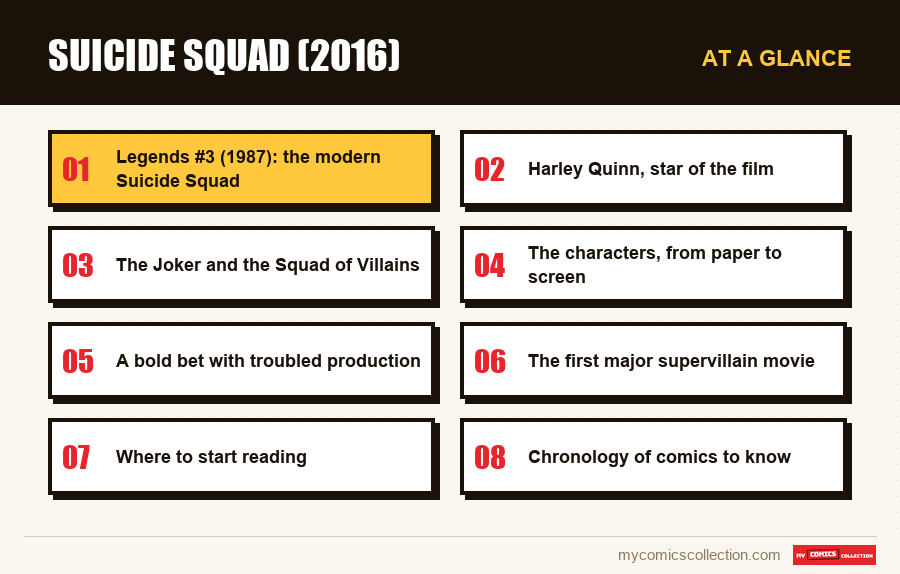
Legends #3 (1987): the modern Suicide Squad
The modern version of the Suicide Squad was born in Legends #3 (1987), under the leadership of John Ostrander. The concept is fascinating: the government recruits incarcerated supervillains to carry out clandestine and dangerous missions, in exchange for a reduced sentence. But an explosive device implanted in their neck dissuades them from fleeing or betraying: hence the nickname "Suicide Squad". Led by the ruthless Amanda Waller, Task Force X is a disposable team, whose members can die at any time. Ostrander's run explored this premise in depth, mixing action, ambiguous morality and personal drama, making Suicide Squad one of DC's most original series.
The film faithfully takes up this founding concept: criminals sent on suicide missions, Amanda Waller and her explosive charges, the idea of an expendable team in the service of the State. Viola Davis plays a chilling and unscrupulous Waller, true to the character. The main freedom lies in the largely original plot, centered on a supernatural threat (the Enchantress) rather than on the spy missions of the comics. The composition of the squad also differs, bringing together villains according to their popularity. The film nevertheless captures the essence of the concept: the moral ambiguity of using criminals as disposable heroes, at the heart of Ostrander's run.
Harley Quinn, star of the film
The most notable character in the film is Harley Quinn, who first appeared in comics in The Batman Adventures #12 (1993), after her debut in the animated series Batman: The Animated Series (1992). Former psychiatrist, Dr. Harleen Quinzel falls in love with the Joker she treats, becoming his accomplice and companion under the name Harley Quinn. A character that has become cult, mixing madness, humor and distress, she embodies a toxic and close relationship with the Joker. Margot Robbie delivers an interpretation that has become iconic, capturing the chaotic energy and vulnerability of the character. Harley is the revelation of the film, to the point of then carrying her own productions.
The film captures the essence of Harley Quinn: her past as a psychiatrist, her relationship with the Joker, her mix of madness and charm. This toxic relationship, central to the character, is explored through flashbacks. The film helped to popularize Harley among the general public, confirming her status as a major DC character, although born in an animated series before joining the comics. For the reader, Harley Quinn is an invitation to discover her evolution in the comics, where she went from the Joker's accomplice to an independent antiheroine. The film captures this pivotal moment, presenting a Harley still linked to the Joker but whose growing autonomy foreshadows her later adventures.
The Joker and the Squad of Villains
The film features several iconic villains alongside Harley. Deadshot (Floyd Lawton), infallible hitman, played by Will Smith, brings a human dimension to the squad. Captain Boomerang , Killer Croc , El Diablo complete the team, each from the comics. THE Joker, played by Jared Leto, plays a secondary role, revolving around Harley rather than at the heart of the plot. This version of the Joker, reimagined with a modern gangster aesthetic, departs from previous interpretations and has been divisive. The film brings together this gallery of criminals under duress, faithful to the concept of the squad.
This team of villains illustrates the originality of the Suicide Squad concept: making criminals the protagonists, with their ambiguous morals and their flaws. Each of these characters has a rich history in the comics, which the film only touches on. Deadshot, in particular, is a tragic and complex figure in Ostrander's run. The film favors action and spectacle over psychological exploration, bringing villains together according to their appeal rather than their narrative coherence. For the reader, this gallery is an invitation to discover the richness of the characters of the Suicide Squad in the comics, where their moral ambiguity and their personal dramas nourish stories of a depth that the film, in its lighter register, does not always reach.
Collecting this series?
Track what you own, what you are missing and what your collection is worth. 7 day trial.
Start my trial →The characters, from paper to screen
- Harley Quinn: Former psychiatrist who became an accomplice of the Joker, loyal to Batman Adventures #12, star of the film.
- Deadshot: Infallible hitman, human dimension of the squad.
- Amanda Waller: Ruthless leader of Task Force X, true to her role.
- The Joker: Reinvented as a modern gangster, secondary role around Harley.
- The other villains: Captain Boomerang, Killer Croc, El Diablo, from the comics.
A bold bet with troubled production
Suicide Squad represented a daring bet: giving the leading role to supervillains, in a team film based on criminals rather than heroes. This concept, original and promising, however came up against a troubled production, marked by reshoots and edited editing to lighten the tone after the mixed success of the previous DC films. The result, with a tone hesitating between darkness and lightness, divided critics and the public. The film struggles to find its balance, torn between the moral ambiguity of its concept and a desire for general public entertainment.
Despite its flaws, the film was notable for the revelation of Harley Quinn and its unique concept. It illustrates the appeal of a team of villains, whose ambiguous morals offer a counterpoint to classic superhero stories. For the reader, Suicide Squad is an invitation to discover John Ostrander's run in the comics, where the concept of the squad is explored with remarkable depth and darkness. The film will at least have made this atypical team known to the general public, paving the way for other adaptations and confirming that DC villains, with their moral complexity, can carry fascinating stories, provided they fully accept their ambiguity.
The first major supervillain movie
Suicide Squad occupies a special place in the history of adaptations: it is one of the first major films to give the leading role to supervillains rather than heroes. This concept, innovative in cinema, reverses the usual formula of the genre by making criminals the protagonists. This audacity, promised by the original material, opened up new narrative perspectives: exploring ambiguous morality, impossible redemption, the humanity of monsters. The film thus broadened the field of possibilities for the genre, proving that a team of villains could carry a blockbuster, even if its execution was not entirely convincing.
This originality reflects the richness of the concept of the Suicide Squad in the comics, where the villains, with their flaws and their ambiguity, offer a fascinating counterpoint to superhero stories. By giving the spotlight to criminals, the film touches on a truth of John Ostrander's run: evil is never simple, and even the worst characters can have their reasons and their moments of humanity. For the reader, Suicide Squad is an invitation to discover this exploration of morality in comics, where the suicide squad questions the boundary between good and evil. The film paved the way for other antihero-centered adaptations, confirming the enduring appeal of these complex figures.
Where to start reading
To extend the film, Legends #3 (1987) introduces John Ostrander's modern Suicide Squad, whose regular series is the benchmark for the concept. The Batman Adventures #12 (1993) marks the first comic book appearance of Harley Quinn. Recent Harley Quinn stories develop her autonomy. This trail covers the source material for a film that adapts the Villain Squad.
Chronology of comics to know
- 1987: Legends #3: the first appearance of the modern Suicide Squad (Ostrander).
- 1993: The Batman Adventures #12: the first comic appearance of Harley Quinn.
- 1980s-1990s: Ostrander's run explores the squad in depth.
Collection side: what numbers to aim for after the film
Suicide Squad points to sought-after modern keys. The Batman Adventures #12 (1993, first appearance in comics of Harley Quinn) is a highly coveted key, whose popularity has exploded with the popularity of the character. Legends #3 (1987, first of the modern Suicide Squad) is another target for Squad fans. The first issues of Ostrander's series offer other leads. These targets cover various budgets. As always, condition and gradation determine value; relying on real recent sales is strongly recommended.
Its place in the saga and for the collector
Suicide Squad brought to the screen an atypical team of villains and revealed Harley Quinn, despite a troubled production. For the collector, it exploded interest in The Batman Adventures #12 and revived Legends #3. It illustrates the effect of adaptations on the market. Beyond speculation, the film invites you to discover John Ostrander's run in the comics, where the concept of the suicide squad is explored in depth. By making the villains the protagonists, he recalls the moral richness of these characters, whose ambiguity nourishes some of DC's most original stories.
The verdict: an unequal squad of villains
- Loyalty: the concept of a suicide mission, Amanda Waller, Harley Quinn, Deadshot and the idea of a disposable team come from the comics.
- Freedoms: the plot of the Enchantress, the secondary and reinvented Joker, the modified composition, the hesitant tone.
- Collectible numbers: The Batman Adventures #12 (Harley Quinn), Legends #3 (Modern Suicide Squad).
Suicide Squad adapts DC's squad of villains by revealing Harley Quinn, faithful to the concept of criminals on suicide missions born in Legends #3. Marked by troubled production and a hesitant tone, the film reinvents the plot. For both the reader and the collector, it is an invitation to discover Legends #3 and Batman Adventures #12.
Frequently asked questions
The modern version was born in Legends #3 (1987), under the leadership of John Ostrander. Supervillains are recruited for dangerous missions in exchange for reduced sentences, under the duress of explosive charges. The film takes up this concept.
In the animated series Batman: The Animated Series (1992), then in comics in The Batman Adventures #12 (1993). A former psychiatrist who became an accomplice of the Joker, she became a cult character, revealed in the cinema by Margot Robbie.
The ruthless leader of Task Force X, who recruits and controls the squad's villains. The central character of Ostrander's run, she embodies the moral ambiguity of the concept. Viola Davis delivers a chilling and faithful interpretation.
Because of a troubled production: reshoots and edited editing to lighten the tone, resulting in a film hesitating between darkness and lightness. Jared Leto's reinvented Joker was also debated. Harley Quinn remains the great success.
The Batman Adventures #12 (1993, Harley Quinn's comic book debut) is a highly coveted modern key. Legends #3 (1987, first of the modern Suicide Squad) is another sought-after target.
Does the film make you want to collect? Estimate the value for free of your issues (Batman Adventures #12, Legends #3…) with our tool based on current eBay listings.