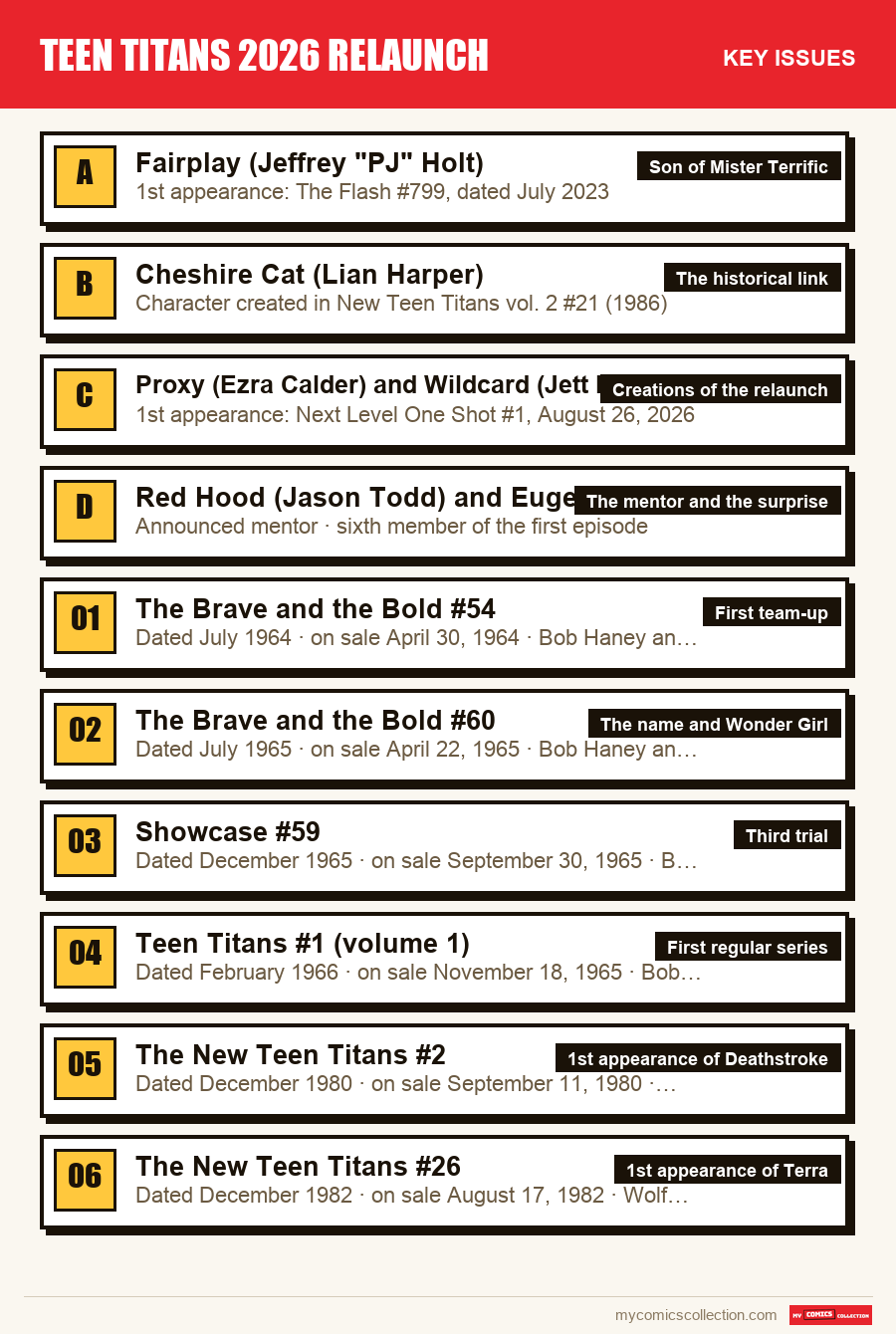
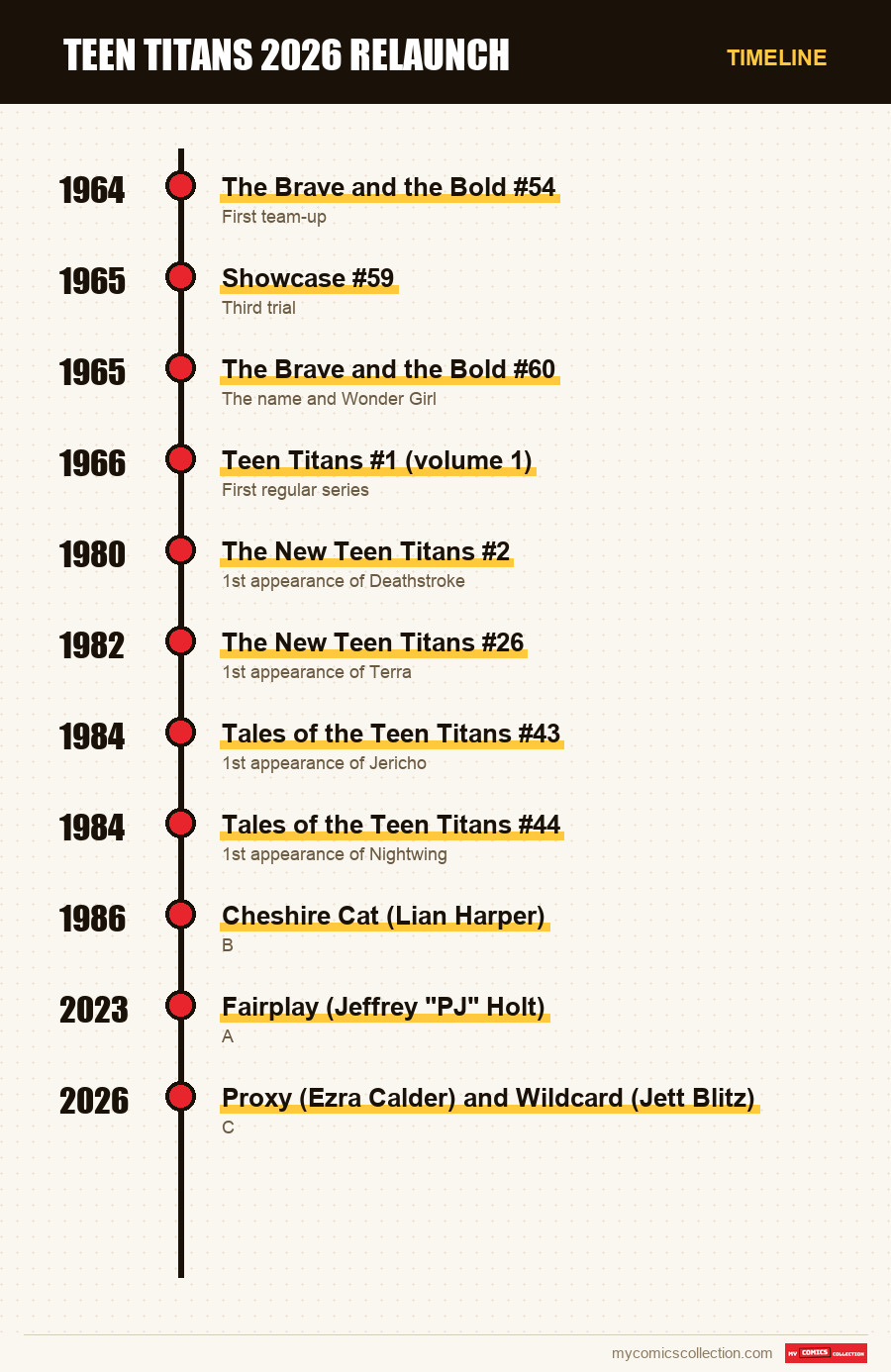
Teen Titans #1 came out on September 2, 2026 under the DC Next Level label, written by Kyle Higgins and drawn by Daniele Di Nicuolo, colors by Marcelo Costa. The team announced by the publisher brings together Fairplay, Cheshire Cat, Proxy and Wildcard, with Red Hood as a reluctant mentor; the first episode adds Eugene Choi. The point almost nobody mentions: Proxy and Wildcard appear a week earlier, unnamed, in Next Level One Shot #1 of August 26, 2026. On the story side, the relaunch brings back into play a handful of precise issues: The Brave and the Bold #54 and #60, DC Comics Presents #26, The New Teen Titans #1, #2 and #26, Tales of the Teen Titans #43 and #44. This article ranks them in order of hunt.
A teen team relaunch at DC always produces the same reflex in the collector: tracing the genealogy back. It is legitimate, and it is also where mistakes concentrate, because the editorial history of the Titans is one of the most chopped up in the catalog. Five decades, seven volumes bearing the title Teen Titans, two parallel series published simultaneously in 1984, an adult title that changed its name three times, and first appearances lodged in issues that do not carry the team's name on their cover.
This article therefore starts from the opposite of the habit. It begins with what the September 2026 relaunch really contains, name by name, because it is verifiable and dated. It then goes back to the issues this relaunch reactivates, giving for each the release date, the credited creators, what happens in it and, above all, the technical reason for its scarcity. An issue is not rare because it is old: it is rare because a distribution mode, a print run or a type of paper limited the number of copies that survive in presentable condition.
We are writing on October 2, 2026. No price guide value is cited here, for a simple reason: no source consulted publishes a dated report on the period, and an invented amount durably damages a buyer's trust. What is available, on the other hand, is the scarcity mechanics, and it is largely enough to rank a shopping list.
What the September 2, 2026 relaunch announces, and what it contains
The publisher announced on June 17, 2026 three regular series launched the same Wednesday, September 2: Legion of Super-Heroes, Teen Titans and The Doom Patrol. All three join the Next Level label, presented as the continuation of a series of launches open to new readers, after titles devoted to Batwoman, Lobo, Deathstroke, Firestorm, Zatanna, Barbara Gordon and Deadman.
Two official statements frame the operation and deserve to be taken seriously, because they say exactly how to read these issues. The first states that these series are "in continuity" and coexist with the publisher's main monthlies, while remaining independent reads with few links among them. The second describes them as very accessible to newcomers, on the model of the parallel line launched in 2024. In other words: an owned entry point, inserted into the shared universe, with no reading prerequisite.
For Teen Titans #1, the manufacturing data are published: 32 pages, main cover by Daniele Di Nicuolo at $3.99, cardstock variants at $4.99 and a foil variant at $6.99. The alternate covers announced are signed by Dan Mora (cardstock and foil), Jim Cheung, Sanford Greene at a 1-for-25 ratio, Hayden Sherman for the label's house treatment, plus a blank cardstock cover meant for sketch autographs.
This cover detail is not trivial for a collector. A 1-for-25 variant means a retailer must order twenty-five copies of the main cover to earn the right to receive a single copy. It is the only one of the seven announced covers whose scarcity is structurally determined in advance, independently of the title's success. The blank cover, for its part, has value only through what an artist adds to it, and its price guide value is therefore never that of the comic but that of the drawing.
The announced team, checked name by name
The official summary sets out the situation: one of their own disappears after attending a rally of Ascend, a fast-growing youth movement that trains teenagers to survive in a world shaped by superhuman clashes. To find him, the group must ally with Red Hood. The publisher sums up the tension in a sentence: Jason finds them tender and reckless, they do not understand that he keeps killing.
That is the real editorial direction, and it is interesting: it is not a team of sidekicks overseen by an exemplary figure, it is a team of young people flanked by a mentor whose method is the problem. The first episode, titled "Meet the Teen Titans!", is cover-dated November 2026 for a September 2 release, and sets its action in late August 2026. It moves between Bludhaven, Happy Harbor, Seattle and its outskirts.
Verified lineup, with each one's first appearance:
Fairplay (Jeffrey "PJ" Holt)
Created by Jeremy Adams and Fernando Pasarin in a series that has nothing to do with the Titans, which is precisely the kind of detail that escapes keyword searches. He is the long-missing son of Michael Holt, and it is he who carries, in the first episode, the line that sums up the series' stance: the team is not doing "nostalgic cosplay."
Cheshire Cat (Lian Harper)
She is the only member whose genealogy goes back to the founding run. Lian Harper is the daughter of Roy Harper, the original Titans' former Speedy, and of the antagonist Cheshire. Marv Wolfman and Eduardo Barreto created her in the 1986 second series. Cheshire Cat's costumed identity, for its part, appears much later, in Catwoman vol. 5 #25.
Proxy (Ezra Calder) and Wildcard (Jett Blitz)
The two entirely new members. Their real names are revealed in Teen Titans #1, which is their full first appearance. But they already appear, unnamed, in a single issue released a week earlier: Next Level One Shot #1, written by Gerry Duggan and drawn by Fernando Blanco, dated October 2026, out on August 26, 2026.
Red Hood (Jason Todd) and Eugene Choi
Red Hood is announced from the press release as a reluctant mentor. Eugene Choi, for his part, does not appear in the official summary and joins the team in the episode: he is a former bearer of the Marvel Family power, designated as a former "Shazam" in the story. Mister Terrific appears in support, Dick Grayson in flashback and in the present.
One last framing point, often misunderstood: this relaunch does not replace the adult team. The title devoted to the Titans grown up took the name New Titans in May 2026, under Tate Brombal's pen and Sami Basri's brush, and kept the numbering of the previous series by resuming at number 33. The two teams therefore coexist, with two distinct titles. It is the first time in a long while that the configuration is this clear.
The founding issues of the 1960s
Before having a title of their own, the Titans were tested three times in tryout magazines. It is the source of the first collecting difficulty: the team's most important issues do not carry its name.
The Brave and the Bold #54
Robin, Kid Flash and Aqualad team up for the first time in "The Thousand-and-One Dooms of Mr. Twister," coming to the rescue of the teenagers of a small town in conflict with their elders. The team has no name yet, no base, no common costume. It has only the guiding idea of the whole franchise: the sidekicks organize without their mentors.
The Brave and the Bold #60
Two decisive things in a single issue. The team is designated there for the first time as the Teen Titans, and Wonder Girl, Donna Troy, becomes its fourth member. The cover is by Nick Cardy, who will become the regular series' emblematic artist. The story, "The Astounding Separated Man," replays the pattern of the town and its youth.
Showcase #59
"The Return of the Teen Titans" is the last trial before the green light. Haney sets up there the tone that will define the era: rock bands, teen slang, light investigation. It is also the issue that seals the editorial decision, since the regular series is launched less than two months later.
Teen Titans #1 (volume 1)
"The Beast-God of Xochatan" sends the team to South America on behalf of a volunteer corps. The title will last fifty-three issues, with an interruption in the mid-1970s before a resumption. It is the franchise's first number 1, and the only one of the seven that opens a new title rather than relaunching an existing one.
1980: the issue everyone cites, and the one everyone forgets
The 1980 relaunch by Marv Wolfman and George Pérez is the pivot of the whole team's history, and it is where the franchise's most frequent collecting mistake plays out.
The New Teen Titans #1 is dated November 1980 and went on sale August 14, 1980. Pérez draws, Romeo Tanghal inks, Adrienne Roy colors, Len Wein edits. Raven gathers Robin, Changeling, Wonder Girl, Cyborg and Kid Flash to go and free Starfire from her extraterrestrial captors. It is the issue you cite, give as a gift, put under plastic.
Yet the three characters created for the occasion, Raven, Cyborg and Starfire, appear a month earlier. The publisher had inserted a presentation signature titled "Where Nightmares Begin!" in DC Comics Presents #26, dated October 1980 and on sale July 10, 1980. The rest of the issue is a Superman and Green Lantern adventure signed Jim Starlin, with Wolfman on the script of the Titans part.
This one-month gap has a considerable practical consequence. For decades, this issue circulated as one Superman episode among others, filed in the bins under the letter D, bought by readers who were not looking for Titans. Its cover shows none of the three characters. Copies in very fine condition are therefore proportionally rarer than for a number 1 that was, for its part, bought and kept as a collectible from its release.
It is the most useful scarcity mechanism to understand in this whole article: an issue kept by chance survives less well than an issue kept on purpose. It applies to all franchises, and it explains why certain first appearances nested in third-party titles remain undervalued for a long time before being abruptly caught up.
The most in-demand first appearances
The New Teen Titans #2
"Today... the Terminator!" introduces Slade Wilson, a methodical mercenary who takes up the contract left by his son. It is the franchise's modern key, and the reason is external to comics: the character has spread through animated series, games and live-action adaptations for forty years. The Next Level label also devoted a title of its own to him before the Titans relaunch.
The New Teen Titans #26
"Runaways" introduces Tara Markov on the team's return from the Vega system. Pérez has said that the character's betrayal was decided from her conception. The issue's importance is therefore entirely retrospective: it is worth only what issues 42 to 44 will make of it two years later.
Tales of the Teen Titans #43
"The Judas Contract: Book Two: Betrayal!" is the issue where the betrayal bursts out, and where Joseph Wilson, Deathstroke's mute son, appears. Jericho remained a second-tier character, which keeps this issue in an intermediate zone: essential for anyone following the saga, secondary for anyone hunting only the famous first appearances.
Tales of the Teen Titans #44
"There Shall Come a Titan!" contains the scene that most durably altered the DC universe in the whole run: Dick Grayson gives up the Robin identity and takes that of Nightwing. Mike DeCarlo and Dick Giordano ink, Todd Klein letters. It is the only issue on the list whose importance goes beyond the Titans franchise and directly touches Batman's.
The Judas Contract, issue by issue
The team's most cited saga reads in four parts: Tales of the Teen Titans #42, #43 and #44, then Annual #3. This structure is the source of a concrete completion difficulty, because the annual is a format apart, printed in a different quantity and filed elsewhere in the bins.
The month of March 1984 adds a complication few guides explain. The publisher launched, on April 17, 1984, a second series titled New Teen Titans, whose number 1 is dated August 1984 and opens on a team training session around Jericho. This series was not sold at newsstands: it was printed on better-quality paper and distributed through the specialty shop circuit. It was published in parallel with Tales of the Teen Titans, whose action was set about six months earlier.
Two series, two numberings, two internal chronologies, two sales circuits, the same writers. For the collector, the consequences are direct and all verifiable:
The saga is not in the 1984 series
The Judas Contract is in Tales of the Teen Titans, not in the second series. Buying the 1984 number 1 thinking you are starting the saga is a frequent mistake.
The print runs are not comparable
A series sold only in specialty shops is ordered firm, with no returns possible. Print runs are therefore lower, but surviving copies are in better condition, since they were bought by already careful readers.
The paper changes the grading verdict
Better-quality paper yellows less. At equal age, an issue of the 1984 series more easily gets a high grade than a 1980 issue printed on newsstand paper. It is not a value judgment, it is a preservation fact.
The last issues are reprints
Tales of the Teen Titans continued until 1988 and, from issue 59, contained only reprints. A high number of this title is therefore neither rare nor new.
What really makes a Titans issue scarce
Four factors, and only one of them concerns the issue's age.
The sales circuit. A 1960s issue existed only at newsstands, sold with return rights: unsold copies were destroyed or sent back stripped of their cover. It is the main cause of the scarcity of the three trial issues. Conversely, a 1980s specialty shop issue was ordered firm and kept.
The medium of the first appearance. A character who debuts in a signature inserted into another title, like Raven, Cyborg and Starfire in 1980, leaves behind fewer carefully kept copies than if he had debuted on an announced cover. The gap widens with time.
External fame. The current hierarchy of Titans issues does not reflect their narrative importance but the exposure of their characters off the page. Deathstroke and Nightwing dominate, not because their issues are the rarest, but because their audience is the widest. It is a mechanic we also describe about the 2013 animated parody, which widened the team's audience without adding anything to the corpus.
Condition, which settles everything. On a 1964 issue with a stapled spine and a flexible cover, two copies two grading notches apart do not belong to the same market. It is the only factor over which a buyer keeps real control, by examining spine creases, corners and flatness before buying.
The recommended hunting order
Here is the hierarchy we propose for a French-speaking collector discovering the franchise through the 2026 relaunch. It goes from the most accessible to the most demanding, which is the reverse of chronological order.
The two 2026 issues
Teen Titans #1 of September 2 in the main cover, and Next Level One Shot #1 of August 26. The second costs the price of a new comic today and contains the first appearance of two team members. It is the only purchase on this list where you are ahead of the market rather than behind.
The 1980 run in collected form, not one by one
Read first. The first forty issues exist in bound volumes, and reading will tell you which ones you want to own as original copies. Our Teen Titans reading guide details the path.
DC Comics Presents #26
Before number 1. It is the real first appearance of three characters, it remains the least sought of the pair, and it can still be found in bins where nobody is looking for it.
Tales of the Teen Titans #44, then New Teen Titans #2
In that order, because the first serves two franchises and the second is the most exposed to fashion cycles. Buying them when attention is elsewhere remains the best method.
The 1960s trial issues, last
Showcase #59 first, then The Brave and the Bold #60, then #54. Three purchases to make by examining the object, never on description alone. A value reference based on recent sales avoids mistaking a middling copy for a fine one.
The recent returns, and what they are worth
Between the founding run and 2026, three modern milestones are worth knowing, less for their scarcity than for their role in current demand.
Teen Titans volume 3 number 1, dated September 2003 and on sale July 16, 2003, by Geoff Johns and Mike McKone, brought together the former sidekicks grown up and a new generation. The issue benefited from an alternate cover signed by Michael Turner and a second printing, two clear signs of an immediate commercial success. For a collector, these are also two variants to tell apart in a collection tracker.
Teen Titans Academy, fifteen issues between 2021 and 2022, turned the team into a school and introduced a batch of young characters. It is the volume whose succession the 2026 relaunch formally takes in the title's chronology.
Finally the adult team had, from November 2023 to January 2024, an event centered on it, Titans: Beast World, written by Tom Taylor and drawn by Ivan Reis, accompanied by many tie-ins. It was the first time the Titans alone carried a universe crossover. This series then gave way to New Titans in May 2026. The detail of the founding series, its print runs and its completion difficulties is covered in our guide to the 1980 New Teen Titans.
What to take from it is simple. Recent relaunches produce little scarcity and a lot of demand: they redirect attention toward old issues without creating new hard-to-find pieces. The September 2026 relaunch will be no exception, with one reservation, which is the 1-for-25 variant and the first appearance lodged in a one-shot devoted to another character.