The licensed crossover is an editorial genre of its own: a publisher rents a property it does not own, has it cross paths with its house catalog, then hands back the keys. Predator vs. Punisher, a four-issue miniseries announced for November 2026 at Marvel, written by Frank Tieri and drawn by Jesús Saíz, with Kingpin and Jigsaw in the cast, is the latest example. The genre has existed since 1976 and Superman vs. The Amazing Spider-Man. Its particularity for the collector is neither artistic nor narrative: it is legal. When the license contract expires, collected editions stop being reprinted and do not come back. The original single issue then becomes the only way to read the story, and that is when its scarcity of use increases. This article explains the mechanism, checks it against dated cases, and draws a buying method from it.
There are two families of crossovers in comics, and they are constantly confused. The first brings together characters who belong to the same owner: when Wolverine meets the Fantastic Four, no lawyer is consulted and no expiry date is written anywhere. The second brings together characters whose rights are held by different companies. That one rests on a contract, and a contract has a duration.
This difference changes nothing about reading. It changes everything about collecting. A house crossover stays reprintable as long as the publisher exists. A licensed crossover only is during the contractual window, and only if both parties still consent. After that, the story does not vanish from the world: it vanishes from catalogs, and survives only in the form in which it first came out.
It is October 2, 2026, and Marvel has announced for November a miniseries that ticks every box of the genre. It is a chance to look at fifty years of editorial practice with the only question that interests a collector: what, in all this, remains accessible?
What a licensed crossover really is
Let us call things by their name. A licensed crossover assumes three elements: a rights holder who does not publish comics itself, a publisher that rents these rights for a defined duration, and a territory of exploitation also defined. The third point is the one forgotten. A license can cover single issues and not collected editions, the American market and not export, paper and not digital. Each of these borders produces, years later, an availability anomaly that the collector wrongly interprets as print run scarcity.
The Predator case is exemplary because the property recently changed tenant, and the date is public. Dark Horse exploited the franchise from 1989, intermittently, until 2020. In July 2020, Marvel announced the acquisition of the comics rights to Predator, Alien and Alien vs. Predator. The first Marvel publications follow, with the Predator series launched in 2022. Thirty years of catalog therefore changed hands in one announcement, and the question of who can reprint what was entirely reopened.
The other singularity of the genre lies in its economics. It is expensive to produce, because the owner has to be paid, and it sells well, because two audiences overlap. Publishers therefore turn to it when they want a visibility spike, not when they want to build. Hence the dominant form, the short miniseries of three to six issues, and the almost systematic absence of an immediate follow-up. Predator vs. Punisher in four issues follows this pattern.
What is confirmed for November 2026
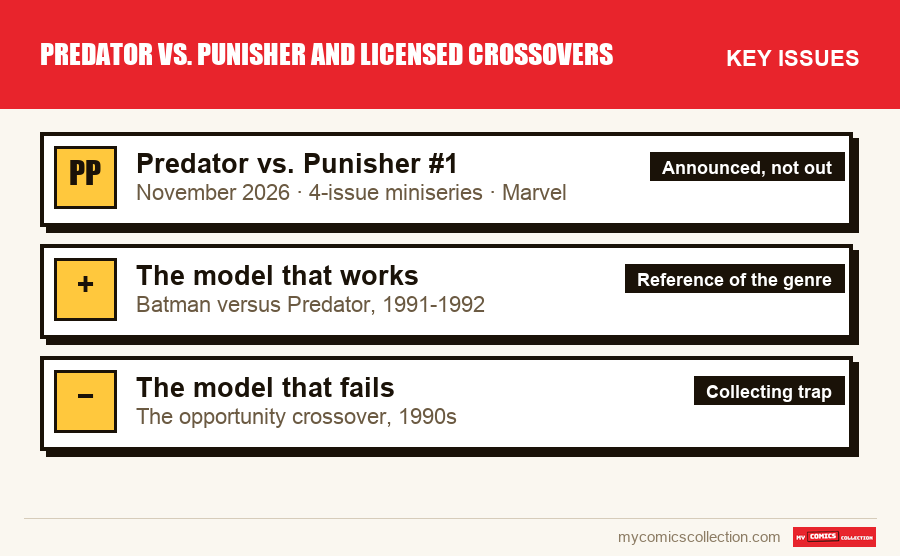
Predator vs. Punisher #1
Script by Frank Tieri, art by Jesús Saíz. In the announced cast: the Punisher, of course, but also Kingpin and Jigsaw. This choice of antagonists deserves to be read for what it is: an anchor in the character's oldest history rather than in his recent period. Frank Castle first appears in The Amazing Spider-Man #129, from February 1974, under the pen of Gerry Conway and the pencils of Ross Andru and John Romita Sr. Jigsaw, that is William Russo, arrives in the same series at #162 of November 1976, created by Len Wein and Ross Andru, after a brief appearance in the previous issue. Kingpin is even older: The Amazing Spider-Man #50, from July 1967, by Stan Lee and John Romita Sr.
Everything else remains to be checked at release. Neither the number of covers, nor the page count, nor the exact format are elements to commit to before you have the issue in hand. And above all, no value. An announced issue has no price guide value, since there is not yet a copy to sell.
Fifty years of practice, in four eras
The history of the genre reads quite clearly in four stages, and each left a different type of object in collections.
1976, the invention. Superman vs. The Amazing Spider-Man appears in early 1976, co-published by DC and Marvel, written by Gerry Conway, drawn by Ross Andru and inked by Dick Giordano, with uncredited contributions from Neal Adams and John Romita Sr. It is the first modern crossover between two superhero publishers, and its writer himself acknowledged there was no rational way to justify the meeting. This frankness of tone is the genre's birth certificate: you accept that the story does not have to fit within a continuity. A sequel, Superman and Spider-Man, arrives in 1981. Note that the partner here is not an outside owner but a direct competitor, which adds a difficulty: the two parties must agree not only on the money, but on who wins.
1989-1998, the golden age of monsters. Dark Horse sets up the model that will dominate the decade. The Aliens and Predator crossover is born in Dark Horse Presents #36, from February 1990, concluding a three-episode arc started at #34 in November 1989 with an Aliens story and continued at #35 in December 1989 with a Predator story. The idea is attributed to an internal working session of the late 1980s, writer and editor Chris Warner being credited with the proposal. The miniseries Aliens vs. Predator follows in 1990. The model is then applied to superheroes: Batman versus Predator, co-published by DC and Dark Horse, comes out in three issues from December 1991 to February 1992, written by Dave Gibbons and drawn by Andy and Adam Kubert. Two sequels arrive: Bloodmatch in four issues from December 1993 to March 1994, by Doug Moench, Paul Gulacy and Terry Austin, then Blood Ties in four issues from November 1997 to February 1998, by Chuck Dixon, Rodolfo Damaggio and Robert Campanella.
1994, the excess. The genre reaches its tipping point the same year as the speculative bubble. The Punisher takes part twice. Punisher/Batman: Deadly Knights appears in 1994, written by Chuck Dixon, co-published by Marvel and DC. And above all, in June 1994, with an August cover date, comes out the most improbable crossover ever authorized: Archie Meets the Punisher, written by Batton Lash, penciled by Stan Goldberg and John Buscema, inked by Tom Palmer. The object is published in two simultaneous versions: the Archie Comics edition, at a $2.95 cover price, and the Marvel edition titled The Punisher Meets Archie, at $3.95, with a die-cut cover and bonus pencil pages. Both contain the same forty-eight-page story. This detail of two editions for one story is typical of the genre and still traps collectors today, who think they have the duplicate of the same issue when they have two distinct objects.
2003 to today, the scarcity of deals between competitors. JLA/Avengers, published from September 2003 to March 2004 in four issues in prestige format, by Kurt Busiek and George Pérez, alternating the titles JLA/Avengers on issues 1 and 3 and Avengers/JLA on issues 2 and 4, is the last big deal of this type between the two houses. It has moreover been reissued several times, including a two-volume hardcover set in 2004 with unpublished pages from an aborted attempt of the 1980s, a softcover collection in 2008, and a 2022 reissue expanded with sixty-four pages of extras. Since then, publisher-to-publisher crossovers have become rarer, while crossovers with outside properties, film and video games, have multiplied. On the Predator side at Marvel, the series of encounters is now well stocked: Predator vs. Wolverine in 2023, Predator vs. Black Panther in 2024, Predator vs. Spider-Man in 2025, to which are added Predator: Black, White & Blood and Predator Kills the Marvel Universe in 2025.
Hits and misses: what makes the difference
Half a century of hindsight lets us state a clear criterion, which has nothing to do with the quality of the art. A licensed crossover succeeds when the rented property serves as a revealer of the house character, and fails when it serves as scenery.
The model that works
The reason is a simple mechanic: a hunter stalking the toughest prey in a city forces Batman to become again what he is supposed to be, a man without powers facing superior technology. The rented element does not do background work, it takes away the hero's usual advantage. Add a top-tier creative team, including the Kubert brothers on art, and the object still holds thirty-five years later.
The model that fails
The symptom is always the same: the story could unfold identically by replacing the rented property with any other. The two universes do not damage each other, they sit side by side for the length of a salable cover. These titles are the ones that age the worst, because they never had any argument other than the novelty of the pairing. They often remain very accessible today, and that is good news for anyone who wants to read rather than speculate.
When the license changes hands
This is the heart of the subject, and the part almost no collecting guide addresses. The three examples that follow are dated and verifiable, and they draw the same movement.
Star Wars. Marvel publishes the original series from 1977 to 1986, a hundred and seven issues and three annuals. After a stint at Blackthorne in 1987 and 1988, Dark Horse takes over the license from 1991 to 2014 and produces more than a hundred titles, among them Dark Empire, Tales of the Jedi and Legacy. Disney's purchase of Lucasfilm in 2012 brings the license back to Marvel in 2015. Twenty-three years of Dark Horse catalog then find themselves under a property that has another publisher. IDW also published Star Wars Adventures from 2017 to 2022, and Dark Horse resumed publications from 2022, which shows that a license is not necessarily exclusive to a single publisher across its full breadth. To find your way in the detail, our guide to the Star Wars collection at Marvel specifically covers the modern period.
Conan. Marvel publishes the original run from October 1970 to December 1993, that is two hundred and seventy-five issues. Dark Horse then exploits the license from 2003 to 2017, and notably republishes the recolored Marvel run under the title Chronicles of Conan. Marvel buys back the rights in 2018 and relaunches the series in January 2019, for twenty-five issues until November 2021. Titan Comics acquires the license in 2022. Three tenant changes in fifty years, and each time the same effect: the reissue program under way stops where it is.
Transformers. The most brutal case. Marvel publishes from 1984 to 1991, then a second volume in 1993-1994. Dreamwave acquires the license in early 2002, then goes bankrupt and loses it in early 2005. IDW follows from 2005, with an issue zero in October, and publishes until November 2018, then a fourth series from March 2019 to June 2022. In late 2022, IDW loses the rights. Skybound begins publishing in June 2023, inaugurating the Energon universe. A bankruptcy in 2005 and a contract end in 2022: two clean breaks, two frozen catalogs.
The real problem: the collected edition that does not come back
Here is the mechanism, stated simply. A collected edition is a reprint. A reprint requires an exploitation right in force. When the contract ends, the outgoing publisher can no longer reprint, and the incoming publisher does not necessarily hold the material, the writer contracts or the authorization to republish what its predecessor had done. In the case of a crossover between two competing publishers, both must also want to reopen the file, which assumes a shared interest that does not always exist.
Consequence for the collector: in this specific genre, the single issue is not an alternative to the collected edition, it is often the only existing medium. Demand then concentrates on an object whose print run has been frozen for decades, and of which nobody will manufacture more copies. It is not speculation, it is arithmetic.
Three practical consequences follow. First, the hierarchy of scarcities flips: on a house series, a low-print-run issue is rare, whereas on a licensed crossover a high-print-run issue can be harder to find in good condition, because it has been read and reread for lack of a reissue. Condition becomes the limiting factor, not the quantity printed.
Next, multiple editions take on outsized importance. Take the 1994 case and its two versions of the same story: a collection that ignores this distinction is incomplete without knowing it. The genre is full of similar cases, different covers depending on the co-publisher, diverging numberings, local-market editions. It is the type of distinction that an issue-by-issue tracker lets you keep and a mental list does not.
Finally, the most favorable buying window is the one where the license is active. While a publisher exploits a property, it reprints and puts its back catalog forward. When the license switches, this flow stops.
Buying method in four steps
Identify who holds what, and since when
Before buying an old crossover, ask yourself a single question: is the rented property still published by the house that published this story? If so, a reissue remains possible and nothing is pressing. If the license has changed hands, consider that what you see is what exists. The switch dates are public and easy to find for the big franchises.
Check whether a parallel edition exists
On any co-published crossover, systematically look for whether it came out under two covers, two titles or two prices depending on the publisher. Note both references in your tracking, even if you only own one. It is the only way to know later what you are really missing.
Choose between reading and preserving before buying
On a title with no foreseeable reissue, a copy in middling condition fulfills the reading function perfectly. Decide which of the two uses you are aiming at before looking at listings, not after. If preservation is the goal, our guide on CGC grading explains when a grading makes sense, and our estimate page recalls why any range is fragile in a genre where observed sales are rare.
For a miniseries in progress, take all four issues or none
A four-episode miniseries over four months is one of the formats where collections get the most holes. Issue 1 is bought in enthusiasm, issue 3 is forgotten, and the collected edition does not necessarily arrive. Put the four deadlines in your missing issues list as soon as the first comes out.
Placing November 2026 in this series
What the genre's history teaches about Predator vs. Punisher comes down to three observations, and none is a value prediction.
First observation: the contractual situation is today the simplest possible. Since the July 2020 announcement, Predator and the Punisher are published by the same publisher. There is therefore no deal between competitors to negotiate, which makes a collected reissue markedly more probable than on the 1990s crossovers. That mechanically reduces pressure on the single issue, and it is good news for the reader rather than for the speculator.
Second observation: this miniseries is not isolated, it belongs to a series of encounters already under way since 2023 with Wolverine, then Black Panther and Spider-Man. A crossover that is part of a recurring series behaves differently from a single event crossover: the novelty effect is lower, the regularity of supply stronger. For the general context of the character's crossovers, our page on Punisher crossovers lists the encounters internal to the Marvel universe.
Third observation: the announced cast is that of the character's founding mythology, not that of his recent period. That suggests a story that plays on familiarity rather than surprise. For a reader discovering Frank Castle, the historic entry point remains his first limited series, The Punisher, and our Punisher collecting guide details its stages.
One unknown remains that must be named: we are writing before publication. Nothing concerning covers, print runs or the title's reception is known as of October 2, 2026. Any claim about this issue's future value would be made up, and the genre whose history we have just gone through teaches precisely that the crossovers announced with the greatest future are not the ones that matter today.