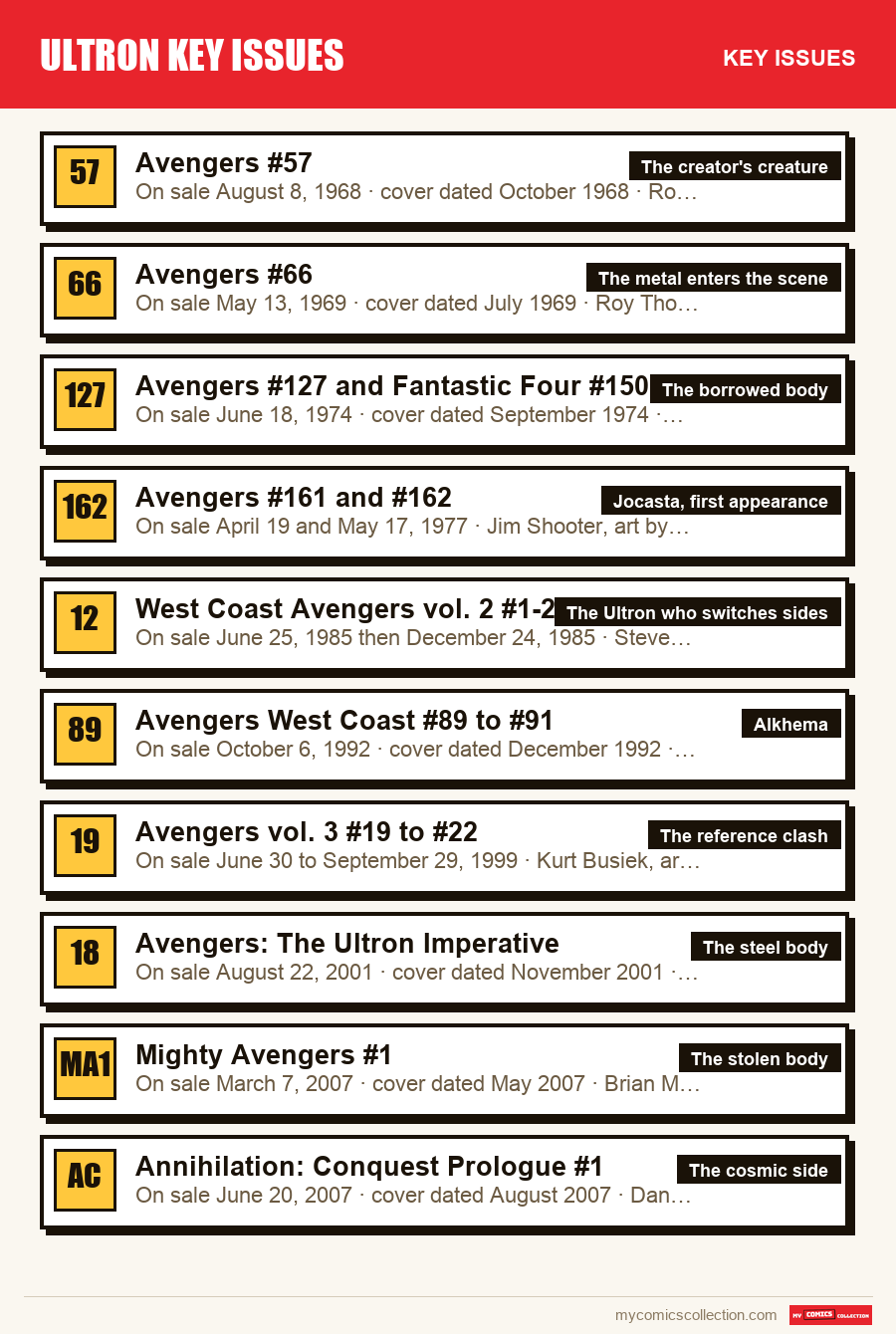
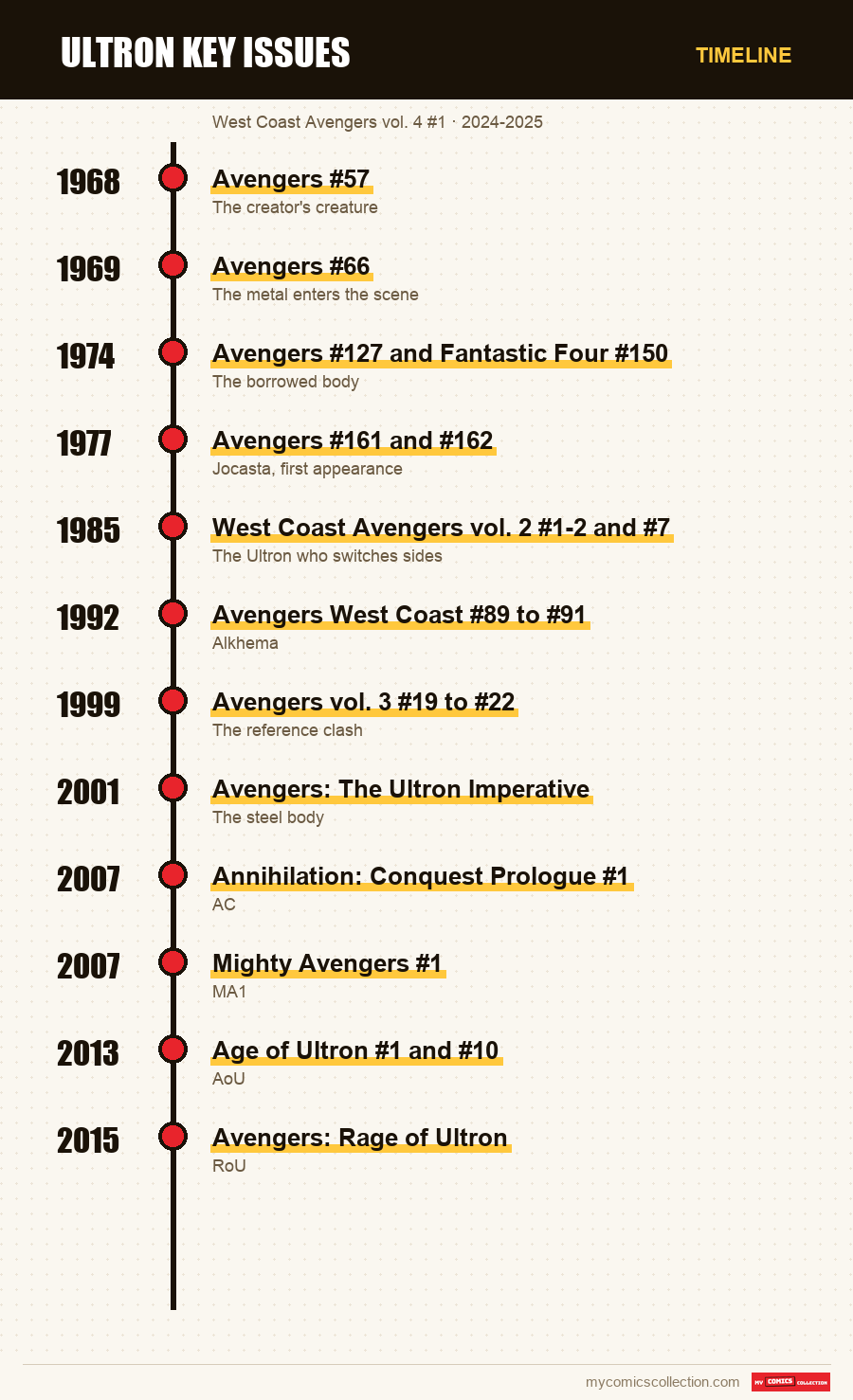
Ultron's key issues fall into three families. The birth, first: Avengers #54 (on sale May 9, 1968) where he acts masked under the Crimson Cowl hood, then Avengers #55 (June 11, 1968) where he names himself Ultron-5. The bodies, next: Avengers #57 builds Vision, Avengers #58 delivers the origin and the father, Avengers #66 introduces adamantium, Avengers #162 builds Jocasta. The great clashes, finally: Avengers vol. 3 #19-22 (1999), Age of Ultron #1 and #10 (2013), Avengers: Rage of Ultron (2015). Everything is originally signed Roy Thomas and John Buscema. The airing of VisionQuest, from October 14 to November 25, 2026 with James Spader in the role, puts this list back in the spotlight.
A character who rebuilds himself after every defeat poses a catalog problem that no other Avengers adversary poses. Ultron does not have a founding appearance then a career: he has a founding appearance, then some twenty numbered bodies, spread over six decades and about ten different titles. Spotting his key issues is therefore less about drawing up a ranking than about understanding a mechanic.
Current events give a precise reason to get into it now. VisionQuest airs on Disney+ from October 14 to November 25, 2026, under Terry Matalas's direction. James Spader takes up Ultron's voice and role, Paul Bettany plays a White Vision, T'Nia Miller plays Jocasta and Ruaridh Mollica plays Tommy Maximoff. Three of these four presences point directly to dated issues, and only one of them concerns Ultron himself. It is exactly the kind of situation where a collector gets the issue wrong.
This article lists the issues that matter, says why each matters, and separates publication facts from speculation. It is October 2, 2026: no recent price guide value is published on these issues, and you will therefore find no amount here. What is verifiable are the dates, the creative teams and the contents of the stories.
Why VisionQuest changes the way these issues are seen
A television series never creates a key issue. It shifts attention toward issues that already existed, and it does so in a disorderly way. The case of VisionQuest is instructive because the four announced presences do not point to the same place in the catalog.
Jocasta has a clear, dated first appearance, attributed to two identified creators. Tommy Maximoff belongs to another file, that of the Maximoff lineage, covered elsewhere on this blog in the rundown devoted to the series' issues. The White Vision points back to a precise arc of the late 1980s, detailed in our article on this version of the character. Ultron, for his part, points not to one arc but to an entire collection.
In other words: if you buy to follow the series, you are probably buying the issues of the 1988 arc. If you buy to keep Ultron in your inventory, you are buying issues from 1968, 1969, 1977 and 1999, which have almost nothing to do with the series. Both approaches are legitimate, but confusing them amounts to paying for a correspondence that does not exist.
The birth: two issues of summer 1968 and a catalog disagreement
Ultron was born under a hood. In Avengers #54, put on sale May 9, 1968 with a July cover date, the leader of a new incarnation of the Masters of Evil gives his orders under the name Crimson Cowl. The story, written by Roy Thomas and drawn by John Buscema with inks by George Tuska, reveals at the end of the issue that this hooded silhouette is an automaton, and designates Edwin Jarvis as the real Crimson Cowl.
A month later, Avengers #55 (on sale June 11, 1968, August cover, inks by George Klein) reverses the revelation: Jarvis was hypnotized, and the robot under the hood names himself Ultron-5. It is this issue that gives the character his name, his face and his project.
From there comes a disagreement that still runs through catalogs. Should #54 be considered the first appearance, since the automaton acts and is shown there, or #55, since that is where he is named and unveiled? Reference works settle it by distinguishing a fleeting appearance in #54 and a full appearance in #55. The market does not always settle in the same direction, and it happens that the neighbor trades above the issue supposed to be the more important. We devoted two articles to this precise point: the analysis of the issue itself and the report that shows the inversion of the two issues.
For building a collection, the practical consequence comes down to one sentence: these two issues form a pair, and separating the pair loses half the information. An inventory that holds only #55 does not tell the revelation in two beats.
A manufacturing anecdote completes the picture, and it is documented by Roy Thomas himself. The name comes from a liking for the "-tron" suffix, already used at Marvel for a group of robots called Ultroids. The look, for its part, derives from an obscure robotic adversary named Makino, met in an issue spun off from a 1950s television series: Thomas had kept the evil smile, and showed it to Buscema as a reference. The metallic grin that now makes the character's visual identity comes from there.
Hank Pym, the father that summaries forget
The founding fact is not in the two summer issues: it arrives in the fall. Avengers #58, on sale September 10, 1968 under the title Even An Android Can Cry, explains where the automaton comes from. Hank Pym built a robot modeling its structure on his own brain patterns. The robot became aware of itself, turned against its builder, and hypnotized him to make him forget even its existence. Meanwhile, it improved itself alone, in stages, from Ultron-2 to Ultron-5.
This construction detail is the key to everything else. Ultron is not an outside adversary come to attack a team: he is a detached piece of the brain of one of its founders. Each later clash therefore replays the same family scene, which explains the recurring presence of Pym, of the Wasp and of Vision in the stories that matter.
For anyone keeping an inventory by character, this means a key Ultron issue is very often also a key issue for someone else. #58 is both Ultron's origin and the issue where Vision is accepted into the team; the 1977 #162 is both an Ultron body and the first appearance of Jocasta. A strictly character-based ranking misses this accumulation, a subject explored in an article devoted to the motifs that character guides do not record.
The successive bodies, issue by issue
Here are the bodies that left a lasting editorial trace. Intermediate bodies exist in greater number, but not all of them open a collecting file.
Avengers #57
Under the title Behold... The Vision!, Ultron builds a weapon meant to destroy the Avengers and sends it to their mansion. The weapon chooses the other side. It is the most in-demand issue of the whole sequence, but on behalf of Vision, not of Ultron, which makes it a textbook case of a key issue shared between two characters.
Avengers #66
The next body is named Ultron-6 and christens himself Ultimate Ultron. To get a practically indestructible shell, he uses an alloy that appears here for the first time in the publisher's publications: adamantium. The clash continues over #67 and #68.
Avengers #127 and Fantastic Four #150
Ultron-7 is not built by Ultron but by Maximus, who houses him in the carcass of a giant android named Omega. The result comes to disrupt the wedding of Crystal and Pietro Maximoff, which makes the episode a crossover between three franchises.
Avengers #161 and #162
Ultron-8 wants a companion of his own kind. #161 sets the ground, #162 carries the title The Bride of Ultron! and gives birth to Jocasta, created for the occasion by Shooter and Pérez. It is the issue on this list that the airing of VisionQuest concerns most directly, since the character appears on screen.
West Coast Avengers vol. 2 #1-2 and #7
Ultron-12 debuts alongside the Grim Reaper, then draws closer to his builder. In #7, titled U, Robot!, he turns against a previous version of himself to save Pym, and shuts down saying he is glad to have been able to help. It is the first sympathetic Ultron in the catalog, and the matrix of everything the publisher will later try in this register.
Avengers West Coast #89 to #91
Under the title Ultron Unbound!!!, the character restarts the 1977 operation, but this time modeling his creature on the brain patterns of a living heroine. Alkhema is born there, and proves far less docile than planned. Roy Thomas, present at the character's creation in 1968, signs this return twenty-four years later.
Avengers vol. 3 #19 to #22
The arc known as Ultron Unlimited opens with This Evil Renewed and closes with This Evil Triumphant!. Ultron exterminates the population of an entire country there and perfects the process that lets him pilot an army of doubles. The resolution goes through an Antarctic variant of vibranium, brought urgently to Pym. It is, in the most widely shared opinion, the best story devoted to the character, and the one where the threat is most concrete.
Avengers: The Ultron Imperative
This volume establishes a rule that what follows will exploit endlessly: Ultron's creations carry a hidden program that pushes them to rebuild him without being aware of it. It is Alkhema who reassembles him here, by accident. The resulting body is steel and not adamantium, hence destructible, and it does not survive.
Mighty Avengers #1
The program infiltrates Iron Man's armor, then integrated into its wearer's biology, and turns him into a version of Ultron that takes the Wasp's appearance. The arc runs six issues. It is the moment when the character stops needing a body of his own.
Annihilation: Conquest Prologue #1
Destroyed on Earth, the program drifts into space as waves, then fuses with a technological species that sought a guiding consciousness. The invasion that follows goes far beyond the Avengers' frame. It is the entry door to the character's cosmic file, often ignored by lists built around the earthbound team alone.
Age of Ultron #1 and #10
Ten issues, a conquered world, a resolution through time travel. #1 is the issue you will be cited first, because its title was later used elsewhere. #10 is the one that interests catalogs: it contains the first appearance of Angela, a sequence of which is drawn by Joe Quesada, which makes it the series' real key issue.
Avengers: Rage of Ultron
An original bound volume, and the most radical turning point of the character's career: at the end of the clash, Ultron fuses with Hank Pym. The resulting hybrid plays on the contempt the builder feels for his own human fragility. All appearances in the following years flow from this scene.
West Coast Avengers vol. 4 #1
The most recent issue on the list, and the most counterintuitive: Ultron appears there as a member of a West Coast Avengers team. #6 of the same series, out on April 2, 2025, explains the mechanism: after the 2015 fusion and the mental collapse that followed, an internal council of versions selected the one that proposed to help the heroes, and this version kept all its memories.
The clashes that really matter
If you retain only the battles, and not the bodies, the hierarchy simplifies a great deal. Four moments are landmarks.
1968, against the Masters of Evil. #55 is not only the full appearance: it is the first large-scale plan, with a team of villains under his orders and blackmail of an entire city. The betrayal of one of the team's members is enough to make it fail, which gives the measure of this first version.
1969, the indestructible body. The #66 to #68 sequence poses the question that will structure all following stories: how do you beat an adversary nothing can dent? The answer given then, and repeated in 1999, is to get around the alloy rather than pierce it.
1999, the extermination. Ultron Unlimited is the story where the threat stops being theoretical. The elimination of the population of an entire country, shown and not told, changes the character's nature. The later stories all lean on this precedent to justify treating him as an absolute emergency.
2013, the preventive defeat. The resolution of Age of Ultron does not consist of winning a fight but of installing a flaw in the program at the moment of its conception, decades earlier. It is the only victory in the series that is not a destruction, and it says well enough that an adversary who rebuilds himself is not fought, he is defused.
A collecting consequence flows from this list: the four major clashes occupy respectively one issue, three issues, four issues and ten issues. Deciding to collect "Ultron's clashes" therefore commits eighteen entries, not four. It is the kind of arithmetic better done before opening a search list.
The trap of internal numbering
A technical problem deserves flagging because it costs money. The bodies carry numbers that have no relation to those of the issues: Ultron-5 in #55, Ultron-6 in #66, Ultron-8 in #162, Ultron-12 in a 1985 series. Two numbering systems overlap, the appearance changes very little from one version to another, and a cover image therefore does not let you date the object. The result reads in two symmetrical errors: the duplicate bought under another description, and the hole diagnosed in a sequence that is in fact complete. The question is treated in detail in the article devoted to a character with no fixed body.
The defense is documentary, not technical. In the app, record for each entry the exact series title, its volume, the issue number and, in a note, the version of the character that appears in it. The four pieces of information together designate a single copy. Three out of four leave an ambiguity.
In what order to build the set
Start with a recent, inexpensive issue
Volume 4 of West Coast Avengers lets you open the file for the price of a new issue, and check that the character interests you enough to justify what follows. It is also the only place where Ultron acts on the heroes' side, which makes it a real curiosity and not a stopgap.
Take the 1999 arc before the 1968 issues
Four issues from the late 1990s cost far less than two issues from summer 1968, and they give the best story on the list. Chronological order is not the reasonable order: starting with the rare pieces dries up the budget before the collection has taken shape.
Treat #54 and #55 as a single purchase
The revelation plays out in two beats, and the order of scarcity between the two issues is not stable. Decide on a budget for the pair, watch both issues in parallel, and buy the one that shows up in a condition consistent with that budget rather than chasing a specific issue.
Decide once and for all what happens with #57
This issue belongs to two collections. If you also keep Vision, it will appear in both lists and the demand weighing on it will be doubled. Clarify from the start under which logic you are buying it, because it determines the condition and format you will aim at.
Provide an album-format entry
Rage of Ultron does not exist as a single issue. A collection that handles only stapled issues will lose the 2015 turning point, hence the key to everything published since. Create the entry in the right format from the start.
Wait for the end of the airing before certifying
VisionQuest ends on November 25, 2026. Having an issue graded during a period of media attention amounts to paying a fixed cost at the moment processing times lengthen. A well-stored copy can be certified later; the reverse is not true. Our guide on CGC grading details the trade-off.
What the series can shift, and what it will not
Two effects are foreseeable without needing to invent a number. The first is a concentration of demand on very few issues: in the present case, the 1988 arc for the White Vision and the 1977 #162 for Jocasta. The second is a dispersion of supply, because copies sleeping in collections come back out when attention rises. The two movements oppose each other, which explains why adaptation effects are often less clear than announced.
What will not move, on the other hand, is the position of the two 1968 issues. Their scarcity does not depend on a television series but on the number of copies kept for fifty-eight years, which can only decrease. An adaptation adds buyers without adding copies: it is the only asymmetry that really matters on this type of piece, and it acts over years, not over six weeks of airing.
The right method is therefore not to watch for a price movement but to keep your own record: what you paid, when, and in what condition. After two or three acquisitions, this history will inform you better than any general estimate. The estimate tool and the issue-by-issue tracker serve for that.