On the French market, the same title has often been relaunched several times, and the number alone does not indicate which relaunch it is: it is the mention “4eseries » which carries the information. A survey of 183 advertisements taken on August 30, 2026 included 143 bearing this mention, on six different titles. Nine of them were “#1”. In other words: without serial generation, a French number 1 does not designate any specific copy, and a story of Ultron published in a host title is only identifiable if we note both.
The starting point of this article is a single line, raised to €1.95: “Wolverine No. 5: Age of Ultron: On the road: Marvel France 4th series V4”. It is instructive because it stacks four pieces of information that we are used to processing separately. A host title that is not that of the character in question. A number. A name of history. And a generation of series, written twice, under two different notations, in the same ad title.
A collector looking to consign this example immediately faces the question: what exactly do they own? A number 5 of Wolverine, certainly. But there are several French series with this name, and the number 5 of one has nothing to do with the number 5 of another. Without the generation mention, the form describes an object that does not exist.
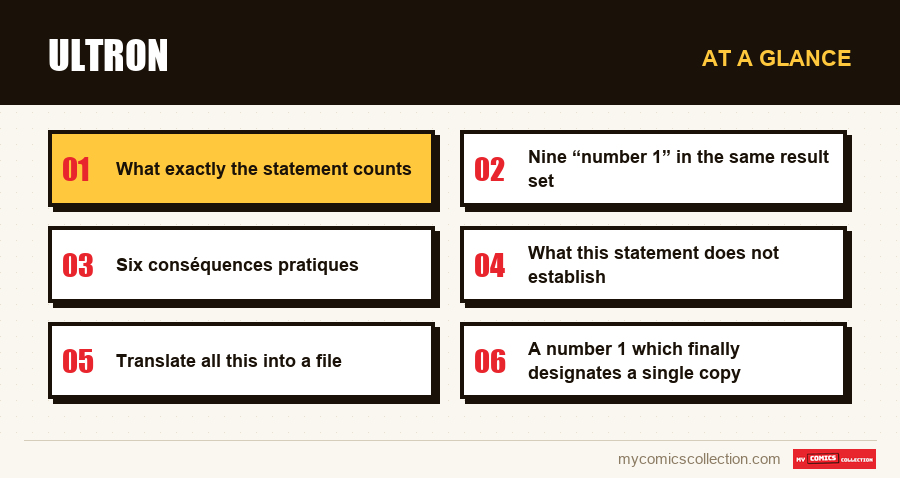
What exactly the statement counts
What I observed: a survey of the French market, August 30, 2026, of which I kept 183 lines once the lots and everything that was not a publication were removed. The following amounts are those that réclamaient les vendeurs that day. Nothing was sold there before my eyes, and a single photo obviously does not draw any curve: it describes an offer, at a given time.
Of these 183 advertisements, 143 carry a mention of series generation written in full: “4th series”, “4th series”, “(4eseries). Eleven carry in addition, or instead, a short notation of the form “V4”. Three bear a mention “cover A”, which designates something else: not the generation of the series, but the cover chosen for the same issue.
The mention does not focus on a title. It is spread over at least six titles:
Nine “number 1” in the same result set
The most telling fact of the survey is the intersection of two criteria. Nine ads carry both a « n° 1 » and a serial generation mention. They refer to distinct publications: a « Marvel Saga 4ème série N° 1 », a « X-Men Universe N° 1 Marvel France 4ème série », a “ Wolverine (4eseries) n° 1 ”, a « Marvel Universe N° 1 à 7 Marvel France 4ème série », and a collection “ Aventures Fiction 4eseries » with another publisher.
The number is not enough
A field « numéro » containing 1 says nothing if the field « série » contains only « Wolverine ». It takes generation for the pair to designate a unique object.
Deux notations coexistent
“4th series” out of 143 ads, “V4” out of 11. The same information is written in two ways which are not similar through any automatic processing.
Host title is not the subject
“Wolverine No. 5: Age of Ultron”, at €1.95: the character sought does not appear in the name of the series. Search by character missing this copy.
“cover A” is another layer
Found in 3 advertisements, it distinguishes two covers of the same issue. To confuse it with serial generation is to overwrite two different distinctions.
We must measure what this implies. On a French shelf, “Wolverine number 1” is not a designation. That's a question. The collector who notes his acquisitions based on the series + number pair alone creates duplicates that he will not see: two different issues will occupy the same line, and he will believe he has one copy where he has two, or the opposite.
The difficulty is not that there is a lack of information. It is present, written in black and white, on the cover as in the advertisements. The difficulty is that it does not pas de place in most inventory sheets, designed around a series + number pair inherited from a market where relaunches have a new name rather than a new generation.
A missing field does not cause a visible error. It causes a silent overwrite: the data is entered, it fits somewhere, and no one notices that it has replaced something else.
Why is the generation not deduced from the year?
A natural temptation is to replace the generation with the date: if we note the year, we think, we will know what recovery is in question. The reading shows that this substitution does not hold. Two ads date a “ Wolverine n° 1 (4eseries) » of July 2013 and a “ Wolverine n° 2 (4eseries) » of August 2013. A third date is “X-Men n°18 Marvel France 4eseries » of December 2014, and a fourth one “Marvel Saga 4eseries n°1» from June 2017.
Four different titles, four different dates, the same declared generation. The fourth series of one title does not begin in the same year as the fourth series of another. The year of publication is useful information, it does not replace the generation, and the two must coexist in the file rather than replacing one for the other.
A reservation must be added. The statement shows the words “4eseries » both on advertisements citing a recent publisher and on a collection from an older publisher. This is enough to establish that the convention does not belong to a single publisher. This says nothing about its age or the way in which it spread: two window lines do not make a history of publishing, and a notice written to sell does not have the value of a publisher's document.
Six conséquences pratiques
Des doublons invisibles
Two numbers 1 from different generations are placed on the same line if the form does not provide the generation. Nothing indicates the collision: the inventory remains consistent in appearance.
Misdiagnosed holes
A series deemed incomplete may be so because the missing numbers belong to another generation. We then look for issues that have never been part of the same suite.
Two scriptures for one fact
“4th series” and “V4” do not automatically move closer together. Sorting by series separates them, counting counts them twice, searching only finds one.
The character is not in the title
An Ultron story may appear in a title in the name of another character. Searching by character name leaves these numbers out of the field, without warning.
Coverage and generation merge
“cover A” distinguishes two covers of the same issue, not two relaunches of the title. Housing both in the same field overwrites one of the two distinctions.
The date does not replace anything
Four titles in the statement declare a fourth series on four different dates. The year places the copy in time; she does not say which suite it is part of.
Collecting this series?
Track what you own, what you are missing and what your collection is worth. 7 day trial.
Start my trial →What this statement does not establish
The statement documents a writing convention, not an editorial reality. It shows that French sellers, on at least six titles, consider it necessary to specify the generation of the series so that their advertisement is understandable. It is a formal observation, and it is solid because it is based on 143 occurrences rather than on one or two isolated cases.
It doesn't say how many generations actually exist for a given title. Let a seller write “fourth series” proves that he wrote it, not that he counted correctly, nor that his way of counting is that of his neighbor. What one designates as the fourth relaunch, another may very well call it something else, and nothing in a sales window allows you to arbitrate between the two.
He doesn't say anything about prices either. The amounts cited here: €1.95, €2.50, €2.97: are used only to identify the ads I am talking about. They do not make any comparison between generations, and a one-day reading would not allow any trend to be established in any case.
Translate all this into a file
Only one instruction to remember: treat series generation as part of the series' identity, not as a commentary. Concretely, the series in your file is not “Wolverine” but “ Wolverine: 4eseries”, just as the publisher is part of it. This is the only way to make the series + number pair unique again.
Three precautions accompany this rule. The first: copy the generation in the form printed on the copy, without standardizing it yourself. If the cover says “V4”, do not write “4eseries”; you would introduce an interpretation where you think you fit. However, you can note the equivalence in a notes field, which keeps both pieces of information without inventing one.
The second: keep a separate field for coverage. « couv A » and “4eseries » answer two different questions: which sequel is it, and which of the covers of this issue. Lodging them in the same field means losing one of the two as soon as the other is entered.
The third: when a story appears in a title that is not its own, note both. The host title and its number identify the physical object; the name of the story allows you to find it when you search by story rather than by series. These are two entries to the same copy, and there is no obligation to choose. The booklet priced at €1.95 is correctly described as “Wolverine, 4eseries, n° 5» for the subject, and by the name of the story for the content.
This discipline costs one more field to enter. It avoids a whole category of errors that can only be corrected by reopening the boxes: a duplicate that nothing indicates, a hole that we look for in the wrong place, a series that we believe to be complete when we have two halves. The cost is reversible, the loss of information is not.
That the title has already been published under this name before and that it is a relaunch, starting from a new number 1. The mention distinguishes this sequel from the previous ones. On the statement of August 30, 2026, 143 out of 183 advertisements carried it, spread over six different titles: it is a shared writing convention, not the practice of an isolated seller.
No, and the statement shows it directly: four titles declare a fourth series on four different dates, from 2013 to 2017. The fourth series of one title does not begin in the same year as that of another. The year places the copy in time, the generation says which suite it is part of; the two complement each other instead of replacing each other.
The two notations designate the same idea of generation, and an announcement of the statement also uses them side by side in the same title. However, they are not brought together through any automatic processing: sorting separates them, counting counts them twice. Copy the printed form on your copy, and note the equivalence separately if necessary.
Noting both. The host title, its generation and its number identify the object you own; the name of the story allows you to find it when you search by story. The booklet priced at €1.95 is number 5 of a fourth series, and it contains an episode of a story centered on Ultron: both information is true and neither replaces the other.
The statement does not provide an answer. He attests that a fourth series is declared on six titles, nothing more. An ad proves that a seller wrote it, not that he counted correctly nor that the numbering is stable from one seller to another. This is one more reason to copy what is printed rather than reconstructing a chronology yourself.
A number 1 which finally designates a single copy
My Comics Collection keeps the series generation with the title, so that the series + issue pair becomes unique again on your shelf.