We imagine that the booklet where Ultron shows himself in full costs more than the one, published just before, where he only passes through. The statement from August 30, 2026 says something else: among the copies offered that day on a general American auction site, that of No. 54 displayed as a fleeting appearance was asked for $45.00, while four copies of No. 55, that of the complete appearance, were asked for between $25.99 and $40.00. These are not sales concluded but sums requested by sellers, at a single moment, on only five advertisements. The conclusion is therefore not that one number is “worth” more than the other: it is that the expected hierarchy is not automatically verified in the copies actually available, and that a collector has every interest in documenting the two lines of his collection rather than relying on a general rule.
There is a distinction in the vocabulary of collectors that has become so familiar that it is no longer questioned: on the one hand the “complete” appearance of a character, that where he occupies the page, acts, speaks, fully exists; on the other the “fugitive” appearance, this silhouette glimpsed one panel before the end, this arm which emerges from the shadows, this bodyless voice which announces what follows. The resulting reasoning seems unstoppable: since the second shows almost nothing and the first shows everything, the first should cost more. This intuition is so strong that it serves as an implicit guide to thousands of purchasing decisions.
The survey carried out on August 30, 2026 on a general auction site, American market, invites us to qualify it. The amounts observed are sums claimed by sellers in current listings, not completed transactions: no one has yet agreed to pay these prices, and there is no guarantee that anyone will do so. The copies verified by an external body were counted separately, because they form a separate market with their own levels. On this precise basis, and on a very small number of announcements, the expected order between the two neighboring numbers of Ultron is not found.
What the reading shows, and nothing more
The query for Ultron and 1968 Avengers issue #55 returned 83 unverified listings, with a low of $25.99, a median of $134.95, and a high of $1,353.80. The copies passed by a verification body, counted separately, formed a set of 60 advertisements, minimum $70.00, median $362.50, maximum $4,100.00. These two sets are not compared term to term: in the second, part of the asking price remunerates the expertise and the encapsulation, not just the booklet.
The maximum, in either case, should not be read as anything other than a demand. A seller who displays $4,100.00 expresses an expectation; as long as no one has paid this sum, it does not measure the market, it measures the optimism of the person who wrote the ad. The median is more meaningful because it resists extremes, but it describes what is proposed, not what is concluded. And as this reading was made only once, on a single date, it contains no information on a movement: it is impossible to conclude that anything is rising, falling or stagnating, since there is no previous point to compare to.
It is by going down to the bottom of the price scale that the surprise appears. The least expensive listings in the set aren't arranged as you would expect, and it's this mess that deserves a close look.
The cheapest ads, viewed one by one
$25.99-#55 without declared condition
The ad is titled "The Avengers #55 (Marvel Comics August 1968)" and says nothing about the condition of the issue. This is the lowest price of the entire survey. It is also the least informative ad: without declared condition, the buyer does not know if he is buying a correct copy or a wreck, and the low price can reflect generosity as well as reserve.
$39.99-#55 in declared weak condition
“Avengers #55, Aug. 1968 […] 1st Ultron, GD/VG” explicitly announces a modest state. Here, at least, the buyer knows what to expect: the seller has named the condition, and the price is read according to it. An announcement that declares a weak state is more useful than an announcement that declares none.
$40.00-#55 with water damage
“Avengers #55 1st Full Appearance Ultron […] 1968 Water Damage”: the flaw is written in the very title of the ad. Water damage is not a surface accident, it has a lasting effect on the paper. This copy does not fall into the same category as an issue described as sound, and its price cannot serve as a benchmark for the issue in general.
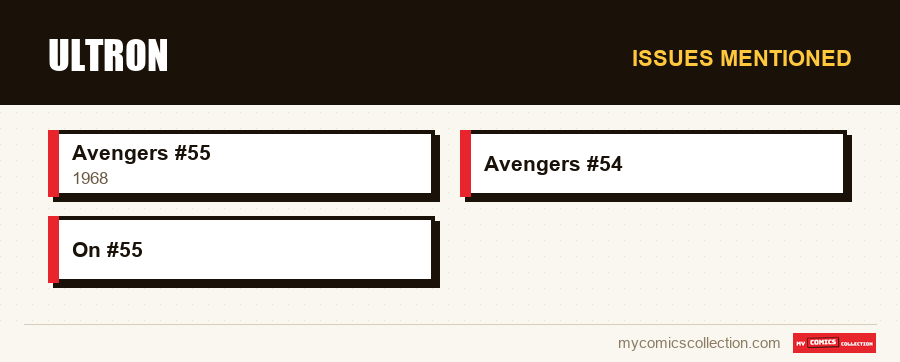
$45.00: No. 54, The Fugitive Apparition
“Avengers #54. KEY 1st Cameo Ultron, 1st New Masters of Evil w/Bonus. Marvel 19[68].” This is the most expensive ad of the five, even though it is for the number that is supposed to show the least. Its title claims two reasons to be sought, not just one, and this accumulation is part of the explanation.
Placed side by side, these five prices say something simple: at the time of the survey, on the copies actually available at the bottom of the scale, the fleeting apparition was asked for more than the four cheapest copies of the complete apparition. The important word is “requested.” None of these copies had found a buyer at the time of the survey, and there is no indication which one will sell or at what price.
Five listings do not constitute a deal. With such a small number, it would be dishonest to assert that the fugitive number is “worth more” than the full number: the only solid observation is that on this precise date, on these precise copies, the expected order was not respected.
What makes the observation interesting is therefore not a price level, but a lesson in method: a general rule on the hierarchy between two numbers never replaces the examination of the copies actually offered at the time of purchase.
Why the expected order can be reversed
Three mechanisms are enough to explain the observed disorder, and none supposes that the market has changed its mind on the relative importance of the two numbers. The first is the declared state. Of the four examples of No. 55 noted at the bottom of the scale, one has reported water damage and another declares no condition. These two do not compare to an accurately described copy: they are cheap because they are damaged or because they are opaque, not because the issue would be devalued.
The second mechanism is the accumulation of search patterns. No. 54 is not on sale for the sole reason that concerns us: its announcement also claims the first appearance of a group of antagonists in a new formation. A booklet can carry several reasons to be coveted, and these reasons do not replace each other, they add up. A buyer coming for the group and a buyer coming for Ultron are competing for the same copy, which is enough to support the asking price regardless of the hierarchy between fleeting appearance and complete appearance.
The third mechanism is the relative scarcity of supply at the time of the survey. No. 55 was present in large numbers, 83 unverified ads and 60 verified ads, which statistically guarantees the presence of very low-end, therefore very cheap, copies. An abundantly offered number automatically produces low floor prices; a number less often offered does not offer the same distribution tail. Comparing the minimums of two sets of different sizes is comparing two things that are not measured in the same way.
Finally, we must accept a part of the irreducible: a seller sets his price as he sees fit. Some align their advertisements with what they believe to be the market value, others liquidate a lot, still others test a sum that they know is high. The lower end of the listing scale reflects the sellers' intentions as much as the value of the items.
Six pitfalls to know before choosing between two neighboring numbers
The silent announcement
A booklet offered for sale without any declared condition is an advertisement without information. At $25.99 it seems the best deal on the list, and this is exactly why you should be wary of it: the low price is not a gift, it is most often the reflection of an uncertainty that the seller did not want to remove.
Instant photography
A reading taken on a single day says nothing about a trend. It contains no previous point of comparison, therefore no direction. Treating a single measurement as evidence of an increase or decrease is the most common and costly mistake.
The defect written in the title
When a seller lists water damage in the very title of his ad, he is not hiding anything, but he is changing categories. This price should never be used as a benchmark to evaluate a healthy copy of the same issue.
The lot disguised as a booklet
An ad that promises a supplement or a bonus does not only sell the booklet advertised. The asking price then covers a set, and comparing it to that of an isolated copy distorts the reading in both directions.
The incomparable workforce
An issue offered in dozens of copies produces a lower minimum than an issue offered rarely, without this reflecting a difference in value. Comparing two minima from sets of very different sizes does not make statistical sense.
The confusion of the two markets
The copies passed by a verification body and the ordinary copies form two separate sets, with very distant medians. Mixing them in the same calculation produces a figure that describes neither.
Collecting this series?
Track what you own, what you are missing and what your collection is worth. 7 day trial.
Start my trial →What Case of Ultron actually changes in a collection
Record both numbers, not just the one you think is “the right one.”When two consecutive issues dispute the same event, memory is not enough. Three years after purchase, in front of a shelf, it becomes impossible to remember whether the copy acquired was that of the fleeting appearance or that of the complete appearance. Both lines must exist in the collection, each with its own mention, even if one is not yet owned: the empty line is as much information as the filled line.
Note the exact reason each number is being searched for. No. 54 makes two claims in its ad, not one. If you only list "first Ultron" next to your copy, you'll lose half the reason you paid that price for it, and you'll later deprive yourself of the argument for its place in the collection. A note field that contains both patterns is better than a field that contains only one.
Record the condition as stated at the time of purchase, and your own reservations. A copy purchased with announced water damage is not the same object as a copy described without defects, even if the application displays them on the same serial line. Taking word for word the condition announced by the seller, then adding what you noticed upon receipt, creates a history that neither memory nor a photograph can replace.
Date each amount you note. The figures in this article are for August 30, 2026 and nothing else. A price noted without its date becomes unusable after a few months: it is no longer useful for comparison, it is misleading. Writing the date next to the amount transforms a dead note into a measuring point, and two dated points are worth infinitely more than an isolated figure retained from memory.
Distinguish what you paid for from what was requested. An amount claimed in an advertisement and an amount actually paid are two different types of information. Mixed in the same field, they produce a systematically inflated collection estimate. Separating the two (what the market expects on the one hand, and what you paid for on the other) is the only way to ever know what your collection really represents.
How to proceed when faced with two numbers competing for an event
The first question to ask yourself is not “which one is worth more” but “what exactly does each one contain”. A number where the character only passes through and a number where he fully acts tell two different moments of the same arrival. Depending on whether you collect the first traces or the first scenes, one or the other will be the right purchase, and this preference is personal, it cannot be deduced from any price table.
The second question is about the state. For a given budget, it's almost always better to have a decent copy of the issue you really want than a degraded copy of the issue you think you should want. The floor prices recorded on August 30, 2026 all correspond, except one, to examples whose condition is either poor or undeclared. The bottom of a market isn't a bargain, it's the price of what no one else has taken.
The third question concerns the number of ads available. A collection of a few announcements does not allow any conclusion on a price level; a set of several dozen begins to draw a range, provided that the verified copies are separated from the others. Moving from one number to a range, then from one dated range to a second dated range, is the only path that leads to actionable information.
The fourth question, finally, is that of coherence with the rest of the collection. Acquiring the two neighboring numbers makes obvious sense when you follow the series over time, and much less when you are only looking for a representative piece. A collector building a complete series will note both lines; a collector who composes a selection of notable issues will choose one, and must be able to explain why: first to himself.
Place these two numbers in a larger whole
A number never exists alone. He belongs to a series which has its own editorial trajectory, and to a character whose notable appearances are spread over decades. To understand why two consecutive fascicles focus so much attention, it is useful to look again the history of the Avengers series and see at what point in his journey these numbers are located. The same logic applies to the character: a reading trail dedicated to Ultron shows that the episodes sought by the market do not always coincide with those that matter narratively.
The gap between narrative importance and commercial importance also deserves attention. A booklet can be decisive in a plot without being researched, and researched without being decisive. The popularity resulting from adaptations is the clearest example: when a story is on the screen, attention is redistributed according to the logic of the film, not according to that of the original series. Compare the film adaptation and the comics from which it is inspired allows us to measure to what extent the two stories diverge, and therefore why the numbers highlighted by the public are not always those that the series considers to be pivotal.
This redistribution of attention has a practical consequence for those who buy: the most cited issues are not necessarily the most interesting to acquire, and there are almost always, around a famous episode, less popular booklets which tell the same period. This is the same method that we apply when we seek to enter an old series without spending an unreasonable budget on it: aim for what is complete and coherent rather than what is labeled as essential.
Still, caution must remain symmetrical. Just as we should not conclude from a single statement that one number has become more expensive than another, we should not conclude from five announcements that a hierarchy has been reversed for good. What August 30, 2026 shows is a pattern: the supply available that day placed the fleeting apparition above the four cheapest copies of the full apparition. Another day, with other sellers, the order could very well become the one we expected, and it would be just as inconclusive.
Frequently asked questions
The answers below are based only on the August 30, 2026 statement, that is to say on amounts requested by sellers in current advertisements, on a general auction site on the American market. None describes a concluded transaction, and none claims to describe an evolution.
No, and the article does not say so. The finding is narrower: among the five least expensive ads noted on August 30, 2026, the copy of No. 54 was asking for $45.00 while four copies of No. 55 were asking for between $25.99 and $40.00. Five advertisements are not enough to establish a price level, and two of them concern damaged or undeclared copies. The good summary is that at this moment, the expected hierarchy was not verified on the copies offered.
Because they don't compare themselves to others. On #55, unverified listings had a median of $134.95 for 83 listings, while the 60 verified copy listings had a median of $362.50. Part of this gap pays for external expertise and material protection, not the fascicle itself. Merging the two together in a single calculation would produce a median that would not describe either market.
That it is a request, not an observed price. An isolated maximum measures the hope of the seller who wrote the ad, and nothing else as long as no one has paid it. The same goes for the maximum of $1,353.80 noted on the unverified side. These upper limits are useful to know the amplitude of what is proposed, never to estimate an example.
It is above all an announcement without information. The seller having not described any conditions, the buyer has no information to anticipate what he will receive. The fact that this is the lowest price of the entire survey is not enough to make it an opportunity: in a group where other sellers declare poor condition or water damage, the total absence of description is the least reassuring signal of the three.
By creating a separate line for each, even if only one is possessed, and by writing in each line the exact reason for which the number is sought: a booklet can carry several, like No. 54 which also claims the first appearance of a group of antagonists. You must add the state declared at the time of purchase, the amount actually paid as distinguished from what was requested, and the date. Without these elements, we no longer know, a few years later, which of the two numbers we have or why we bought it.
Keep track of both numbers, not just memory
When two consecutive issues compete for the same first appearance, only one record per issue allows you to know, years later, what you own, in what condition, at what price and for what reason. My Comics Collection lets you record each copy with its declared condition, your personal notes, and the dated amount you actually paid.