Ultron does not have a fixed body: appeared in 1968, it rebuilds itself after each destruction, generally in a new and more advanced envelope. This property makes him an antagonist that the writers can call back without ever having to explain his return, but it takes away from him what makes an adversary worrying: the possibility of ending things. For the reader who classifies booklets, it creates a very concrete problem: appearance no longer allows us to date an appearance, and two covers separated by twenty years can show two silhouettes with no visible connection.
Most long-term adversaries in a superhero universe age in one way or another. Their costume evolves, their silhouette stabilizes, a drawing ends up establishing itself as the reference version, and the reader recognizes the figure at first glance even on a background panel. Ultron escapes this logic by construction. He is a machine, he repairs himself, and he repairs himself by modifying himself. This is not an accident of continuity that successive authors have let slip: it is the very definition of the character, established from its creation and never abandoned since. The consequence is that the character has no canonical image, only a succession of states.
This absence of a stable image is coupled with a second, even heavier absence: that of an end. A character who can rebuild himself indefinitely cannot die believably. It can be dismantled, deactivated, buried, dispersed: none of this closes anything, since reconstruction is part of the concept. These two gaps, one visual and the other narrative, respond to each other. They make Ultron a textbook case: an inexhaustible storyline force which becomes, for anyone who wants to tidy up, identify or document, a permanent puzzle.
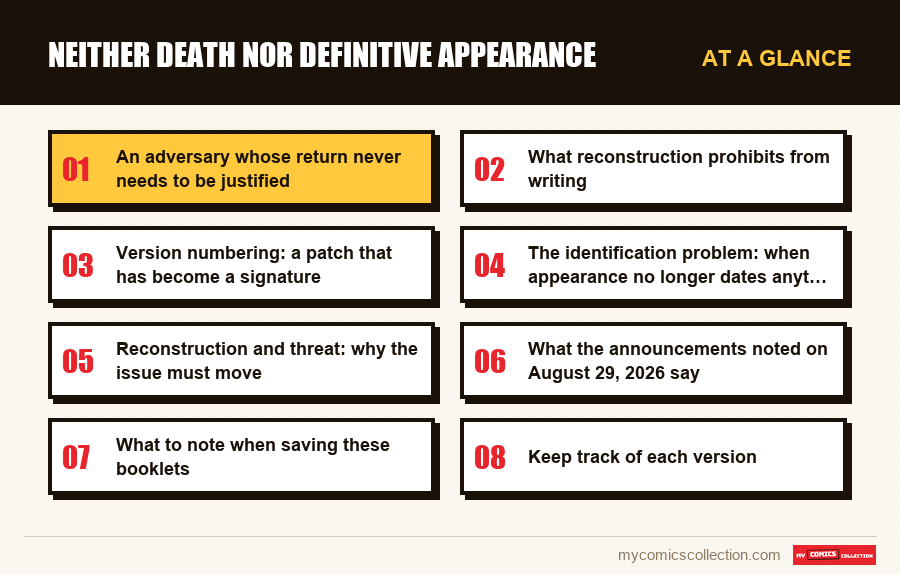
An adversary whose return never needs to be justified
Writing a recurring antagonist costs a lot of explanation. Each time a villain reappears after being put out of action, we must tell the story of how he got out: the escape, the double, the double, the false death, the rescue by a third party. These justifications pile up, contradict each other, and end up boring the reader who has understood that the process is only a production convenience. A character who rebuilds completely eliminates this expense item. His reappearance requires no lines of justification, because coming back is what he does.
The economy is real. A writer who opens an arc with this antagonist doesn't have to negotiate with what the previous arc left behind. He does not inherit a narrative debt. He can take the character almost anywhere he wants, in the state he wants, and the reader accepts it without protesting: it's even what he expects. Few figures offer such freedom of reproduction, and this is probably the reason why this one has gone through all the editorial periods without ever leaving the active catalog.
Added to this flexibility is a second gift: climbing is integrated into the concept. An ordinary adversary advances through external additions (a new piece of equipment, an alliance, a power gained along the way) and each addition must be installed, explained, made plausible. Here, progression is mechanical. The next version is stronger because it was remade taking into account what failed. The threat increases a notch with each cycle without anything needing to be justified, since improvement is the normal way in which a machine repairs itself.
This escalation engine has a downside that the authors quickly encountered: it cannot stop. If each version is better than the previous one, the curve goes up indefinitely, and an opponent who goes up indefinitely ends up going outside the scale of his own universe. The solution employed in practice was to break linearity: weaker versions, incomplete versions, parallel versions, returns to previous states. Consistency loses, longevity gains.
What reconstruction prohibits from writing
Aucune destruction ne pèse
The final scene where the antagonist falls to pieces loses all power once the reader knows that it will be canceled. It becomes a punctuation, not a conclusion. The authors know this and quickly stop staging it as a climax.
Aucune victoire non plus
If the defeat of the adversary is not definitive, the success of the hero is not either. He doesn't win, he pushes back. An entire category of endings, the one where the protagonist definitively resolves a problem, becomes inaccessible with this character.
Survival suspense disappears
Wondering if the antagonist will survive no longer makes sense. The most basic mechanism of a confrontation, uncertainty about its outcome, is neutralized in advance, and it must be replaced by something else.
La continuité se dilue
Since any version can reappear at any time, the order of appearances ceases to tell a progression. The character's timeline becomes a list of occurrences rather than a narrative.
These four constraints are not writing defects: they follow logically from the postulate. An author who takes charge of the character accepts them at the same time as the ease of recall mentioned above. It's an exchange, and it's pretty well balanced as long as the story doesn't seek to conclude. The difficulties begin when an ambitious arc wants to give the confrontation definitive weight: the character then resists his own story.
A detail to keep in mind when browsing the apparitions: the order of publication and the logical order do not necessarily coincide. A version destroyed in an issue may reappear intact later without anything having been said in between, simply because another editorial team needed it.
This is why a list of appearances is better than a timeline. The first describes what exists, the second claims to describe an evolution which has never been written as such.
Version numbering: a patch that has become a signature
Faced with a character without a stable form, the authors adopted a simple solution: give a number to each state. This convention solves a real problem: it makes it possible to unambiguously designate the version we are talking about, to justify a difference in appearance, and to explain why a particular confrontation ended differently than the previous one. It transforms an inconsistency into functionality.
But it has a side effect that no one probably anticipated at this point: it changes the nature of the character. A numbered individual is no longer quite an individual, it is a series. The reader no longer follows a figure who goes through trials, he follows a range of successive models. The difference is subtle but you can feel it when reading: it's hard to get attached to an iteration, and attachment is precisely what makes an antagonist disturbing rather than decorative.
Numbering also creates its own frictions. The counters do not always follow each other, versions are overlooked, some exist in parallel, others are mentioned without ever being shown. What was meant to clarify ends up producing a second layer to document, superimposed on the first. The reader who seeks to find his way must now keep two registers: what has been published, and what the fiction asserts about the order of models.
Finally, there is a more interesting background effect. To number is to admit that the character is not a body but a reproducible plan. This idea is exciting on paper and formidable in practice: it alienates the reader as much as it intrigues him. The best sequences devoted to this antagonist are those which treat reconstruction as a curse rather than as a technical characteristic.
The identification problem: when appearance no longer dates anything
The silhouette does not betray the era
For most characters, a costume detail is enough to place a square within a few years. Here, no: a stripped-down version may be recent and a massive version may be old. The usual visual cue is unusable.
Deux fascicules éloignés, aucune ressemblance
It is perfectly possible to place two covers twenty years apart side by side and find no common graphic element. There is no indication that the same entity appears there, outside of the editorial context.
Sales descriptions remain unclear
An announcement mentions the name without specifying the version, the complete or fleeting appearance, nor what distinguishes it from another. The description does not compensate for the absence of visual cues, it makes it worse.
Duplicates are hiding
As the appearances differ, two copies of the same booklet stored at different times can be perceived as two separate entries. The duplicate is then noticed on the reference, never on the image.
Internal numbering confuses search
Searching by version number returns both mentions and actual appearances. The figure belongs in fiction, not cataloging, and the two systems do not align.
Team narratives complicate attribution
Many appearances occur in collective titles rather than in a series of their own. The booklet is filed under the name of the team, and the character does not appear anywhere in the file.
None of these six points is insurmountable taken in isolation. Combined, they explain why a collection devoted to this character is built up more slowly than another, and why it is less verified. The collector spends an abnormal amount of his time establishing what he already owns.
Collecting this series?
Track what you own, what you are missing and what your collection is worth. 7 day trial.
Start my trial →Reconstruction and threat: why the issue must move
An indestructible adversary ceases to be frightening at the precise moment when the reader realizes that he will come back anyway. It's not a question of power: you can make the character as devastating as you want, the fear doesn't come back. It needs something uncertain, and the survival of this antagonist is never uncertain. The threat is emptied from within without anything having been weakened on paper.
The authors who understood this shifted the stakes. Since we cannot play on the question “will he survive?” ", the question remains "what will he destroy before we stop him?" ". The worry is about the damage, not the outcome. What is at stake becomes what it will have cost, in lives, in places, in damaged relationships between the protagonists: losses that cannot be reconstructed. The contrast works: a machine that repairs itself in the face of things that cannot be repaired.
A second way consists of moving the issue towards the interior of the characters who confront it. The adversary becomes a revealer: what he forces to do, what he pushes to admit, the morally costly decisions he imposes. The story is no longer about its destruction but about the price paid to delay it. This is where this character gives his best pages, because his permanence ceases to be a problem and becomes the subject.
A third, rarer way completely reverses the proposition: making mechanical immortality a burden for the person concerned himself. Always coming back, without being able to stop, is not necessarily enviable. Treated in this way, the character gains a depth that neither power nor escalation gave him. Reconstruction is no longer a tactical advantage, it is a condemnation.
These three movements have one thing in common: they accept the postulate instead of fighting against it. The least compelling arcs are those that promise a definitive ending, because the reader knows from the first page that the promise will not be kept. On this specific character, announcing a conclusion is tantamount to announcing a disappointment.
What the announcements noted on August 29, 2026 say
A one-off statement allows us to illustrate the state of the offer, provided we remember what it is. The amounts below reflect what sellers were asking for that day, not completed transactions. A displayed amount only binds the person who displays it.
As for copies not passed by a verification body, there were 116 advertisements, ranging from $24.00 to $550.00, with a median value of $74.99. The most exploitable fact of this series is not the top of the range but its bottom: out of one hundred and sixteen proposals, none fell below twenty-four dollars. An isolated maximum like that of $550.00 says nothing other than a seller's expectation; a floor held on a workforce of this size is significantly more solid information.
As for verified copies, there were 20 advertisements, from $70.00 to $999.95, median at $236.00. Twenty announcements is a small number: a handful of withdrawals or additions would be enough to move the median by several dozen dollars. This subset deserves to be cited, not presented as an established price level.
Last point, and it is decisive: these figures come from a single reading, carried out on a single date. A single measurement cannot by definition show any movement: neither rise, nor fall, nor stability. Any trend reading from these values would be an invention. To observe an evolution, it would be necessary to repeat the exercise at regular intervals and compare readings constructed in the same way.
What to note when saving these booklets
Note the version depicted, not just the name. This is the most specific precaution for this character. A card that only indicates his name will be unusable in six months, because nothing will allow us to find out what it looked like. A brief description of the silhouette seen on the box or cover, noted at the time of recording, is better than further research.
Distinguish the actual appearance from the mere mention. Many booklets evoke the character, show a carcass, a signal or a fragment, without him acting in the story. For a figure whose existence is intermittent by nature, this distinction changes everything: it separates what matters in a thematic collection from what only resembles it.
Register the bearer title, including when it is a collective title. His appearances are largely distributed in team series, where his name appears neither on the edge nor in the box index. Without the exact reference of the title, a booklet which is important for this character disappears in a section classified under another name.
Record the date of your price statement, not just the amount. Since an isolated value says nothing about an evolution, the amount without its date is dead data. With the date, the same amount becomes the first point in a usable series. This is the only way to notice a movement later instead of assuming it.
Explicitly separate verified copies from others. The two sets noted on August 29, 2026 have neither the same amplitude nor the same median, and the second is based on only twenty announcements. Mixing the two in the same field produces an average that describes nothing. Two separate lines cost a few seconds and avoid a false conclusion.
Because reconstruction has been part of its definition since 1968. Each time it is destroyed, it returns in a new envelope, often different and often more accomplished. No drawing has therefore established itself over the long term as the canonical version, contrary to what happens for a character whose costume stabilizes over time.
No, and this is the main difficulty of identification. The appearance does not follow chronology: a bare figure may belong to a recent period and a massive figure to an ancient period. You must use the reference in the booklet, never the image.
They make it possible to unambiguously designate a given state of the character and to explain the differences in appearance from one story to another. However, they belong to fiction and do not correspond to any cataloging system: searching for a booklet by this number returns as many mentions as real appearances.
Not if the tension is based on his survival, since this is a foregone conclusion. The stories that work move the stakes elsewhere: on the extent of the damage done before he is stopped, or on the price his adversary must pay to delay him. What cannot be reconstructed then becomes the real subject.
No. This is a single record of monies requested by sellers, not closed sales, and a measurement taken on a single date cannot show any movement. The twenty announcements of verified copies also constitute too small a number to derive a reliable price level.
Keep track of each version
A character without a stable appearance is documented the moment the booklet passes into your hands, not six months later. Record the reference, the version represented and the date of your survey, and your collection remains readable even when the images no longer look the same.