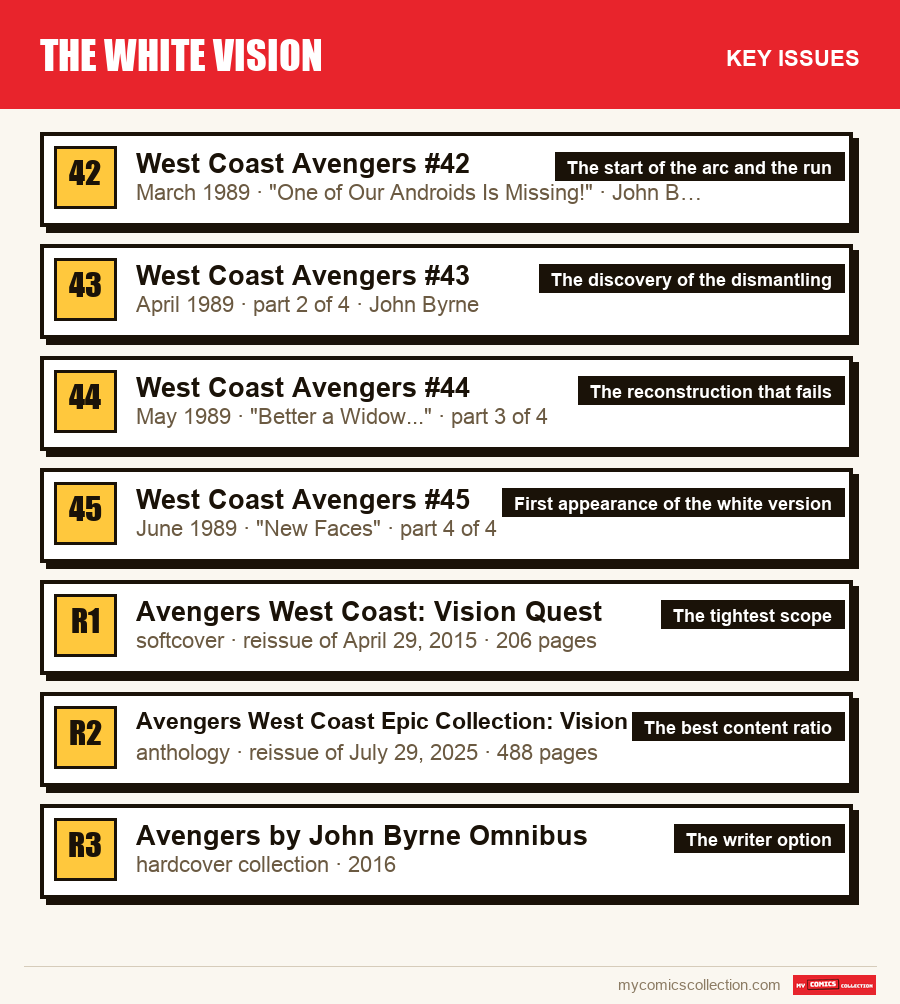
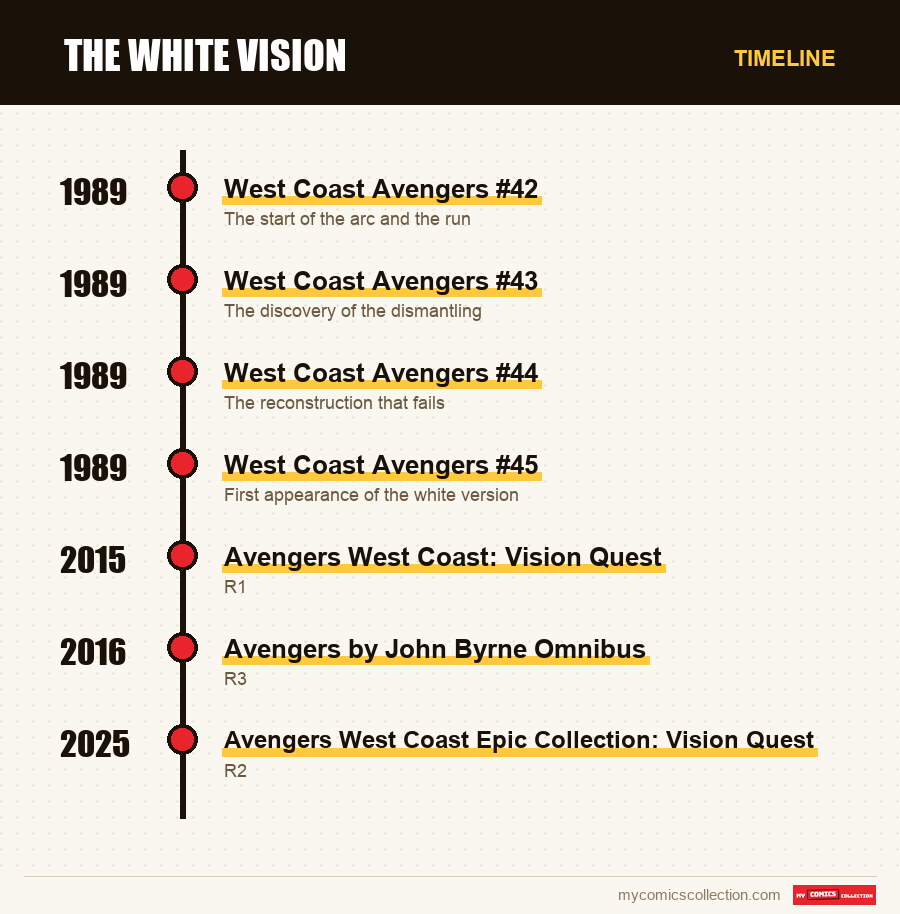
The white Vision is born in "Vision Quest," a four-part arc written and drawn by John Byrne in West Coast Avengers: #42 (March 1989), #43 (April 1989), #44 (May 1989) and #45 (June 1989). Government agencies kidnap and dismantle the synthezoid; Hank Pym rebuilds him, but Wonder Man refuses to lend his brain patterns again, and the machine comes back bleached, with no emotional memory and no emotion. The issue the market singles out is #45, where this version first appears. The three previous ones tell the kidnapping and dismantling, and they trade distinctly below. Three bound editions cover the arc, including a 488-page anthology reissued on July 29, 2025.
Owning a version of a character is not the same as owning the character. It is a distinction you grasp quickly when looking for the white Vision: the one returning to the screen on October 14, 2026 in VisionQuest is not that of Avengers #57, and the issue carrying him is not the same object, neither in the same decade nor in the same price range.
This article therefore does not deal with the character's creation in 1968, nor with his general price. It deals with a precise object: an arc of four issues published in spring 1989, only one of which actually contains the white version's appearance, and the other three the mechanism that produces it. Knowing which does what is the only information that changes a buying decision.
The rest follows: what the hierarchy of the four issues looks like, which fifth issue the period announcement promised, which of the arc's consequences are true and which are wrongly attributed, and at what point a bound edition becomes the best purchase.
An arc of four issues, a single appearance
"Vision Quest" reads as a story in four beats, and that is exactly how it was published: each issue carries the mention of its part, from one of four to four of four. But for someone buying rather than reading, the arc is not homogeneous. The white version does not exist in the first three issues, because the first three issues tell precisely its manufacture.
The breakdown is clear. #42 notes the disappearance. #43 finds the machine dismantled. #44 rebuilds it without managing to restore it. #45 shows what comes out. Result: only one of the four issues can legitimately carry the first-appearance mention, and it is this one that sellers put forward, systematically, when they know what they are selling.
This asymmetry has a mechanical effect on asking prices. On an arc where a single issue carries the event, the difference between that issue and its immediate neighbors is considerable, while the content gap is small: the four issues come out a month apart, by the same writer, with the same artist, at the same publisher, at roughly the same print run. Nothing physically distinguishes #45 from #44. What distinguishes it comes down to one panel.
For the buyer, this opens two frankly different strategies, and neither is better than the other in the absolute. Either you buy #45 alone, and you own the version; or you buy all four, and you own the story that produced it. The first option costs the price of the motif. The second costs the price of the motif plus three issues of ordinary series, that is, not much more. We come back to it at the bound editions, because that is where the trade-off becomes interesting.
The four issues, one by one
Here is what each contains, with its cover date. The publication order is also the reading order, and the arc cannot be understood out of order: #45 is unreadable alone.
West Coast Avengers #42
First issue of John Byrne on the series, and first part of the arc. The story opens on an ordinary morning at the team's headquarters: the Scarlet Witch wakes up, her husband has disappeared, a search of the grounds finds nothing. Byrne opens his stint on the title by clearing off-screen several elements left by the previous writer, and it is already a statement of intent.
West Coast Avengers #43
The team traces a base of the organization Vigilance and finds the synthezoid reduced to spare parts, an object of experimentation. It is the issue that sets up the arc's political spring: the machine was not destroyed by a costumed adversary but dismantled by state services, in retaliation for an earlier episode where it took control of the world's computer networks.
West Coast Avengers #44
Hank Pym reassembles the body and manages to restore the memories, but not the attachment to those memories. For that he would need Simon Williams' brain patterns again, that is, Wonder Man's, which had served as the emotional matrix at the character's origin. The Scarlet Witch finds him and asks him to agree. He refuses. The whole arc rests on this refusal: it is not the dismantling that deprives the machine of its emotions, it is a human decision made afterward.
West Coast Avengers #45
The issue to buy if you buy only one. The machine rises bleached, endowed with increased abilities and devoid of affect, to the point that its teammates openly wonder what it has become. It is this issue, and no other, that listings designate as the first appearance of this version. The plural title is no accident: this issue also introduces a new face in the team's roster, imposed by the government.
The fifth issue the announcement promised
A period detail deserves knowing, because it explains lots that still circulate. On the last page of #41, a house ad presented "Vision Quest" as a five-part story, covering issues 42 to 46. The published arc has four, and #46 (July 1989) tells something else, while directly extending the consequences.
Practical consequence: you find sets sold as #42-45 and others as #42-46, both presented as complete, both defensible. If you buy in a lot, check which of the two scopes is offered before comparing two offers. A lot of five issues is no more complete than a lot of four: it contains one more episode, which is not the same thing.
This kind of gap between announcement and publication is frequent on late-1980s series, where editorial plans shifted along the way. It makes neither description dishonest. It simply makes comparing offers impossible if you do not read the detail of the contents.
What the arc truly changes, and what is wrongly attributed to it
"Vision Quest" has the reputation of an arc with enormous consequences. This reputation is deserved, but it has absorbed along the way events that are not in it. For a collector, the distinction is very concrete: it determines which issues to buy if you truly want the rest of the story.
What is indeed in the arc. The white version, obviously, and Wonder Man's refusal that makes it definitive. The couple's separation, since the rebuilt machine no longer recognizes its marriage as something concerning it. And the arrival in the roster of an operative placed there by the government as a watchdog, which pushes Hawkeye to leave the team's chairmanship in protest.
What is not in it. The disappearance of the twins. You often read that "Vision Quest" makes the couple's children disappear: it is false, and the error spreads because the two stories follow each other in the same title, under the same writer, a few months apart. The twins are reabsorbed by Master Pandemonium in issue 51, out in late 1989, and it is Agatha Harkness who then erases their memory from their mother's mind.
What is not in it either. The Scarlet Witch's breakdown. Her collapse is indeed a consequence of these events, but it unfolds in the arc called "Darker Than Scarlet," issues 51 to 57 then 60 to 62 of the title renamed Avengers West Coast. The character comes out of "Vision Quest" damaged, not destroyed.
For anyone wanting the complete chain, the buying scope is therefore not four issues but a good fifteen, spread over two arcs and two titles, since the series changes name at issue 47. It is precisely the case where a bound edition becomes reasonable, and we are getting there. To place all this in the character's long trajectory, the recap of Vision key issues gives the overview, and the reading path the order in which to take them.
The Byrne versus Englehart controversy
Impossible to speak of this arc without the quarrel that has accompanied it for thirty-seven years, because it explains why a 1989 issue is still debated today.
The couple of Vision and the Scarlet Witch was not Byrne's idea. It had been patiently built by Steve Englehart, first in Avengers in the early 1970s, then through the wedding in Giant-Size Avengers #4 in 1975, then by the second series devoted to the couple in 1985, the one that gives birth to the twins. Englehart was still writing West Coast Avengers at issue 41, just before Byrne's arrival.
Byrne takes the title at #42 and, from this first issue, sweeps off-screen elements left by his predecessor: the division of the team into two units is resolved without being seen, members return without explanation. Then he dismantles the central character of the Englehart setup and returns him to the state of a machine. The reproach made to Byrne lies in this sequence: having undone in four issues what another writer took fifteen years to build, and having done so by starting with not taking up what existed.
The defense exists too, and it is not weak. The arc is tight, its mechanism is logical, it takes seriously a question the series had avoided since 1968, namely what happens to a machine when treated as a machine. And Wonder Man's refusal, which is the heart of the story, is a character choice perfectly coherent with his history.
For a collector, this controversy has a counterintuitive effect: it sustains demand instead of reducing it. An arc hated by part of the readership remains an arc everyone talks about, and whose resulting version has survived its critics. The white version became a recurring incarnation, taken up elsewhere, adapted to the screen. The rereadings that disappear are those nobody argues about, not those that cause anger.
What television has done to demand since 2021
#45 went from the status of a forgotten series episode to that of a sought-after issue in two steps, and both are televisual.
First step, January to March 2021. The series WandaVision takes up Byrne's central idea: official services recover the synthezoid's body and produce a bleached, affectless version of it. The parallel is direct enough that the trade press immediately sent viewers back to the 1989 arc. An issue nobody was looking for began to be sought by name, with a stable formula in listings, that of the first appearance of the white version.
Second step, now. VisionQuest arrives on Disney+ on Wednesday, October 14, 2026, in eight episodes, with Paul Bettany in the role, James Spader as Ultron and Terry Matalas at the helm of the series. The series' title is the arc's title. It is not a wink: it is a source designation, which makes the issue findable by anyone who simply typed the series' name in a search bar.
What to do with this information when buying? Three things, and none consists in predicting an amount.
First, accept that the October 2026 window is the worst for buying and the best for selling. An influx of neophyte buyers on a precise issue always produces the same effect: the priciest offers find takers before the cheaper ones, because newcomers buy the first legible listing and not the fifth. Waiting a few weeks after the broadcast ends costs zero and changes the atmosphere.
Next, remember that an adaptation's effect concentrates on a single issue. In 2021, it was #45 that moved, not the whole arc. #42, #43 and #44 stayed what they were, Copper Age series episodes widely available. It is good news for anyone wanting the complete arc: only a quarter of the purchase is subject to news pressure.
Finally, beware of mentions applied after the fact. On an issue turned in-demand again thanks to a television series, descriptions are enriched with qualifiers the object did not carry in 1989. The issue has not changed; its label has. The only check that counts remains the title, number and printed date, legible on a decent cover photograph. The same reflex applies to the rest of the file devoted to the character.
Single issues or bound edition?
Three collections give access to the arc, with very different scopes. The choice plays out on what you truly want: to read, or to own the issue.
Avengers West Coast: Vision Quest
Reprints issues 42 to 50, that is the arc and its immediate fallout, without going as far as the twins' disappearance. It is the volume closest to what someone wants who wishes to read "Vision Quest" and understand what follows, without committing to two years of series.
Avengers West Coast Epic Collection: Vision Quest
The most complete volume of the three for anyone wanting the whole chain. It gathers West Coast Avengers #38 to #46, Avengers West Coast #47 to #52, two annuals and a backup. In other words: the four issues of the arc, the #46 originally announced, the four episodes preceding Byrne's arrival, and #51 where the twins disappear.
Avengers by John Byrne Omnibus
Gathers West Coast Avengers #42 to #46, Avengers West Coast #47 to #62 and its annual, as well as Avengers #305 to #318 and an annual. It is no longer a volume on the Vision: it is a volume on the creator, covering the entirety of his stint on the two titles.
The reasoning is then fairly simple. The bound edition wins as soon as the goal is to read, and wins widely: four separate issues in good condition cover only a quarter of what the anthology contains, and they handle less easily. Separate issues win as soon as the goal is to own the first appearance, because a collection does not contain it: it contains its reprint, which has no collecting value and all the reading value.
The most rational combination, for most people, is therefore to take the anthology to read and a single issue, #45, to own. It avoids buying in high grade three episodes whose content will never be reread, while keeping the object carrying the event. It is also the combination least exposed to the October 2026 agitation, since the collection is printed to the publisher's demand and does not depend on scarcity.
Buying this arc cleanly, in five moves
First decide which of the two objects you want
The version is #45 alone. The story is the anthology. Both is both. What not to do is buy four issues hoping the set is worth more than the sum: on this arc, a single issue carries the motif, and the other three remain series episodes.
Check the announced scope before comparing two lots
A lot of #42-45 and a lot of #42-46 are not the same thing, and both present as complete. Read the list of issues rather than the heading. On an arc whose period announcement promised five parts, this ambiguity is native, not accidental.
Decide between raw and certified before looking at the offers
On a widely available Copper Age issue, a certified copy in very high grade and a raw copy in fine condition do not address the same buyer and do not compare. Deciding in advance which of the two you seek avoids spending an hour comparing different objects.
Do not let the broadcast window decide for you
The series starts on October 14, 2026 and will last eight episodes. During this period, attention is at its maximum and the choice of copies at its lowest. Nothing, on an issue printed at large scale in 1989, justifies buying under these conditions rather than two months later.
Note the version, not just the character
An inventory that only mentions the character's name becomes unusable as soon as several versions coexist. The line must carry the precise version, the number, the cover date and the reason for purchase. Failing which you will one day rebuy what you already own.
The fifth point is not a formality on this particular file. Between the 1968 creation, the teenager from Young Avengers, the synthetic family of the 2015 run and the white version of 1989, one name designates four distinct collectibles. The app lets you hold them on four separate lines, with series, number and cover year, which is the only way to find one without stumbling on the others. For those who want to measure where their set stands, the estimate works on observed sales, issue by issue, and not on character averages.