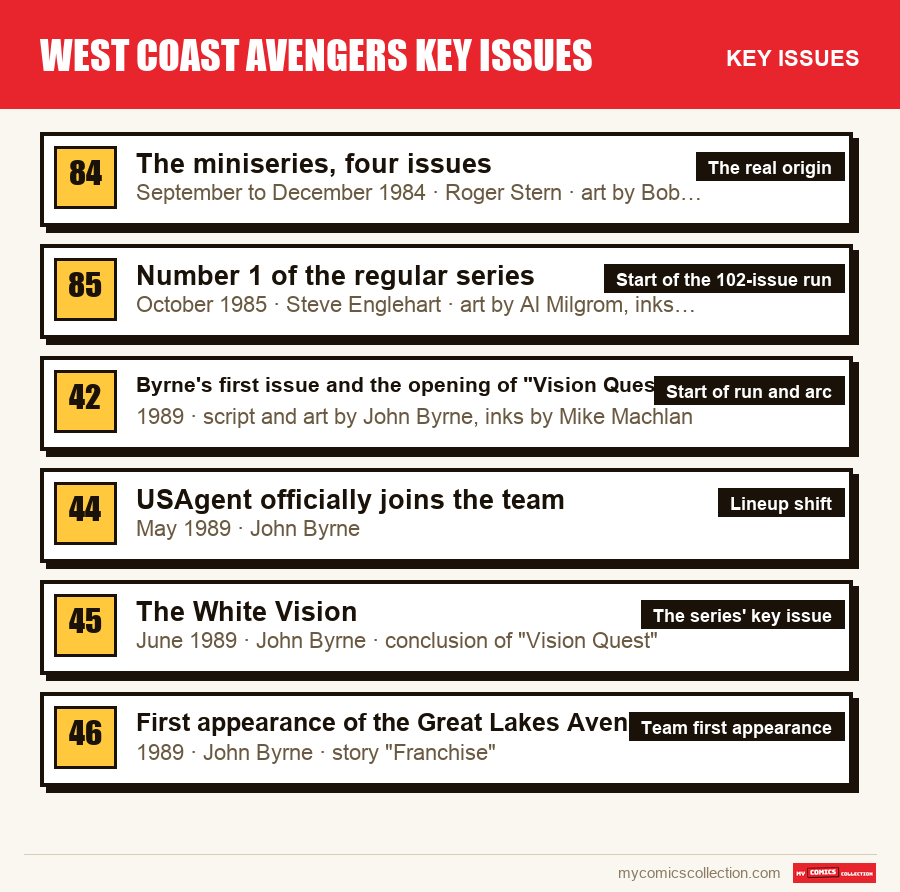
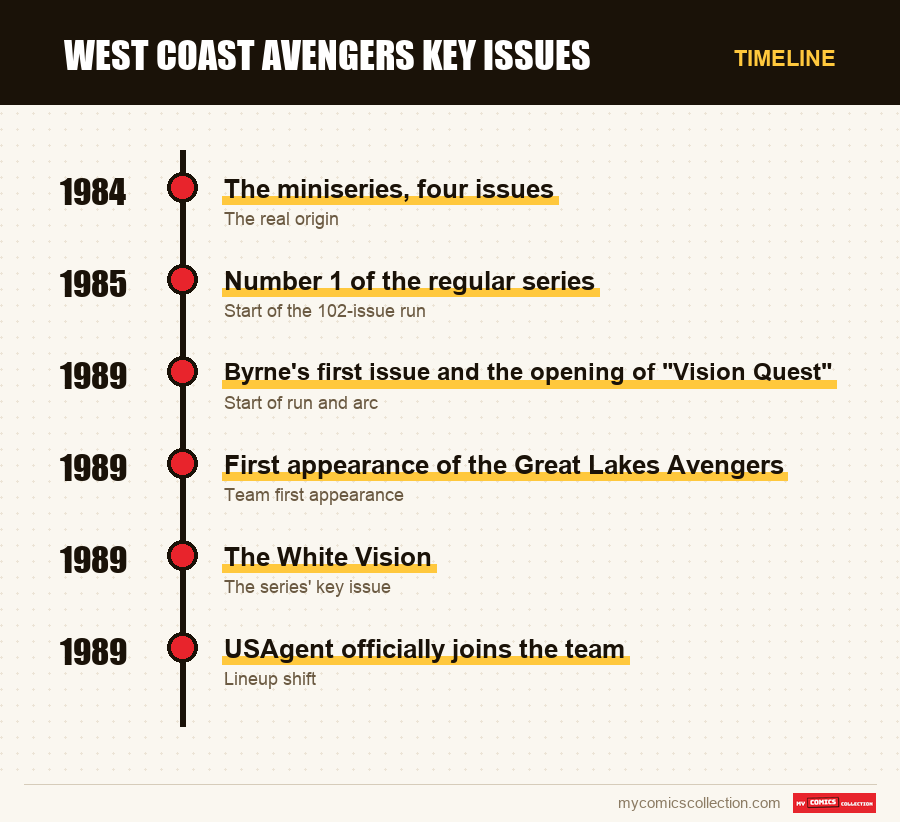
The Avengers' California branch was born in a four-issue miniseries, from September to December 1984, by Roger Stern on script and Bob Hall on art, centered on Hawkeye. The regular series follows in October 1985 and runs for 102 issues until January 1994. The issues that really matter are concentrated in a handful of months: #42, first issue of John Byrne's run, the "Vision Quest" arc (#42 to #45) that dismantles the Vision, #45 which reveals the White Vision, #44 where USAgent joins the team and #46, first appearance of the Great Lakes Avengers. The title becomes Avengers West Coast at #47 (August 1989), which splits the series in two in most catalogs. The television series VisionQuest, eight episodes from October 14, 2026, takes up the title and subject of Byrne's arc.
There is a silent rule of the comics market: the parent series captures attention, and the spin-off series collects indifference. Avengers has its famous issues, its records, its guides, its rankings. The California branch of the same franchise, published for almost ten years and rich in 102 issues, is nearly invisible in collector conversations. It has no mythical issue, no cover recognizable to the general public, no auction record to tell about.
This invisibility is a market fact, not a quality judgment. It simply means that this series' issues circulate with no narrative to accompany them, and that a collector who knows where to look buys the same objects as others without paying the attention premium. Yet the series contains at least half a dozen issues that carry a real event: a first appearance, a lasting character transformation, a title change. And one of these events arrives, in October 2026, on screens.
This article does not deal with the Avengers in general. It deals with a specific series, its editorial shifts, and how to assemble it in full without putting in the budget of a single 1963 issue.
Why team spin-off series stay in the blind spot
The phenomenon is systematic and it has identifiable causes. Understanding these causes avoids confusing "cheap" with "uninteresting".
The spin-off series has no founding issue. A collector entering a franchise first looks for the origin: the first appearance of the team, the first lineup, the first confrontation. The California branch, for its part, starts with characters already known, in a team that already exists. Its number 1 is the first of nothing essential, except itself. That immediately removes the market's most powerful demand engine.
It is published in parallel, so it seems optional. As long as the main series runs, a spin-off series is perceived as a supplement. Reading guides place it in an appendix, reprints treat it afterward, and the idea sets in that you can skip it without missing anything. It is true for overall reading, it is false for one-off events, which were not told twice.
It changed title. This is the most underestimated factor, and it deserves a section of its own below. A series that carries two names fully exists nowhere: neither databases, nor sales catalogs, nor collectors' memory restores it as one block.
It ends without ceremony. A series canceled after 102 issues, with no memorable final issue or immediate relaunch, leaves no narrative trace. The series people talk about are those that end with an event.
Result: demand concentrates on two or three issues that first-appearance fans have spotted, and the other hundred circulate at lot prices. For anyone looking to assemble a complete run, it is a favorable configuration, and it is rare for a Marvel series of the 1980s.
Two births: 1984 then 1985
First thing to know, because it makes many people miss issues: there are two series, not one. A collector who buys "the complete series" and stops at the 102-issue run has left four issues behind, and they are the oldest.
The miniseries, four issues
This is where the team exists for the first time. Hawkeye is given the job of setting up a western branch of the Avengers and himself recruits his lineup: Mockingbird, Wonder Man, Tigra, and an Iron Man who is actually Jim Rhodes under the armor, which the team does not know at first. This last detail says a lot about the tone of the series: a second-rank branch, made up of members the parent house did not retain, and led by the least powerful archer of the group. That is precisely what makes it a good series.
Number 1 of the regular series
With the miniseries having worked, Marvel turns it into a monthly series. It will last until January 1994. Steve Englehart, who had already marked the parent series in the 1970s, takes the script and stays there for most of the first half of the run. Al Milgrom draws, Joe Sinnott inks: a professional art team, with no fashion effects, which gives the series a homogeneous visual look over dozens of issues.
What Steve Englehart really brought
Englehart could have written a filler series. He did something else, and that is why the run is still read today by those who take an interest in it.
His main contribution is a shift of genre. Instead of telling world-scale threats on a smaller scale, he wrote a series of damaged characters, in which consequences do not resolve by the next issue. The most ambitious arc of his period is "Lost in Space-Time", opened at issue 17 (February 1987), which sends the team into the past. The setup is spectacular, but it is not what left a trace: it is what happens to Mockingbird during this journey.
Englehart puts his heroine in a situation where she lets the Phantom Rider die, who had abused her. The team then applies its rule against murder, and Hawkeye and Mockingbird's marriage does not recover. Mockingbird, Tigra and Moon Knight end up leaving the team together. It is a rare sequence for a 1987 Marvel title: an unforgiven moral fault, which durably dismantles a team and a couple.
The rest of his period sets up the furniture that will serve afterward. Moon Knight joins the lineup, which brings a hitherto solitary character into a team title. Above all, USAgent enters as a government-imposed overseer: the series gets a permanent internal conflict, because the Avengers' most marginal team finds itself with an official chaperone. Englehart leaves the title before the end of the decade, after a very long stint for the time.
John Byrne, issue 42, and "Vision Quest"
The following run is the reason this series still exists in conversations. John Byrne takes over the title at issue 42 and holds it until issue 57. He arrives with an immediate project, and executes it in four issues.
Byrne's first issue and the opening of "Vision Quest"
Two collecting events in a single issue: the start of an identified creator's run, and the first part of a four-episode arc. Byrne sets up the disappearance of the Vision, kidnapped then dismantled by authorities who judge the android too dangerous to keep existing. The arc's title, "Vision Quest", plays on the double meaning of the character's name and the initiatory quest.
USAgent officially joins the team
John Walker joins the California lineup, placed there by the government. The character had already appeared elsewhere under other identities, so it is not a first appearance in the strict sense: it is his lasting settlement in a team, and the starting point of the long career as troublemaker that has defined the character since. For anyone following USAgent rather than the team, it is the series' reference issue.
The White Vision
This is the issue that counts. Hank Pym rebuilds the Vision, but the reassembled android no longer has the previous one's color or emotions: he returns chalky white, emptied of the affect he drew from Wonder Man's brain patterns, which Wonder Man refuses to lend again. The narrative consequence goes well beyond the series: the couple formed with the Scarlet Witch does not survive the ordeal, and the two characters end up on different teams.
First appearance of the Great Lakes Avengers
Immediately after the series' darkest arc, Byrne follows with a comedy: Hawkeye and Mockingbird go to inspect, in Milwaukee, a group of powered individuals who have proclaimed themselves the Great Lakes Avengers. The idea is a joke on the franchise logic that the California series itself embodies. This joke gave birth to a recurring team, reused for decades, with its own series.
Issue 47 and the title-change trap
From issue 47, dated August 1989, the series is no longer called West Coast Avengers on the cover but Avengers West Coast. The numbering continues without interruption, the creative team does not change, the story goes on. Only the logo switches.
For a reader, it is a detail. For a collection, it is a lasting source of errors, and it shows up in three ways.
Catalogs split the series in two. Depending on the database consulted, issues 1 to 46 and 47 to 102 appear under two distinct entries. A collector who checks his run on only one of these entries believes himself fifty issues behind or ahead.
Resale listings carry both names indifferently. Searching for an issue under only one of the two titles misses part of the supply, sometimes the cheapest, simply because it is badly named. This is particularly true for the issues around the switch.
Issues 42 to 46 are the most exposed. They are the most sought-after of the run, and they are on the old-title side, a few issues from the change. Sales lists sometimes label them under the new name, by reflex. A badly named issue is a less-seen issue, therefore cheaper.
Practical consequence: in an inventory, this series must be recorded as a single set of 102 issues, with a note indicating the title-change point. It is exactly the kind of case where a series record in a tracking app is worth more than a handwritten list, because it keeps the continuity that public catalogs have lost.
Late-1980s print runs, a pivotal period
This is the most misunderstood point of this series, and it conditions any reasoning about its scarcity.
The key issues of this run are dated 1989. That year sits exactly between two production regimes. Before, in the 1970s, comics were printed to be sold at newsstands, read, then thrown away: survival rates are low, which explains the scarcity of copies in good condition from the Bronze Age. After, from 1991 and 1992, the industry enters a phase of overproduction where series are printed in the millions, bought to be kept sealed, which definitively annihilated any scarcity on these titles.
1989 is between the two. The specialty shop network exists and sells to collectors who keep their issues, so copies in good condition are far more numerous than for a 1972 comic. But the speculative bubble has not yet had its effect on quantities, and a low-profile spin-off series gets no precautionary orders. That gives a particular situation, which must be stated carefully: abundance of read copies, but no massive accumulation of perfect copies.
Two concrete consequences for buying.
First, a common copy of this series is found easily and without tension. Relative scarcity is low, supply is regular, and nothing justifies rushing on a listing.
Next, high grade is not a given. On a 1992 comic printed for speculation, a very high grade is the norm. On a 1989 spin-off series, bought by readers and not by stockpilers, it is much less so. That is why the price hierarchy on this run is very flat in average conditions and rises sharply in the upper conditions. If you aim for high grade, that is where patience serves; if you aim for reading and completeness, it serves nothing.
One last point of method, because it comes back with every series of this period: newsstand copies and shop-network copies coexist in the late 1980s, with different barcodes. This distinction matters for some collectors and not for others. Before attaching importance to it, simply check on your own copies which ones you own, and note it. A recorded piece of information is worth more than a theory.
The end of the series, and the two revivals of the concept
The series stops at issue 102, in January 1994. The last part of the run is carried by Roy Thomas and Dann Thomas, who move the series into the big events of the era, including "Operation: Galactic Storm", and who have Mockingbird die there. The final issue is written by Dan Abnett and Andy Lanning. The cancellation comes without a memorable closing issue, which completes the explanation for the absence of legend around this series.
The concept has been revived twice since, and both revivals are short series that must be cataloged separately.
The 2018 series, written by Kelly Thompson and initially drawn by Stefano Caselli, runs from September 2018 to June 2019 and stops at its tenth issue. It sets Hawkeye in Los Angeles at the head of a team of young heroes, including Kate Bishop, America Chavez, Quentin Quire and Gwenpool, funded by a reality TV show. It is a series of light tone, owned as such, and its brevity makes it an easy run to complete in one go.
The series launched in November 2024, written by Gerry Duggan and drawn by Danny Kim, reassembles a team around Iron Man and War Machine, with Spider-Woman, Firestar, an Ultron on the road to redemption and Blue Bolt, a former henchman placed in the team by a sentence-reduction program. The stated theme is the redemption of former adversaries. The series has had second printings, which indicates initial orders underestimated by retailers.
These two series are not the same collection as the 1985 run. They share a name, not a numbering, and not a market. Mixing them in an inventory is the most common error on this title, right after forgetting the 1984 miniseries.
What VisionQuest changes, in October 2026
The television series VisionQuest arrives on Disney+ in eight episodes from October 14, 2026. Terry Matalas is its showrunner, Paul Bettany takes up the White Vision there, and James Spader returns as Ultron. It is presented as the last installment of a set opened by WandaVision and continued by Agatha All Along.
The important point for a collector is not the cast. It is that the series' title and subject come directly from Byrne's 1989 arc. A White Vision deprived of his memories and emotions, seeking to become himself again, is literally the content of issues 42 to 45. It is rare for a television production to go looking for its material in a forgotten spin-off series rather than in the parent series.
What to do with this information? Nothing spectacular, and above all nothing urgent. The experience of previous adaptations suggests a regular pattern: attention first goes to the easiest-to-name issue, often with a lag between announcement and broadcast, then largely falls back. The issues that retain something are those that carry a real first appearance, not those that are merely cited.
In the present case, this clearly isolates issue 45. It is the only one of the lot to carry an identifiable first appearance directly recognizable on screen. Issue 42 benefits from the status of start of run and start of arc, which is solid but less immediate. Issues 43 and 44 are intermediate episodes, bought mostly by those who want the complete arc. And the complete arc is precisely the right way to buy it, because a complete arc is read, shelved and resold as a block, whereas an isolated issue depends entirely on the market's mood.
Building the series without breaking the bank
Here is the method that works on this type of run: long, little demanded, with a handful of expensive issues.
Start with the arc, not issue 1
On a series whose interest is concentrated, buying the "Vision Quest" arc as a block immediately gives a coherent object: four issues that tell a complete story and include the key issue. If you are to buy only one thing from this series, it is this. The 1985 number 1 can wait: it will always be available.
Add 46 while it stays discreet
An entire team's first appearance, in an issue adjacent to the series' most sought-after arc, is the kind of issue that gets hunted quietly before being cited everywhere. There is no urgency and no reason to wait.
Take the rest in lots, not one by one
A 102-issue series bought piece by piece costs mostly in shipping and time. Little-demanded runs circulate in big sets, often assembled by collectors parting with an entire block. It is the cheapest way to go from ten issues to eighty. Just check that the lot does not stop at issue 46 because of the title change.
Always search under both titles
Any search on this series must be done twice, under the old and the new name. It is mechanical, it takes ten seconds, and it is where the badly labeled listings are found, therefore less seen and cheaper.
Grade only issue 45, and only in very good condition
Having a 1989 issue graded makes sense only if the condition justifies the fixed cost of the operation. On this series, that concerns essentially issue 45, and at a stretch 42 and 46. For everything else, grading costs more than it brings. A well-kept raw copy remains gradable later; a copy graded for nothing does not degrade, but the money spent does not come back.
Record the miniseries separately, from the start
Four 1984 issues under a distinct title and numbering: if you do not create them as a separate series in your inventory, you will forget them. It is the number one cause of "complete" runs that are incomplete on this title.
Where to start, depending on what you are looking for
Three profiles, three different entries, and none is better than the others.
If you come for the Vision. Take issues 42 to 45, read them before the October broadcast, and you will have the exact source of what the television series tells. You can then decide whether the rest of the run interests you, with full knowledge.
If you come for the complete run. Start with a lot of the second half, which is the least demanded and cheapest part, then work back toward the key issues. It is counterintuitive but effective: easy issues are bought once, expensive issues are negotiated, and it is better to negotiate at the end of the path, when only two or three pieces are missing and you know exactly what you are looking for.
If you come for first appearances. Issues 45 and 46 are enough, and 44 if USAgent interests you. Three issues, one single arc to know, no obligation to buy the other hundred. It is the soberest way to enter this series, and there is nothing shameful about it.
In all cases, the same advice applies, because it holds for any long run: note what you own at the time you buy it, with the exact title carried by the cover. On a series that changed its name in the middle of its life, it is the only information nobody can reconstruct for you.