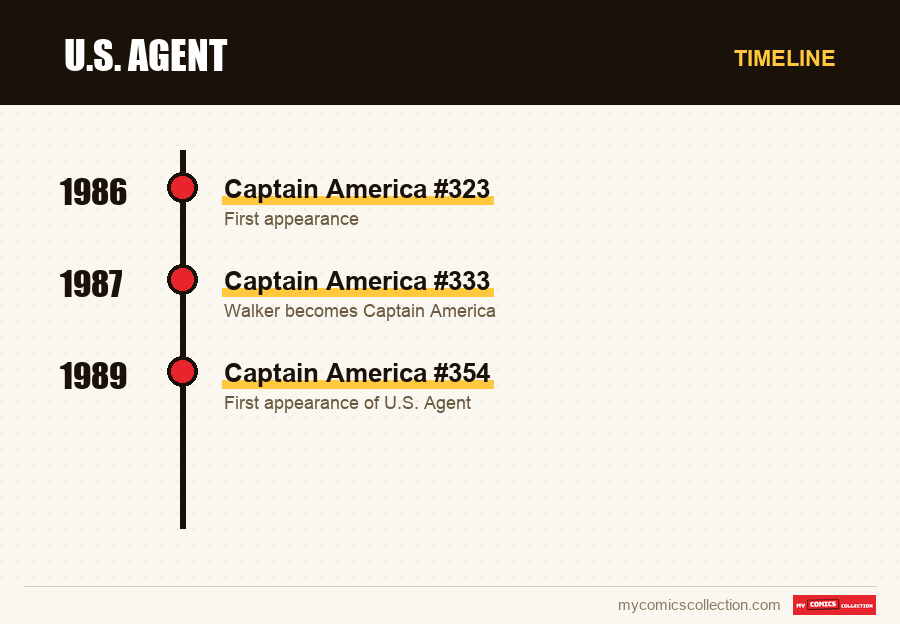
John Walker first appears in Captain America #323, dated November 1986 and put on sale July 29, 1986, under the name Super-Patriot. The script is by Mark Gruenwald, the art by Paul Neary. Three other issues of the same series form his backbone: #333 (September 1987), where he becomes Captain America in place of Steve Rogers; #350 (February 1989), where he gives up the shield; and #354 (June 1989), where he takes the identity of U.S. Agent. He then joins the West Coast Avengers at #44 (May 1989). On screen, Wyatt Russell has played him since the series The Falcon and the Winter Soldier (2021), and he is announced in Avengers: Doomsday (December 18, 2026).
Few Marvel characters were conceived as a thesis. John Walker is one. When Mark Gruenwald creates him in 1986, he is not looking for a new adversary for Captain America: he is looking to show what the shield would become in the hands of someone who shares its muscles, discipline and displayed patriotism, but not its judgment. The whole story of the character flows from this starting point.
This page follows Walker from his appearance as Super-Patriot to his recent roles, stopping on the issues that mark an identity change. It complements our list of Captain America key issues, which covers the series as a whole, and our file on the Thunderbolts and Avengers: Doomsday, which devotes a paragraph to each team member. Here, the subject is Walker alone.
The cover dates, on-sale dates and credits were checked in the publisher's encyclopedic database. No price is given: no dated, public source allows a serious valuation of these issues in fall 2026.
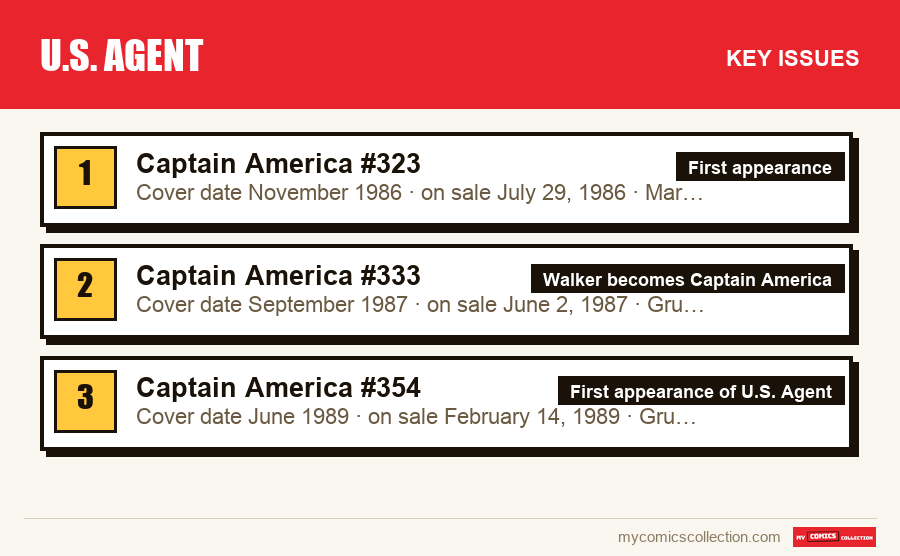
Captain America #323: the arrival of Super-Patriot
Captain America #323
The episode is titled "Super-Patriot Is Here." John Walker bursts in as a self-proclaimed costumed hero, backed by a promoter and former army buddies, and publicly challenges Captain America by presenting himself as a more modern and combative patriot.
The 1986 context is essential. Gruenwald has written Captain America since #307 and will keep it for a decade. He sets up Walker as an answer to the America of the Reagan years: a former soldier from Georgia, raised in Custer's Grove, who never saw war during his service and keeps a frustration from it. With three friends from Fort Bragg, Lemar Hoskins, Hector Lennox and Jerome Johnson, he launches a hero career with the help of a promoter, Ethan Thurm, who finds backers and thinks in terms of image.
His three friends form his support team, the "Bold Urban Commandos," nicknamed the Buckies. To discredit Captain America, they commit violence while posing as his supporters. Walker, for his part, denies any involvement and challenges Steve Rogers. The character is thus born ambiguous: sincere in his conviction, complacent about the means.
Captain America #333: the replacement
The shift happens less than a year later. In #332, Steve Rogers refuses to become the agent of the Commission on Superhuman Activities, a government body that believes it holds the rights to the costume, and gives up his identity. In #333, dated September 1987 and put on sale June 2, 1987, the Commission chooses his successor. The episode is titled "The Replacement," and the replacement is John Walker. The art is by Tom Morgan.
Captain America #333
Walker receives the costume and the shield. He is trained to speak, act and fight like his predecessor, under Taskmaster's direction, whose photographic memory of movements makes imitation possible. Lemar Hoskins becomes his Bucky.
The period that follows, about seventeen issues, is the character's richest. Walker wants to do well and never manages. Lemar drops the name Bucky to become Battlestar, his partner. The new Captain America is sent to arrest unregistered mutants, face the Watchdogs in his own city, cross Spider-Man on an ill-founded mission.
The breaking point comes when Walker's identity is made public and his parents are murdered. He takes revenge with a violence the shield has never known, including against his former friends Hector and Jerome. The Commission considers dismissing him. It does not, because its head secretly obeys a man calling himself Mr. Smith, who is none other than the Red Skull. Walker is kept because he is useful to his worst enemy.
Captain America #350: the shield returned
#350, dated February 1989 and put on sale October 11, 1988, closes the arc. Written by Gruenwald and drawn by Kieron Dwyer, it is titled "Seeing Red." Steve Rogers, who operated under the name The Captain, faces the Red Skull, and the Commission's manipulation is revealed. Walker and Rogers appear together. The Commission takes the costume from Walker and offers to give it back to Rogers.
Walker accepts, and it is one of his best scenes: he declares publicly that wearing the uniform was an honor, then hands it back. The issue is a double, the series' anniversary, and it is often sought for the confrontation with the Red Skull as much as for Walker.
Captain America #354: birth of U.S. Agent
Captain America #354
After a faked death, including in the Commission's eyes, Walker reappears under a new name. He wears a variant of the costume Rogers had adopted as The Captain, and a vibranium disc as a shield. To demonstrate his abilities, he fights a guard in armor.
U.S. Agent's costume is a borrowing. The black and red he wears was first Rogers' during the issues where he had abandoned the flag. Walker thus inherits Steve's wardrobe twice over, and it is no accident: Gruenwald keeps making him a double, a reflection of what Captain America could have become.
West Coast Avengers #44: the watchdog turned teammate
The character immediately leaves the Captain America series. In West Coast Avengers #44, dated May 1989, written and drawn by John Byrne, the Commission imposes Walker on the West Coast team as leader and watchdog, in exchange for a possible restoration of the group's government authorization. He is notably tasked there with keeping an eye on the Vision.
This period, detailed in our guide to the key issues of the West Coast Avengers, is when Walker becomes a teammate. He remains brutal, often unpleasant, but he is integrated. He also reconnects with Battlestar there. When the team disbands, he throws his costume and shield into the Hudson, then joins Force Works, the team formed by Tony Stark in the mid-1990s.
The series in his name: 1993, 2001 and 2020
U.S. Agent has had three miniseries, each signed by a writer who knew him well.
U.S. Agent (1993), four issues whose first is dated June 1993, is written by Mark Gruenwald, his creator, and drawn by M.C. Wyman. The first episode is titled "Road to Redemption," a title that states the ambition: to make Walker a character seeking redemption.
USAgent (2001), three issues whose first is dated August 2001, is the complete work of Jerry Ordway, writer and artist. It remains the least known of the three.
U.S.Agent (2020), five issues whose first came out on November 4, 2020, is written by Christopher Priest and drawn by Georges Jeanty, under the title "American Zealot." It appears a few months before the television series and gives the character new depth, plunging him back into a rural America that distrusts him as much as he distrusts it.
Team roles, from the 1990s to today
Walker is a team character more than a solitary hero. He has successively led or joined:
- The Jury, a squad of armored vigilantes funded by a corporation, which faces the Thunderbolts in Thunderbolts #23 (1999) and fails against their new leader, Hawkeye;
- the New Invaders (2004), where he demands to be called Captain America, which those who knew Rogers refuse;
- Omega Flight, during Civil War, where, in favor of the registration law, he is sent to Canada to track criminals who took refuge there;
- the Mighty Avengers, recruited by a fake Scarlet Witch who turns out to be Loki;
- the Thunderbolts of 2022, in Devil's Reign, as leader of Wilson Fisk's team, while secretly working against him.
One episode deserves separate mention: in Thunderbolts #142 (2010), Walker loses an arm and a leg, severed by Nuke, during a battle against Norman Osborn's covert team in Asgard. He then takes over running a prison and only returns to the front line later, at the head of the Dark Avengers.
Unlike Yelena Belova and Alexei Shostakov, Walker does not appear in Bucky Barnes' Thunderbolts launched in December 2023. The film's trio therefore has no exact equivalent on paper.
From page to screen: what the 2021 series kept
Wyatt Russell plays John Walker in The Falcon and the Winter Soldier (2021), then in Thunderbolts* (2025). He is part of the Avengers: Doomsday cast, announced by Marvel Studios on March 26, 2025, with Anthony Mackie as Captain America and Sebastian Stan as Bucky Barnes.
The series takes the essentials of Gruenwald's arc and tightens it: a decorated soldier designated by the government to take the shield, a partner named Lemar Hoskins, a loss that tips him into violence, and the switch to the name U.S. Agent. What it changes is Sam Wilson's place, who replaces Steve Rogers as legitimate heir, and the length: where the comics take twenty issues, the series takes six episodes.
To compare the arc with those of the shield's other heirs, the page for Captain America and that for the Falcon gather the corresponding issues.
Building a John Walker collection
The four Captain America issues
#323 (Super-Patriot), #333 (Captain America), #350 (the shield returned) and #354 (U.S. Agent). It is the essentials, and everything is in the same series.
The complete arc for reading
From #323 to #354, in collected form rather than single issues: reading it as a block makes Gruenwald's mechanics understood far better than a selection of key issues.
The entry into the Avengers
West Coast Avengers #44 (1989), for the passage from government agent to teammate.
The three miniseries
1993 (Gruenwald), 2001 (Ordway), 2020 (Priest). The last is the most readable for anyone discovering the character through the screen.
Three confusions to avoid
Super-Patriot is not a single character. The name has been carried by others, at Marvel and at other publishers. For Walker, only Captain America #323 from 1986 counts.
#333 is not the first appearance. It is often presented as "the first John Walker as Captain America," which is accurate, but it arrives ten issues after the real start. A listing presenting it as a first appearance has the wrong issue.
U.S. Agent is not the 1986 name. The U.S. Agent identity is only born at #354, in 1989. The earlier issues show Walker as Super-Patriot or as Captain America, never under this name.