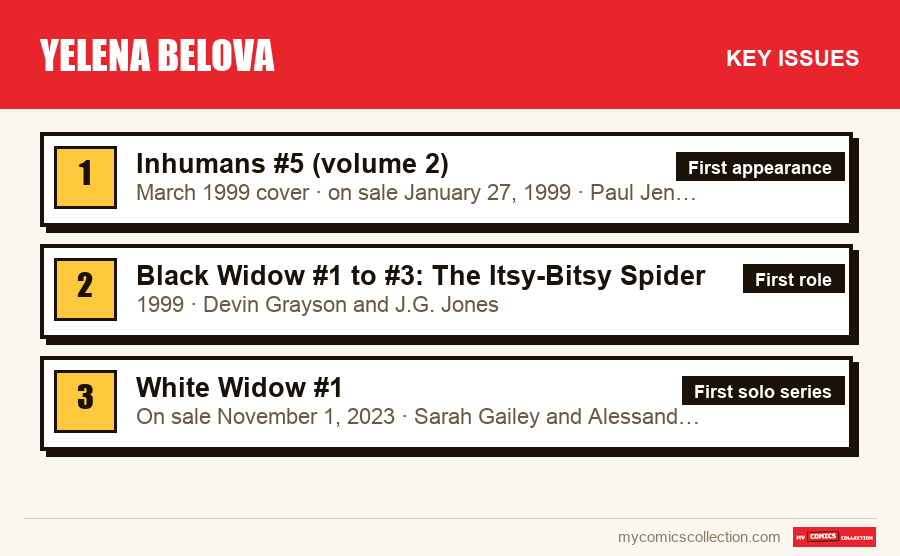
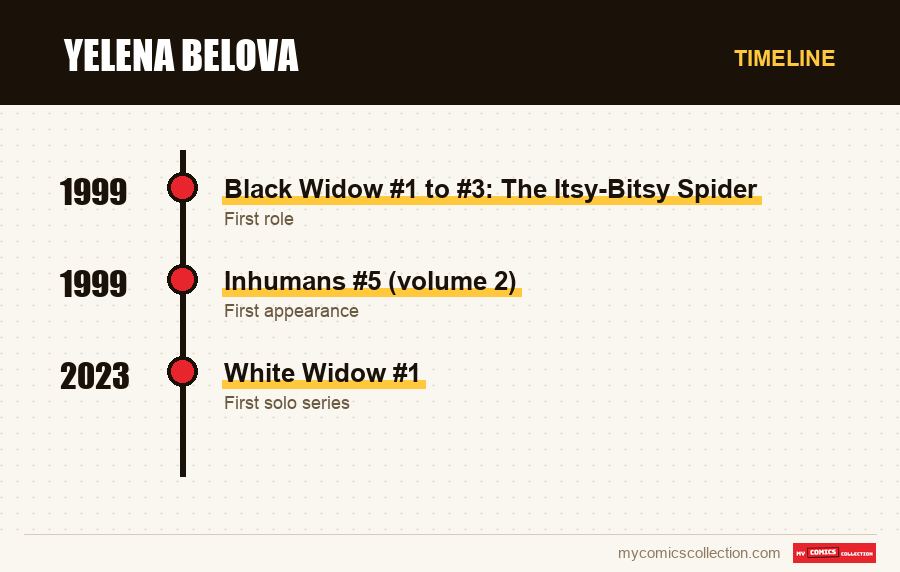
Yelena Belova first appears in Inhumans #5, volume 2, dated March 1999 and put on sale on January 27, 1999, in the Marvel Knights maxiseries by Paul Jenkins and Jae Lee. The publisher's wiki credits her creation to Devin Grayson, J.G. Jones, Paul Jenkins and Jae Lee. She is a Russian agent there, the new holder of the Black Widow name. Her real first role comes three months later in Black Widow #1 (1999), by Grayson and Jones, the first of three miniseries that build her: The Itsy-Bitsy Spider (1999), Breakdown (2001) and Pale Little Spider (2002). She then goes through the New Avengers, the 2009 Thunderbolts, A.I.M., then becomes the White Widow (2023 series). On screen, Florence Pugh has played her since 2021, and she is in the cast of Avengers: Doomsday (December 18, 2026).
Yelena Belova has a rare particularity at Marvel: she was born as a replacement. When she appears in 1999, the publisher is not trying to invent a heroine, it is trying to pose a question to Natasha Romanoff. What becomes of a Black Widow when another, younger, better-rated, trained by the same machine, claims to wear the name better than she does? The whole first decade of the character revolves around this question, and that is why she cannot be read like an ordinary superheroine's file.
This file follows Yelena from the first issue where she appears to her current version. It distinguishes what is an appearance, what is a real debut, what is a stage of characterization and what is merely a passing role. The Thunderbolts team in the movies and the first appearances of each of its members are covered elsewhere, in our file on the Thunderbolts and Avengers: Doomsday; here, only one person interests us, and her whole paper trajectory.
The issues cited have been verified one by one in the publisher's encyclopedic database (cover dates, on-sale dates, writers, artists). No price is put forward: no dated public source allows a serious one on these issues in fall 2026.
The first-appearance issue: Inhumans #5 (1999)
Inhumans #5 (volume 2)
Fifth episode of the twelve-issue maxiseries published under the Marvel Knights label. Yelena works there for Colonel Yuri Stalyenko, who tries, under Maximus's influence, to bring down the defenses of the Inhuman city of Attilan. She passes to an American agent a device supplied by Maximus, meant to give human nations an advantage against the protected city.
The context matters. In 1998, Marvel entrusts a handful of writers with a more adult, more graphically polished line, which relaunches a few characters outside the big series. Jenkins and Lee's Inhumans maxiseries is one of its most noted titles, awarded and reissued since. Yelena is only a minor piece in it, but she already enters it under the Black Widow name, which is enough to make it a collectible.
The main trap lies in the title. There are several Inhumans series and several issues #5. The one that counts is volume 2, dated March 1999, with the Marvel Knights label on the cover and Jae Lee's very recognizable graphic signature. A 1970s Inhumans #5 has nothing to do with Yelena. Before any purchase, check the cover date and the label, not just the number.
The real debut: Black Widow #1 (1999)
If Inhumans #5 is the first appearance, the character's real birth happens three months later. Black Widow #1, dated June 1999 and put on sale on April 28, 1999, opens a three-issue miniseries written by Devin Grayson and drawn by J.G. Jones, under the overall title The Itsy-Bitsy Spider. This is where Yelena becomes someone.
The script places her in Natasha's shadow. The two governments, Russian and American, send Natasha to retrieve a biological weapon, the Deathless Frenzy, in a fictional country, Rhapastan. Yelena gets herself sent behind her to make sure the sample comes back to Moscow. For several days, she spies on her from a neighboring apartment, not knowing that Natasha spotted her from the start. They fight together, then against each other, and Yelena comes out of the episode saved by the one she wanted to surpass.
The sentence that sums up the arc is Natasha's at the end: espionage is not a superhero activity, and passion has no place in it. Yelena, for her part, is all passion: she wants to be the best Black Widow in history, and her training results are supposed to exceed her elder's. This tension founds everything that follows.
Black Widow #1 to #3: The Itsy-Bitsy Spider
Three issues that set up the rivalry with Natasha, the Rhapastan mission and the character's central idea: a schoolbook perfection never confronted with reality.
Breakdown (2001): the story that breaks her
The second miniseries, Black Widow volume 2, three issues of which the first is dated January 2001, brings together Devin Grayson and Greg Rucka on script and Scott Hampton on art. Its title, Breakdown, says exactly what happens.
To teach Yelena what espionage really is, Natasha stages an operation of remarkable cruelty. With Nick Fury's agreement, Yelena is kidnapped and operated on: she is given Natasha's face, while Natasha takes hers. Left in her elder's apartment, Yelena wanders New York with a face that is not hers, is ordered to eliminate "Yelena Belova" and attacks herself without knowing it. Daredevil, reluctantly associated with the plan, helps her find herself.
The denouement is one of the hardest in the character's history. Yelena discovers that her superior, Stalyenko, regards her as a disposable tool and that the patriotism instilled in her serves mostly his personal interests. She neutralizes him, then confronts Natasha. Natasha answers that she now knows what a spy is. Yelena demands her face back and describes the ordeal as a violation of her identity.
It is the most important story for understanding the adult Yelena. Everything that makes her bitter, mistrustful and later able to change sides comes from there.
Pale Little Spider (2002): the origin, told after the fact
In 2002, Marvel's adult label publishes Black Widow: Pale Little Spider, three issues written by Greg Rucka and drawn by Igor Kordey, the first dated June 2002. The story goes back before everything else, to the time when Yelena is still a Red Room student.
She is seen there as a captain within the academy, close to her instructor, Colonel Starkovsky. When he is found dead in an underground club, Yelena investigates and discovers that another woman wore a costume identical to hers, obsessed with the Black Widow image. She ends up eliminating her. The last twist reveals that Starkovsky's death was part of a Red Room plan meant to force Yelena to assert herself.
The tone is dark, explicit, reserved for an adult audience. It is also the only story that gives Yelena a childhood and training of her own, distinct from Natasha's. For anyone wanting a complete reading, it is read third, even though it takes place first.
The Havana period and Black Widow 2 (2005)
After Breakdown, Yelena leaves espionage for a time. She builds a lingerie business based in Havana, protects sex workers and distributes medicine to the sick. It is in this state that Black Widow 2 finds her, a six-issue miniseries written by Richard K. Morgan and drawn by Sean Phillips (first issue dated November 2005, subtitled The Things They Say About Her).
The rivalry eases there. Yelena offers refuge to Natasha on the run, asks her help in a case of stolen medical supplies in Miami, then, with Daredevil, pulls her from the clutches of those who wanted to search her memory. For the first time, the two women act as equals. This period is often forgotten by key-issue lists, wrongly: it proves the character could exist outside the opposition that had given birth to her.
New Avengers: the Super-Adaptoid (2005-2006)
The return to action is brutal. In New Avengers #6 (2005), Yelena commands a battalion illegally mining vibranium in the Savage Land. Sauron attacks her and burns her badly. On her hospital bed, a Hydra agent offers to repair her body and give her revenge.
The sequel appears in New Avengers Annual #1, dated June 2006, written by Brian Michael Bendis and drawn by Olivier Coipel. Transformed by A.I.M. into the Super-Adaptoid, Yelena attacks the Avengers in their tower just before the wedding of Luke Cage and Jessica Jones. She absorbs the powers of those who hit her, including those of Sentry, but also the madness of his double, the Void. When her sponsors understand she will fail, they eliminate her from a distance.
The episode has particular interest in 2026: it already crosses Yelena and Bob Reynolds, alias Sentry, whom the movies brought together in Thunderbolts* in 2025. The link is fortuitous, but it gives this annual new relevance for anyone following the films.
Thunderbolts (2009): the fake Yelena
The Thunderbolts cross paths with the character for the first time in 2009, and in a rigged way. In Thunderbolts #128, dated March 2009, written by Andy Diggle and drawn by Roberto de la Torre, Norman Osborn catches Yelena looting an abandoned S.H.I.E.L.D. installation and offers her to lead his new team in the field.
But in #134, we discover that this Yelena is Natasha in disguise, infiltrated on Nick Fury's orders. Osborn had known from the start, and used it. In #136, he recovers the real Yelena's body. For a collector, these issues pose a vocabulary problem: the character drawn under the name of Yelena is not her. They count in the Thunderbolts' history, far less in hers.
From A.I.M. to the White Widow
Recovered by A.I.M., Yelena enters the organization's high council as minister of state of the island it has turned into a sovereign country. The episodes of Secret Avengers (volume 2, 2013) show her as an adversary of S.H.I.E.L.D., facing Natasha once again. Later, Tales of Suspense #103 and #104 reveal that a reconstituted Red Room was growing clones of Yelena to recover its best agents.
The modern turning point comes in two stages. In Widowmakers: Red Guardian and Yelena Belova #1, put on sale on November 18, 2020 and written by Devin Grayson, her creator, with art by Michele Bandini, Yelena receives a white costume and frees Alexei Shostakov from an Antarctic prison. The same year, in Kelly Thompson's Black Widow series (volume 8), she infiltrates the life of Natasha, deprived of her memory, by posing as a babysitter, and helps her come back to herself.
Then comes White Widow #1, put on sale on November 1, 2023, written by Sarah Gailey and drawn by Alessandro Miracolo, four issues. Yelena, a hired killer, settles in a town called Idylhaven with her dog, clashes with a society that recruits assassins, and discovers she likes being part of a group. It is her first series in her own name, twenty-four years after her creation. Her current name, in the publisher's database, is moreover White Widow.
White Widow #1
Four issues, a Yelena who finally owns a name of her own and leaves Natasha's shadow. A light, almost neighborhood story, which contrasts with the darkness of the beginnings.
The 2023 Thunderbolts: finally on the team
The real Yelena joins the Thunderbolts in the volume launched on December 6, 2023 (Thunderbolts #1, February 2024 cover date), written by Collin Kelly and Jackson Lanzing and drawn by Geraldo Borges. The team, assembled by Bucky Barnes, goes after the Red Skull's fortune and bases. It is Yelena who calls Alexei Shostakov to join them, and the duo inherited from the movies thus finds itself, for the first time, on the same team on paper. The arc concludes in #4 with an assault in Latveria.
This coming together is the clearest example of a round trip between screen and paper. The 2021 Black Widow film had invented a substitute family (Natasha, Yelena, Alexei, Melina) that did not exist in the comics. The 2020 to 2023 series gradually brought Yelena and Alexei closer, until the Thunderbolts brought them together.
What the movies changed, and what they did not
On screen, Florence Pugh plays Yelena in Black Widow (2021), in the series Hawkeye the same year, then in Thunderbolts* (2025), of which she is the central character. Marvel Studios has confirmed her in the cast of Avengers: Doomsday, expected in theaters on December 18, 2026. Our comparison of the Black Widow film and the comics details the gaps.
The main one concerns the relationship with Natasha. The film makes her a sister of the heart, raised with her in a fake family. The comics make her a rival, then an enemy, then an ally of circumstance, and the relationship never really becomes sisterly there. The second gap concerns humor: the cinema Yelena is funny, the 1999 one is not at all. It is the White Widow series that brings paper closest to screen.
What the movies did not change, on the other hand, is the issue hierarchy. No film created a new first appearance, and no recent series replaces Inhumans #5. A modern cover that takes up the actress's face is a derivative object, not a key issue.
Building a Yelena Belova collection: the recommended order
The foundation: two 1999 issues
Inhumans #5 (volume 2) for the first appearance, Black Widow #1 (1999) for the first role. These are the only two issues whose place is indisputable.
The three founding miniseries
The Itsy-Bitsy Spider (1999), Breakdown (2001) and Pale Little Spider (2002): nine issues in all. For reading, a collection suffices; for the collection, the original issues.
The transformation milestones
New Avengers Annual #1 (2006) for the Super-Adaptoid, Widowmakers #1 (2020) for the white costume, White Widow #1 (2023) for the solo series.
The link with the screen
Thunderbolts #1 (2023) and the rest of the arc, for the duo with Alexei. The 2009 Thunderbolts are to be taken knowing they show a fake Yelena.
To go further on the elder, our sheet on Black Widow's first appearance goes back to Natasha and to Tales of Suspense #52, and the page devoted to Black Widow gathers all the issues tied to the name.
Three frequent mistakes on this character
Confusing the volumes. There are about ten Black Widow series, all numbered from 1. The Black Widow #1 that counts for Yelena is the 1999 one, signed Grayson and Jones. The 2001 one opens Breakdown, the 2020 one belongs to Kelly Thompson. Only the cover date lets you tell them apart for sure.
Taking the 2009 Thunderbolts for a debut. Issue 128 is often presented as "Yelena joins the Thunderbolts." That is inaccurate: the woman who accepts Osborn's offer is Natasha. Yelena's real first stint on the team dates from 2023.
Believing a film raises all the issues. Attention concentrates on the first appearance and, to a lesser extent, on the first role. The intermediate episodes, even excellent, remain abundant. Better to read them in collection and reserve the collecting budget for the two 1999 issues.
Also read
- Black Cat: first appearance, Amazing Spider-Man #194 (1979)
- Mysterio: first appearance, Amazing Spider-Man #13 (1964)
- Blade: first appearance, Tomb of Dracula #10 (1973)
- Man-Thing: first appearance, Savage Tales #1 (1971)
- U.S. Agent: John Walker's first appearance, from Super-Patriot to Captain America