
Natasha Romanoff / Black Widow was born in April 1964 in Tales of Suspense #52 under the pen of Stan Lee , Don Rico (screenplay) and the pencil of Don Heck. Initially presented as a Soviet spy antagonist of Iron Man, she gradually shifts towards the hero camp before obtaining her iconic black costume in Amazing Adventures #1 (August 1970). The character carried 8 volumes of solo series (2001 → 2023) plus major arcs in Daredevil, the Avengers and Champion. Cult runs: Marjorie Liu 2010 (8 issues), Nathan Edmondson 2014-2015 (20 issues), Mark Waid & Chris Samnee 2016-2017 (12 issues) and Kelly Thompson 2020-2021 (15 issues). The MCU solo film (2021) starring Scarlett Johansson took the Silver Age series to historic heights. This article traces the complete genesis, gives the chronology of all the Black Widow series in order, and lists the key issues to know to build a structured collection.
In the Marvel pantheon, Black Widow occupies a special place: neither mutant, nor demi-goddess, nor endowed with spectacular superpowers: just a spy trained by the Soviet Red Room, an elite fighter whose main weapon is tactical intelligence. Natasha Romanoff entered Marvel in 1964 as the antagonist of Iron Man in Tales of Suspense, a fatal spy manipulating Hawkeye on behalf of the KGB, before becoming one of the most enduring Avengers, Daredevil's partner, the founder of the Champions, and ultimately the cinematic icon played by Scarlett Johansson for a decade of MCU. Her editorial career is a: unlike Spider-Man or Wolverine, Natasha has never carried a long and typical solo series. Her story is read through mini-series, short runs, structuring appearances in other titles, and successive relaunches which reflect as much the evolution of the character as Marvel's editorial hesitations in the face of female heroines.
This guide will give you everything you need to know to understand the birth of Black Widow , follow the complete timeline of Black Widow comics in order , and identify the key numbers and major arcs to be integrated as a priority. We'll cover the character's 60 years, from Tales of Suspense #52 (1964) to Kelly Thompson's volume (2020-2021) and beyond, distinguishing the solo volumes, the defining Daredevil and Avengers arcs, and the colossal impact of the MCU on the Black Widow comics market.
If you already own Black Widow issues and would like to complete your collection, check out our complete guide to the Black Widow collection which covers organization, valuation and purchasing strategy. For a detailed analysis of the most valuable numbers, see our Black Widow key numbers guide.
The birth of Black Widow: Marvel in 1964
To understand how Natasha Romanoff was born, we must dive back into the Marvel excitement of 1963-1964. Stan Lee and the creative team had just launched the Fantastic Four (1961), Hulk, Spider-Man, Thor, Iron Man, Doctor Strange, X-Men and the Avengers in three years. THE Tales of Suspense, which had become Iron Man's solo title since #39 (March 1963), needed recurring antagonists to support the character. After The Mandarin (#50) and The Crimson Dynamo, Lee and his collaborators imagine a female antagonist linked to the Cold War: an attractive Soviet spy, sent by the KGB to neutralize Tony Stark.
The scenario of Tales of Suspense #52 is attributed to Stan Lee and Don Rico (N. Korok), with drawings by Don Heck, Iron Man's official designer at that time. Rico, a Golden Age veteran who worked at Timely Comics in the 1940s, brings the spy dimension to the story. Don Heck designs an elegant woman in a black dress, without a superhero costume, without a mask, without a visible gadget: a spy in the classic sense of the term, halfway between the James Bond films (Dr. No had just been released in 1962) and the tradition of the noir novel. The initial concept of Black Widow is based on the Soviet femme fatale: beautiful, dangerous, sent to manipulate a patriotic American industrialist. This Cold War structure will determine the character's DNA during its first ten years of existence.
Tales of Suspense #52 (April 1964)
Black Widow makes her first appearance in Tales of Suspense #52 (cover dated April 1964), in a story titled "The Crimson Dynamo Strikes Again!". Ironically, the Black Widow is not mentioned on the cover: it is the Crimson Dynamo who is highlighted. The plot: Natasha Romanoff, a Soviet intelligence agent, arrives in the United States to convince the Crimson Dynamo (Anton Vanko, defector in the service of Stark Industries) to return to the USSR. She also manipulates Boris Turgenov, a second Soviet agent, to lead the operation. This is the first appearance of a character who will become one of Marvel's most popular heroines, but at this point Natasha is a naughty without a costume, without a distinctive code name, and without the combat skills that modern readers associate with him.
Subsequent appearances in Tales of Suspense #53 and #57 develop the character: Natasha recruits Hawkeye (Tales of Suspense #57, September 1964) and manipulates him into attacking Iron Man. The Natasha/Clint Barton relationship, begun in these pages, would become one of the most enduring narrative threads in the Marvel Universe: which explains why collectors of the two characters regularly overlap. See our Black Widow key numbers guide for the detailed analysis of the values of these first numbers.
The shift towards heroism (1966-1970)
Natasha's transformation into a heroine occurs gradually, over several years and through different titles. In Avengers #29-30 (1966), she betrays the KGB and begins to collaborate with the Avengers. Her relationship with Hawkeye becomes more complex: she is no longer the manipulator, but a woman caught between two worlds, trying to redeem her past as a spy. In Amazing Spider-Man #86 (July 1970), Natasha appears in a new redesigned costume, a tight black jumpsuit with a mask, but it's really in Amazing Adventures #1 (August 1970) that this new visual identity was fully established, with the "Widow's Bite" bracelets and the iconic look that would endure for five decades.
Amazing Adventures et la première solo series (1970-1971)
Amazing Adventures #1 (August 1970) marks a major turning point in Black Widow's history. The series, written by Gary Friedrich and drawn by John Buscema, alternates between stories of Black Widow (odd numbers) and the Inhuman (even numbers). This is the first time that Natasha has been treated as a heroine in her own right, with her own series and a fully defined visual identity. John Buscema's black suit, later refined by Gene Colan, became the visual archetype of the character.
Black Widow appears in Amazing Adventures #1 to #8 (August 1970 - September 1971), eight issues. The run is short but seminal: it establishes Natasha as an urban heroine, operating in New York as an independent vigilante, without direct affiliation with the Avengers. The stories combine espionage, street action and questions of identity: a formula that the best subsequent solo series (Waid/Samnee, Thompson) would take up fifty years later.
Contexte éditorial : In 1970, Marvel was attempting to diversify its featured female characters. Amazing Adventures with Black Widow and the series The Cat (1972) were among Maison des Idées' first efforts to give heroines their own series. The commercial success remained modest, but the cultural impact was considerable: Black Widow proved that a heroine could wear a title, even partially, without being reduced to the role of love interest.
The Daredevil run (1971-1975): partner of Hell's Kitchen
Black Widow's relationship with Daredevil is one of the richest chapters in her comic book history. From Daredevil #81 (November 1971), Natasha becomes Matt Murdock's romantic and operational partner. She leaves New York for San Francisco, where the duo settles. The title of the series is temporarily changed to "Daredevil and the Black Widow "from #92 (October 1972) and until #107 (January 1974): a rare editorial recognition for a female character at that time.
This run, written successively by Gerry Conway , Steve Gerber and Tony Isabella, with the masterful drawings of Gene Colan puis Bob Brown, gives Natasha an unprecedented narrative depth. She is not a simple sidekick: she leads her own investigations, faces her own enemies (including the Silver Samurai) and makes decisions independent of Matt. For collectors, the numbers Daredevil #81 , #87 (appearance of the Black Widow on the cover), #92 (first number with joint title) and #99-100 are major pieces. A Daredevil #81 in CGC 9.4 regularly trades around 300-500 dollars in 2026.
The Champion (1975-1978)
After her separation from Daredevil, Natasha co-founded the Champions in The Champions #1 (October 1975), a Los Angeles-based team including Hercules, Ghost Rider (Johnny Blaze), Iceman and Angel. Written by Tony Isabella puis Bill Mantlo, the series lasted 17 issues (1975-1978). The Champions remain a Bronze Age curiosity, a motley team that never found its audience, but #1 is a sought-after key issue because it represents the first title where Black Widow is co-founder and leader of a team. In CGC 9.6, Champions #1 reaches 200-350 dollars.
Modern solo series: from 2001 to today
Unlike Spider-Man or Captain America, Black Widow has never had a continuous solo series spanning several decades. His solo editorial history is made up of mini-series, relaunches and short runs: which makes the collection both accessible (not 600 from a single series) and complex to structure (you have to know the different volumes). Here is the complete timeline of the solo series in order.
Black Widow Vol. 1 (2001): Devin Grayson & J.G. Jones
La première véritable mini-solo series de Black Widow paraît en 2001 : Black Widow (Vol. 1) , scénarisée par Devin Grayson with the drawings of J.G. Jones. Three issues that explore Natasha's past at the Red Room, her Soviet training, and the ghosts of her past as an assassin. J.G. Jones delivers a cinematic graphic treatment, with page compositions that anticipate the spy-thriller aesthetic of future MCU films. This mini is followed by a second series of three issues (Black Widow Vol. 2 , 2001) par Grayson and Scott Hampton, which continues the narrative arc begun in the first volume. The two make a cohesive set of six issues, very affordable on the secondary market.
Black Widow Vol. 3 (2004): Richard K. Morgan & Bill Sienkiewicz
British science fiction novelist Richard K. Morgan (auteur de Altered Carbon) signs a run of six issues under the label Marvel Knights, with the expressionist drawings of Bill Sienkiewicz and Goran Parlov. Morgan treats Natasha like a noir novel protagonist: post-Cold War geopolitics, internal betrayals within intelligence, raw violence. It's a pure spy story that makes no concessions to the superhero genre. Long undervalued by the market, #1 in this series saw its interest increase with the MCU wave. A must for fans of the spy-thriller genre. A second mini-series of five issues ("The Things They Say About Her", 2005) completes the Morgan diptych.
Black Widow Vol. 4 (2010): Marjorie Liu & Daniel Acuña
La série Black Widow (Vol. 4, 2010) of Marjorie Liu with the drawings of Daniel Acuña is a creative turning point for the character. In eight issues, Liu explores Natasha's complex psychology: her debts to her Soviet past, her difficulty in trusting, and the permanent paranoia of a spy who no longer knows who is manipulating her. Acuña's graphic treatment (saturated colors, cinematic compositions, twilight atmosphere) gives the title a unique visual identity. #1 experienced a nice increase in value between 2010 and 2026, driven by the post-MCU film craze and the growing recognition of Liu's work in the comics community.
Black Widow Vol. 5 (2014-2015): Nathan Edmondson & Phil Noto
Le run de Nathan Edmondson and Phil Noto over 20 issues is the first long-term solo ongoing devoted to Black Widow. Noto, whose watercolor style evokes the best European illustrators, creates plates of rare elegance which make each issue a graphic object in itself. The story follows Natasha on solo spy missions around the world, each arc exploring a part of her past: Red Room, secret missions, blood debts. This run benefited from an excellent critical and commercial reception, driven by the presence of Black Widow in Captain America: The Winter Soldier (2014) et Avengers : L'Ère d'Ultron (2015). #1 in CGC 9.8 trades around $50-80, an accessible entry point for modern collectors.
Black Widow Vol. 6 (2016-2017): Mark Waid & Chris Samnee
Le run de Mark Waid and Chris Samnee (12 issues) is unanimously considered to be the best Black Widow solo run in history. Samnee, awarded an Eisner Award for his work on Daredevil, brings an exceptional narrative graphic style: silent pages of pure action, dynamic compositions, visual storytelling that makes the narration almost cinematic. Waid constructs a narrative where Natasha is on the run from S.H.I.E.L.D. after discovering the truth about the Red Room's training program: a headlong escape that is both a chase and a quest for atonement.
The first issue opens with an escape scene from the S.H.I.E.L.D. helicarrier. entirely silent, over six pages, which has become one of the most celebrated opening sequences in modern comics. The 12 issues form a coherent set perfectly suited to the full run collection. #1 in CGC 9.8 hits $80-$120 in 2026, and the full run lot easily trades for $60-$100 depending on condition.
Black Widow Vol. 7 (2019): Jen & Sylvia Soska
A run of five issues scripted by the filmmakers Jen et Sylvia Soska (the "Twisted Twins"), with drawings by Flaviano. A short arc that explores the theme of mind control and the Red Room from a psychological horror angle. This volume is less collected than the previous ones, but offers an original narrative angle on the character.
Black Widow Vol. 8 (2020-2021): Kelly Thompson & Elena Casagrande
La série Black Widow (2020) of Kelly Thompson with the drawings of Elena Casagrande takes a bold narrative approach: Natasha, victim of memory erasure, leads an ordinary life in a small coastal New England town under the name "Natalie". This 15-issue run explores what Natasha would be without her past as a spy: a deconstruction of the character that cuts to the heart of her identity. Thompson, who had already proven his mastery of female Marvel characters with Hawkeye (Kate Bishop) et Captain Marvel, delivers an emotionally rich story that won over critics.
The timing of publication coincides with the release of the film Black Widow (2021), which gave #1 exceptional commercial visibility. In CGC 9.8, the standard #1 reaches $40-70, while some variants (notably the Adam Hughes variant ratio) exceed $150. For modern runs collectors, this Thompson volume is a must-have.
Biography of Natasha Romanoff (Black Widow)
Natasha Romanoff , aka Black Widow, is a Marvel Comics character created by Stan Lee , Don Rico (screenplay) and Don Heck (drawing). His first appearance is in Tales of Suspense #52 , published in April 1964.
Natasha Romanoff's identity sheet
- Real name: Natalia Alianovna Romanova (Наталья Альяновна Романова)
- Date of birth: 1928 (Silver Age origins): variations: 1984 in some modern runs (post-Red Room)
- Place of birth: Stalingrad, Soviet Union (today Volgograd, Russia)
- First appearance : Tales of Suspense #52 (April 1964)
- Creators: Stan Lee, Don Rico, Don Heck
- Memberships: Avengers, S.H.I.E.L.D., Champions, ex-KGB, ex-Red Room
- Occupation: Spy, Superheroine, Ex-KGB assassin
- Marital status: Widow (Alexei Shostakov / Red Guardian)
Character origins
Taken in as a child by the KGB's Red Room program during World War II, Natasha Romanoff was trained from a young age to become an elite spy and assassin. She receives the Black Widow serum which slows down her aging and improves her physical abilities. Initially antagonist of Iron Man in Tales of Suspense #52 (1964), she defected to the West and joined S.H.I.E.L.D. then the Avengers, becoming one of Marvel's most iconic heroines.
Powers and Abilities
- Black Widow Serum: significantly slows down aging, strengthens the immune system, increases physical strength.
- Red Room Training: complete mastery of all martial arts (ballet, gymnastics, Sambo, judo, karate, taekwondo).
- Espionage and infiltration: multilingual, expert in disguises, hacking, psychological manipulation.
- Arsenal signing: “Widow's Bite” (electric bracelets), Glock pistols, tourniquets, Kevlar fishing line.
- Close combat: one of the most dangerous fighters in the Marvel universe.
Catalog your Black Widow collection
Import your Black Widow series into My Comics Collection and instantly identify your missing issues, from Silver Age Tales of Suspense to the Kelly Thompson run.
Free 7-day trial, No obligationCollecting this series?
Track what you own, what you are missing and what your collection is worth. 7 day trial.
Start my trial →The impact of the MCU on Black Widow comics
L'influence du Marvel Cinematic Universe in the Black Widow comics market is colossal and documentable. Scarlett Johansson plays Natasha Romanoff for the first time in Iron Man 2 (2010), puis dans The Avengers (2012), Captain America: The Winter Soldier (2014), Avengers: L'Ère d'Ultron (2015), Captain America: Civil War (2016), Avengers: Infinity War (2018), Avengers: Endgame (2019) and finally the solo film Black Widow (2021). Each film release has caused a wave of interest in the character's original comics.
The most spectacular effect concerns Tales of Suspense #52: a copy in CGC 4.0 which sold for 400-600 dollars in 2010 will reach from now on 2,500-3,500 dollars in 2026. In CGC 9.0, the rare copies exceed 20,000 dollars. The introduction of Yelena Belova (Florence Pugh) in the film Black Widow (2021) and in the series Hawkeye has also created a second collection front: Inhumans #5 (1999, first appearance of Yelena Belova) rose from a few dollars to $150-300 in CGC 9.8 between 2019 and 2022, before stabilizing around $80-150 in 2026.
Yelena Belova: the second Black Widow
Créée par Devin Grayson and J.G. Jones in Inhumans #5 (March 1999), Yelena Belova is the second woman to wear the mantle of Black Widow. Coming from the same Red Room program as Natasha, she is presented as her direct rival: younger, more obedient to the system, and determined to prove that she is the better Widow. Her rise in the MCU thanks to Florence Pugh has made her a key issue of intense speculation. Savvy collectors also keep an eye out Black Widow Vol. 1 #1 (2001, Grayson/Jones), which develops the Yelena arc in depth, and New Avengers #1 (2005), où Yelena apparaît sous l'identité de Super-Adaptoid.
Key issues Black Widow: the essential issues and their values
Here are the most strategic numbers for any Black Widow collection, with indicative values for the 2026 market. For an even more detailed analysis, check out our complete guide to Black Widow key numbers.
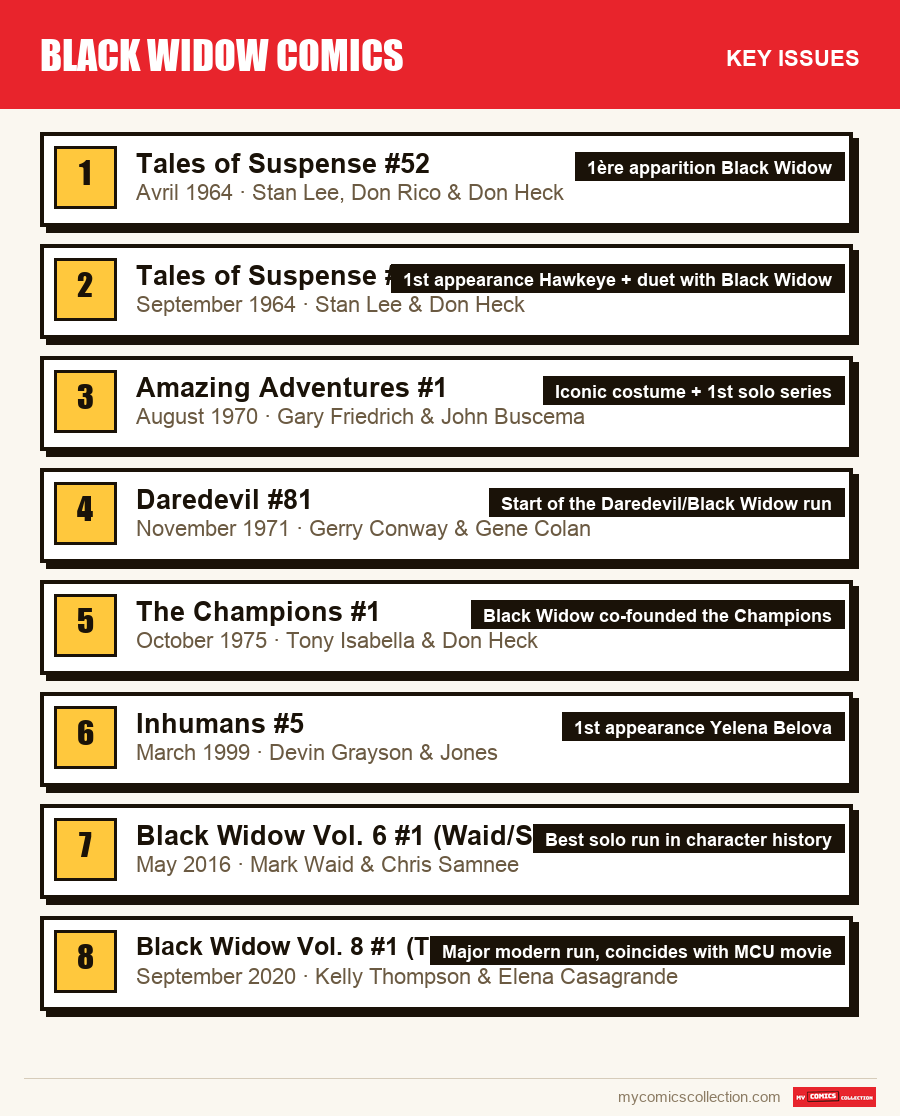
Tales of Suspense #52
First appearance of Natasha Romanoff, Soviet spy antagonist of Iron Man. Key issue Silver Age the most valuable of the entire Black Widow collection. Post-MCU demand has increased prices fivefold in fifteen years. Rare issue in high condition because few readers kept it at the time: Black Widow not even appearing on the cover.
Tales of Suspense #57
First appearance of Hawkeye (Clint Barton), manipulated by Black Widow to attack Iron Man. Double key issue which is of interest to collectors of both characters. Prices is primarily carried by Hawkeye, but Natasha's presence as a major antagonist makes this an essential issue of any serious Black Widow collection.
Amazing Adventures #1
First solo series (shared with the Inhuman) and adoption of the iconic black costume with the Widow's Bite. Pivotal number that transforms Natasha from spy to superhero. Key issue Bronze Age essential, more affordable than Tales of Suspense #52 but just as structuring for the character.
Daredevil #81
First issue of the Daredevil/Black Widow era. Natasha joins Matt Murdock as a partner in San Francisco. The title will officially become "Daredevil and the Black Widow" at #92. Key issue cross sought by collectors of both characters.
The Champions #1
First issue of the Champions team (Black Widow, Hercules, Ghost Rider, Iceman, Angel). Natasha as leader and co-founder. Curiosity of the Bronze Age which completes any exhaustive collection. Stable market with a slight upward trend driven by Bronze Age nostalgia.
Inhumans #5
First appearance of the second Black Widow, Yelena Belova. Key from post-MCU speculation after the interpretation of Florence Pugh in the film Black Widow (2021) and the Hawkeye series. Prices peaked in 2021-2022 before stabilizing at a still significant level.
Black Widow Vol. 6 #1 (Waid/Samnee)
First issue of the run unanimously recognized as the creative peak of Black Widow solo. The silent six-page opening has become legendary. Complete run of 12 numbers ideal to collect in batches. Value constantly increasing since 2016.
Black Widow Vol. 8 #1 (Thompson/Casagrande)
First issue of the Kelly Thompson run, published in full window of the MCU film Black Widow. Original narrative concept (Amnesiac Natasha), excellent critical reception. Several variant covers sought including the Adam Hughes variant ratio. Modern accessible entry point.
Structuring your Black Widow collection: strategy and priorities
The Black Widow collection is naturally structured into several layers, depending on the budget and ambition of the collector:
The founding base (Silver Age / Bronze Age)
The pre-1980 issues form the historical basis: Tales of Suspense #52 (1st appearance), Amazing Adventures #1-8 (first solo series), Daredevil #81-107 (run Daredevil/Black Widow), The Champions #1-17 (Black Widow team leader). This base represents a significant investment if we aim for key issues in high condition, but the secondary issues (Amazing Adventures #3-8, Champions #2-17) remain very accessible: often less than 20-30 dollars in readable condition.
Modern solo series (2001-2023)
The most effective approach for collectors on a reasonable budget is to aim for complete runs modern solo series. The market for #1s is supported by MCU speculation, but interior issues (#2 to last) are often found at $3-8 each in Near Mint condition. Priority: the run Waid/Samnee (Vol. 6, 12 issues) for artistic quality, the run Thompson/Casagrande (Vol. 8, 15 issues) for narrative relevance, and run Edmondson/Noto (Vol. 5, 20 issues) for the exceptional graphic treatment of Phil Noto.
Strategic cross-appearances
Black Widow appears in dozens of Avengers, Secret Avengers, and Marvel events. The most strategic for a specialized collector: Avengers #29-30 (shifts towards heroism), Marvel Fanfare #10-13 (1983, run George Pérez), Web of Black Widow #1-5 (2019, Jody Houser), and the event issues where Natasha plays a central role (Secret War #1, 2004; Secret Avengers #1, 2010). To organize and track these cross-appearances, a collection management tool like My Comics Collection is essential: it allows you to catalog the numbers by character and automatically identify the missing ones.
Collector's tip: The Black Widow collection naturally intersects with those of Hawkeye, Daredevil, Iron Man and the Avengers. If you already collect one of these characters, you probably own several Black Widow key issues without knowing it. Use the functionality of tracking number by number to identify these overlaps and avoid duplicates during your next purchases.
Summary timeline of the Black Widow series
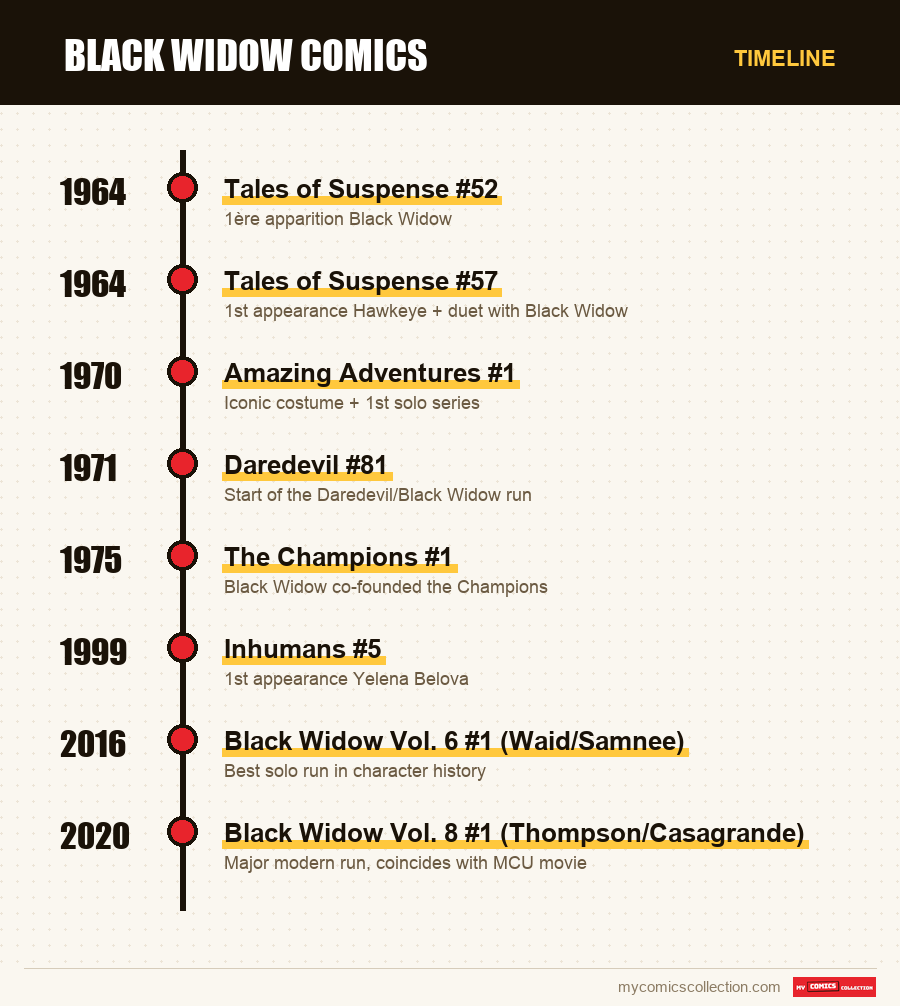
For collectors who want a quick overview, here is the timeline of the main Black Widow series and arcs:
- 1964: Tales of Suspense #52: first appearance (Soviet spy, Iron Man antagonist)
- 1964: Tales of Suspense #57: Hawkeye manipulation
- 1966: Avengers #29-30: switch to the heroes’ camp
- 1970: Amazing Spider-Man #86: first new costume
- 1970-1971: Amazing Adventures #1-8: first solo series (shared)
- 1971-1974: Daredevil #81-107: “Daredevil and the Black Widow” era
- 1975-1978: The Champions #1-17: co-founder and leader
- 1983: Marvel Fanfare #10-13: run George Pérez
- 1999: Inhumans #5: First appearance Yelena Belova
- 2001: Black Widow Vol. 1-2 (6 issues): Devin Grayson & Jones
- 2004-2005: Black Widow Vol. 3 (6+5 numbers): Richard Morgan & Bill Sienkiewicz
- 2010: Black Widow Vol. 4 (8 issues): Marjorie Liu & Daniel Acuna
- 2014-2015: Black Widow Vol. 5 (20 issues): Nathan Edmondson & Phil Noto
- 2016-2017: Black Widow Vol. 6 (12 issues): Mark Waid & Chris Samnee
- 2019: Black Widow Vol. 7 (5 numbers): Jen & Sylvia Soska
- 2020-2021: Black Widow Vol. 8 (15 issues): Kelly Thompson & Elena Casagrande
This timeline is your roadmap to building a complete collection. By crossing it with our Black Widow collector's guide, you will be able to prioritize your acquisitions according to your budget and your collecting objectives.
Track your Black Widow progress
With My Comics Collection, import each Black Widow series and instantly view your completion percentage, missing issues, and estimated value of your collection.
Free trial 7 days, No obligationGo further
- Black Widow comics: the reading guide for new collectors
- The Best Black Widow Comic Runs: A Collector's Guide to Natasha Romanoff's Essential Series
- The Best Black Widow Comic Story Arcs
- Top 10 essential Black Widow key issues
- Black Widow's First Appearance: Tales of Suspense #52: Value, CGC & Collector's Guide
- Collection Guide: Black Widow : Complete Guide