Mysterio first appears in The Amazing Spider-Man #13, dated June 1964 and put on sale on March 10, 1964. The episode is titled "The Menace of... Mysterio!", written by Stan Lee and drawn and inked by Steve Ditko. Mysterio presents himself there as a vigilante, before Spider-Man exposes a special effects specialist who imitated his powers to have him accused of burglaries. A later revelation made Mysterio one of the "aliens" of Amazing Spider-Man #2 (1963), but that does not change his status: #13 remains his first appearance. The issue was reprinted as early as Marvel Tales #8 (May 1967), then in collected editions. It sits just before #14, the first appearance of the Green Goblin, which places it in the most sought-after zone of the series' early days.
Among Spider-Man's historic enemies, Mysterio holds a place apart. He has no superpowers. His weapon is illusion: smoke, holograms, rigged sets, the whole arsenal of a film craftsman gone over to the wrong side. This concept, far ahead of its time, explains why he came back in force on screen in 2019 and why he remains a recurring figure of today's comics.
This article focuses on his birth issue: what Amazing Spider-Man #13 contains, what sets it apart from its immediate neighbors, its reprints, and how to approach it in a collection.
The issue: Amazing Spider-Man #13
The Amazing Spider-Man #13: "The Menace of... Mysterio!"
The issue is the work of the founding duo: Lee on script, Ditko on art and inks. It introduces Mysterio and his costume, which became one of the most recognizable of the series with its glass fishbowl helmet. Ditko also draws the cover.
What the episode tells
Witnesses report Spider-Man burglarizing shops at night. Peter Parker comes to wonder whether he is acting without knowing it, in his sleep. At the same time, he needs money to help Aunt May pay her mortgage and clashes with J. Jonah Jameson.
A new costumed character, Mysterio, then presents himself at the Daily Bugle as a vigilante determined to capture Spider-Man, and issues him a public challenge on the Brooklyn Bridge. The press hails him as a hero. Spider-Man plants a tracer on him, follows it back to his hideout, and discovers the truth: Mysterio is a special effects specialist who artificially reproduced his abilities to have him accused of the burglaries. Spider-Man records his confession, and the fake vigilante ends up in prison.
The episode plays on a device Lee and Ditko often use at the time: Spider-Man is suspected by the public, and an adversary takes advantage. But here, the adversary builds the false image himself. It is this idea, crime through staging, that makes Mysterio a lasting character.
The question of the "aliens" of Amazing Spider-Man #2
Collectors sometimes come across the idea that Mysterio appeared before #13. It comes from a revelation published much later. In Amazing Spider-Man #2 (1963), Spider-Man fights supposed extraterrestrials linked to the Tinkerer. Years later, the series Peter Parker, the Spectacular Spider-Man establishes, in its #51, that Quentin Beck was one of those fake aliens, in disguise. A more recent issue, Amazing Spider-Man #1.1 of 2014, also develops the circumstances that led him to go after Spider-Man.
These revelations take nothing away from #13's status. In #2, nothing tells the reader it is Mysterio: the character, his name and his costume do not exist yet. The market, the databases and most guides recognize #13 as the first appearance. #2 keeps its own interest, which rests mostly on the first appearance of the Vulture, not on Mysterio.
This kind of debate is common, and it has real effects on prices. Our article on the difference between first appearance, cameo and full appearance explains how the market settles these cases.
What sets #13 apart from its neighbors
#13 sits in the middle of an exceptional run. The first twenty issues of Amazing Spider-Man introduce almost all of the series' great enemies. For a collector, that means #13 is rarely bought alone: it fits into a run many seek to complete.
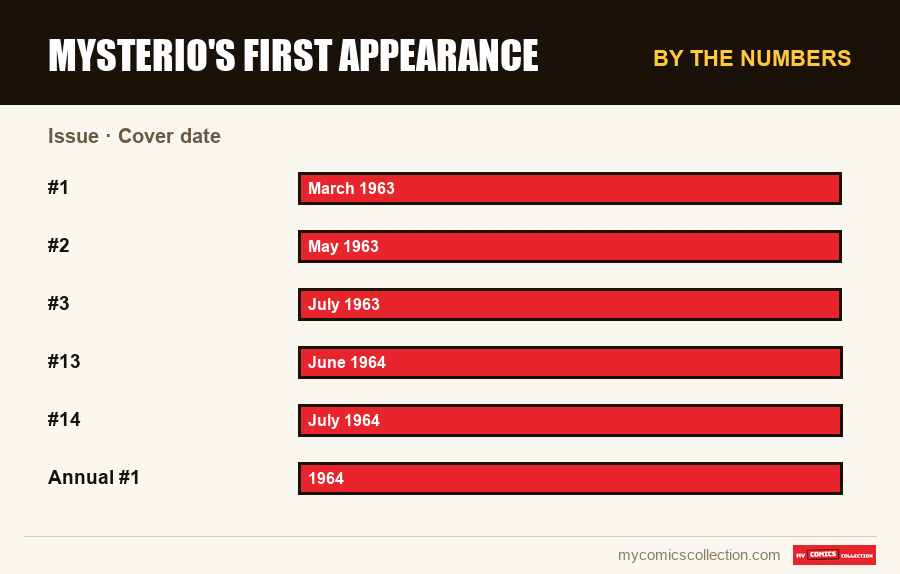
| Issue | Cover date | Main first appearance |
|---|---|---|
| #1 | March 1963 | The Chameleon, first issue of the series |
| #2 | May 1963 | The Vulture, the Tinkerer |
| #3 | July 1963 | Doctor Octopus |
| #13 | June 1964 | Mysterio |
| #14 | July 1964 | The Green Goblin |
| Annual #1 | 1964 | The Sinister Six assembled |
The overwhelming neighbor: #14
The next issue introduces the Green Goblin, the most important enemy of the series. He logically dominates the market of this period. #13 benefits indirectly: it is often sought at the same time as #14, by collectors who want the complete run, but it remains clearly cheaper.
The other neighbor to remember is annual #1 from 1964, which brings the Sinister Six together for the first time, Mysterio among them. It is his first participation in a team of enemies, a few months after his birth. For a collection centered on Mysterio, it is the natural complement to #13.
For an overview of the series' early days, our list of Spider-Man key issues places #13 among the other first appearances, and the article on the first appearance of Spider-Man goes back to Amazing Fantasy #15.
The reprints
#13 was reprinted very early, which is good news for the reader and a point of attention for the collector.
Marvel Tales #8, May 1967
The magazine Marvel Tales reprints the first Spider-Man episodes in order. #8, dated May 1967, contains the story of #13. It is the first reprint, barely three years after the original. It is recognized without difficulty: title, cover and date are those of Marvel Tales.
The Marvel Masterworks collections
The second volume of the Marvel Masterworks devoted to Amazing Spider-Man, published in 1988, reprints issues #11 to #20. It has been reissued several times since. It is the most comfortable way to read the episode with its neighbors.
The French editions
The episode has been translated several times in France, in magazines then in the omnibuses devoted to Spider-Man's beginnings. These editions are reading books, with no value relationship to the American original.
None of these reprints replaces the original on the first-appearance market. Our article on the difference between first printing and reprint details how the market treats this type of edition.
#13 in a collection
#13 holds an interesting position. It is a first appearance of a top-tier enemy, by Lee and Ditko, in the most sought-after period of the series. But it is overshadowed by #14 which follows it, and by the more famous first appearances of Doctor Octopus or the Vulture. That makes it historically a second-tier key, more accessible than the big ones.
Cinema has changed the character's fame: the 2019 film, where Mysterio is the main adversary, introduced him to an audience that did not know him. Our comparison Far From Home, the film versus the comics shows how much the film respected the central idea of #13: the villain manufactures a false reality.
No figure is given here: on a 1964 issue, the copy's grade moves the price by considerable proportions, and an undated price guide would make no sense. To estimate a specific copy, you have to start from its real condition.
Check that it really is the original
Title The Amazing Spider-Man, number 13, date of June 1964, period cover price. A cover that carries another title or another date is a reprint.
Examine the condition methodically
Spine, corners, staples, freshness of the colors, presence of restoration. On an issue of this age, an undeclared restoration completely changes the value: professional grading flags it with a distinct label.
Think in runs
#13 makes full sense next to #14 and annual #1. If you aim for a collection of Spider-Man's first appearances, set a consistent condition level for the whole run rather than looking for the best possible copy of a single issue.
Mysterio after #13
Without going into his biography, a few reference points help place the issues that follow. Mysterio is part of the Sinister Six from annual #1 in 1964. He then becomes a recurring enemy of Spider-Man, and also goes after Daredevil in the 1998-1999 "Guardian Devil" arc, where he plays a decisive role. These issues interest a character collection, but none has the status of #13.
Read also
- Black Cat: first appearance, Amazing Spider-Man #194 (1979)
- Blade: first appearance, Tomb of Dracula #10 (1973)
- Man-Thing: first appearance, Savage Tales #1 (1971)
- Yelena Belova: her first appearance and where to read it
- U.S. Agent: the first appearance of John Walker, from Super-Patriot to Captain America