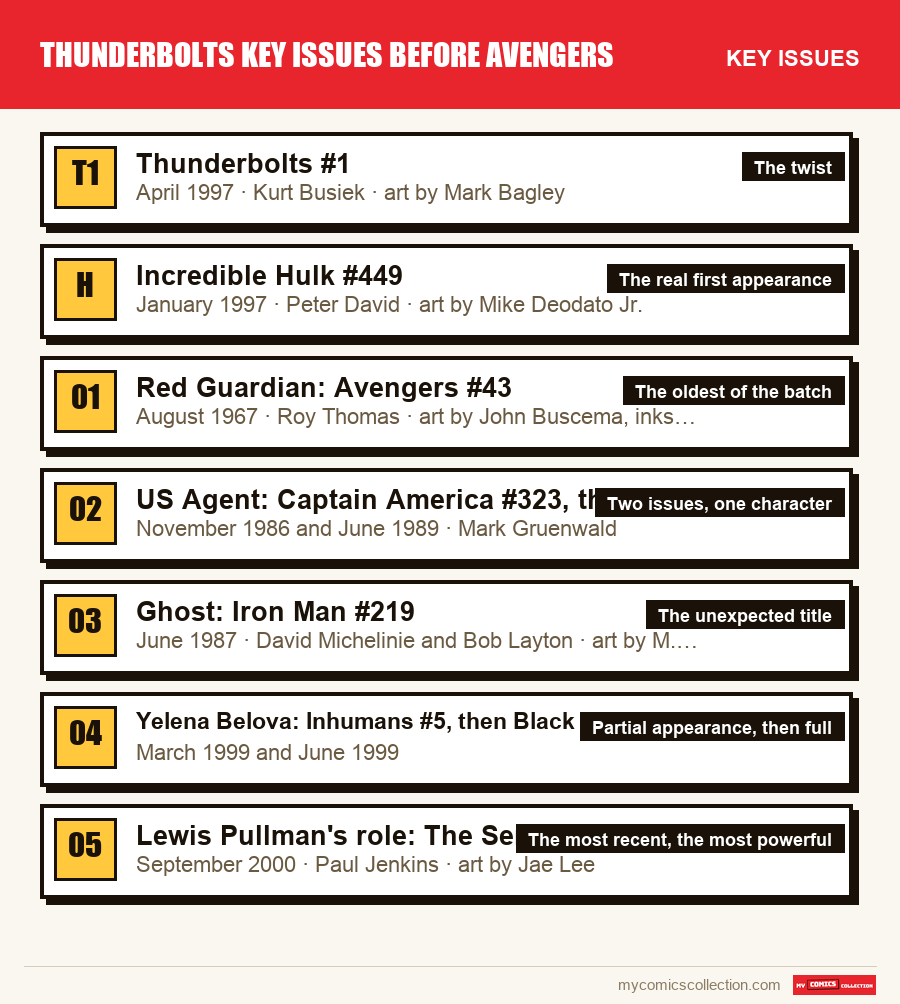
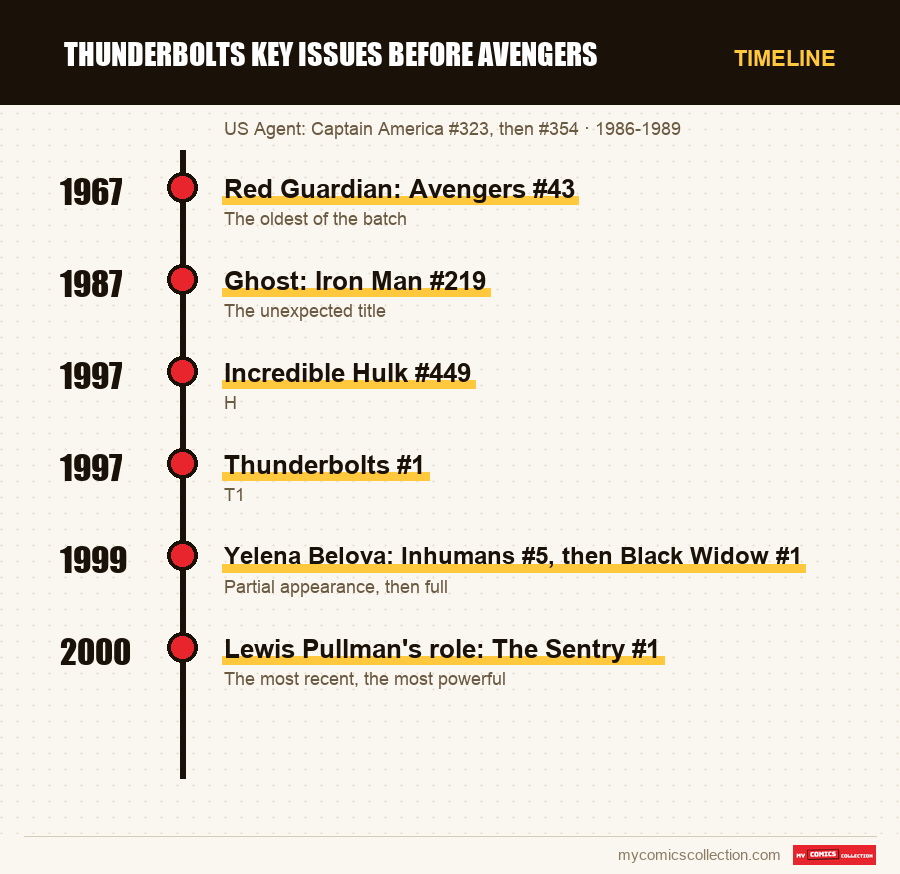
The Thunderbolts* film team is announced in Avengers: Doomsday, whose release has been pushed from May 2026 to December 18, 2026. On paper, the issue that really matters is Thunderbolts #1 (April 1997, Kurt Busiek and Mark Bagley): its last page reveals that this team of brand-new heroes is actually the Masters of Evil in disguise, a secret the publisher kept until it went on sale. The group's true first appearance is, however, earlier: Incredible Hulk #449 (January 1997). For the members on screen, the issues to know are Avengers #43 (1967) for the Red Guardian, Captain America #323 (1986) for John Walker, Iron Man #219 (1987) for Ghost and Inhumans #5 (1999) for Yelena Belova.
There are two ways to read a movie poster when you collect comics: note the characters' names to look for their first appearances, or ask where the idea that brings them together comes from. In the Thunderbolts' case, the second question is the more interesting, because that idea comes down to a single 1997 issue and, more precisely, to a single page of that issue.
This article is written on October 1st, 2026. Avengers: Doomsday is not out: the date set is December 18, 2026, after a delay from May 1st, 2026. Nothing that follows depends on the film's content, and no future price guide is announced in it, for the simple reason that it does not exist yet. What does exist is a precise bibliography, with dates, issue numbers and verifiable creator names.
The angle is therefore as follows: understand what makes Thunderbolts #1 an object apart, then review the issues where these characters were really born, with particular attention to two tricky cases, Yelena Belova and Ghost.
What is confirmed, as of October 1st, 2026
Let us start with the factual, since it is the shortest part. Avengers: Doomsday is directed by Joe and Anthony Russo and will come out on December 18, 2026, after a move from spring 2026 decided as part of a reshuffling of the studio's calendar, which also pushed Avengers: Secret Wars to December 2027.
The announced cast includes the whole team seen in Thunderbolts*: Sebastian Stan, Florence Pugh as Yelena Belova, Wyatt Russell as John Walker, David Harbour as Alexei Shostakov, Hannah John-Kamen as Ghost and Lewis Pullman as Bob Reynolds. The group was therefore not the detour of a standalone film: it enters the main story.
The rest is speculation, and we will not go there. For the details of the film's casting and calendar, another article on the site covers it; this one stays on paper.
Thunderbolts #1 (1997): an issue whose value rests on its last page
To understand why this issue holds a place apart, you have to put yourself back in the editorial situation of fall 1996. The Onslaught crossover has just ended with the apparent disappearance of the Avengers and the Fantastic Four, whose series are entrusted to other creative teams in a separate universe. The main Marvel universe therefore finds itself, for the first time in decades, without its two founding teams.
It is this void that the new team claims to fill. Six unknown characters present themselves as the natural successors of the vanished heroes, with new costumes and an irreproachable spokesman called Citizen V. The 1997 reader has no reason to doubt: the series is announced as a classic superhero launch, and the publisher's communication stays silent on the essential.
The essential arrives on the last page. The Thunderbolts are the Masters of Evil, that is, the villain lineup most associated with the Avengers, operating under false identities to win the trust of a world orphaned of its protectors. Citizen V is Baron Helmut Zemo. The full correspondence is as follows: MACH-1 is the Beetle, Techno is the Fixer, Atlas is Goliath, Songbird is Screaming Mimi, and Meteorite is Moonstone.
This twist is the reason the issue exists as a collectible, and it deserves to be put precisely. In most cases, a comic gains value because it contains a first appearance, that is, information that will stay true forever and can be reprinted identically. Here, what the issue contains is a reading effect, a surprise, and that effect can only happen once in a reader's life. The market values the medium of a secret, not only the medium of a character.
Thunderbolts #1
First issue of the series, and the only place where the reveal happens in its proper spot, that is, without the reader knowing it in advance. The story sets up for about twenty pages a perfectly credible team of heroes, then flips the table. Kurt Busiek built on this starting point a redemption story that spans years: by dint of playing heroes in front of cameras, some of these criminals end up wanting to be one for real, and Songbird and Atlas are the best examples.
Incredible Hulk #449
Three months before the launch of their series, the six Thunderbolts appear in the Hulk series then written by Peter David. They are presented there exactly as the Marvel universe's public is supposed to see them: a new team of heroes, nothing more. The issue therefore does not contain the twist, and that is precisely what makes it an interesting object. From the bibliography's point of view, though, it is the one that carries the first-appearance credit for the team.
The practical consequence is simple. If the goal is bibliographic completeness, Incredible Hulk #449 is indispensable and Thunderbolts #1 comes with it; if the goal is to own the turning point, the order reverses. Both issues are 1990s comics printed in large quantity: they can be found, and the work is more about condition than the hunt. It is the type of trade-off our collection tracking app serves to document issue by issue, rather than from memory.
The first appearances, member by member
Let us move on to the film's team. Four of the five characters covered here have existed in comics for a long time, sometimes much longer than you would imagine, and none was born in a Thunderbolts series. Sebastian Stan's case is deliberately left aside: the site already devotes a dedicated article to his first appearance and a complete list of his key issues.
Red Guardian: Avengers #43
Alexei Shostakov first appears in Avengers #43, and he already appears in costume. The character is conceived as the Soviet answer to Captain America, in a story that revolves around Natasha Romanoff. It is by far the oldest piece of this list: a Silver Age issue published nearly thirty years before the creation of the Thunderbolts.
US Agent: Captain America #323, then #354
John Walker is the member whose bibliography splits most clearly. He is born in Captain America #323 (November 1986), created by Mark Gruenwald and Paul Neary, under the name Super-Patriot, and he is conceived there as an antagonist: a sincere patriot whose patriotism is precisely the problem. He becomes Captain America in issue #333 (September 1987), then takes the identity of US Agent in issue #354 (June 1989), drawn by Kieron Dwyer.
Ghost: Iron Man #219
This is the most counterintuitive case on the list. Ghost comes neither from a team series nor from an Ant-Man-related title: the character is born in Iron Man #219, as an adversary of Tony Stark. He is an industrial saboteur with armor that makes him intangible and invisible, hired to destroy companies from within. His most remarkable peculiarity is editorial: his civilian identity has never been revealed in the comics.
Yelena Belova: Inhumans #5, then Black Widow #1
Second tricky case. Yelena Belova first appears in Inhumans volume 2 #5 (March 1999), written by Paul Jenkins and drawn by Jae Lee, a series with no thematic connection to her. Her face is not shown there, which gives this appearance the status of a partial appearance. Her real introduction comes three months later in Black Widow #1 (June 1999), written by Devin Grayson and drawn by J.G. Jones, a three-issue miniseries built around her rivalry with Natasha Romanoff.
Lewis Pullman's role: The Sentry #1
Lewis Pullman plays Bob Reynolds, the Sentry, and incidentally the Void. The character is born in The Sentry #1 (September 2000), first episode of a five-issue miniseries by Paul Jenkins and Jae Lee, the same creative duo as Yelena's partial appearance a year earlier. The narrative device is bold: the Sentry is presented as a hero who always existed in the Marvel universe but whose memory has been erased from every mind, his own included.
What paper did after the film
A detail that often goes unnoticed, and is yet more useful than a list of old keys: comics brought this team together before the film. In December 2023, Marvel launched a new Thunderbolts series, written by Jackson Lanzing and Collin Kelly, drawn by Geraldo Borges, whose lineup closely resembles the screen one. Bucky Barnes leads a group there that includes Yelena Belova, Alexei Shostakov and John Walker, with a spy-fiction register rather than a classic superhero story.
For a collector, it is a reminder of the real mechanism: publishers often line up paper with what is in the works on screen, which creates recent issues that are easy to find and old first appearances that, for their part, can no longer be manufactured.
Note also that the link between John Walker and the Thunderbolts is old and repeated in the comics: he has been, at different times, a member, a supervisor of the team and the leader of one of its lineups. He is the only character in the film whose association with this name is solidly established on paper, well before any adaptation.
The method, to avoid buying the wrong issue
This list has an unpleasant characteristic: it mixes a 1967 issue, two 1980s issues, three late-1990s issues and a 2000 issue. The buying rules are not the same depending on the era, and the classic mistakes differ. Here is the course of action that avoids unpleasant surprises.
Decide what you are buying before looking for a price
Partial first appearance, full first appearance, first appearance of a costume, event issue: these four things have different values and sometimes interchangeable wording in listings. For Yelena as for John Walker, the choice of issue entirely determines what you own.
Check the print run before talking about scarcity
The three most recent issues on this list, from 1997 to 2000, were printed at high levels and come from a period when readers already preserved their copies carefully. A high grade is not a rarity there, it is the expected condition. Conversely, on Avengers #43, any clean copy is remarkable. Applying the same reasoning to both systematically leads to overpaying for the more recent one.
Check the original printing on reprinted issues
Thunderbolts #1 is among the issues that have been reprinted, and a reprint's cover looks a lot like the original. The check is done in the legal notice on the inside page, which indicates the printing. It is a thirty-second reflex that avoids confusing two objects whose value has nothing in common.
Wait for the film's release to judge the market
Historically, price movements around a release are read over twelve to twenty-four months, not fifteen days. Buying now for reading reasons is perfectly defensible; buying in anticipation of a precise movement is a gamble, not a method.
Take inventory before buying
On a list spread over four decades and six series, the most common mistake is not paying too much: it is rebuying an issue you already own, or forgetting the second issue of a pair like #323 and #354. Our free estimate tool also lets you place a copy you already own.
Three reasoning mistakes to avoid on this batch
The first is to believe that a character seen on screen buys their first comics appearance. Ghost's case demonstrates it by absurdity: the film's character and the comic's character share a name, a costume and powers, but not an identity. Iron Man #219 remains an interesting issue in its own right, and not at all for the reason the poster suggests.
The second is to look for the 1997 twist in a collected edition. Kurt Busiek's stories are available in bound volumes, and that is the best way to read them, but the collection contains the story, not the surprise: the reveal is announced there by the back cover and sometimes by the title itself.
The third is to treat this team as a stable entity. The Thunderbolts have changed lineup, boss and status a good dozen times since 1997: infiltrated villains, sincere redemption team, government tool, prison squad, espionage cell. There is therefore no key list that would cover the team as such. The keys exist at the level of characters, and at the level of the founding issue.
To extend your reading, the lists of Bronze Age Avengers key issues and of the modern period cover the context in which these characters evolve, and the comparison between the 2025 film and its sources details the adaptation gaps.