Of the five cheapest ads in Avengers #66 noted on August 30, 2026, four name adamantium before naming any character. The booklet sells first for the first mention of a fictional metal, then only for Ultron or the Vision. It is an entire collection motif (the object, the material, the place) that no inventory organized by character can record. Amounts quoted here are prices claimed by sellers on a single date, not completed sales.
We learn to locate the booklets sought by the characters: first appearance, first cover, first team. The vocabulary of the guides is entirely built on this, and the organization of the collections follows. Then we come across a number whose sellers all highlight something else: a metal. Not a hero, not a villain, not a team: an invented material, cited for the first time in a dialogue or shown in a panel, and this quotation is enough to structure the asking price.
Avengers #66, dated July 1969, is this textbook case. The issue contains something to interest a reader of Ultron and a reader of Vision, and yet the dominant commercial argument, in the survey carried out on August 30, 2026 on a general auction site on the American market, is adamantium. Four of the five cheapest listings put the name of the metal at the top of the title. The reason for the price is therefore not the one that a collector accustomed to guides by character would look for, and there is, in most inventories, no box to record it.
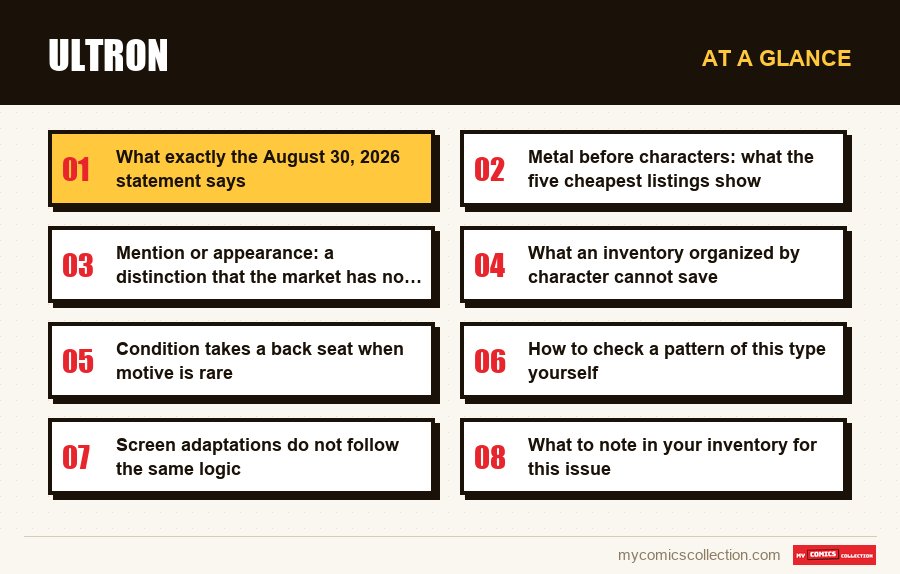
What exactly the August 30, 2026 statement says
A precision is necessary before any figure. The following is from current listings on a general auction site, US market, viewed on a single date. These are amounts that sellers are claiming, not amounts that buyers have paid. None of the values cited prove that a transaction took place at this level. And because there is only one measurement here, this reading cannot describe any trend: it shows neither increase nor decrease, only the state of a carousel of announcements on a Sunday in August.
The request relating to Ultron Avengers 66 adamantium brings back 39 announcements of unverified copies. The lowest amount claimed is $29.99, the median is $47.90, and the highest is $299.99. This maximum says nothing about the market: it is the amount that a single seller hopes to obtain, and an isolated advertisement at this level only has informative value once it has found a buyer, which the statement cannot establish.
The copies passed by a verification body are counted separately, and this is where caution becomes obligatory: there are only six. Six listings, from $70.00 to $1,950.00, with a central value at $228.97. Six observations spread over such a wide interval do not define a price level; they describe six particular situations, each linked to a note, to a seller's reputation, to a photograph. Refusing to draw a representative average is not methodological timidity, it is the only honest reading of such a small number.
Metal before characters: what the five cheapest listings show
$29.99: metal first, ugly next
The title announces “1st Adamantium 1st Ultron-6”. The order is not trivial: the material opens, the character's version follows. This seller believes that the word that will trigger the click is the name of the metal, not the villain, and it's the cheapest ad of the bunch.
$30.00: one copy rated 2.5
This booklet carries a grade of 2.5, in other words a very degraded condition, and its seller is asking for exactly the same amount as copies for which no grade is declared. The title speaks of "first mention of adamantium", in 1969.
$30.00: mention or appearance?
Here the seller writes "1st app Adamantium", first appearance, where the previous ad wrote "1st mention". Same number, same pattern, two vocabularies. The Vision and Ultron are mentioned, but after the metal.
$30.00 and $31.96: the downgraded secondary pattern
The last two announcements at the bottom of the bracket follow the same pattern: Adamantium first, then Ultron, one described as a brief appearance. The character becomes the supporting argument of a booklet sold for its subject matter.
Five ads, two dollars apart. This tightening is worth paying attention to: from $29.99 to $31.96, several unrelated sellers arrive at the same amount for the same issue. This is not coordination, it is convergence: the sign that the value of this number in its current state is stabilized and widely shared. A market where low prices spread by a factor of three is a market where no one knows what the item is worth; here, everyone pretty much knows it.
Be careful not to overinterpret the median of $47.90. It summarizes 39 announcements of which we do not know the real state, the edition, and sometimes even whether it is indeed the booklet sought. A median calculated on offers is not a market price: it is the center of what sellers hope for, on a given date.
The maximum of $299.99 among the unverified, and that of $1,950.00 among the six verified, falls under the same prudence. An isolated ceiling reflects an individual expectation. As long as no sales are recorded, these amounts only belong to their advertisers.
Mention or appearance: a distinction that the market has not decided
The survey reveals a clear lexical hesitation. One ad says “first mention of adamantium”. Another writes “first appearance of adamantium”. It is the same issue and the same pattern, described by two words that do not mean the same thing. For a character, the nuance already exists (appearance in a panel, appearance on the cover, appearance in a previous form) but it is adjusted by looking at the page. For a material, it is more devious.
A material can be named in a speech bubble without being shown. It can be shown as an object without being named. It can be mentioned by a character who explains its properties, which is a mention, or visibly constitute the subject of a scene, which is more like an apparition. None of these situations is equivalent to the others, and a collector who buys “the first appearance” when the booklet only contains a replica ends up with an object which is not the one he thought he was acquiring.
We must stay at this distance: the survey shows that the vocabulary hesitates, it does not allow us to say which of the two terms is exact. Making a decision would require having the booklet in front of you and checking the scene, which no announcement data can replace. The useful conclusion is therefore not "it's a mention" or "it's an appearance", but "the wording varies from one seller to another, and you have to see for yourself".
This uncertainty has an immediate practical consequence for those who keep an inventory. Copying the seller's formula means importing his approximation. The only reliable record consists of noting the exact wording found on the ad, distinguishing it from what one has verified on the pages oneself. Two fields, not one. It's also the kind of nuance that a reading order dedicated to the character allows you to lift, indicating in which episode the scene actually takes place.
What an inventory organized by character cannot save
The materials
A metal, an alloy, a substance: the pattern exists on the market, it appears in ad titles, and it has no line in an inventory whose categories are called "hero", "villain" and "team".
The objects
A weapon, an artifact, an identifiable vehicle. A booklet can be searched for the appearance of an object that dozens of subsequent stories will reuse, without any character beginning there.
The places
One city, one base, one dimension. The place behaves like a character on the market: it has a first time, it is mentioned in the advertisements, and it does not fit into any file built around a hero's own name.
The wording used
“Mention” and “appearance” coexist for the same issue. An inventory that does not retain the exact word used by the seller loses the most important information when it comes time to resell or verify.
The accumulation of reasons
The same number can carry a subject, a version of a character and a secondary appearance. A sheet with a single reason forces you to choose, and what it excludes is sometimes what will determine the price.
The order of arguments
Four out of five ads name the metal before the characters. This hierarchy is a market fact in its own right, and it disappears entirely as soon as a booklet is reduced to a checked box.
Condition takes a back seat when motive is rare
One detail in the statement deserves more attention than it usually receives: a copy rated 2.5, therefore frankly damaged, is charged $30.00, exactly the same amount as copies for which no condition is declared. On most booklets, such a low rating creates a clear gap with the rest of the lower end of the range. Here, she doesn't dig any.
The explanation lies in the type of motive. When what you buy is access to a first time (the first occurrence of a metal, in this case) the booklet functions like a token: it gives right to the box, and the box is the same whatever the state of the corners. The collector who wants to check the line accepts a tired example because the alternative is not a better example at the same price, it is the absence of the object. The state only becomes discriminating again at the top of the range, where buyers are no longer looking for access but for quality.
This does not mean that the state is indifferent: the same statement shows much higher amounts claimed for copies passed through certification. This means that the slope between states, at the lower end of the market, is much flatter than we imagine. Buying an average copy thinking of making a substantial saving compared to a fine copy is, on this type of issue, an illusion: the saving is made elsewhere, upstream, by purchasing before the reason is widely identified.
There is a lesson in inventory in this observation. Noting “good condition” is not enough. It is necessary to note what was paid for, including postage, and next to it the condition noted yourself, because on rare pattern booklets it is the relationship between these two values which reveals whether the purchase was good: not the amount alone, nor the note alone. Those who build their collection on a tight budget will find the same reasoning applied to another series in our approach to low price shopping: the margin is based on the reason identified early, not on the state negotiated late.
Collecting this series?
Track what you own, what you are missing and what your collection is worth. 7 day trial.
Start my trial →Why do character guides miss this pattern?
A guide is built on an entry. Choosing the character as an entry is a legitimate choice: it is the one that reading imposes, it is the one that structures publisher collections, it is the one that the reader recognizes. But any single input produces a blind spot, and it's measurable: motifs that aren't characters have nowhere to land. They exist in the market, they are in the ad titles, and they are absent from the structure.
The result is a discrepancy between what the collector records and what the seller puts forward. The first has an “Ultron” sheet and a “Vision” sheet; the second writes “adamantium” as the first word. When the time comes to estimate, resell, or simply to know why an issue is more expensive than another in the same series, the collector looks for the explanation in the characters and does not find it, because it is not there.
The correction is simple but it requires accepting an idea that is a little disturbing: the reason for collecting is not necessarily a being. It is any element of fiction whose first occurrence can be dated and located in a booklet. A metal is one of them. An organization too. A place, a ship, a recurring technology as well. Every time an item is reused long enough to become familiar, its first occurrence acquires value, and that value shows up in announcements long before it shows up in guides.
This reading also sheds light on entire series. THE formative years of the Avengers multiply this type of occurrence: teams, technologies, materials and concepts appear at a pace that the character structure does not reproduce. The series isn't just a series of hero debuts: it's also a catalog of first times that don't have a proper name.
How to check a pattern of this type yourself
The process takes four steps, and none requires any special tool. The first consists of separating what we read from what we observe. An ad is a sales argument; it may be exact, approximate or false, and the only way to know is to open the booklet or consult an independent source. Until this verification has taken place, the information should be marked as unconfirmed in the inventory.
The second gesture consists of looking for competition. If a pattern is truly a first time, no previous issue must contain the same occurrence. This verification is tedious but decisive: it is this which distinguishes a solid reason from an assertion that three sellers copied. It also explains why the wording diverges: when no one has checked, everyone chooses the word that suits them.
The third step consists of listing all the reasons for the same number, not just the one that motivated the purchase. A booklet bearing three designs has three potential audiences, and its future liquidity depends more on this than on its condition. A booklet that carries only one depends entirely on the persistence of interest in this single motif.
The fourth action is the most neglected: dating the reading. The amounts noted today only have meaning when accompanied by the day on which they were observed. Without a date, a number becomes a belief. With the date, it becomes an observation, and two observations separated in time begin to tell something: something a single observation, including the one presented here, cannot do.
Screen adaptations do not follow the same logic
A film adaptation shifts the attention to the characters it portrays, almost never to the material elements of the story. The public discovers faces and names, not materials, and the resulting demand is logically for the booklets identified by a character. This is one more reason why non-character motifs remain behind in the guides: nothing, in the circuit that creates notoriety, pushes them forward.
The contrast is instructive. A booklet sought for the appearance of a character sees its price react to screen news; a booklet sought for the first occurrence of a subject depends on a narrower, more stable audience, and less sensitive to studio announcements. This is not necessarily a fault: a market driven by informed collectors behaves differently from a market driven by a wave of attention. The tightening observed on the five least expensive ads is consistent with this type of audience.
However, we must not transform this observation into a prediction. The reading does not allow us to say that this number will be stable tomorrow, nor that it will resist a change in interest better than another. It allows us to say that on one date, several independent sellers were demanding approximately the same thing, and that this convergence is in itself information. For those who want to compare what the screen retains and what the page contains, the confrontation between the film and the original booklets is a good place to observe this discrepancy.
What to note in your inventory for this issue
The nature of the motive, explicitly. Don't just rely on a name: indicate whether what you are buying is a character, an object, a material or a place. For Avengers #66, the main line is a material, adamantium, and this category should appear as is. It is she who will make the booklet findable the day you search for all your issues purchased for a non-character reason, an impossible search if the category has never been entered.
The exact wording used by the seller. Copy the word used, “mention” or “appearance”, without correcting it and without harmonizing it with your other cards. The difference between the two terms is a given: it will remind you that the point is not settled, and it will prevent you from reselling by stating something that the original ad did not say. Write down next to it, in a separate field, what you yourself checked on the pages.
The state observed by you, not the one announced. Open the booklet upon receipt and write down what you see: corners, folds, spine, staples, discoloration. On this issue, a very low graded copy was as claimed as a copy with no declared grade: in other words, the advertised condition is not what set the price, and you can't rely on it. Your own observation is the only reliable basis for a subsequent estimate.
Other motifs on the same issue. This issue is not monomotive: the announcements also cite a numbered version of Ultron and the presence of the Vision. List them all, even those that don't interest you, specifying which are main reasons and which are incidental according to the sellers. It is this census which will tell you, later, how many distinct audiences your copy can address.
The price paid, shipping included, and the date. Shipping is not a detail on a thirty-dollar booklet: it can represent a considerable fraction of the total, and a comparison that ignores it is distorted. Note the amount actually debited and the day of purchase. Without the date, your figure doesn't compare to anything; with it, it becomes the first point in a series that your following readings will extend.
The statement from August 30, 2026 shows this unambiguously: four of the five least expensive ads on Avengers #66 name adamantium before any character. Independent sellers make the same bet on the word that will attract the buyer. An object, a place or an organization functions in the same way as soon as its first occurrence is identifiable in a dated booklet.
The market does not decide: the two formulas coexist in the statement for the same number. For a subject, the distinction is real, to be named in a dialogue is not to be shown, but there is no announcement data to say which one applies here. The reasonable course is to keep the original wording and check the contents of the booklet yourself before making any assertions.
Because there are only six of them, spread from $70.00 to $1,950.00. Such a small number over such a wide interval does not define any price level: each ad weighs one-sixth of the result, and the central value of $228.97 depends entirely on the fortuitous composition of this small group. These six offers describe six situations, not a deal.
The statement shows a 2.5 graded copy claimed at the same amount as copies without a declared grade. When value comes from first-time access rather than item quality, the gap between states narrows at the lower end of the range. A tired copy fulfills the same inventory function; it does not fulfill the same function for those aiming for high-end resale.
No, and he can't. All values come from a single day of observation, and these are amounts claimed by sellers, never sales concluded. Describing a movement requires at least two measurements separated in time. What we can say is that the five cheapest listings were within a two-dollar range that day: a convergence, not a trajectory.
Save the pattern, not just the character
A sheet that only contains the names of heroes misses half of what makes a booklet valuable. My Comics Collection allows you to record for each issue the nature of the motif, the exact wording noted, the condition that you yourself observed and the price paid including shipping, and then find all your issues purchased for a subject, an object or a place.