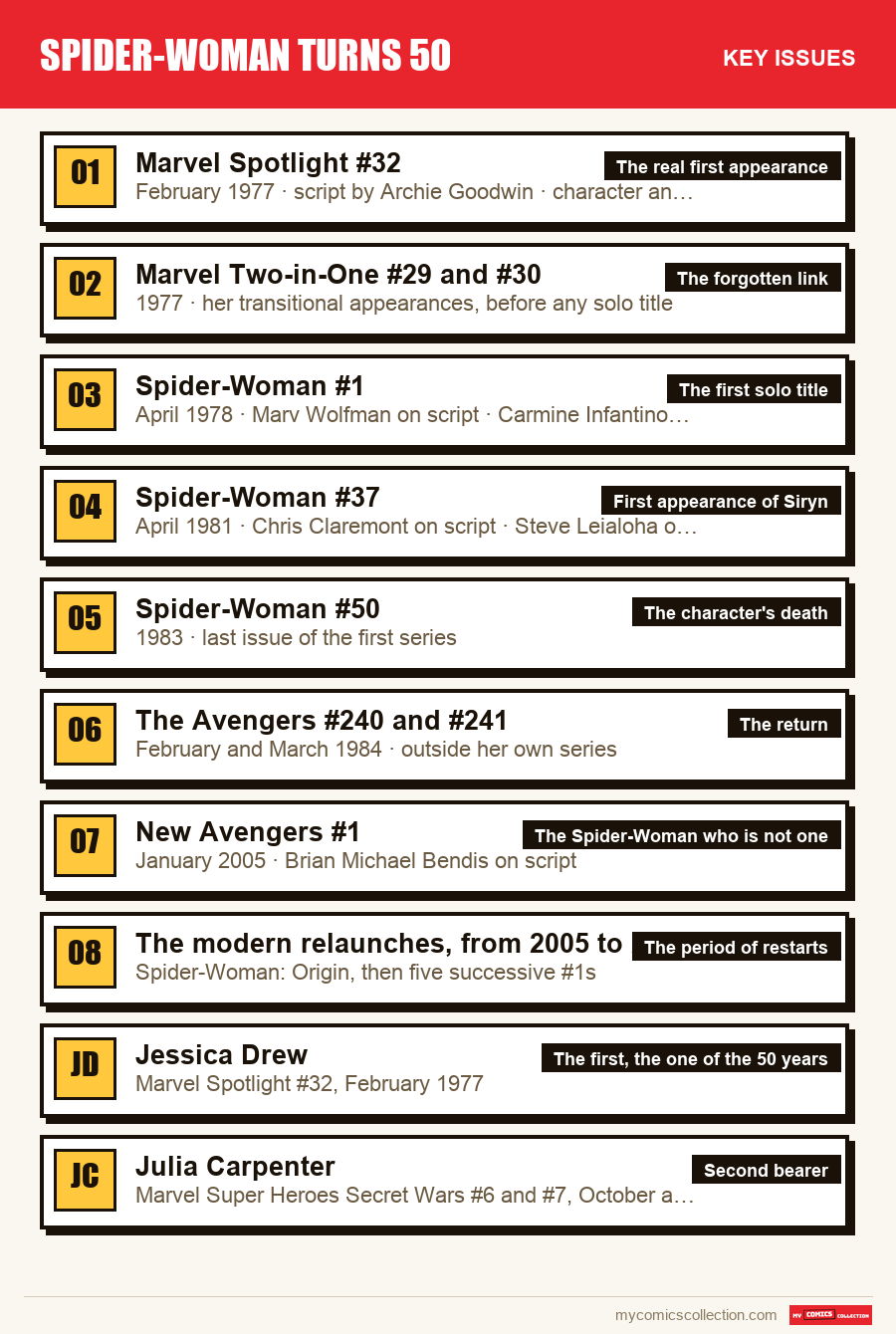
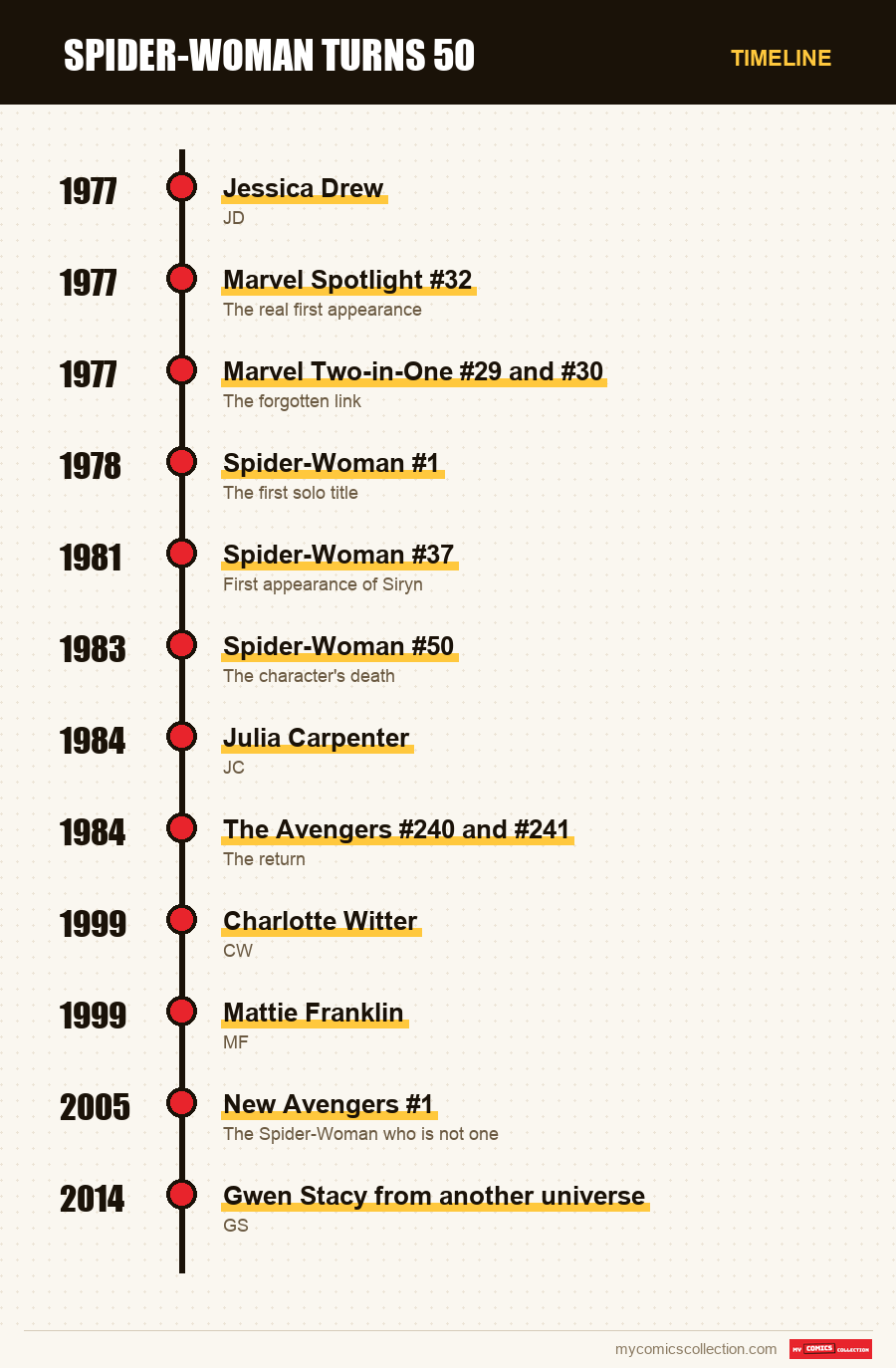
Jessica Drew first appears in Marvel Spotlight #32, dated February 1977, on a script by Archie Goodwin and based on a character conceived and costumed by Marie Severin. It is the only issue that is her first appearance, and that is precisely where buyers go wrong: at least five different women have carried the name Spider-Woman, each with her own first issue. Julia Carpenter appears in Marvel Super Heroes Secret Wars #6 and #7 (1984), Mattie Franklin takes up the costume in Amazing Spider-Man vol. 2 #5 (May 1999), Charlotte Witter arrives in the same issue on the antagonist side, and the Gwen Stacy of Edge of Spider-Verse #2 (2014) is the Spider-Woman of her universe. A Spider-Woman #1 announced for November 2026, with Carnage opposite, celebrates the character's fiftieth anniversary.
A character's fiftieth anniversary almost always produces the same effect on the secondary market: demand concentrates on one issue, and sellers realign their listings on the keyword being searched. In Spider-Woman's case, this mechanism runs into an obstacle few Marvel franchises face to this degree. The name does not belong to a single person. It has been assigned, taken up, stolen and varied over nearly forty years, by different writers and artists, in different titles, each time with a perfectly real and perfectly distinct "first appearance."
The result is measurable in listings. A search on "Spider-Woman first appearance" brings back, depending on the seller, an issue from 1977, 1984, 1999 or 2014. The four answers are defensible if you specify who you are talking about, and all four are wrong if you do not. This article therefore fixes the map of the name's bearers, then runs through the pivotal issues of Jessica Drew, the one whose anniversary Marvel is celebrating. We write on October 2, 2026: the new Spider-Woman #1 has not come out, no copy is circulating, and there is no market value for it.
November 2026: what is confirmed, and what is not
Marvel has dated for November 2026 a Spider-Woman #1 presented as the marker of the character's fiftieth anniversary, with Carnage as the antagonist. That is the essential of what is public at the time of writing, and you have to stick to it. November 2026 is also the month of Friendly Neighborhood Mary Jane #1, Jean Grey #1 and Predator vs. Punisher #1: the publisher is making several launches coexist, which is not neutral for anyone wanting to buy in store on release day.
What is not confirmed deserves as much attention. The series' length has not been announced as a closed miniseries, so you must refrain from treating it as one. The detail of the variant covers is not published. And a major convention takes place from October 8 to 11, 2026: clarifications are expected there, but nothing has been said there yet as these lines are written. Any announcement you see attributed to this event before mid-October is an invention.
One structural point, however, is already legible. It is the fourth or fifth relaunch of a solo series under the name Spider-Woman since 2009, depending on how you count the miniseries. This frequency says two opposite things and both are true: Marvel judges the character solid enough to deserve a regular title, and that title has never lasted long enough to settle in. It is neither good nor bad, it is a datum.
Marvel Spotlight #32: a first appearance born of a trial title
The 1977 context explains almost everything about this issue. Marvel Spotlight was not a series: it was a testing ground, where the publisher placed new characters to gauge readership reaction before committing to a regular title. The same device had already produced Werewolf by Night in issues 2 to 4, Ghost Rider from issue 5, the Son of Satan in issues 12 and 13, and Moon Knight in issues 28 and 29. Spider-Woman arrives at the end of this logic, in issue 32.
Direct consequence for the collector: Jessica Drew's first appearance is not a #1. It is buried in the middle of an anthology whose title does not carry her name, which makes this type of issue durably under-identified, and explains why a hurried buyer spontaneously looks for a Spider-Woman #1, which exists but is not the first appearance.
Marvel Spotlight #32
The only issue that is Jessica Drew's first appearance, and the starting point of the fifty years celebrated in November 2026. Public credits are constant on two names: Archie Goodwin on script, Marie Severin for the conception of the character and her red and yellow costume. This costume matters: it has returned without major modification several times, including after a complete redesign in the early 2020s.
Marvel Two-in-One #29 and #30
Between the Marvel Spotlight trial and the launch of her series, Jessica Drew passes through the Thing's team-up anthology, where she shares the bill over two issues, one alongside Shang-Chi. They are nothing like a first appearance but they have a practical use: much easier to find than the 1977 issue, they count among the character's very first appearances. It is often where you start when you want an old piece without aiming for the key.
The pivotal issues of Jessica Drew
Once the first appearance is set aside, Jessica Drew's career reads as a succession of clean breaks: killed in her own final issue, resurrected elsewhere, replaced for years by an extraterrestrial, then given back to herself. Each of these moments produced an identifiable issue.
Spider-Woman #1
The first issue of the first series, the one that will run fifty issues until 1983. The starting team has weight, and the series will change hands several times along the way: it is this rotation, notably the arrival of Chris Claremont, that will produce its most sought-after issues.
Spider-Woman #37
The most interesting issue of the run, and the least intuitive. It is here that Theresa Cassidy appears, future Siryn, daughter of Banshee and future member of X-Force, and she debuts on the wrong side of the plot. In other words: a Spider-Woman issue is actually a mutant key, published in the middle of Claremont's run on the X-Men.
Spider-Woman #50
The series ends on the death of its heroine, facing Morgan le Fay. It is a frank ending, not a fizzling cancellation, and it has two effects: issue 50 becomes a collecting target in its own right, which is rare for a final issue of the 1980s, and it creates a narrative gap that Marvel will fill less than a year later, elsewhere.
The Avengers #240 and #241
The resurrection does not take place in a title bearing her name but in the Avengers series, less than a year after issue 50. Almost no listing flags it, because nothing on the cover announces it. For anyone building a followed collection rather than a pile of keys, this two-parter is nevertheless the link without which what follows cannot be explained.
New Avengers #1
The trickiest trap of the character's whole career. The Spider-Woman who joins this team, and who will play a central role in it for years, is not Jessica Drew: it is Veranke, Skrull queen, who took her place and her appearance. The writer stated that he planned it from this first issue, and the revelation will only come during Secret Invasion.
The modern relaunches, from 2005 to 2024
The miniseries Spider-Woman: Origin, launched in late 2005 by Brian Michael Bendis and Brian Reed with the Luna brothers on art, resets the origin. A series signed Bendis and Alex Maleev follows, two Dennis Hopeless titles in the mid-2010s, then a series by Karla Pacheco drawn by Pere Perez from March 2020. Each of these relaunches has its own #1.
The most consequential of the lot is the 2015 #1, which opens on a heroine in her second trimester of pregnancy and will give a son named Gerry. The choice was debated at the time and proved structuring: the child became a permanent engine, taken up through the 2024 story where he is kidnapped by Hydra, artificially aged and turned against his mother.
The map of the name's bearers, and the issue that goes with each
The name Spider-Woman has never been protected inside the fiction: it was taken up with no lineage, sometimes against Jessica Drew's wishes, sometimes in another universe. Here is what each possible answer to the question "what is Spider-Woman's first appearance" covers.
Jessica Drew
The only one to whom the November 2026 anniversary refers, and the only one whose first appearance is found in the 1970s. If a listing says "first appearance of Spider-Woman" with no further precision and offers an issue after 1977, it is talking about another person, consciously or not.
Julia Carpenter
The second Spider-Woman is born in the middle of Marvel's first great summer crossover. Her case illustrates the distinction that costs the collector most: issue 6 is a partial appearance and issue 7 the first full appearance. Both issues sell, at different levels, and the gap is justified only by this nuance.
Mattie Franklin
Third bearer, and the most tangled file of the five. Records do not agree on her very first appearance in civilian identity: some point to an issue of Spectacular Spider-Man from the mid-1990s, others to the pair formed by Spectacular Spider-Man #262, in shadow, and Amazing Spider-Man #441, in autumn 1998. However, the date she takes up the costume does not move from one source to another: Amazing Spider-Man volume 2 #5, May 1999, in a three-part story that leads directly into the launch of her own series.
Charlotte Witter
Fourth bearer, and the only one introduced as an adversary. She appears in the same issue as Mattie Franklin's taking up the costume: a single issue therefore contains two events of first importance concerning two different Spider-Women, and an honest listing must specify which of the two it highlights.
Gwen Stacy from another universe
In her home universe, she is the local Spider-Woman: it is the name her costume carries, not a fan nickname. The public knows her under other names, and her title changed banners along the way. The issue where she first appears is one of the most identified modern keys in the catalog, therefore the most likely to be confused with that of 1977 by a buyer who knows only the name.
Carnage opposite: what the bill moves, and what it does not
Pitting Carnage against Jessica Drew is a legible publisher choice: he is the most bankable antagonist in Spider-Man's neighborhood, the one whose presence on a cover is enough to raise a store order. For an anniversary issue whose heroine has never had a solidly established rogues gallery, it is an immediate attention lever.
The consequence to anticipate is known and mechanical. When a highly sought-after antagonist is announced on a title with a more modest print run than his own, pressure shifts first to his own old keys, not to the new issue. Carnage's first full appearance, in Amazing Spider-Man #361 of April 1992, is already one of the most followed issues of the early 1990s, and it owes nothing to this launch. Buying the November 2026 #1 to bet on Carnage amounts to buying the vehicle instead of the passenger.
What the bill does not move, however, is the hierarchy of Jessica Drew's issues. Marvel Spotlight #32 will remain her first appearance whatever happens in November, and the 1981 Spider-Woman #37 will remain a mutant key. An anniversary revives demand on existing issues: it does not create new ones.
Buying without getting the Spider-Woman wrong
Four reflexes are enough to eliminate most of the risk of error on this character.
Demand a person's name, not a costume name
Before any purchase presented as a Spider-Woman first appearance, ask who it is. Jessica Drew, Julia Carpenter, Mattie Franklin, Charlotte Witter or a Gwen Stacy from another universe: each has her issue, and the scarcity gaps between these issues are considerable. A listing that refuses to specify tells you something.
Distinguish partial appearance from full appearance
Julia Carpenter's case on the 1984 issues 6 and 7 is the textbook example, and the same caution applies to Mattie Franklin's shadow appearances. On a CGC-graded issue, the label generally mentions this nuance: read it in full rather than stopping at the grade.
Check the title's banner and numbering
Marvel Spotlight exists in two volumes, and Amazing Spider-Man has been renumbered several times. A volume 2 #5 is not a volume 1 #5, and a cover reused in a reprint is not an original edition. The publication year printed on the issue almost always settles the doubt.
Decide before November, not during
An anniversary #1 concentrates attention over a few weeks. If your target is the 1978 run or the 1977 key, finalize your list now, while demand is still on something else. If it is the November issue, place an order with your bookstore: 2026's sellouts have been numerous on much less anticipated titles.
One underlying question remains that the anniversary makes more visible than usual. Jessica Drew's mainstream fame rests in part on a sixteen-episode cartoon, aired from September 22, 1979 to January 5, 1980, Marvel's first animated series led by a heroine. Fifty years later, she still has no live-action adaptation in her name. That is both what has kept her old issues at moderate demand compared to other 1970s first appearances, and what leaves a margin that few characters of this caliber retain. A fiftieth anniversary guarantees nothing: it only indicates that the publisher keeps investing. To build around her rather than around a single issue, the reasonable entry points are the two 1977 transitional appearances, the run started in 1978, and an estimate of what you already own before deciding.
Frequently asked questions
That of Jessica Drew, the first to carry the name, is Marvel Spotlight #32, dated February 1977. The script is by Archie Goodwin and the character and her costume were conceived by Marie Severin. It is this issue, and no other, that makes the fifty years celebrated in November 2026. Any listing offering a later issue as the "first appearance of Spider-Woman" is actually talking about another bearer of the name: Julia Carpenter in 1984, Mattie Franklin or Charlotte Witter in 1999, a Gwen Stacy from another universe in 2014. These issues exist and have their own value, but they are not interchangeable with the 1977 one.
No. Spider-Woman #1, dated April 1978, is the first issue of her first solo series, written by Marv Wolfman and drawn by Carmine Infantino. The character's first appearance predates it by more than a year, in the anthology Marvel Spotlight. The confusion is frequent because an issue bearing the character's name naturally seems to be her starting point. For a collection, this #1 is an interesting run-entry piece and clearly more affordable than the origin key, but it does not replace it and should not be paid for as such.
At least five significantly in main continuity or in an identified universe: Jessica Drew since 1977, Julia Carpenter since 1984, Mattie Franklin and Charlotte Witter since 1999, and the Gwen Stacy of a parallel Earth since 2014. Several versions from alternate universes are added, including a variation that appeared in the Ultimate line in 2006, born of a Peter Parker clone. This proliferation is the reason the name alone is never enough to identify an issue: you must always go back to the name of the person wearing the costume.
Because it contains the first appearance of Theresa Cassidy, future Siryn, daughter of Banshee and future member of X-Force. The issue is written by Chris Claremont and drawn by Steve Leialoha, in April 1981, right in the period when Claremont was reshaping the mutant franchise. It is therefore a key of the X-Men universe lodged in a series that does not carry their name, which makes it regularly invisible in bins sorted by title. For an attentive buyer, it is one of the few mid-run issues of that era that deserves an active search.
No, and that is deliberate on the writer's part. The Spider-Woman who joins the team in New Avengers #1, in January 2005, is Veranke, Skrull queen who took on Jessica Drew's appearance and place. The substitution is only revealed during Secret Invasion, several years of publication later, and Brian Michael Bendis stated that he planned it from this first issue. Concretely, for a collector, this means a whole period of important Spider-Woman appearances are not appearances of Jessica Drew. The precision changes the meaning of a listing.
If you want to read it, yes, and preferably by reserving it at a bookstore rather than counting on restock: 2026 has multiplied sellouts on less anticipated titles. If you buy it betting on a gain, know that no market value exists for an unreleased issue, that an anniversary #1 is generally printed accordingly, and that the character has already had several #1s since 2009. Carnage's presence supports attention but creates no scarcity. An abundant #1 remains an abundant #1, whatever the cover.
A partial appearance shows the character incompletely: in shadow, from behind, in a single panel, or only under her civilian identity. The full appearance shows her identifiable and fully present. The value gap between the two can be significant, and the name Spider-Woman provides two textbook cases: Julia Carpenter, partial in issue 6 of the 1984 crossover then full in issue 7, and Mattie Franklin, whose first appearances include a silhouette in shadow. On a CGC-graded copy, this nuance appears on the label: it is read in full, not just the numerical grade.
In animation, yes, and early: a sixteen-episode series aired from September 22, 1979 to January 5, 1980, co-produced by the publisher's animation arm. It has the distinction of being the first Marvel animated series led by a superheroine, the character remaining at the center even when other heroes appeared in it. In live action, however, she has no adaptation in her name to date. It is one of the elements that explain why her old issues remain less contested than those of characters from the same decade who moved to cinema.