The run of G. Willow Wilson on Poison Ivy was born from a short story published in Gotham City Villains Anniversary Giant #1 (art by Emma Rios), which became a six-issue miniseries announced in March 2022 for DC's Pride Month, extended to twelve in August 2022, then turned into a regular series in February 2023. Issue #1 came out on June 7, 2022, drawn by Marcio Takara. Forty-eight issues have appeared to date, all written by Wilson and all covered by Jessica Fong. The run turned Pamela Isley into mayor of Gotham (#42), delivered a new origin (#19 to #21) and served as the engine of the Bad Seeds event from August to October 2026. #50 is set for December 2026.
There are a handful of DC villains able to carry a solo series. There are far fewer able to carry it for fifty consecutive issues, with a single writer in the credits and with the title changing neither name, volume nor numbering along the way. That is precisely what the Poison Ivy series launched in June 2022 is accomplishing, and it is why it deserves a separate look.
G. Willow Wilson's run is not one more origin reread. It is a series that moved the character up a notch in Gotham's editorial hierarchy: from an occasional Batman adversary, Pamela Isley became in four and a half years an autonomous protagonist, with her own supporting cast and finally an elected office that triggered a city-wide crossover. For a collector, this changes the question: you are no longer looking for an impossible-to-find old issue, you are looking for which issues of an abundant modern series will still make sense in ten years.
This article starts where the character's history in comics leaves off. Her first appearance, in Batman #181 of April 1966, is covered in detail in that dedicated guide, and we do not return to it here. What follows concerns the modern run: its structure, its pivotal issues, the characters it created, the role of Bad Seeds, and the economics of a long series whose making is documented week after week.
Where the run starts: eight pages, a miniseries, then a regular series
The starting point is not Poison Ivy #1. It is a short story of a handful of pages titled "Ophiocordyceps Lamia," published in Gotham City Villains Anniversary Giant #1, a late-2021 anniversary collection devoted to Gotham's villains, whose contents also lined up a Penguin segment written by Danny DeVito and drawn by Dan Mora. Wilson writes the Poison Ivy segment there, drawn by Emma Rios. This segment introduces two elements the whole run will exploit: the parasitic fungus named Ophiocordyceps Lamia, and a human resources employee at a chemical plant who will stay in the title's lexicon under the name Janet-From-HR.
Wilson herself stressed the improbability of what followed, in an interview published by DC in February 2025 at the time of the thirtieth issue: the series was born from an eight-page short story that became a six-issue miniseries, and getting a regular series order from such a thin base is, by her own admission, unusual. The editorial timeline, for its part, is documented:
March 2022: announcement of a six-issue miniseries
DC includes the project in its Pride Month program. Announced team: Wilson on script, Marcio Takara on art, Arif Prianto on colors, Hassan Otsmane-Elhaou on lettering. Jessica Fong is on the main cover.
June 2022: #1 arrives in stores
Released June 7, 2022. The story picks up after "Fear State": Ivy is stripped of her powers and dying, and undertakes a last journey to put an end to the human species. The narration goes through the letters she writes to Harley Quinn.
August 2022: extension to twelve issues
DC doubles the order before the end of the first arc. Atagun Ilhan joins Takara to illustrate the second arc.
February 2023: move to a regular series
The miniseries becomes an open-ended monthly title, with no numbering reset. It is this decision that makes reaching a fiftieth issue possible.
December 2026: #50
DC's December 2026 schedule lists Poison Ivy #50 as a milestone of the run. Forty-eight issues had come out by late September 2026.
One detail matters for anyone wanting a collection with no gaps: the pace was not strictly monthly. The title skipped July and August 2023, the two months during which Wilson and Atagun Ilhan delivered the two-part Knight Terrors: Poison Ivy miniseries for the event of the same name. It also skipped August 2024 and July 2025. In other words, the numbering is continuous but the calendar is not, and a listing by release date will produce voids that are not missing issues.
What the run does with the character
Wilson described her project as "a love story from a villain's point of view." The phrase hides more structural work, and three shifts explain why the series lasted where so many solo titles of second-string villains stop at the twelfth issue.
Batman leaves the frame. The series takes place in the Batman universe without being a Batman title, and the Dark Knight is not its engine. Critics were divided on this: Wilson was criticized for missing the Ivy/Batman relationship, and exactly the opposite was praised. In both cases, the finding is the same, it is a series whose main character needs no guardianship.
Organic horror becomes the register. Plant and fungal body horror is the run's dominant texture, and Wilson acknowledged it was new ground for her. The Ophiocordyceps Lamia is no gimmick: it is a parasitic fungus presented as present on Earth since the origins, and the vector by which Ivy plans to end humanity. This choice pulls the series toward genre and gives it an identity that changes of artist have not erased.
Ecology serves as the engine, not the backdrop. Wilson formulated the ridge line sharply: Ivy kills, regularly, for motives the reader understands, and the writing problem consists in never glorifying the act while conveying the urgency. It is this thread that leads the character to the mayoralty, and that earned the series the GLAAD Media Award for best comic book at the thirty-fifth GLAAD Media Awards ceremony.
The trajectory over four and a half years is a descent then a climb back: attempt to eradicate humanity, change of course, clashes with other plant elementals, involuntary inheritance of a cult, then a political career. The relationship with Harley Quinn runs through the whole run intermittently, while Janet-From-HR settles in as a central figure of the entourage. To place this couple in the DC catalog, the Harley Quinn universe in comics gives the detail of the series concerned.
The run's pivotal issues
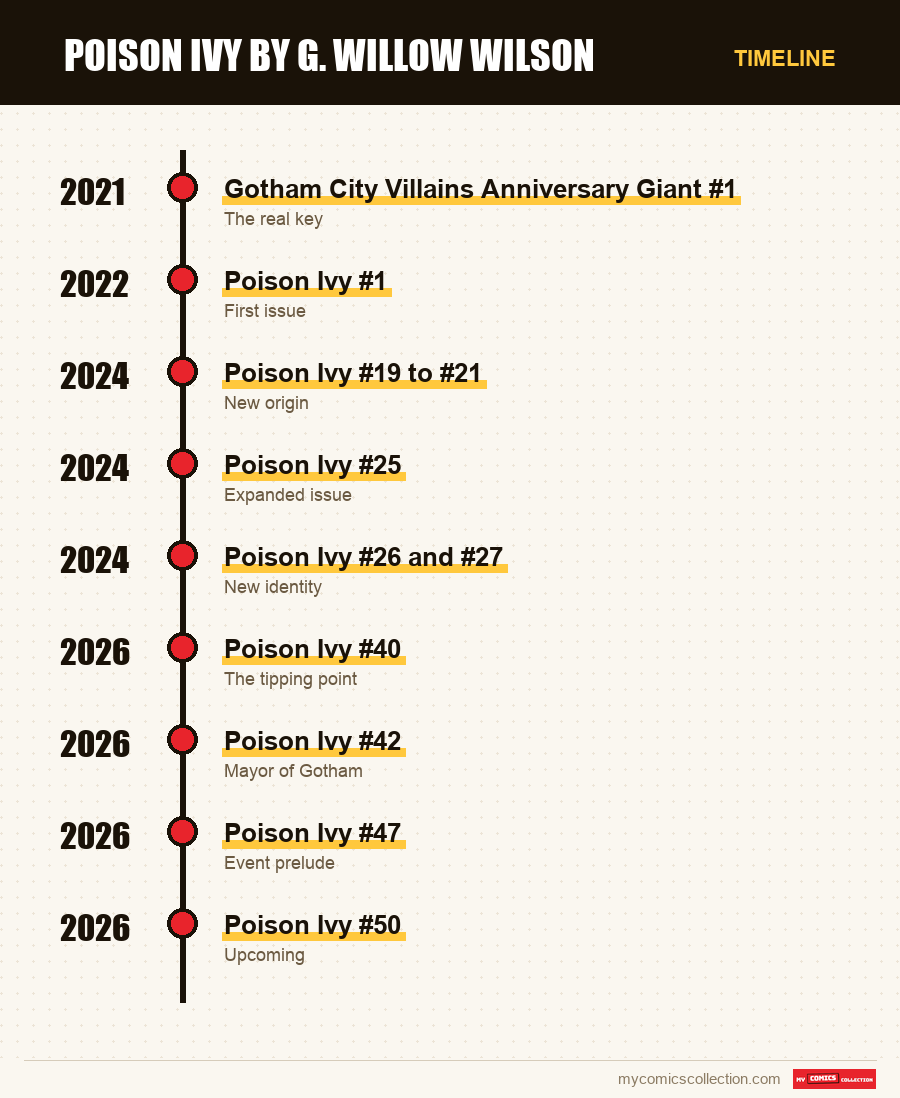
In a series of fifty issues all available, the question is not scarcity but function: which issues do something the others do not. Here are the pivots, in order of narrative importance.
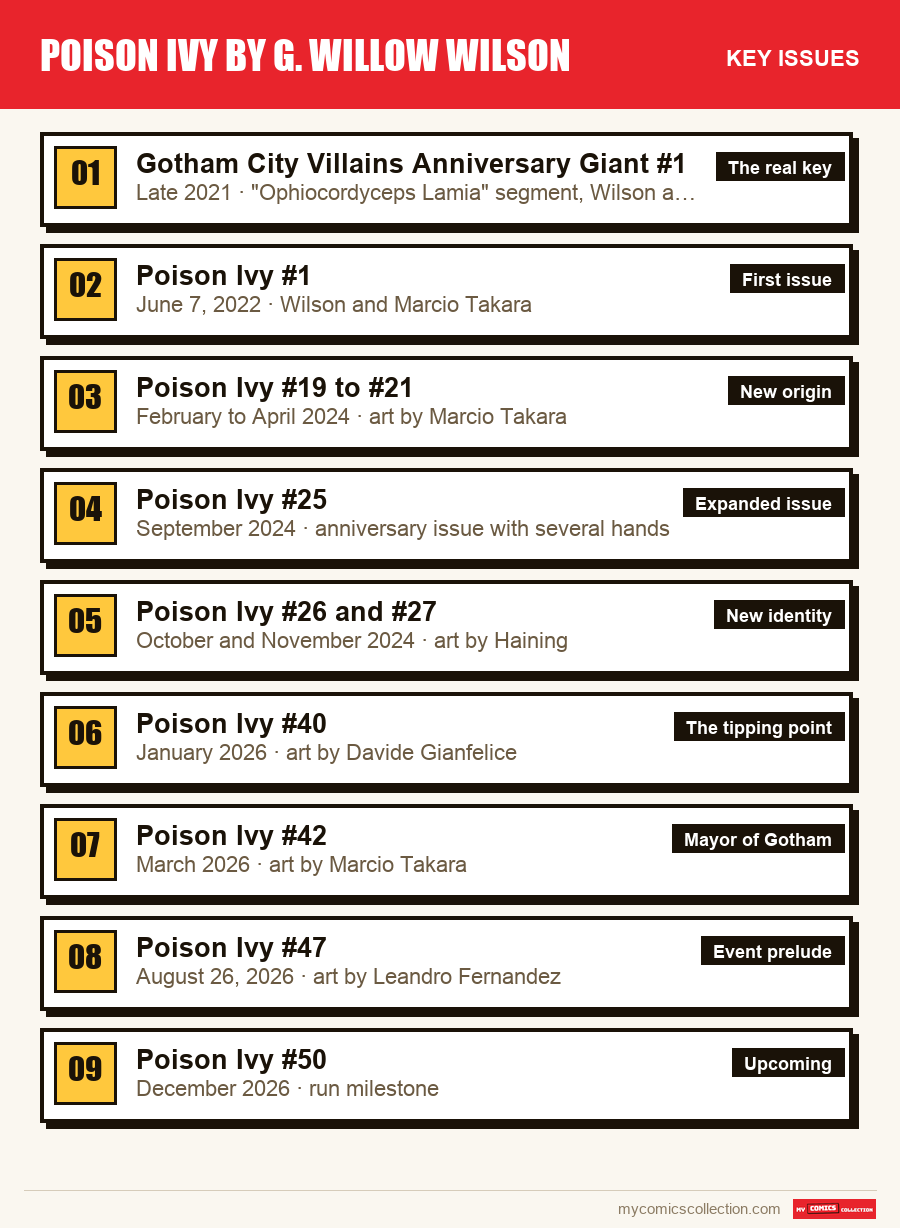
Gotham City Villains Anniversary Giant #1
The run's prologue, and the issue the lists forget because it is buried in a multi-character anniversary collection, ordered for its overall contents and not for this segment of a few pages. Yet it is where Janet-From-HR and the fungus that structures the first twelve issues are born.
Poison Ivy #1
The launch, and by far the run's most abundant issue: seven covers, namely a main one by Jessica Fong, a variant by Warren Louw, a 1:25 incentive by Nick Robles, a 1:50 incentive by Frank Cho and Sabine Rich, a DC Pride variant by Kris Anka, a team variant by Dan Mora and a cover by Will Jack. Average of 8.9 out of 10 across the first fifteen aggregated reviews.
Poison Ivy #19 to #21
Three issues that retake the character's origin, from the biochemistry student to the metamorphosis. It is the run's most commented arc, because it puts back in play a foundation set in 1988. #21 is read as the issue where Pamela Isley takes back the narration of her own story, without the filter of an outside narrator.
Poison Ivy #25
The only issue of the run to open its contents to other pens: around Wilson's story, segments signed Joanne Starer, Grace Ellis, Gretchen Felker-Martin and Dan Watters, drawn by Haining, Brian Level and Atagun Ilhan. On covers, a main one by Jessica Fong, a variant by Noobovich and two 1:25 incentives by Marcio Takara and Brian Bolland.
Poison Ivy #26 and #27
#26 introduces the Order of the Green Knight, the cult Ivy inherits in spite of herself. #27 is the issue where she takes on the Green Knight identity, the first major alias added to the character in decades, and the one where the run begins to give her the command experience that will make her move into politics credible.
Poison Ivy #40
The issue that brings Ivy back to Gotham and puts her in the presence of Vandal Savage, now police commissioner. The offer is simple: work for the city rather than against it, under the guardianship of an artificial intelligence magnate, Marie Henley. Ivy kills her in the middle of the street, and the scene is filmed. Everything that follows flows from there.
Poison Ivy #42
An acquittal and a reversed public opinion later, Pamela Isley becomes mayor of Gotham, and the alias of Mayor Isley appears in this issue. The irony is complete: an elected eco-terrorist now heads, on paper, Commissioner Vandal Savage.
Poison Ivy #47
The official prelude to Bad Seeds, released the same day as the event's first chapter. Main cover by Jessica Fong, variants by Noobovich, Kyuyong Eom and Manny Vincent Carbonilla. The pitch fits in one sentence: Gotham is done with Mayor Isley, but Mayor Isley is not done with Gotham.
Poison Ivy #50
The fiftieth issue, listed on DC's December 2026 schedule. It arrives just after the event's exit, which makes it a rebuilding issue: what becomes of a city returned to plant prehistory, and what becomes of a mayor who delivered it. The issue's art team has not yet been published.
The first appearances the run created
It is the point where a long modern run stands apart from a mere string of episodes: it manufactures heritage. Over forty-eight issues, Wilson introduced a whole cast, and it is that cast that gives the intermediate issues a reference value. The identified creations, in order of appearance:
- Janet-From-HR and the Ophiocordyceps Lamia, in Gotham City Villains Anniversary Giant #1, credited to Wilson and Emma Rios. Janet Mitchell went from human resources employee to the most lasting figure in Ivy's entourage.
- Beatrice Crawley: unnamed cameo in #6, full first appearance and name reveal in #7.
- Gwendolyn Caltrope: in #10, in the group contaminated by the fungus.
- Undine Holdings and Peter Undine: the company appears unnamed in #13, Peter Undine in image in #14 then fully in #15. The industrial antagonist of the run's second third.
- Greensteel: sketched in #14, named and developed in #15.
- Tuuru, first designated as "the Tree of Life": in #24.
- The Order of the Green Knight: in #26.
- Ed Cooper: name revealed and origin in #31.
- Marie Henley and Juhi Prakash: in #40.
A useful clarification, because the confusion is frequent: Bella Garten, the Gardener, is not a creation of this run. She was created by James Tynion IV and Jorge Jiménez and first appears in Batman (vol. 3) #107. She comes into Ivy's entourage, and the off-series Batman Secret Files: The Gardener #1 is collected in the run's first bound volume, which explains the misunderstanding. Confusing the two amounts to looking for a key in the wrong title.
The run also produced side issues that count in a complete collection: Knight Terrors: Poison Ivy #1 and #2 by Wilson and Atagun Ilhan in summer 2023; Poison Ivy: Uncovered #1 the same summer, written by Jessica Berbey and drawn by Claire Roe under a Guillem March cover; Poison Ivy/Swamp Thing: Feral Trees #1 in fall 2024, by Wilson and Mike Perkins; and the annual Poison Ivy 2025 Annual #1, "Lake, Maiden, Sword," by Wilson and Mark Buckingham, in late 2025.
The successive artists, and what the rotation changes
A series of fifty monthly issues does not hold on a single artist, and this one never claimed otherwise. The succession, as the credits document it, is as follows:
- Marcio Takara: #1 to #5, #9 to #16, #19 to #21, #33 to #35, #38 and #39, #42. He defines the title's graphic vocabulary and returns to it at each structuring arc.
- Brian Level: #6, then #31 and #32.
- Atagun Ilhan: #7 and #8, then #36 and #37, plus the two Knight Terrors.
- Luana Vecchio: #17 and #18.
- Haining: #22 to #30, the run's longest continuous sequence after Takara, and the one covering the Order of the Green Knight.
- Davide Gianfelice: #40 and #41, hence the political tipping point.
- Jaime Infante: #43 and #44.
- Leandro Fernandez: #45 to #48, the whole Bad Seeds block.
Three constants explain why the series stays recognizable despite eight artists: Arif Prianto on colors and Hassan Otsmane-Elhaou on lettering since #1, and above all Jessica Fong, who signed the main cover of all forty-eight issues released. In an industry where main covers change hands every six months, it is an almost isolated case, and it gives the run a visual spine legible at a glance on a shelf. For a collector, the rotation remains operational information: it cuts the run into coherent blocks better bought together than one by one.
Bad Seeds: what a solo run gains by becoming an event
DC announced Batman: Bad Seeds on May 21, 2026, for a start in August and a run through October. The setup is presented as a Gotham-wide crossover, held over a single night of story, and spread over ten weeks of release. Matt Fraction, then on Batman, and G. Willow Wilson are its showrunners.
The narrative mechanism comes entirely from the solo run. To obtain immunity after a murder committed in #38 and protection against Vandal Savage, Mayor Isley cedes Gotham to the Parliament of Trees. The city loses power and network early in the evening and begins to transform: buildings swallowed by vines, streets invaded by carnivorous flora, neighborhoods brought back to a primitive state. At the same time, the municipal police, under paramilitary control, prepare a toxin meant to kill Ivy that would cause thousands of collateral victims. The published release structure is as follows:
Prologue in the solo run
Poison Ivy #45, #46 and #47. #47, of August 26, 2026, is the officially stamped prelude.
Launch: Batman: Bad Seeds: Sunset #1
Also on August 26, 2026. Fraction and Wilson on script, Giuseppe Camuncoli, Cliff Rathburn and Tomeu Morey on art and cover, with variants by Dan Mora, Marcio Takara, Jorge Jiménez and a glow-in-the-dark variant by Jeff Spokes.
Heart of the event, September and October
The central chapters run through Batman, Poison Ivy and Detective Comics. Poison Ivy #48, released September 30, 2026, is the series' chapter in this setup, and a #49 is announced for later in October.
Tie-ins
Batgirl, Batwoman, Catwoman, Nightwing and Harley Quinn each deliver chapters, to which are added dedicated event miniseries.
Close: Batman: Bad Seeds: Sunrise #1
The exit issue announced to close the night.
The effect on the run is twofold. The event validates the series: a solo title of a secondary villain supplies the driving plot of a complete Batman crossover, which had not been seen in recent memory. But it blurs its legibility for whoever reads it later, since #45 to #49 are only fully understood with the chapters published elsewhere. It is the usual price of a crossover, and a reason to keep a precise inventory. On crossover mechanics at DC, the guide to the DC universe in comics gives the landmarks, and the Harley Quinn crossovers show how the problem arises on the neighboring title.
Collecting a long modern series: what it's really worth
Here is the sore point, and it must be said frankly: a modern monthly series of fifty issues is not rare. The issues were printed for a circuit of specialty shops that order firmly, the run has already been reissued eight times in bound volumes, and its first third comes out again in a deluxe edition in October 2026 with #1 to #12. Any reader who wants to read this run can read it without ever touching an original issue. That does not mean there is nothing to collect: it means the value shifts toward four precise things.
Ratio covers, not print runs
On a modern title, scarcity is built by the publisher through incentive covers: a 1:25 exists only at the rate of one copy per twenty-five firm orders of the main cover. #1 had a 1:25 and a 1:50, #25 two 1:25s. These copies constitute the run's true limited supply. The Harley Quinn variants guide details how to read these notices on a comparable DC title.
Issues with a function, not round numbers
A modern series' #1 is by construction the most printed. The issues that matter over time are those that carry a verifiable event: a first appearance, a change of identity, a change of status. Here, the 2021 prologue, the #19 to #21 arc, #26 and #27, #40 and #42.
The side issues, because they are forgotten
The 2021 anniversary collection, the two Knight Terrors, Feral Trees, the annual: the pieces a hurried buyer leaves aside and a complete collection demands. Their supply circulates little, not through print scarcity but through initial disinterest.
Condition, because it is the only lever left
When the print run does not create scarcity, condition does. Before considering certification, read our comparison between CGC strategies on vintage and modern comics: the logic is not the same, and the calculation is often unfavorable on an ordinary modern.
A word on prices, and it will be the only one: we give none. No source consulted publishes a dated price record on these issues in fall 2026, and there is by definition no price for an unreleased issue like #50. What can be said comes down to a relative hierarchy: the high-ratio incentives of #1 and #25 are the hardest pieces to assemble, the 2021 prologue the easiest to underestimate, and the main covers of the intermediate issues are abundant. For an up-to-date range on a specific copy, an estimate based on actually observed sales beats a frozen guide.
The market context also invites caution on any modern series. On the weekly register report of September 22 to 28, 2026, covering more than six hundred equipped stores, DC represented 41.29% of copies sold and placed six titles in the top 10, but it is a point-of-sale report over a week and not a monthly or annual market share, and no monthly 2026 data is published. Our analysis of the direct market rise puts these figures in their place, and our file on modern comics from 2020 to 2026 explains why most recent series do not behave like old keys.
Following the run without gaps, and knowing why you do it
The practical difficulty is not finding the issues, it is knowing which ones you have. Fifty issues, two side miniseries, an annual, two one-shots, an anniversary collection, eight bound volumes and a deluxe edition: the same story exists in about ten forms. Three reflexes avoid most mistakes. Inventory by issue number and not by collection, the only unit that does not overlap. Note the cover held and not just the number, since a #1 can designate seven different objects. And keep the list of crossover chapters published in other titles, otherwise rereading the Bad Seeds block will be incomprehensible in five years. That is what issue-by-issue tracking allows, and what brings out the missing issues of a long run. For those approaching the character through Harley Quinn, the modern Harley Quinn key issues and the Harley Quinn hub cross this period, as does the Batman hub for the Gotham side.
Remains the underlying question. If it is financial, the honest answer is no: a widely printed monthly run, reissued eight times and already available in deluxe has none of the characteristics of a rarity, and any contrary claim would require figures nobody publishes. If it is about heritage, the answer changes. This run produced characters now settled in the DC canon, a new origin for a figure created in 1966, a lasting alias, a political office and a complete Batman crossover. Fifty consecutive issues written by one person, covered by one illustrator and carried by an unchanged color and lettering team does not happen often, and even less on a series whose main character was, ten years ago, a secondary adversary among others. It is a collection that makes sense because it documents a real editorial shift, not because it promises a gain.