The most sought-after Harley Quinn comic is The Batman Adventures #12 (September 1993), her first printed appearance: a CGC 9.8 direct edition copy has traded around $3,250 in recent sales, while the newsstand variant in the same grade has reached $5,280. Harley Quinn is an entirely modern character, created in 1992, with no Silver Age or Bronze Age keys of any kind.
Harley Quinn was born for animation, not the printed page. Paul Dini and Bruce Timm created her for Batman: The Animated Series, where she first appeared in the episode "Joker's Favor" on September 11, 1992, voiced by Arleen Sorkin. It was only a year later, in September 1993, that the character made her print debut in The Batman Adventures #12. Fan reception was immediate and lasting: Harley Quinn would go on to become one of DC's top-selling characters in comics, merchandise, and film adaptations alike.
This guide sticks to the verifiable . Our eBay estimator tool does not index the batman-adventures , harley-quinn , or suicide-squad series: these titles are not in its whitelist and return "invalid parameters." No eBay median from that tool is cited here. All figures come exclusively from publicly documented sources: sellmycomicbooks.com, GoCollect, Bleeding Cool, PriceCharting, and specialist press. Where no documented record exists, we stay qualitative.
Harley Quinn key issue ranking (documented market data)
Every issue listed below belongs to the Modern Age (1992 onward). There are no Harley Quinn keys before that date: the character simply did not exist. Any listing claiming otherwise is either a reprint, a facsimile, or a mistake.
| Issue | Significance | Documented value (CGC 9.8) |
|---|---|---|
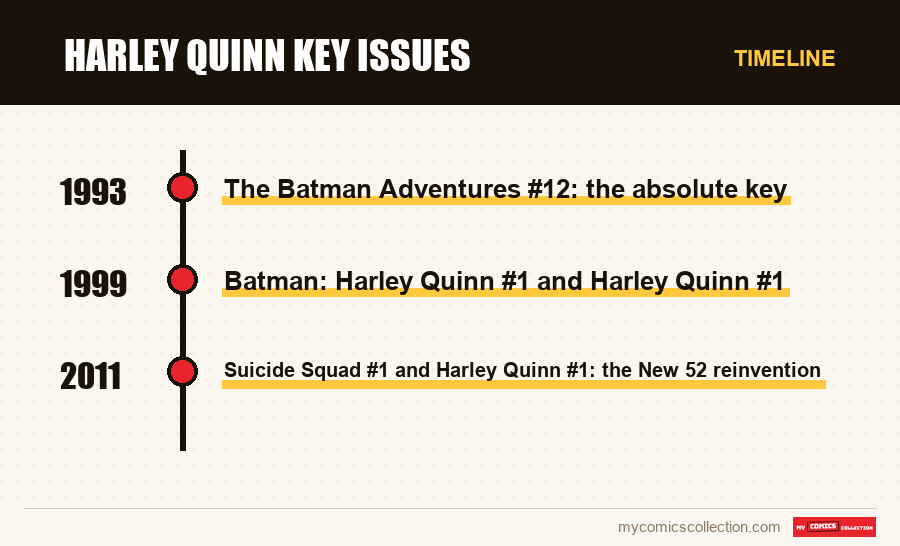
| The Batman Adventures #12 (Sep. 1993) | 1st comic appearance | ~$3,250 (direct edition) · ~$5,280 (newsstand) |
| The Batman Adventures: Mad Love (Feb. 1994) | Origin of Harleen Quinzel, Eisner Award winner | ~$3,700 |
| Batman: Harley Quinn #1 (Oct. 1999) | 1st appearance in DC main continuity | Qualitatively strong: no public record documented |
| Harley Quinn #1 (Dec. 2000) | First solo ongoing series | Accessible in high grade: no public record documented |
| Suicide Squad #1 (Sep. 2011, New 52) | New "Damaged" look, character relaunch | Active market: no public record documented |
| Harley Quinn #1 (Nov. 2013, Conner/Palmiotti) | Start of the best-selling solo run | Entry-level: no public record documented |
The Batman Adventures #12 (1993): the absolute key
Published in September 1993 by DC Comics, The Batman Adventures #12 is the single most important issue for any Harley Quinn collector. Written by Kelley Puckett with art by Mike Parobeck and Rick Burchett, it presents Harley Quinn in print for the first time: in the animated series tie-in universe rather than main DC continuity. One important nuance: Paul Dini and Bruce Timm, who created Harley for animation, did not write or draw this issue; their contribution to the print medium would come the following year with Mad Love.
Recent market data (sellmycomicbooks.com, 2024) documents a CGC 9.8 direct edition trading around $3,250 and the newsstand variant, scarcer in high grade, at around $5,280. CGC 9.6 copies have sold in the $1,300-$1,430 range. Overstreet lists this issue in its Top 20 Modern Age comics. Approximately 9,000 copies are CGC-certified, making it reasonably accessible in lower grades while sustained demand keeps high-grade copies firmly in premium territory.
The Batman Adventures: Mad Love (1994): the origin story by Dini & Timm
Published in February 1994 in prestige format by DC Comics, The Batman Adventures: Mad Love is the work Paul Dini wrote and Bruce Timm illustrated directly for the comics medium. This one-shot tells the story of Harleen Quinzel, a psychiatrist at Arkham Asylum who falls in love with the Joker and becomes Harley Quinn: an origin that was later adapted into an episode of The New Batman Adventures and has shaped every subsequent version of the character, including the films. Mad Love won both the Eisner Award and the Harvey Award for Best Single Issue in 1994, a rare double distinction.
Its market trajectory is well documented: CGC 9.8 copies now trade around $3,700, up from under $100 a decade ago. Even a CGC 6.0 now exceeds $500. This is one of the best-documented 1990s comics for value appreciation on the secondary market, driven partly by its critical prestige and partly by the broader cultural resurgence of the character.
Batman: Harley Quinn #1 (1999) and Harley Quinn #1 (2000)
In October 1999, DC published Batman: Harley Quinn #1, a one-shot written by Paul Dini with a painted cover by Alex Ross. This issue marked Harley Quinn's official entry into the main DC Universe continuity: her first canonical appearance outside the animated tie-in universe. The Dini-and-Ross combination makes it qualitatively significant for collectors, though no auction record has been publicly documented for high-grade copies in the sources reviewed here.
In December 2000, writer Karl Kesel and artist Terry Dodson launched Harley Quinn #1, the first issue of the character's very first solo ongoing series. That editorial decision, giving Harley her own title, was itself a milestone, reflecting the character's genuine breakout status. The issue remains accessible in high grade, with no standout public record identified in available sources.
Suicide Squad #1 (2011) and Harley Quinn #1 (2013): the New 52 reinvention
As part of DC's New 52 September 2011 relaunch, Suicide Squad #1, written by Adam Glass with art by Federico Dallocchio, gave Harley Quinn a radically redesigned look: the red-and-black "Damaged" costume that would define her visual identity for a generation. Her dynamic with the Joker was reframed in a darker, more psychologically complex register. The 2016 Suicide Squad film starring Margot Robbie grossed $749 million worldwide and drove a measurable spike in collector demand across all Harley keys.
In November 2013, Amanda Conner and Jimmy Palmiotti took over the solo series with Harley Quinn #1 (vol. 2). Their long, popular run is the version of Harley that millions of readers discovered through the 2010s. The animated series Harley Quinn (DC Universe, premiering November 29, 2019, with Kaley Cuoco as the lead voice) further extended that momentum. These 2011 and 2013 issues remain accessible at the entry level, with high-grade CGC copies that reflect their status as sought-after modern keys: though neither approaches the price ceiling set by Batman Adventures #12 or Mad Love.
Own a Harley Quinn comic? Get a free valuation with our tool based on real eBay sales to find its low, median, and high value.
Frequently asked questions
The Batman Adventures #12 (September 1993), written by Kelley Puckett with Mike Parobeck and Rick Burchett on art. She had appeared on screen a year earlier, in the episode "Joker's Favor" (September 11, 1992) of Batman: The Animated Series.
No: the character was born in 1992, so all her key issues belong to the modern era. Anyone claiming otherwise is offering a counterfeit or mixing up characters.
This February 1994 one-shot, written and drawn by Paul Dini and Bruce Timm, tells the origin of Harleen Quinzel, a psychiatrist at Arkham Asylum who falls in love with the Joker. It influenced every later version of the character.
With Batman: Harley Quinn #1 (October 1999), written by Paul Dini with a cover by Alex Ross. Her first ongoing solo series, Harley Quinn #1, was launched in December 2000 by Karl Kesel and Terry Dodson.
Suicide Squad #1 (September 2011), which gives her a new look, and Harley Quinn #1 (November 2013) by Amanda Conner and Jimmy Palmiotti. These issues remain accessible at entry level.