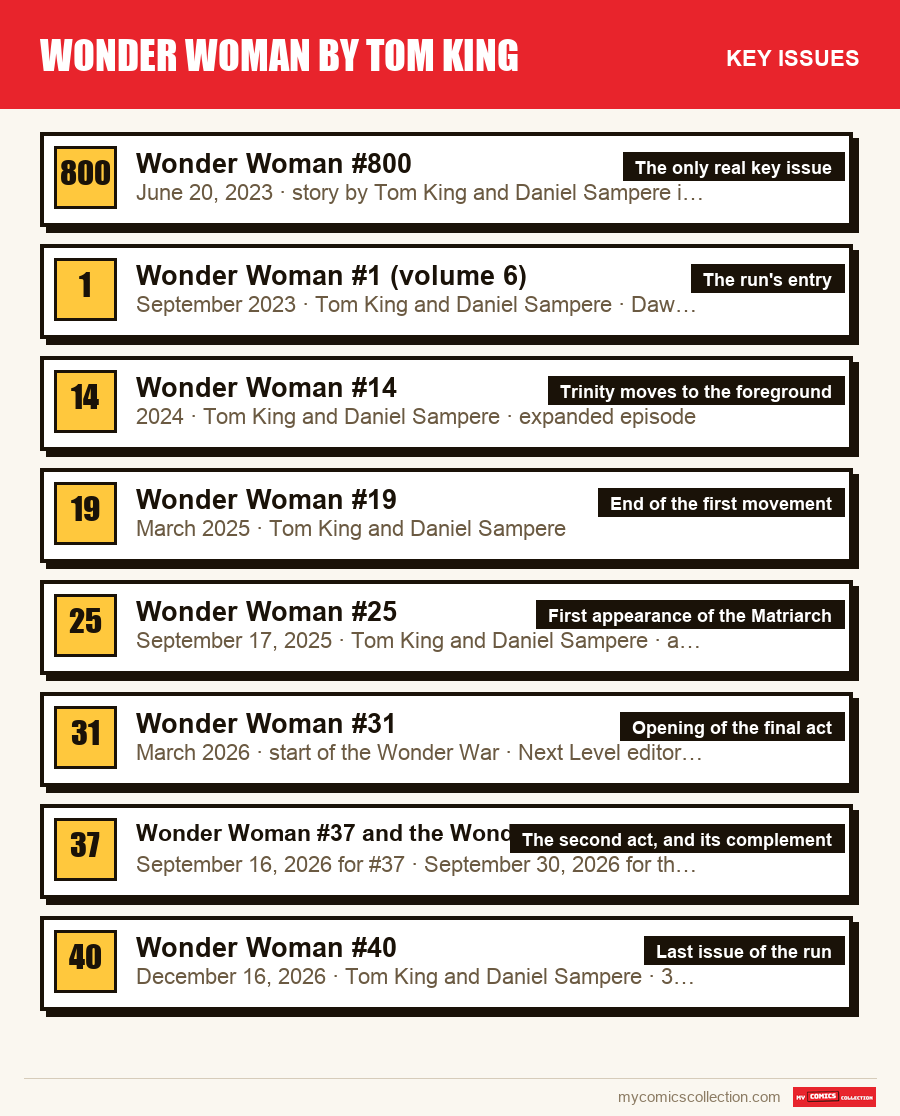
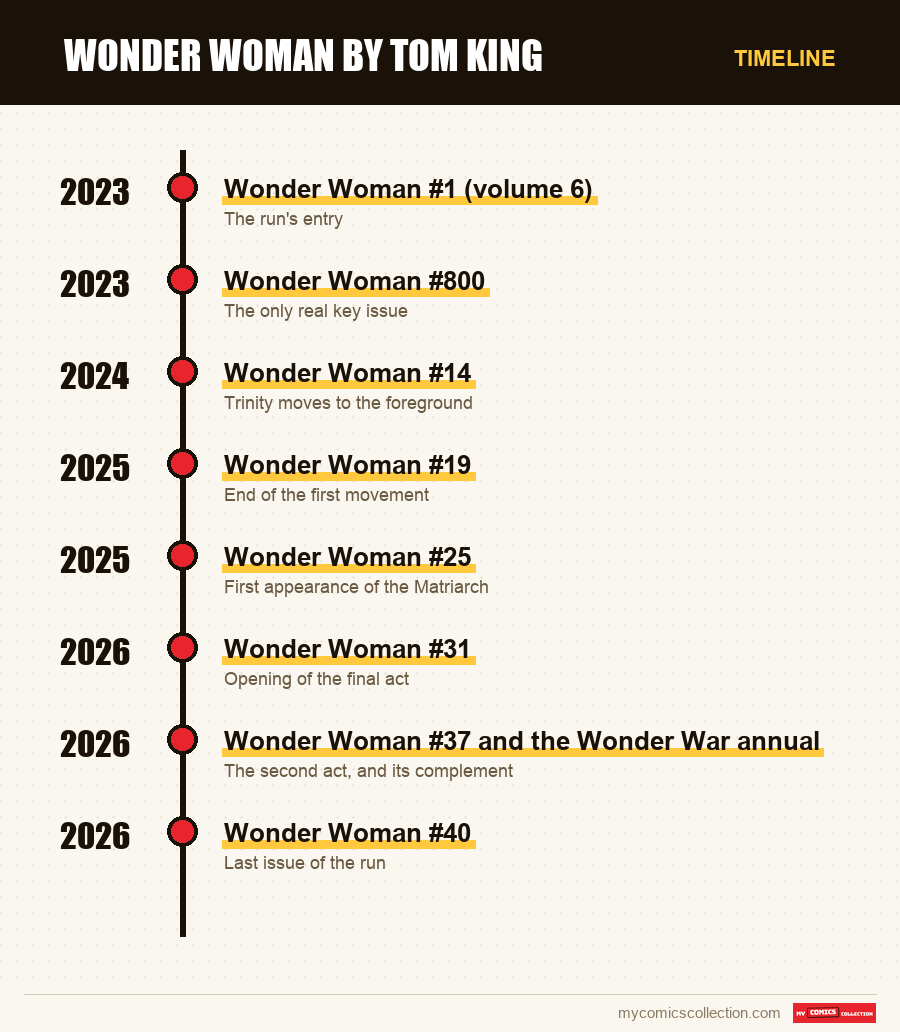
The Tom King and Daniel Sampere run on Wonder Woman ends with issue 40, announced for December 16, 2026, on the conclusion of the Wonder War. Begun in September 2023 as part of Dawn of DC, preceded by an opening story published in Wonder Woman #800 on June 20, 2023, the run leaves behind a lasting creation: Trinity, Diana's daughter. The pivotal issues are few and identifiable: #800 (first appearance of Trinity), #1 (opening), #14 (first big episode devoted to Trinity), #19 (end of the confrontation with the Sovereign), #25 (first appearance of the Matriarch, September 17, 2025), #31 (start of the Wonder War) and #40. Everything else is a modern high-print-run run: pleasant to complete, unlikely to become scarce.
A run coming to an end is one of the rare occasions when a collector has all the data at the same time. The number of issues is known, the creators are identified, the collections are partly already published, and the issues that really count have had time to stand out from the pack. It is exactly the opposite of a launch, where everything is hypothesis. Tom King and Daniel Sampere's run on Wonder Woman is entering that moment: its last issue is announced, its story is wrapped up, and the question that remains is purely practical.
That question is this: what do you do with a forty-issue run published between 2023 and 2026, drawn almost entirely by the same hand, and of which every single issue was printed in quantities amply sufficient that nobody will ever be short? The honest answer is neither "buy everything" nor "buy nothing." It goes through a distinction that most key-issue lists refuse to make, and that this article takes seriously: an issue important for the story and an issue important for the collection are not the same object.
We are on October 2, 2026. Issue 37 came out on September 16, the special annual on September 30, and issue 40 is solicited for December 16. No successor has been announced on the series. Everything that follows relies on information published by the publisher and the trade press as of that date.
Forty issues, and what that number already says
Tom King has stated that he originally envisioned a hundred issues, and revised that plan as his commitments outside comic books grew. The run therefore stops at forty, which makes it a long run by current standards but far below the initial ambition. This gap is not a production anecdote: it explains the shape of the result. A run planned for a hundred issues and delivered in forty necessarily concentrates its developments, and that shows in the density of the last year.
The exact scope deserves to be laid out, because it is the first source of error when trying to assemble the set. The narrative starting point is not issue 1 but a story published in Wonder Woman #800, on June 20, 2023, an anniversary issue with a collective table of contents that also contains contributions from other teams. The relaunched series, for its part, starts in September 2023 with a new issue 1, as part of the publisher's Dawn of DC initiative. In other words, the run's first issue bears the number 800, and the second bears the number 1. Any list that starts at issue 1 is incomplete.
On the art side, the continuity is remarkable and it is the strongest argument in favor of this set. Daniel Sampere handles most of the forty issues, main covers included, over more than three years. This regularity has become rare: most long runs of the period alternate three or four artists. For anyone collecting by visual coherence rather than by key issue, it is a decisive criterion, and it appears in no market value ranking.
One last framing element: the end is dated and documented by the publisher itself. Issue 40 is announced for December 16, 2026, written by Tom King, drawn and covered by Daniel Sampere, with variants signed David Nakayama, Julian Totino Tedesco and Jamie Hewlett, in thirty-two pages, a card-stock variant being offered at a higher price than the standard edition. The presentation text announces that the Matriarch and her father, the Sovereign, gather a group of villains to destroy Wonder Woman, and that Diana and her family defend the shores of Themyscira.
What the run introduced, and what will remain of it
A run is not judged on its sales but on what the sequel is obliged to keep. On that criterion, the legacy of these forty issues is fairly easy to sort.
Trinity, Diana's daughter, is the most likely lasting creation. Introduced in Wonder Woman #800 within a story set in the future, written by King and drawn by Sampere, she carries the civilian name Elizabeth, Lizzie, and stands out through a red, white and blue costume and three lassos of different colors. King explained that he conceived her not as a second Wonder Woman but as a new figure, designed to stand alongside the heirs of Superman and Batman. She then occupied regular backup stories at the end of issues, which King described as an openly acknowledged tribute to daily newspaper strips, then a big main episode, then a continuity of her own. Her path as a character, her first appearance and her following appearances belong to a distinct subject, covered separately in our pages devoted to Trinity: here, just remember that she is the element of the run the publisher will have the most trouble putting back in the closet.
The Sovereign and the Matriarch form the second contribution. The Sovereign is the antagonist of the run's first half, built as a manipulator rather than a physical threat: King summed up the mechanics of the central arc in three trials meant to break Diana, relying notably on a lasso of lies, an object introduced by the run and since become one of its most cited contributions. This confrontation finds its conclusion in issue 19, in March 2025. The Matriarch arrives next, in issue 25 of September 17, 2025, and the final issue's presentation text confirms she is the Sovereign's daughter. She is, according to remarks made by the creative team, an evolution of the same idea, with a more frank disposition to exercise her power openly.
A return to clay origins. The run reinstalls in main continuity Diana's mythological origin, sculpted from clay, in place of the divine parentage established in the early 2010s. It is a fundamental editorial decision, touching the character's definition rather than an episode, and it is the kind of choice a following run visibly keeps or cancels. It also returns in the story itself: Trinity is born of an operation of the same order, where clay and the intervention of Diana's mother replace biology.
A political context. The run opens on a law that bans the Amazons' presence on American soil and on the creation of a special force charged with expelling them. It is the narrative engine of the first year and the reason for the title of the first collection. For the collector, the interest is indirect but real: this device generated issues very readable in isolation, which makes the first issues easier to hand to someone than the average ongoing series.
The pivotal issues, and why exactly
Here are the issues that stand out, with the precise reason for their presence. The dates and teams are those published by the publisher.
Wonder Woman #800
First appearance of Trinity. It is the issue that checks the only box the market recognizes without discussion on a recent comic: a first appearance of a character the publisher keeps using. The issue is moreover an anniversary one, in expanded format, and its table of contents includes other stories, including a contribution by Becky Cloonan and Michael W. Conrad and pages by Joëlle Jones and Jen Bartel.
Wonder Woman #1 (volume 6)
The starting point of the series proper: the law against the Amazons, the special force, the setup of the Sovereign. It is the issue you must own to read the run in order, and it is also the one printed in the greatest quantity, since a relaunch #1 always concentrates orders. The two facts go together, and the second tempers the first.
Wonder Woman #14
King presented this issue as the big episode that finally takes the main story toward Trinity, with an extended page count drawn by Sampere. It is the shift between a character confined to backup stories and a character established in the central plot.
Wonder Woman #19
The publisher's presentation announces the conclusion of the war between Diana and the Sovereign. It is the run's real caesura: what precedes forms a coherent set of nineteen issues, what follows opens a second movement with a new adversary. A reader who wants only half the run has a clean exit here.
Wonder Woman #25
The second issue of the run to introduce a character meant to last. It also sets up the trajectory that will lead to the Wonder War. It was accompanied by an unusual number of alternate covers, including ratio variants, a blank cover, a metallic cover and a seasonal variant.
Wonder Woman #31
The Wonder War begins here, as part of the editorial program the publisher launched in 2026 and which we detail in our guide to the Next Level program. It is the entry issue for anyone who wants to read only the run's conclusion without picking up from 2023.
Wonder Woman #37 and the Wonder War annual
Issue 37 opens the second act of the Wonder War: Steve Trevor and Trinity, returned from the future, try to convince Diana of a threat located twenty years ahead. Two weeks later, a forty-eight-page special annual devoted to the Matriarch, written by Stephanie Williams and Leah Williams, drawn by Eduardo Pansica and Belén Ortega, tells the character's path after the events of issue 34.
Wonder Woman #40
The conclusion of the Wonder War and of the run. The Matriarch and the Sovereign gather a group of villains against Diana, who defends Themyscira with her family. Variants announced by David Nakayama, Julian Totino Tedesco and Jamie Hewlett.
Important for the story, important for the collector
This is the point most lists gloss over, and yet it is the only one that changes a purchase decision. The two notions almost never overlap.
An issue is important for the story when removing it makes the narrative incomprehensible, or when it contains the scene everyone is talking about. In this run, that designates issue 14, issue 19, issue 31 and issue 40. These are issues whose value is reading value: they fully justify their place on the shelf, and they are the reason you own the run.
An issue is important for the collector when it meets three conditions that have nothing to do with the quality of the story. First, it contains a lasting bibliographic fact, and in modern practice that means a first appearance of a character who outlives the series' creator. Second, it was put into circulation in a quantity below future demand, which almost always implies that nobody anticipated that demand at the time of orders. Third, this fact remains verifiable years later, because it is inscribed in the issue and not in a commentary.
Apply this grid to the run: a single issue combines all three conditions, 800. #25 meets the first and the third, but not the second, since the volume of variants shows that demand was anticipated. #1 meets only the third, its opening status. All the others are reading issues.
This conclusion is neither pessimistic nor cynical. It simply avoids the costliest trap of the modern comic, which consists of paying a premium because an issue is "important." In a contemporary run, narrative importance is public, discussed online on release day, and therefore built into retailer orders. What creates scarcity is the opposite: an importance that was not visible at the time of the print run. We develop this mechanism in our dossier on reading print runs.
The gaps in the run, and why they matter
A run that ends is not a clean sequence of forty identical issues. Two irregularities deserve to be known before getting started.
Not all issues are by the run's team. Issue 29, released on January 21, 2026, is written by Stephanie Williams and drawn by Jeffrey Spokes: an episode where the Amazons look after Diana's daughter for an evening. It is a good standalone issue, and it is also an issue that makes the expression "complete King and Sampere run" a lie. You have to choose: either you collect the series, and it enters the set, or you collect the creators, and it leaves it. Both positions are defensible, the important thing is to fix it before buying, otherwise the collection remains indefinitely ambiguous.
The collections do not cover everything. The volumes published to date gather issues 1 to 6, 7 to 13, 14 to 19, 22 to 28 and 31 to 36, the latter being announced for November 2026. The numbering speaks for itself: some issues appear in none of the volumes published. We do not speculate on the reasons for these absences, but the practical consequence is clear. Anyone who buys only the collections does not get the complete run, and will miss issues, some of which take part in setting up the second half. It is the most concrete argument in favor of a mixed approach, discussed below.
What is a complete modern run worth, honestly
Let us ask the question without detour, since it is the one that interests. A forty-issue run published between 2023 and 2026, printed at comfortable levels and perfectly documented by order records, is not an investment. It will not be one in ten years either, barring an improbable accident, and for a mechanical reason: scarcity cannot be decreed after the fact. The copies already exist, in number, with people who bought them new and shelved them properly.
That does not make the set pointless, far from it. But the value lies elsewhere, and it is of three kinds.
Use value. Forty issues drawn by the same person, telling a story with a beginning, a middle and an announced end, can be reread. It is rare, and it is the only form of guaranteed return in this affair. A coherent run is worth, on the shelf, more than twelve mismatched key issues from twelve different series.
Completeness value. A closed run is a finite target. It has a last issue, therefore a day when you can say it is done. For many collectors, this satisfaction is the real engine, and it has no monetary counterpart. The complete Wonder Woman collection guide details this logic at the scale of the whole title.
Entry-point value. A recent run costs, per issue, a fraction of what any old issue of the character costs. For someone discovering Wonder Woman who cannot afford to aim for Wonder Woman #1 of 1942, it is a way to build a real, legible and coherent collection. Our reference points on modern-era key issues are in the dossier modern Wonder Woman key issues, and the ranking of periods in the best Wonder Woman runs.
Single issues or collections: the choice depends on use
The two formats do not answer the same intent, and confusing them produces frustrating collections.
Single issues keep what collections lose: the main covers in their original format, the backup stories in their publication context, the letter pages and ads that date the object. On this particular run, the backup stories devoted to Trinity have real importance, and their place at the end of the issue is part of their effect. It is also the only format that gives access to all forty issues.
Collections offer reading comfort, less shelf space, and a lower price per page. But they arrive late, they skip issues as we just saw, and they are reprinted, which means they carry no scarcity. Our comparison of collection formats details the manufacturing trade-offs.
The soundest position, for this run, is to combine: collections for comfortable rereading, and single issues for the pivotal issues and for those in no volume. It is less elegant than a single rule, but it is what the bibliography imposes here.
And grading?
The question comes up systematically on recent runs, and the answer is almost always the same. Having a 2023 or 2026 comic graded makes sense in one case and one only: when the copy has a characteristic that time will make hard to find, and when authentication of condition brings information that direct observation does not give. On this run, it can be discussed for issue 800, and for it alone. For the rest, new copies are numerous, very high grades are too, and the certified grade only confirms what everyone can verify. Our guide to grading applied to Wonder Woman details the thresholds beyond which the operation is justified.
How to build this set without going wrong
Fix the scope in writing
Three possible scopes, and only one to choose. The creators' run: the story from issue 800, then issues 1 to 40 except those signed by other teams. The series: issues 1 to 40, annual included. The complete story: the series plus issue 800 plus the related releases tied to Trinity. Note your choice in your collection tracking tool before the first purchase, not after.
Treat issue 800 separately
It is the only issue in the scope whose buying logic differs from the rest. It is sought first, in fine condition, and its release date, June 20, 2023, helps rule out confusion with other issues bearing a neighboring number in the title's long history.
Buy the common issues in lots
Thirty-five issues of a recent run are found without difficulty and often grouped. Buying them in packs of ten reduces the number of shipments, therefore fees and the risk of damage in transit. It is a collection where search effort is useless, and where logistics effort pays off a lot.
Ignore the variants, unless there is an explicit project
Issues 25 and 40 received several alternate covers, some ratio. Collecting the variants of a modern run is a legitimate project, but it is another project, with another budget and another end. Mixing the two is the quickest way to finish neither. Our reference points on this subject are gathered in the dossier on Wonder Woman variants.
Wait for January to decide
Issue 40 comes out on December 16, 2026. The weeks following the end of a run are those when demand converges, because everyone reads the retrospectives at the same time. A month or two later, pressure falls back and lots reappear. Nothing in this run requires being bought in a rush.
If you manage the set in a tracking app, two settings save time: mark the chosen scope as a closed list of forty-one entries, and let the tool produce the list of missing issues rather than keeping it in your head. On a modern run, the common mistake is not missing a scarce issue, it is buying the same one twice.
What we do not yet know
Honesty of method: as of October 2, 2026, several points remain open, and no serious review can settle them.
No creative team has been announced to take over the title, and the December 2026 solicitations mention none. Trinity's fate after the last issue is therefore not public. It is the main unknown, and also the most determining for the run's posterity: a character the house keeps using takes a place in the bibliography, a character put back in the closet takes none.
The New York convention takes place from October 8 to 11, 2026, and announcements are usually made there on the publisher's main titles. Nothing has been said to date. If you are reading these lines after that date, the information may exist, and it is not here.
Finally, we publish no amount for this run. No source consulted publishes a recent and verifiable price record on these issues, and announcing a market value without naming its origin would be exactly the flaw this article seeks to avoid. For an estimate of your own copies, our free estimate works from observed sales rather than impressions.