Youth and nostalgia license comics are, in fall 2026, among the biggest sellers on the American market: Ben 10 at Dynamite, written by Joe Casey, has passed 500,000 copies in five months, and Muppets Take the Marvel Universe #1 appears in the top 5 of the register report of September 22 to 28, 2026, alongside four superhero titles. These figures say nothing about their future in collections, and the history of the genre is brutally uneven: some license titles are among the most sought-after comics of the twentieth century, the vast majority are worth nothing and will never be reprinted. The difference comes down neither to quality nor to initial success, but to two things: the real print run and an issue's ability to contain something that survives the license.
A collector looking at American sales in fall 2026 runs into an apparent anomaly. The titles flying off shelves are not all superhero number 1s carried by a star creator. There is also a comic drawn from a 2005 animated series and a comic featuring puppets born in 1976. The second ranked in the top five sales of a week measured across more than six hundred stores, the first moved half a million copies in five issues.
The reflex reaction is to see a buy signal. That is precisely the mistake the genre has been making people commit for eighty years. The youth license is the category of comics that has produced, proportionally, the biggest gap between immediate commercial success and lasting collecting value. It has given mythical pieces and mountains of unsellable paper, often the same year, sometimes at the same publisher.
This article deals neither with the content of these series nor with their reading interest. It deals with a mechanism: why the license sells, who really buys it, and under what conditions a license comic becomes a collectible rather than dormant stock. All the precedents cited are dated and verifiable.
What the September 2026 figures really show
Let us start by framing the two facts, because they are often cited poorly.
The first concerns Ben 10, published by Dynamite and written by Joe Casey. The announced total exceeds 500,000 cumulative copies over five months. It is therefore not a number 1 at half a million: it is a series whose issues add up to this volume. The distinction changes everything for a collector, because a print run spread over five issues means that each individual issue circulates in high but not extravagant quantity, and above all that the series held. An order curve that does not collapse between the first and third issue is a far more solid indicator than a spectacular start.
The second concerns Muppets Take the Marvel Universe #1, ranked in the top five sales of the register report taken from September 22 to 28, 2026 in more than six hundred equipped stores. We must be exact about the nature of this data: it is a weekly report of points of sale, not a market share. In this specific week, the four other titles at the top of the ranking were superhero series, three of them from the Absolute line. A puppet comic in the middle of this pack is remarkable, but a one-week ranking says nothing about a quarter.
What these two facts establish, together, is limited and solid: the family license is no longer a marginal segment of the specialty store market. It occupies positions that were believed reserved for costumed franchises. Everything else remains to be shown.
Why these titles sell, and to whom
Three mechanisms overlap, and it is useful to separate them because they do not have the same consequences for future value.
The license is a shortcut to fame. A publisher launching an original series has to make its title, concept and characters known. A publisher publishing Ben 10 has nothing to explain: the target audience already knows what it is. This communication saving translates directly into orders from retailers, who take less risk on a recognized name than on a creation. It is a distribution advantage, not an artistic advantage, and it has no effect on scarcity.
The buyer is almost never the child. This is the most counterintuitive point of the segment. License comics sold in specialty stores are mostly bought by adults, either for themselves or for a child whose reading they supervise. A 2005 animated series now targets thirty-somethings who watched it when it aired. The 1976 puppets target their parents. It is not a youth market, it is an adult nostalgia market dressed as youth, and it obeys the same reflexes as the rest of the collecting market: buying number 1s, attention to covers, preservation.
Crossing with a superhero catalog widens the audience further. A title that brings license characters into a house universe no longer addresses only the license's audience: it also addresses readers of the host universe, who buy it as a curiosity. That is exactly the configuration of the title ranked in late September 2026. This type of crossover produces very strong and very short sales spikes.
Retain the consequence: all three mechanisms inflate the print run. None of the three produces scarcity. A license comic that sells well is, by construction, an abundant comic.
The long precedent: eighty years of youth license at newsstands
American publishing history offers enough documented cases that we need not speculate. Here are the stages that matter, and what each teaches.
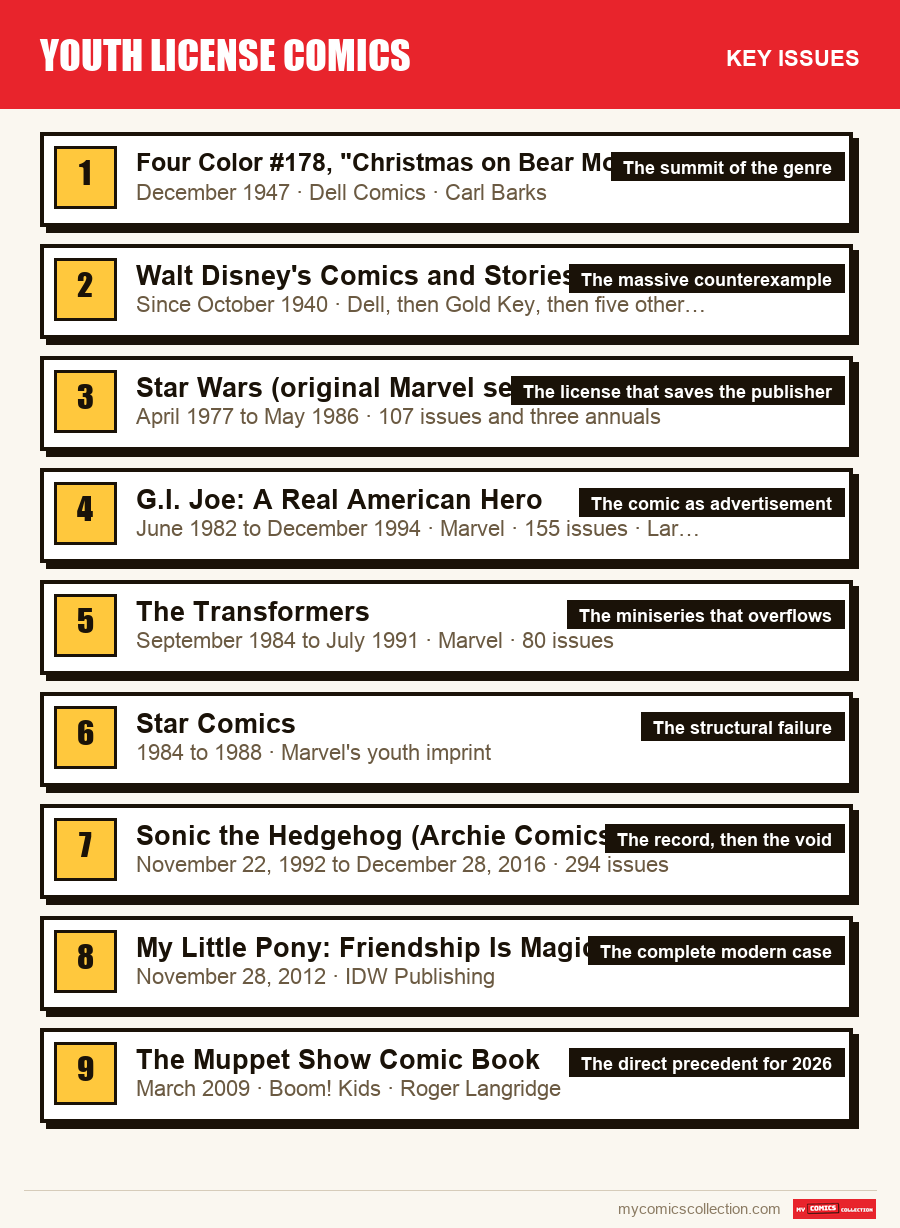
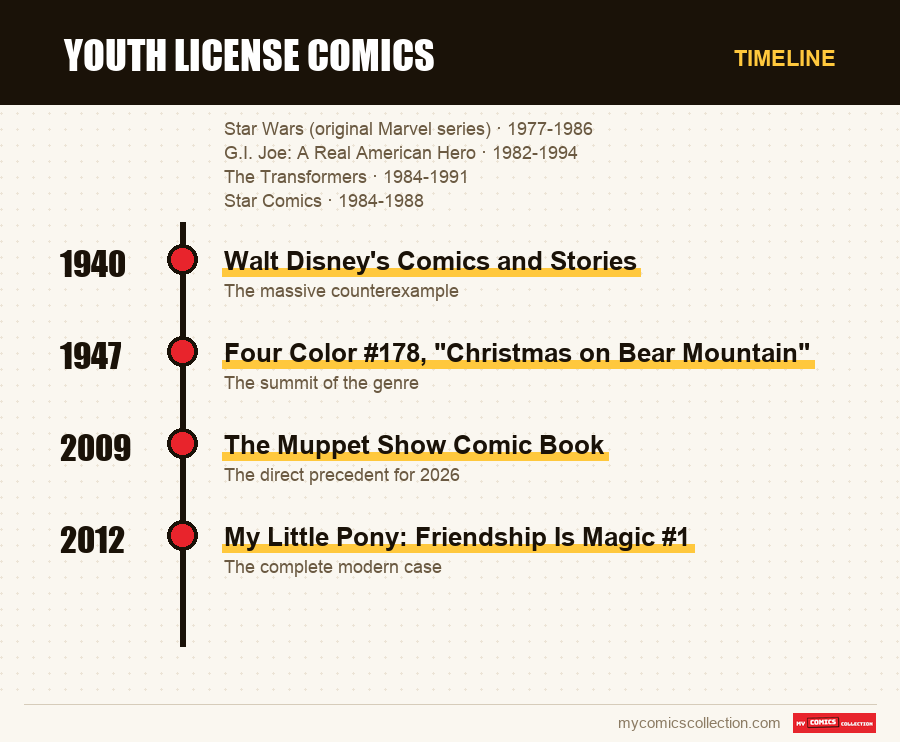
Four Color #178, "Christmas on Bear Mountain"
A Disney license comic, aimed at children, sold at newsstands in a catch-all collection. It contains the first appearance of Scrooge McDuck, created by Carl Barks in a twenty-page story. This issue is today one of the most sought-after postwar comics, and for a single reason: it introduced a character who then invaded the license's canon, the cartoons, the parks and the merchandise. The license did not give the comic its value. The comic gave the license a character.
Walt Disney's Comics and Stories
The same license universe, the same era, an opposite fate. This monthly reached a million copies per issue as early as issue 23, in August 1942, and peaked at 3,115,000 copies for issue 144 of September 1952, which made it the best-selling comic in the United States. Carl Barks wrote and drew Donald stories there from issue 31, in April 1943, to issue 312, in September 1966. In other words: great material, in industrial print runs. Almost all of these issues are found easily and are worth almost nothing, apart from a handful of very high-grade copies and the rare issues containing a first appearance.
Star Wars (original Marvel series)
The first issue went on sale on April 12, 1977, before the film's release. The adaptation of the first six issues is by Roy Thomas and Howard Chaykin, before the series became an ongoing creation taken over by Archie Goodwin and Carmine Infantino from issue 11, in May 1978. According to former Marvel editor in chief Jim Shooter, the strong sales of these comics financially saved the publisher in 1977 and 1978. The series very quickly crossed the hundred-thousand-copy threshold that triggered royalty payments to the license holder. The detail of its collecting history is covered elsewhere, in our collecting guide to Marvel's Star Wars comics.
G.I. Joe: A Real American Hero
Hasbro relaunches a figure line in 1982 and orders from Marvel a comic loaded with providing them a narrative background. It is the first comic book to have been the subject of a television ad, and the maneuver was legal as much as commercial: promoting the comic rather than the toy let it get around the limits placed on toy advertising spots. Monthly sales rose from about 157,920 copies in 1983 to 331,475 in 1985, making the title Marvel's top subscription seller that year. In 1987, the editorial staff was receiving 1,200 reader letters a week.
The Transformers
Scheduled at first as a four-issue miniseries, it became an eighty-episode monthly, written mainly by Bob Budiansky then by Simon Furman for the last arcs. The comic's function was to tell the story of a toy line; it ended up building a mythology that later versions of the franchise took up. It is the most reproducible pattern of the genre: the license orders a promotional vehicle, and the vehicle invents canon.
Star Comics
Marvel creates in 1984 an entire imprint devoted to child readers, essentially made up of adaptations of animated series and toy lines: Muppet Babies, Fraggle Rock, Heathcliff, Care Bears, Strawberry Shortcake, ThunderCats, Masters of the Universe, as well as the Droids and Ewoks series drawn from Star Wars. The imprint was dissolved in late 1987, the last release carrying a cover date of May 1988. Marvel had launched Star to fill the void left by the end of Gold Key's youth titles in 1983; the imprint did not find its balance and some of its titles were absorbed under the main banner.
Sonic the Hedgehog (Archie Comics)
Launched in partnership with Sega, this title is the longest-running American comic without renumbering, and the longest ever drawn from a video game as from a license. In April 1994, it was the third best-selling comic in the United States, ahead of all of DC and all of Marvel except the X-Men titles. In 2013, it was running around nine to twelve thousand copies a month, double its own publisher's flagship title. The license was withdrawn by the Japanese holder and the series stopped in late 2016; another publisher took up the license in 2017, without the cast of characters created at Archie.
My Little Pony: Friendship Is Magic #1
More than a hundred thousand pre-orders before release, more than eighty thousand copies actually counted, fifteenth best sale of November 2012 and one of only two non-DC, non-Marvel titles in the year's top 100. Four successive reprints for the first issue alone. And nineteen different covers, six of them forming a continuous mural and thirteen variants reserved for points of sale. The main series lasted 102 issues, until October 2021.
The Muppet Show Comic Book
Ten issues for the main series, written and drawn by the same creator, well received by critics. Then the license changed hands: the publishing agreement expires in 2011, and it is the rights holder's comics subsidiary that takes over the title, renamed, for four issues in 2012. This story is exactly the one preceding the late September 2026 success: the same property, already through two publishers in three years, returns to the front of the ranking fifteen years later.
The rule that emerges from these nine cases
Lined up, these precedents draw a fairly clear mechanism, and it contradicts common intuition.
Commercial success is inversely correlated with scarcity. The best-selling license comic in American history is also the one that is worth nothing. Three million copies a month in 1952 produced a stock that seventy years have not exhausted. Every time a license title tops a ranking, that ranking must be read as information about future abundance.
What gains value is the first appearance that migrates. Scrooge McDuck has no value because he appeared in a Disney comic, but because he became a central piece of the license itself. Same logic for the characters that toy comics invented and that the lines, cartoons and films then adopted. The test is simple and applied after the fact: does this issue contain something the license can no longer do without?
Survival rate makes old material scarce, not print run. Youth comics were given to children, who treated them as objects of use. That is why a title printed at a million copies in 1942 can be hard to find in good condition. This source of scarcity no longer exists: a license comic bought in 2026 by a nostalgic adult is immediately protected, sorted and preserved. Waiting for time to do its destructive work is an outdated strategy.
The license's risk is not the comic's risk. A publisher that loses a license does not only stop publishing: it loses the right to reprint, sometimes the right to exploit the characters created for the occasion. A twenty-four-year run can become legally inaccessible. This creates a real scarcity on existing paper, but a non-reprintable scarcity, concerning an entire continuity rather than identified issues. It is not the same thing as a key issue.
How to approach the fall 2026 licenses
Let us apply all this to the two titles that open this article, without announcing any future value.
Read the figure before interpreting it
Half a million copies over five issues is not half a million on one issue. A weekly ranking is not a market share. These two titles are abundant, and they will stay so: neither series contains any scarcity signal today.
Look for the first appearance, not the number 1
On a license, number 1 is the object everyone buys and the worst placed to become rare. What deserves spotting is an issue introducing a character, a version or a place that the license will reuse elsewhere. This is detected through reading, by following the series, not on release day.
Treat multiple covers as noise
Nineteen covers for a license issue in 2012 produced nineteen abundant objects plus a few exceptions. If you buy to read, take the main cover. If you buy a variant, demand to know what distribution condition it is subject to, and consider that without this information, the variant is worth no more than the standard version.
Anticipate the interruption
License series stop without notice, at the expiry of an agreement that is not public. On this type of title, the bound volume is no guarantee of later availability: it may become impossible to reprint. If a license series really interests you, complete it while it is running.
Decide on grading by the grade, not by the name
On an abundant modern title, the only lasting differentiating factor is condition. Submitting a license comic to grading makes sense only if the copy has a real chance of reaching the top of the scale, and if the issue otherwise has an identified interest. When in doubt, the cost of the process exceeds the expected gain.
What the youth license does to the organization of a collection
There is a practical effect, less discussed than the question of value, and which causes more concrete problems day to day.
License series are the hardest to track of the whole market. They change publisher, and with it numbering. They alternate miniseries of four or five issues, special issues, one-shots and annuals, with no apparent logic. They often carry titles very close to one another, because the rights holder imposes the presence of the property's name in every heading. A collection that accumulates fifteen years of comics drawn from one youth franchise ends up with a dozen sequences numbered 1 to 5 and no simple way of knowing which is complete.
This is exactly the use case that justifies issue-by-issue tracking rather than a list of series. The right unit of tracking, on a license, is not the title: it is the publisher and the publication window. Knowing that issue 3 of a five-issue miniseries published by a given publisher between such and such years is missing is actionable information; knowing that "an issue of the series" is missing is not. Spotting absent issues is all the more useful on this segment because the gaps are not filled by a reprint.
Second practical effect: separating lots. A collector who buys both for themselves and for a child quickly mixes two collections with incompatible uses, one meant to be read and worn out, the other to be preserved. Our guide to introducing a child to comics covers this point in detail, and our selection by age bracket covers the editorial side. The essentials fit in one sentence: a youth license bought for a child is not a collectible, and wanting it to be both guarantees missing both.
The limits of what can be said today
Three things must stay out of this article, and it is more honest to name them.
No price guide, no numerical price movement over the recent period is available in the sources consulted. The amounts circulating about modern license comics come from announcements, not from observed, dated sales. Consequently, this article speaks of relative hierarchy, trend and scarcity, never of amounts.
The editorial future of these licenses is not known. A major convention takes place October 8 to 11, 2026, and announcements are expected there, but nothing had been said yet at the time these lines are written. The waves of solicitations beyond December 2026 are not published. Any claim about the duration of these series would be a projection.
Finally, the general shift of collecting money toward categories other than printed comics is a subject in itself, which we cover separately in our analysis of the 2026 public records and in our comparison of the comics market and the card market. There is, however, a direct link with our subject: objects of childhood nostalgia capture a growing share of adult collectors' attention, all categories combined. The youth license in comics is the paper version of this movement.
For the record, the only youth license comic to have become a first-rank piece by the opposite route, that of the confidential print run rather than mass success, is an independent creation that became a license and not a license that became a comic. Its path is told in our editorial history of the Ninja Turtles and its decisive issues in our survey of the franchise's key issues, starting with the first issue of 1984. This precedent is the most cited of the genre and the least reproducible: it demonstrates nothing about licenses launched at five hundred thousand copies.