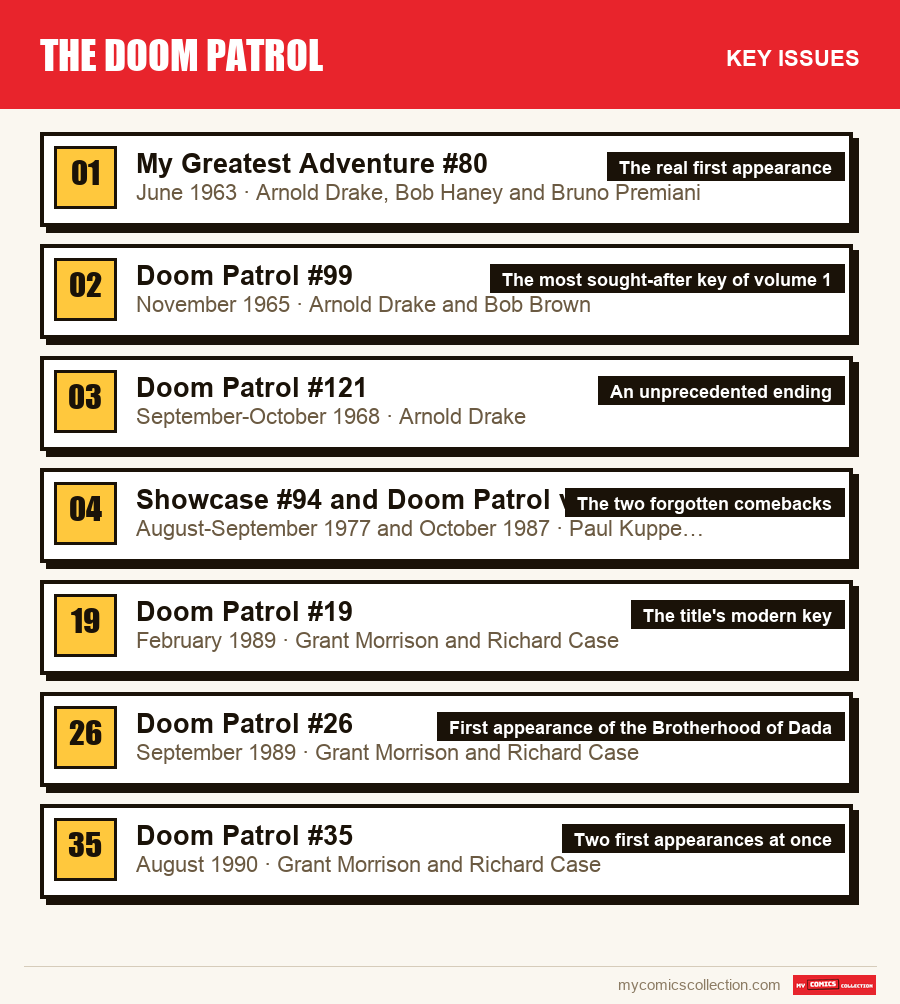
The Doom Patrol #1 came out on September 2, 2026 under the DC Next Level label, written by Darcy Van Poelgeest, drawn, inked and colored by Niko Henrichon: 24 pages, rated "Teen", cover price announced by the publisher at $3.99. The official pitch is unexpected: the team is broke and retrains as heroes for hire, the first case being a missing cat. On the collecting side, the keys are not there. They are in My Greatest Adventure #80 (June 1963, first appearance of the team), Doom Patrol #99 (November 1965, first appearance of Beast Boy) and above all in Grant Morrison's run opening at #19 (February 1989), which brings Crazy Jane, then the Brotherhood of Dada at #26 and Danny the Street at #35. This article ranks all this in order of real priority.
There are teams you collect for their characters, and teams you collect for their creators. The Doom Patrol belongs unambiguously to the second category, and that is what makes it more interesting to study than the two other relaunches DC launched the same day. Nobody buys an issue because Cliff Steele is in it. You buy because a specific writer took over at a specific moment and turned a catalog series into something else.
This particularity has a direct consequence on how to approach the September 2026 relaunch. A new Batman series is judged on its place in continuity; a new Doom Patrol series is judged on the identity of its creators and the freedom they are given. That is exactly the angle under which to read the assignment of Darcy Van Poelgeest and Niko Henrichon, and it is also the grid that lets you rank sixty-three years of earlier issues without getting lost.
Everything that follows is dated and verifiable. What is not, because the series has just started and no public market data concerns it, is not written.
What the September 2, 2026 relaunch really announces
Let us start with the facts published by the publisher, without extrapolation. The Doom Patrol #1 came out on Wednesday, September 2, 2026. Darcy Van Poelgeest is on script. Niko Henrichon does the art, the color and the cover, which is a more significant detail than it seems: an artist who colors his own work imposes an entire visual identity, not negotiated with a color studio. The issue is 24 pages, shows an American cover price of $3.99 and carries the "Teen" rating.
The official pitch is a surprise. The team is financially dry and adopts a hero-for-hire model to avoid collapse, material as much as psychological. Its first mission sounds like a joke: finding a missing cat. The case naturally turns out to be something else entirely, and the presentation text announces that, away from the gaze of Robotman, Elasti-Girl and Negative Man, a figure from the team's past is about to cross the border that separates them from their reality.
Three lessons emerge, and they are enough to frame the purchase.
The cast is not a superhero cast. Van Poelgeest comes from auteur comics, where he has been honored at the Eisners. Henrichon made his name on graphically very tight stories, including Pride of Baghdad and Spectators. Neither has a reputation built on the mechanics of the monthly team serial. On an ordinary franchise, this would be an anomaly. On this one, it is the rule: the only versions of the Doom Patrol that left a lasting trace were all entrusted to creators from another register.
The lineup shown is the historic trio. Robotman, Elasti-Girl and Negative Man are the 1963 members. The publisher is therefore not launching a team rebuilt around recent figures: it returns to the original core. For anyone who wants to trace the title's genealogy, this means the oldest issues remain relevant, which is not always true in a relaunch.
The "Teen" rating is editorial information. The title is not published under an adult-reader imprint, unlike a significant part of its history. It is a deliberate distribution choice: DC wants this series in the main flow, not on a separate shelf. We come back to it below, because it is precisely the variable that determined this title's collecting value for thirty years.
What is not publicly announced, however, deserves to be said clearly: the total number of planned issues is not communicated, and no schedule beyond the first issues is consolidated. An ongoing series and a miniseries are not collected the same way, and the information is missing.
1963: the first appearance, and a three-month coincidence
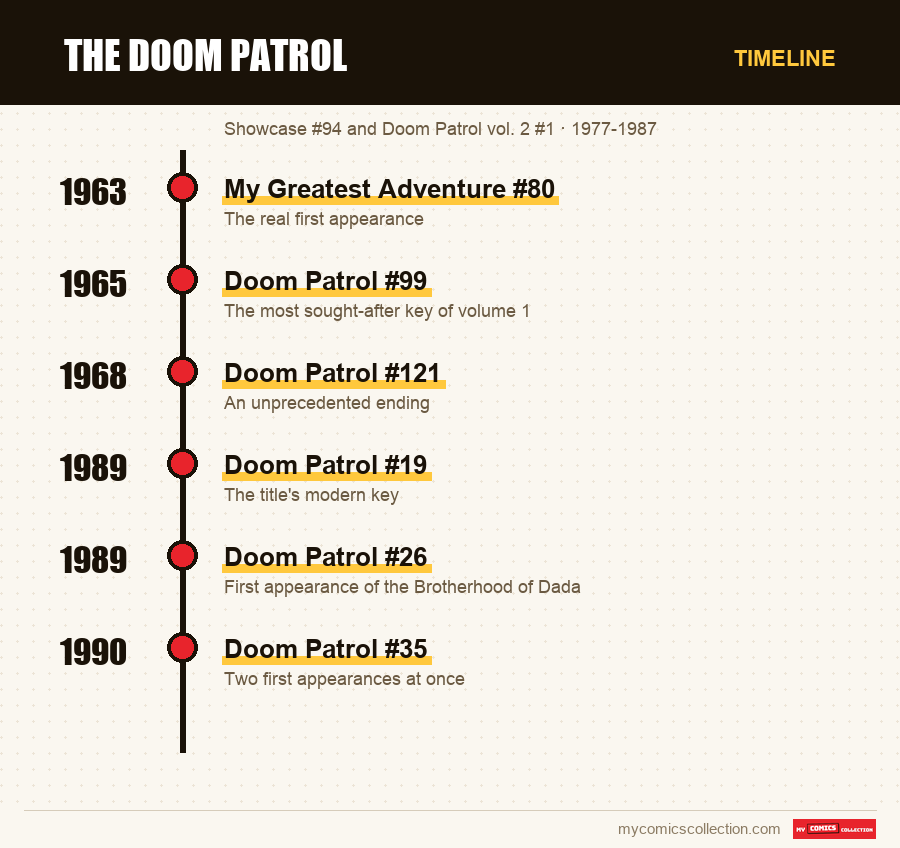
The Doom Patrol did not debut in a title with its name. It first appears in My Greatest Adventure #80, dated June 1963, an adventure and fantasy magazine that the publisher was trying to save by injecting superheroes. Arnold Drake and Bob Haney co-wrote the script, Bruno Premiani drew. Drake would later say he received the commission on a Friday for delivery the following Tuesday, which gives a good sense of the level of editorial premeditation behind the operation.
The concept, for its part, is anything but sloppy. Three survivors whose powers are the direct product of a personal disaster, brought together by a man in a wheelchair, and treated by the outside world as monsters rather than saviors. Drake would then write the entirety of the team's adventures until the end of this first period, in 1968.
Three months after My Greatest Adventure #80 comes out, at the competitor, The X-Men #1, dated September 1963. A team of outcasts with powers that society rejects, led by a mentor in a wheelchair, and facing an opposing group whose name is almost that of the Brotherhood of Evil fought by the Doom Patrol. Drake noted the resemblance and flagged it to his superiors, where it met no support, to the point that he had to admit a coincidence remained possible. This is the documented state of the file, and it is more honest to stick to it than to decide: no public evidence exists either way.
For the collector, this proximity is not an anecdote. It explains part of the gap in fame, and therefore in demand, between two first appearances separated by a quarter. One fed half a century of cinema and animation; the other remains a connoisseur's piece. You will find the general overview of periods and their print runs in our guide to the ages of the comic book, and the hub devoted to the X-Men gives the other side of the story.
The issues that matter before Morrison
Only four milestones, but each follows a different collecting logic: the first appearance of a team, the change of title, the first appearance of a character who became far more famous than the series, and a radical series ending.
My Greatest Adventure #80
This is number one in the literal sense: the whole team is born here in a magazine that does not carry its name. Two difficulties characterize it. First, it is an anthology release, therefore printed and preserved as an adventure magazine and not as a superhero title, which strongly reduces the number of copies in fine condition. Second, its title does not contain the words "Doom Patrol", which makes it invisible to anyone searching by series name.
Doom Patrol #99
First appearance of Beast Boy, Garfield Logan. The character will leave the Doom Patrol to become a pillar of the New Teen Titans, then one of the publisher's most exposed figures on television and in animation. Result: demand for this issue does not come from Doom Patrol readers, it comes from elsewhere, and it is much broader.
Doom Patrol #121
Drake ends his series by killing the team. In 1968, in a mainstream superhero comic, this is a nearly unprecedented decision, and it lastingly defined the title's reputation: the Doom Patrol is the team whose death is canon. All later revivals had to deal with this legacy.
Showcase #94 and Doom Patrol vol. 2 #1
Showcase #94, with Joe Staton on art, launches a reconstituted team and introduces Celsius, Negative Woman and Tempest. Ten years later, Kupperberg opens a second volume in October 1987, drawn by Steve Lightle. These two milestones are indispensable to understanding the series and secondary in a buying hierarchy: they carried neither a highly sought-after first appearance nor a run that became a reference.
February 1989: Morrison takes the series at issue 19
This tipping point is the heart of the file. Grant Morrison does not launch a new series: he takes over Kupperberg's ongoing one, at #19, dated February 1989, with Richard Case on art. There is therefore no number 1 to buy to enter the title's most important run, which is rare and has long worked in favor of the attentive collector.
What Morrison sets up is documented and verifiable: a story that deals head-on with mental health, gender identity and self-discovery, in an openly surreal register. Three issues concentrate the first appearances that flow from it.
Doom Patrol #19
First issue of the run, and first appearance of Crazy Jane. The character, whose civil name is Kay Challis, carries a dissociative disorder born of a childhood trauma, with sixty-four personalities each endowed with distinct abilities. Morrison indicated that he drew on an autobiographical account published on the subject, which sheds light on the treatment, very far from the usual laboratory accident.
Doom Patrol #26
Morrison replaces the 1960s Brotherhood of Evil with a Brotherhood of Dada devoted to the absurd, led by Mr. Nobody. The gesture is programmatic: it is no longer about facing criminals but an aesthetic. This issue is the run's second key in order of demand, carried by the antagonist whom the television adaptation made famous.
Doom Patrol #35
A double issue in terms of keys: it introduces Flex Mentallo and Danny the Street. Flex will get a four-issue miniseries in 1996, which gives him a collector base of his own. Danny is a living, conscious street, able to insert itself into any urban fabric, whose conception questions the codes of heroic masculinity. The name is a pun on that of an Irish music-hall artist, the "street" part being obvious.
The run stops at #63. That is forty-five consecutive issues, readable in one block, with no mandatory crossover, on a title whose numbering never restarts. For a reader, it is one of the most comfortable entries in the DC catalog. For a collector, it is a finite, quantifiable goal, which is welcome when so many modern runs scatter into parallel series.
1993: the move to the adult imprint, and what it changes
The next issue, #64, is the first issue of the title published under the adult-reader imprint that DC set up in 1993. Rachel Pollack takes over the writing and carries it to #87, in February 1995, where the series stops.
This shift is more than a logo change, and it has three very concrete effects that a collector should keep in mind.
It changes the readership, therefore the print runs. A title aimed at adults sells less, but to buyers who preserve better. Counterintuitive result: low-print issues can be found in better average condition than high-print issues of the same period.
It reshuffles the title's internal hierarchy. In a series' history, moving under an auteur imprint almost always creates a second identifiable entry point, distinct from number 1. Here, #64 plays this role. It is far less sought-after than #19, and that is logical: it opens a period that did not produce a major first appearance. It remains the issue you need to know to understand the title's structure, and not to confuse two very different periods sold under the same numbering.
It places the Doom Patrol in an editorial family. The imprint did not invent this register, it grouped series that already existed. Our history of this imprint at DC retraces this construction, and the selection of the key issues it produced lets you place the Doom Patrol among its neighbors.
This is where the 2026 relaunch takes on particular relief. By publishing The Doom Patrol #1 with a "Teen" rating, within an imprint meant to put second-tier characters back into production, DC does the opposite of the 1993 movement. The publisher is betting that this team's strangeness can hold in the mainstream flow, whereas thirty years of editorial history suggest it mostly thrived at the margins. That is the real stake of the series, far more than the identity of the missing cat.
After 1995: three revivals and a lesson
What follows fits in three dates and confirms the rule stated at the start. John Byrne relaunches the title in August 2004. Keith Giffen launches another version in February 2009, canceled in May 2011. Gerard Way and Nick Derington open a new series on September 14, 2016 under the alternative imprint built around this project, for twelve issues, extended by a sequel published from July 2019 to July 2020.
Of these three attempts, the 2016 one is the only one that created lasting collecting demand, and for the same reason as 1989: a creator from elsewhere, a broader freedom of tone, a strong graphic identity. The other two, entrusted to seasoned professionals of classic superhero work, left no key.
The lesson is usable immediately, and it is worth more than a forecast. On this title, collecting value follows the departure from the editorial norm, not the fame of the signature. A recognized creator applying the genre's usual grammar has never produced a sought-after issue here. An unexpected creator given free rein has done it twice.
The buying hierarchy, in order
Here is the order we recommend, from the most solid to the most debatable. It depends on no price guide and remains valid whatever the market's evolution.
Doom Patrol #19, before anything else
First appearance of Crazy Jane and opening of the run that defines the title. It is the only issue of this series that combines both demand engines: an identifiable first appearance and a run entry point. It is not flagged as such on its cover, which keeps it still accessible in late-1980s lots.
Doom Patrol #99 if your interest goes beyond the Doom Patrol
First appearance of Beast Boy. To be preferred over #19 in only one case: if you also collect the Teen Titans or if you reason on the Silver Age period alone. Demand there is broader but comes from another collecting universe, and the available condition is markedly more constrained.
#26 and #35 to consolidate the run
Brotherhood of Dada on one side, Flex Mentallo and Danny the Street on the other. These are the two issues to secure before completing the rest of the run as opportunities arise, because they are the ones whose demand is carried by characters independently of the series.
The complete #19 to #63 run for reading, not in pieces
Forty-five issues with no particular premium outside the three keys above. Collected editions are reprinted regularly and are the reasonable route to read. Buying the run issue by issue is justified only if you aim for uniform condition across the whole.
My Greatest Adventure #80 when budget and patience allow
Historic piece and the hardest issue in the file. Two precautions: verify that it is indeed #80 and not a neighboring issue of the same anthology, and accept that an average-condition 1963 copy remains a good buy on this title, the high-grade supply being structurally tiny.
The 2026 The Doom Patrol #1 as a reading copy
Take it in standard cover if the series interests you, read it, and keep it clean without deciding right away. No objective element lets us say today what this issue will become. A well-shelved copy can be graded in two years; the reverse does not exist.
The three signals to follow on the new series
Rather than watching prices, three verifiable indicators will tell fairly quickly what this relaunch is worth as a collectible.
The real format. As long as the publisher does not announce a number of issues, the series is to be treated as open, therefore liable to stop at any moment. The publication of an end point, or on the contrary of a long schedule, is the first piece of information that will change the picture.
The announced "figure from the past". The presentation text evokes a revenant about to cross the border into the team's world, without naming them. If this figure is an existing character, the issue concerned will be a return issue, a category that counts little. If it is a creation, it will be a first appearance, a category that counts a lot. The whole difference in potential lies there.
How issues two and three hold up. It is between #1 and #3 that a catalog series loses most of its orders. A relaunch that holds its pace over this segment has a chance of establishing characters; a relaunch that drops will produce at best a short curiosity. Issue-by-issue tracking is enough to see it without reading anything else.
One last remark, which holds for all three September 2, 2026 relaunches and singularly for this one. The Doom Patrol has never been a high-volume title. Its collecting value was built on issues that few people bought at the time, because they seemed to have nothing at stake. It is the opposite profile of an anticipated, over-ordered launch. If the 2026 series produces a key, it will probably be discovered after the fact, in an issue nobody talked about on release day. Keeping a record of what you own is, in this configuration, more useful than anticipating.