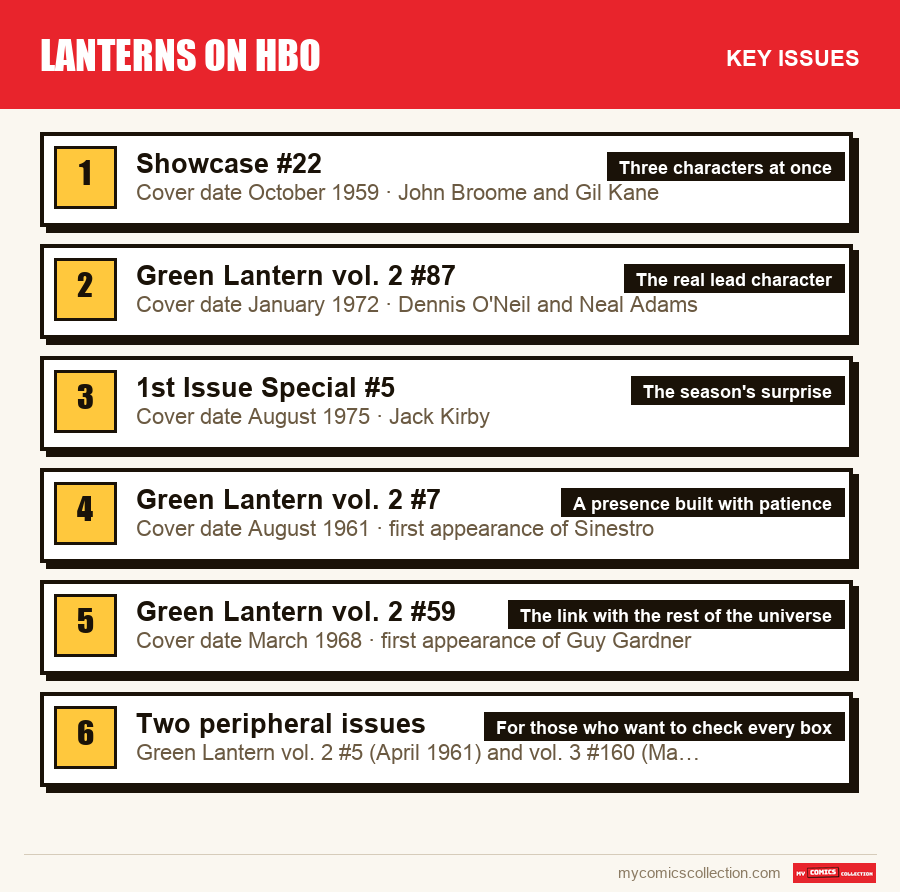
Lanterns aired on HBO from August 16 to October 4, 2026, in eight weekly episodes. Created by Chris Mundy, Damon Lindelof and Tom King, it features Hal Jordan (Kyle Chandler) and John Stewart (Aaron Pierre) in a criminal investigation in Nebraska, spread across two eras, 2016 and 2026. A decisive point for a collector: the showrunner stated that the series adapts no specific comic story. It draws on the franchise's background without transposing an identifiable arc. The issues it therefore puts back in the light are character first appearances: Showcase #22 for Hal Jordan and Abin Sur, Green Lantern vol. 2 #87 for John Stewart, #7 for Sinestro, and above all 1st Issue Special #5 for the Manhunters, whom the series makes its central antagonist. A finished season is not collected like an awaited one: this article explains why.
TV adaptations of comics are read in two stages. The first is the wait: you know who will be on screen, you do not know what the series will do with them, and this ignorance has commercial value for anyone selling issues. The second begins when the last minute of the last episode has aired. At that moment, everything the season had to reveal is public, the list of issues concerned is closed, and all that remains is to see what the secondhand market does with information everybody has.
Lanterns has entered this second stage. Season 1 aired on HBO from August 16 to October 4, 2026, at one episode a week. This article is written on October 2, 2026, that is, after seven episodes aired and two days before the eighth, titled Dirt and Stars, written by the three creators. Everything that follows therefore rests on almost the whole season, and nothing that follows anticipates the ending.
The exercise is not to predict a price. No source consulted publishes a dated price record on the issues concerned since August, and nobody can seriously assert today what the broadcast will have done to certified copies of Showcase #22. The exercise is more useful: establishing exactly what the series touches in the bibliography, what it invented from scratch, and how the end of a broadcast changes the buyer's position.
What Lanterns is, and what it does not adapt
The series has a long genealogy. A Green Lantern series project had been in development since October 2019, then ordered at ten episodes by the platform in October 2020, in a version that could not use Hal Jordan or John Stewart, reserved for film, and fell back on other ring bearers. Everything was reset after the reorganization of DC Studios in October 2022. The project announced on January 31, 2023 is a different object: a terrestrial police story, built around the two best-known Lanterns, and not the space opera envisioned until then.
The concept was proposed by Tom King, comics writer and member of the DC Studios writers' room. Chris Mundy is the showrunner, chosen for his work on crime fiction, and Damon Lindelof joined the team as third creator. The three wrote the pilot and the series bible before the end of May 2024. HBO ordered eight episodes in June 2024. Shooting took place in Los Angeles from February to July 2025, with four directors, including James Hawes for the first two episodes.
The tone references the team owns are not comics: they are two television series, a crime fiction and an espionage thriller. The production speaks of a police duo, a two-era story, and a register closer to neo-western than space opera. The marketing was in fact criticized, up to the second trailer of May 2026, for removing almost all trace of green and power ring from its visuals.
And here is the fact that commands everything else for a collector. Asked about his sources, the showrunner indicated that the series adapts no specific comic plot: it is steeped in the franchise's background, the power rings are indeed the engine, other elements of the corpus are seen or cited, but there is no transposed arc. The stated intention was to make the series accessible to those who have never read an issue, while rewarding those who have.
This statement is worth more than a long list of readings. When a series adapts an identifiable arc, the collector knows what to look for: the issues of that arc, and only them. When it adapts none, interest shifts entirely to the first appearances of the characters used on screen, which are for the most part old issues, known for decades, and already expensive before the series existed.
The issues the season puts back in the light
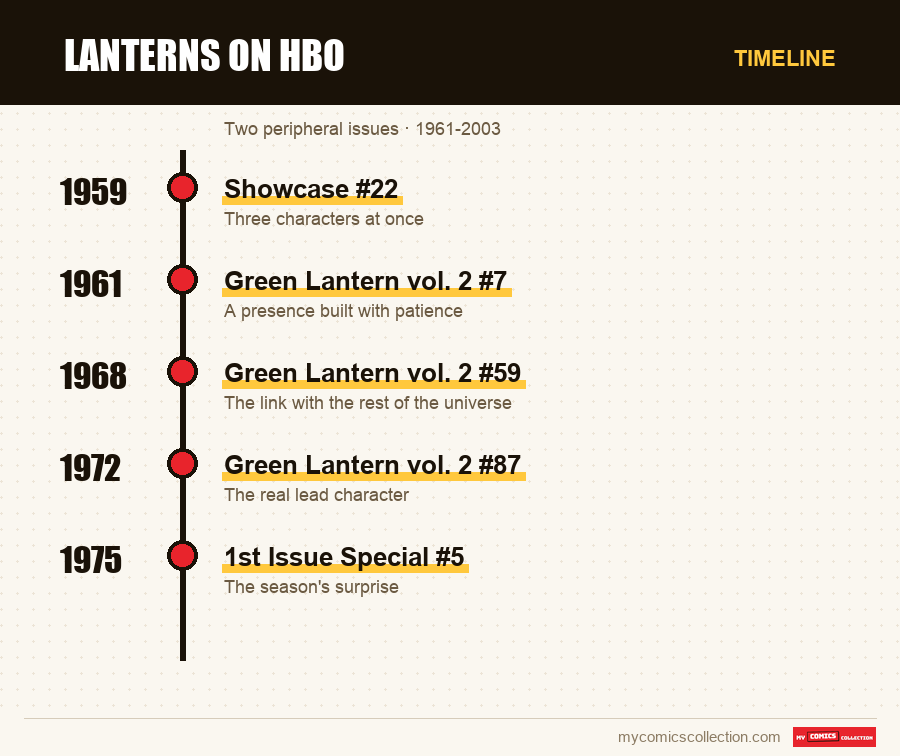
Here are the issues Season 1 brings back into the conversation, in order of importance to the story, with what the series does and does not do with them.
Showcase #22
The first episode opens on Hal Jordan chosen to succeed Abin Sur after his death. These two characters appear for the first time in the same issue, in the story "S.O.S. Green Lantern," and Carol Ferris is also in it, returning in the 2026 storyline. A single issue therefore covers three presences of the season. It is the simplest explanation of its status: it is not only the launch of a character, it is the launch of an entire setup.
Green Lantern vol. 2 #87
John Stewart enters the scene in the story "Beware My Power!", at the heart of O'Neil and Adams's social run. The series makes him its real protagonist: he is the one we follow in 2026, it is his childhood and family that episodes 3 and 7 strip layer by layer, and it is his refusal of the ring that closes episode 5. Critics have also noted that the exploration of his experience as a Black hero is what the season does best.
1st Issue Special #5
It is the issue nobody expected in a Green Lantern adaptation. The season's antagonist is a Manhunter, the first interstellar police force made by the Guardians of the Universe before the creation of the Corps, destroyed by its creators when it went astray. Episode 5 states it clearly: Zoe is the sole survivor, and it is she who killed Abin Sur. The storyline of the species exterminated by a terror gas, discovered in episode 7, takes up the very logic of these robots: judge, then punish, then exterminate.
Green Lantern vol. 2 #7
Thaal Sinestro, played by Ulrich Thomsen, is the moral backdrop of the whole season. The series presents him as Hal's mentor and father figure, expelled from the Corps after a failed coup in which he killed a Guardian, imprisoned off Earth in 2016, escaped in 2026, and unmasked under a hood at the end of episode 7. The Guardians, for their part, worry about what Hal may have inherited from him: it is the suspicion engine running beneath the investigation.
Green Lantern vol. 2 #59
Guy Gardner, played by Nathan Fillion, is the only character of the season who explicitly links the series to the rest of the DC Studios production. He belongs to the 2026 storyline, he is summoned by John by means of a beacon in episode 6, and it is he who tells the viewer that Sinestro has escaped. His appearance is brief, but fills a precise function: recalling that a Corps still exists around this rural-county story.
Two peripheral issues
Hector Hammond, first appearance in the fifth issue of the 1960 series, is not really Hector Hammond on screen: an engineer is forced to take on this identity as a decoy, in episode 4. Lianna, the Guardian played by Laura Linney who selects John, first appears in Green Lantern vol. 3 #160, written by Judd Winick and drawn by Dale Eaglesham, in "Offspring, Part 1." It is the most recent and easiest-to-find issue on this whole list.
A seventh issue deserves a separate mention. Episode 7 builds all its emotional charge on Martin Jordan, Hal's father, and on what the series calls the family legacy. The character was set up by the miniseries Green Lantern: Emerald Dawn, six issues cover-dated December 1989 to May 1990. It is an inexpensive read, and by far the closest to what the series does with Hal's past.
What the series invents, and why it matters when buying
The list of inventions is long, and it is collecting information, not criticism.
- Rushville, in Sheridan County, Nebraska, the central setting, as well as Sheriff Kerry Kane and the whole Macon family.
- John's recruitment by the Guardians and not by a ring, presented on screen as a unique anomaly in the Corps' history.
- Abin Sur's death attributed to a Manhunter. In the corpus, the reference episode is quite different: the Secret Origin story, published in the fourth Green Lantern series in 2008, has his ship crash after the escape of Atrocitus, a prisoner he was carrying.
- The depressive legacy of the Jordan family, revealed in episode 7, and the suspicion that follows about the circumstances of Hal's death.
- Antaan and his exterminated species, who give the story its motive, and Zoe in her human form.
Practical consequence, and a good one for a reasonable buyer: none of these inventions has a first appearance to buy. A character created for television does not create a rare issue. The demand triggered by the series can therefore only fall on a short, public and old list, all of whose elements were already identified as major before August 2026. There is no obscure issue to dig up ahead of the others, and the opposite promise must be taken for what it is.
One category remains to watch, because it is the only one where something new can appear: if the publisher decides to bring an element of the series into its issues, for example the TV version of a character or a name invented on screen, then a recent issue will become the paper first appearance of that element. Nothing of the kind has been published as of this article.
Demand after the broadcast, not before
This is the real question of this article: what changes, for a collector, between an awaited series and a finished one?
Let's start with what is measured. The audience was strong and growing. The network reported 9.3 million viewers worldwide over the first three days of the first episode, including 6.6 million in the United States, the best launch for a DC Studios series on its platform. The third episode reached a season peak with 10 million worldwide and 7 million in the United States over the same window, and the pilot passed 20 million cumulative viewers worldwide. The series ranked among the five biggest launches in the platform's history. Critical reception followed: a review aggregator showed 92% favorable reviews out of 146 critics, for an average score of 7.7 out of 10, and a second, weighted one, 72 out of 100 from 38 critics.
These figures say one thing and one thing only: many people watched, and most liked it. They say nothing about the secondhand market, and one must resist the temptation to convert them into a prediction. Between an audience and the purchase of a 1959 issue, there is a long chain of decisions, and television supplies the first link, not the last.
What the end of a broadcast changes comes down to three mechanisms.
Information stops arriving in pieces. For eight weeks, each Sunday brought a revelation likely to point to a new issue: the Manhunter's identity in episode 5, Sinestro's return in episode 7. Each revelation concentrates attention on a precise issue for a few days. Once the season is over, there is no more calendar, so no more trigger. Attention scatters instead of concentrating.
The scarcity of information disappears. Whoever had guessed in August that the Manhunters would be at the center of the season held a temporary advantage. On October 4, that advantage exists for nobody: the full list of characters used is known to all who watched, and to all who read a summary. A market where information is fully shared no longer rewards speed, it rewards patience.
The question shifts toward the sequel. And on this point, the situation is very precisely one of waiting. The network recruited in May 2026 a television and comics writer as co-showrunner of a possible season 2, a writers' room had been working for about six weeks by late August 2026, but the order itself was held pending the audience's reception. The other two creators did not return to writing, held by other projects. In other words: as of October 2, 2026, the sequel is neither confirmed nor publicly ruled out. The New York comics convention runs October 8 to 11, 2026, four days after the end of the broadcast, and nothing has yet been said there as of this writing.
For a buyer, reading this sequence is fairly direct. The window where you pay the most is the waiting and broadcast one, because that is where uncertainty has value. The window that opens after a final episode, and before any announcement of a sequel, is the least tight of the two. It is not necessarily cheap, because the issues in question were already major pieces, but it is calm. It is the difference between buying an object and buying a rumor.
Reading and collecting around the series without mistakes
Decide whether you are buying to read or to keep
These are two separate budgets. To read what the series evokes, collections suffice and cost a fraction of the price of an original issue. To keep, the relevant list comes down to six issues, all identified above, and none needs to be bought within the week.
Do not confuse the two Green Lanterns of the Golden and Silver Ages
Alan Scott, created in 1940, and Hal Jordan, created in 1959, share a name and a ring, nothing else. The series concerns only the lineage of Hal Jordan and John Stewart. Buying a 1940s issue thinking you are buying the source of Lanterns is the most frequent mistake, and the most expensive. Our selection of Silver Age key issues delimits the right scope.
Take a modern entry door with no continuity
Absolute Green Lantern, launched April 2, 2025 by Al Ewing and Jahnoy Lindsay, is a complete reinvention of the concept requiring no prior reading, whose first arc fits in six issues. It is the simplest starting point for someone coming out of the series who wants to read something new rather than archive.
Check condition before checking scarcity
On issues from 1959 to 1972, the price gap between two copies of the same issue is far larger than the gap between two different issues. The useful question is therefore not "which one to buy" but "in what condition, and at what price." An estimate made before purchase beats a regret afterward, and our free estimate serves precisely to frame this order of magnitude.
Record what you already own
Many French-speaking collections already contain one or two of these issues, bought ten years ago without thinking. The useful reflex after a TV series is not to buy, it is to inventory. Our collection management app lets you know in a few minutes whether the list is already partly checked off.
What the series says about the publishing context of fall 2026
One last framing point, useful to avoid overinterpreting. The register report for the week of September 22 to 28, 2026, covering more than six hundred equipped stores in North America, places DC ahead of Marvel with 41.29% against 28.62%, and six of the publisher's titles in the top ten. It is tempting to link this result to the ongoing broadcast. It is best avoided, for two reasons: this report covers one week and a sample of specialty stores, it does not constitute a monthly or annual market share, which does not publicly exist for 2026 anyway; and none of the titles carrying this result has any relation to Green Lantern.
What the series really does to the catalog is more modest and more lasting: it installs John Stewart as the franchise's reference figure for an audience that had never opened an issue. It is a shift in hierarchy, not a price movement. Over thirty years, this kind of shift has more effect on a bibliography than any peak of a few weeks, because it decides which characters a publisher entrusts its series to. Our pages on the impact of Green Lantern adaptations on the market and our Green Lantern reading guide take over on this ground, one on the documented-values side, the other on the reading-path side.
For anyone discovering the franchise through television, finally, the best advice is the least spectacular: read first, buy afterward, and let the fifteen days after an announcement pass. Our starter guide for a Green Lantern collection is designed for that order.