Green Lantern spans eighty-five years of comics and four ring-bearers on Earth. The best entry point for a new reader is Green Lantern: Rebirth #1 (2004, Geoff Johns): six accessible issues that bring Hal Jordan back to centre stage and establish the entire modern mythology. For the collector, the landmark keys are Showcase #22 (1959, 1st appearance of Hal Jordan): a CGC 9.2 sold for $149,000 at Heritage Auctions in 2018, and All-American Comics #16 (1940, 1st appearance of Alan Scott), whose CGC 6.5 realised $215,100 at Heritage in 2018.
Green Lantern is unusual in comics history: the title is not tied to a single character but to an idea: a hero armed with a ring of will, sworn to protect a sector of space. Alan Scott (Golden Age, 1940) has no cosmic connection to Hal Jordan (Silver Age, 1959); they share a name and visual language, not a universe. That distinction matters before you open any series.
This guide follows publication order and identifies the most accessible collections for each era. eBay figures come from our estimator (eBay.fr + eBay.com, June 2026, all grades combined); auction records are documented by Heritage Auctions. The Showcase and All-American Comics series are indexed separately by our tool: no usable median is available for either grail.
Step 0: Two Green Lanterns, one name
Alan Scott first appeared in July 1940 in All-American Comics #16, created by artist Martin Nodell and writer Bill Finger. His ring is magical, his weakness the colour yellow, his world entirely terrestrial. He has no connection to the Green Lantern Corps. It is the Golden Age: pulp adventure, art-deco iconography. Hal Jordan was born in October 1959 in Showcase #22, written by John Broome and drawn by Gil Kane. His ring is a technological weapon entrusted by the Guardians of the Universe. It is the Silver Age: cosmic science fiction, a rational reinvention of the superhero. Reading them in strict chronological order is unnecessary: the essential thing is not to confuse them.
Where to start: the recommended entry point
Green Lantern: Rebirth #1-6 (2004, Geoff Johns & Ethan Van Sciver) is the best entry point for a reader today. In six issues Johns rehabilitates Hal Jordan, persona non grata since 1994, explains his fall and return, and installs the complete cosmology that would fuel the following decade. No prior knowledge is required. The series is collected in the Green Lantern: Rebirth trade paperback (DC Comics). It is also the chronological launch of the Johns saga, and the issue most deliberately designed for new readers.
The O'Neil / Adams run: the essential Bronze Age (1970-1972)
After Rebirth, many readers work their way back to Green Lantern vol.2 #76 (April 1970). Dennis O'Neil (script) and Neal Adams (art) transformed Hal Jordan into a socially engaged hero, confronting racism, poverty, and drugs alongside Green Arrow. The first issue won the Shazam Award for Best Individual Story of 1970. The run (#76 to #89, 1970-1972) is widely regarded as the foundation of the Bronze Age of American comics, and introduces John Stewart in #87 (1972, 1st appearance, alongside a brief cameo by Guy Gardner). On eBay these issues carry modest low-grade medians: median 9 EUR for #76 (69 listings) and #87 (66 listings): mid-grade CGC copies command considerably more. The run is collected in English in Green Lantern/Green Arrow (DC Archives or TPB).
The Geoff Johns saga: the heart of the modern era (2004-2013)
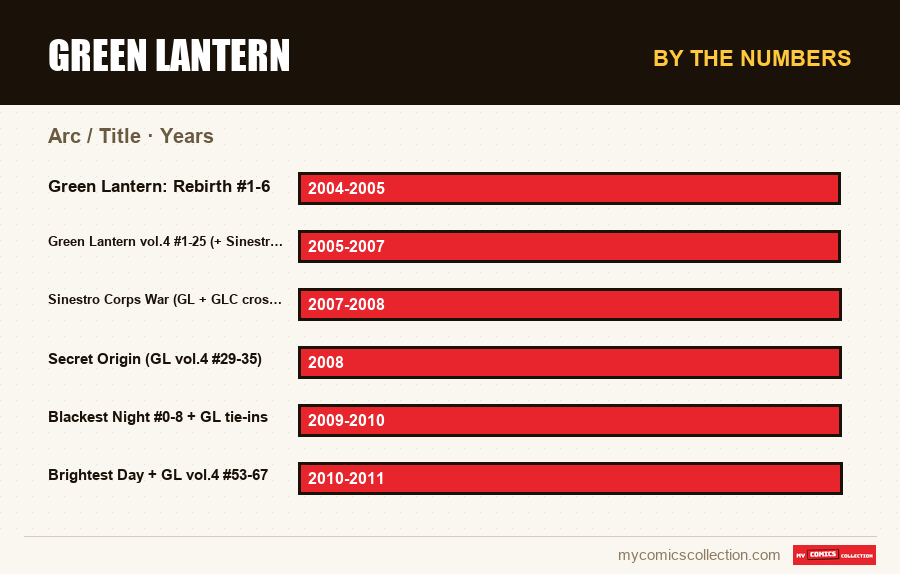
After Rebirth the ongoing Green Lantern vol.4 series launched in 2005 with Johns writing. Recommended reading order:
| Arc / Title | Years | Summary |
|---|---|---|
| Green Lantern: Rebirth #1-6 | 2004-2005 | Entry point: Hal Jordan's return |
| Green Lantern vol.4 #1-25 (+ Sinestro Corps Special #1) | 2005-2007 | Building the Corps, the Spectre, Sinestro Corps War set-up |
| Sinestro Corps War (GL + GLC crossover) | 2007-2008 | First intergalactic war |
| Secret Origin (GL vol.4 #29-35) | 2008 | Hal Jordan's origin retold: readable standalone |
| Blackest Night #0-8 + GL tie-ins | 2009-2010 | Full emotional spectrum, climax of the saga |
| Brightest Day + GL vol.4 #53-67 | 2010-2011 | Aftermath of Blackest Night |
Sinestro Corps War (2007) and Blackest Night (2009) are the two high points of the saga. Reading them without Rebirth is possible but diminishes the payoff. Issues from vol.4 show a median of 9 EUR for #200 on eBay (35 listings), representative of mid-run singles.
The key issues: Alan Scott and Hal Jordan
All-American Comics #16 (July 1940) is a Golden Age grail: fewer than sixty copies have been CGC-certified, including only two unrestored high-grade copies (CGC 8.0 and 9.4) that have never appeared at public auction. The CGC 6.5 that sold for $215,100 at Heritage Auctions in 2018 remains the most recent documented public reference. Our eBay tool does not index this series: no median is available.
Showcase #22 (October 1959) anchors the Silver Age: the CGC 9.2, the highest certified grade, sold for $149,000 at Heritage in 2018, then for $105,000 in 2021. Low-grade copies (CGC 0.5) circulate around $1,200; a CGC 7.0 sold for $15,000 in 2024, per sellmycomicbooks.com. The Showcase series is indexed separately by our estimator: no median is available.
Current series and the TV show
For readers who want to jump in today, the post-Johns runs (New 52 , Hal Jordan and the Green Lantern Corps 2016-2020, and the more recent 2023+ series) are largely self-contained and accessible without prior knowledge. The TV series Lanterns (HBO Max, 16 August 2026) stars Kyle Chandler as Hal Jordan and Aaron Pierre as John Stewart in a crime thriller with a buddy-cop tone, showrun by Chris Mundy. The announcement has renewed collector interest in key Bronze Age issues, particularly Green Lantern #87: the 1st appearance of John Stewart.
Own a Green Lantern comic? Get a free valuation with our tool based on real eBay sales to find its low, median, and high value.
Frequently asked questions
With Green Lantern: Rebirth #1-6 (2004, Geoff Johns and Ethan Van Sciver). In six issues, the miniseries rehabilitates Hal Jordan, explains his fall and return, and requires no prior knowledge.
Alan Scott debuts in July 1940 in All-American Comics #16, created by Martin Nodell and Bill Finger: his ring is magical and he does not belong to the Corps. Hal Jordan appears in October 1959 in Showcase #22, written by John Broome and drawn by Gil Kane.
In Green Lantern vol.2 #76 to #89 (1970-1972), Dennis O'Neil and Neal Adams confront Hal Jordan with racism, poverty and drugs alongside Green Arrow. The first issue won the Shazam Award for best individual story of 1970.
Rebirth, then Green Lantern vol.4 #1-25 (with the Sinestro Corps Special), the Sinestro Corps War, Secret Origin (#29-35), Blackest Night with its tie-ins, and finally Brightest Day. The Sinestro Corps War and Blackest Night are its two peaks.
Yes, the post-Johns series (New 52, Hal Jordan and the Green Lantern Corps, then the 2023 and later series) are self-contained. The TV series Lanterns (August 16, 2026), with Kyle Chandler as Hal Jordan and Aaron Pierre as John Stewart, is another way into the universe.